
Door Thermal Bridging: Detailing It Out (India 2026)
Where heat short-circuits the envelope at door frames, jambs, thresholds and lintels — and how to detail thermal breaks, insulated reveals and continuous insulation to stop heat loss and condensation.
A door can have an excellent core U-value and still bleed heat — because the weak point is rarely the leaf, it is the junction. Door thermal bridging is the localised short-circuit where a conductive path (a frame, a lintel, an uninsulated reveal, a threshold tying inside to outside) lets heat bypass the insulation around the opening. In an air-conditioned Indian home this matters twice over: it drives up the cooling load, and it cools an internal surface below the dew point, where humid air condenses and mould follows. This Studio Matrx guide is the detailing lens — what a thermal bridge actually is, exactly where it forms at a door, the heat-loss and condensation consequences, and how to detail it out with thermal breaks, insulated reveals, continuous insulation and sealing so the envelope performs as drawn rather than as built. As a rule of thumb, the cleaner the U-value of the door, the more the surrounding junctions dominate its real-world performance.
What a thermal bridge actually is
A thermal bridge is any part of the building envelope where heat flows more easily than through the surrounding fabric — usually because a conductive material breaks the insulation line, or because the geometry of a corner or junction concentrates heat flow. Engineers split them into two kinds. A repeating (linear) thermal bridge runs along a junction and is measured by a psi value (the Greek letter psi, in W/m·K) — the extra heat loss per metre of, say, a door jamb or threshold. A point thermal bridge is a localised penetration (a fixing, a bracket) measured by a chi value in W/K. For doors, the linear junctions around the frame perimeter dominate. The key idea is that the insulation around an opening must be continuous — wherever it stops, or wherever a conductive material crosses it, a bridge forms. This is why India's Eco-Niwas Samhita (ENS) for residential envelopes and ECBC for commercial both push continuous, unbroken insulation lines; thermal bridges are precisely the gaps that erode the headline U-value into a much worse effective U-value on site.
Where thermal bridges form at a door
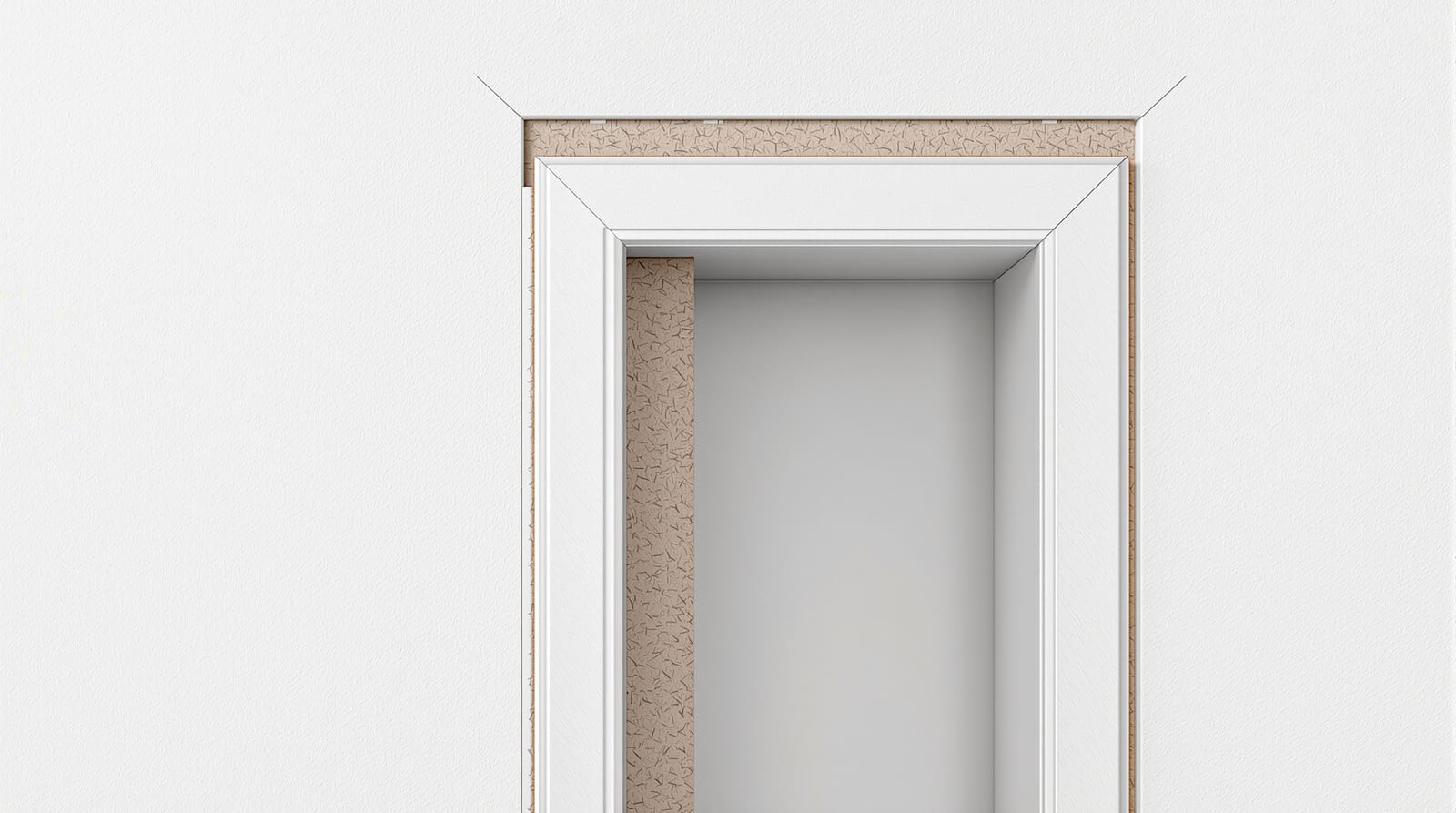
A door opening is a cluster of junctions, and each one is a candidate bridge. The diagram below maps the four classic locations on a section through a door in an insulated masonry or framed wall.
The four classic locations
- The lintel / head. A reinforced-concrete lintel over the opening is a dense, conductive band tying the outer and inner wall faces together — a textbook repeating bridge unless the insulation is carried across or returned around it.
- The reveal / jamb. The narrow strip of wall framing the side of the opening is often left uninsulated for the door frame, breaking the wall's insulation line right at the perimeter.
- The frame itself. A solid aluminium or steel frame conducts straight through the wall. This is the single biggest bridge on metal doors and is why a thermal break is non-negotiable on aluminium — see thermal break doors.
- The threshold / sill. The floor junction ties an exterior slab to the interior floor; an uninsulated threshold is a continuous bridge along the full door width, and a common cold spot for condensation.
The heat-loss and condensation consequences
Thermal bridging hurts in two distinct ways. First, extra heat loss (or gain): every bridge adds a parallel path that the headline U-value never counted, so the effective whole-opening U-value is worse than the door's product rating. In an AC home in hot-dry or composite India, an uninsulated metal frame can quietly add a meaningful slice to the cooling load year after year. Second — and often more damaging — is surface condensation and mould. A bridge cools an internal surface (the inner face of a metal frame, the threshold, a reveal corner) below the dew point of the indoor air. Where a cooled surface meets humid Indian air, water condenses; persistent condensation feeds mould, stains finishes, corrodes fixings and degrades timber. In warm-humid and coastal zones, where indoor humidity is high, the condensation risk is the headline concern even more than the energy penalty. The metric that captures this is the temperature factor (fRsi) — the higher the internal surface temperature relative to inside and outside air, the safer the junction. Detailing the bridge out raises fRsi and pushes the surface back above dew point — the full moisture-management strategy lives in door condensation control. To pressure-test a specific junction, run the door condensation risk checker.
Indicative junction performance
| Door junction | Typical issue | Relative bridge severity | Primary consequence |
|---|---|---|---|
| RC lintel (uninsulated) | Dense conductive band | High | Heat gain + head condensation |
| Reveal / jamb (bare) | Insulation line broken | Medium-high | Perimeter heat loss |
| Aluminium frame (no break) | Metal conducts through | Very high | Frame condensation + loss |
| Threshold / floor slab | Slab ties in to out | Medium-high | Cold-spot condensation |
| Frame fixings / lugs | Point penetrations | Low-medium | Minor localised loss |
How to detail thermal bridging out
The whole job is to keep the insulation line continuous around the opening and to interrupt every conductive path that crosses it. Five moves do most of the work.
1. Specify a thermal break in the frame
On aluminium and steel doors, a polyamide thermal-break strip separates the outer and inner halves of the frame so heat cannot conduct straight through. This is the single highest-value detail on metal doors in AC homes — a non-broken aluminium frame is one of the worst bridges in the whole envelope. The companion piece door thermal performance covers how this rolls into the overall U-value.
2. Insulate the reveal and carry the insulation across the lintel
Return the wall insulation into the reveal and across (or around) the lintel so the line never stops at the opening. Even a thin insulated reveal board markedly raises the internal surface temperature at the jamb and head, cutting both heat loss and condensation risk.
3. Maintain continuous insulation and overlap it onto the frame
Lap the wall insulation so it overlaps the frame rather than butting against it with a gap. Continuous insulation that physically touches the frame insulation line removes the geometric bridge at the meeting point. This is the principle ENS and ECBC encode — an unbroken envelope.
4. Insulate the threshold and break the floor path
Use an insulated threshold or a thermal-break sill profile so the exterior slab is not tied directly to the interior floor. This is especially important for level-access and accessible doors where the threshold is wide and shallow.
5. Seal the junction airtight
A bridge and an air leak often live at the same gap. Filling the perimeter with low-expansion foam or backer rod and sealant, then taping/membrane-sealing for air-tightness, stops both convective heat loss and the humid-air ingress that condenses on cold surfaces. For the sealing layer, see door air-tightness and the broader weather-resistant doors detailing.
A detailing decision matrix
Use this to choose the right intervention for the junction and climate you are working in. As a rule of thumb, in warm-humid and coastal zones lead with condensation control; in hot-dry and composite zones lead with heat-flow reduction — though good detailing fixes both.
| Junction | Best-value detail | Why it works | Watch in India |
|---|---|---|---|
| Metal frame | Polyamide thermal break | Cuts metal conduction path | Essential in AC homes |
| Lintel / head | Insulation carried across | Keeps line continuous | RC lintels conduct hard |
| Reveal / jamb | Insulated reveal board | Raises surface temperature | Don't leave bare for frame |
| Threshold | Thermal-break sill | Breaks slab-to-floor path | Coastal damp + condensation |
| All junctions | Airtight seal + foam | Stops leak + humid ingress | Monsoon-driven moisture |
Why it matters for envelope performance
Thermal bridging is where the design U-value meets reality. A door specified at a clean foam-core or thermal-break rating can perform far worse once the surrounding junctions are added in, and in humid India the condensation it triggers can cause damage that long outlasts the energy penalty. Detailing the bridges out — thermal breaks, insulated reveals, continuous insulation, an insulated threshold and an airtight seal — is precisely the discipline that Passive House and net-zero envelopes are built on: ultra-low U-value, airtight, and thermal-bridge-free. For India this is also a durability story — a junction that never condenses never grows mould or corrodes — and durability is itself sustainability. To size the whole-opening number, use the door U-value calculator. For how these details earn green-building credit, see doors for green buildings and passive house doors; both sit under the door thermal performance Act pillar, and the whole doors story is anchored by the complete door guide.
Frequently asked questions
What is a thermal bridge at a door, in plain terms?
It is a spot around the door opening where heat takes a shortcut past the insulation — usually through the frame, an uninsulated reveal or lintel, or the threshold that ties the outside to the inside. The insulation line is broken or crossed by a conductive material, so heat flows faster there than through the surrounding wall.
Why does thermal bridging cause condensation and mould?
A bridge cools an internal surface below the dew point of the indoor air. Where that cold surface meets humid air — common across warm-humid and coastal India — water condenses on it. Persistent condensation feeds mould, stains finishes and corrodes or rots the junction. Raising the surface temperature by detailing the bridge out keeps the surface above dew point.
Do I really need a thermal break on an aluminium door?
In an air-conditioned home, yes. A solid aluminium frame conducts heat straight through the wall and is one of the worst bridges in the envelope, both for heat flow and for frame condensation. A polyamide thermal break separates the inner and outer halves of the frame and is the single highest-value detail on metal doors. See thermal break doors.
How is door thermal bridging measured?
Linear (repeating) bridges along a junction are measured by a psi value in W/m·K — extra heat loss per metre of jamb, head or threshold — while point penetrations use a chi value in W/K. Condensation risk is captured by the temperature factor (fRsi): the higher the internal surface temperature, the safer the junction.
Do Indian codes address thermal bridging at doors?
Indirectly but firmly. The Eco-Niwas Samhita (ENS) for residential envelopes and ECBC for commercial both require continuous, unbroken insulation lines and account for envelope U-values; thermal bridges are exactly the discontinuities that erode those values on site. Good junction detailing is how you make the rated performance real.
Which Indian climate zones should worry most about door thermal bridges?
All of them, but for different reasons. Hot-dry and composite zones feel the heat-gain and cooling-load penalty most; warm-humid and coastal zones face the bigger condensation and mould risk because indoor humidity is high. Sound detailing — thermal break, insulated reveal, continuous insulation, airtight seal — addresses both at once.
Export this guide
Related Guides — Deep-dive reading
Door Thermal Performance: U-Value & Heat Loss (India 2026)
How doors gain and lose heat in Indian homes, what U-value really means, and what makes a door thermally good enough to cut your AC bill.
Home Doors & EntrancesDoor Condensation Control: Stop Sweating Doors (India 2026)
Why metal and glass doors sweat in AC rooms and the monsoon, the mould risk it creates, and how thermal breaks, insulated cores and Low-E glazing stop it.
Home Doors & EntrancesEnergy-Efficient Facades in India: How the Building Skin Cuts Your Cooling, Heating & Lighting Bills
How a building facade drives cooling, heating and lighting energy in India, the three levers of solar-heat-gain control, insulation and daylighting, U-value, SHGC, VLT and WWR in plain terms, ECBC and Eco-Niwas expectations, and real Indian green buildings.
Building FacadesRelated Tools — Try Free
Material Decision Framework (M-Score)
Score 30+ Indian construction materials across cost, durability, climate fit, maintenance, and sustainability.
MaterialsAccessible Door Checker
Check a door against wheelchair-accessibility guidance — clear width, threshold, handle and closer force per RPwD 2021.
Compliance ToolAluminium Door Cost Calculator
Estimate an aluminium door cost by opening size, profile grade, finish, glazing and type, with fitting and GST.
Door Calculator