
Thermal Insulated Doors for Indian Homes (India 2026)
How foam-core, insulated metal and uPVC doors cut heat transfer — where they pay off in AC homes, hill stations and extreme climates.
Most heat that flows between your air-conditioned room and the hot outside slips through the envelope — and an ordinary door is one of the leakiest parts of it. Thermal insulated doors fix this by trapping a low-conductivity core (rigid foam, polyurethane, or honeycomb) between two outer skins, then sealing the perimeter so conditioned air cannot escape. The result is a door with a much lower U-value: where a hollow flush door behaves like a thin sheet, an insulated door behaves like an insulated wall. This Studio Matrx guide explains how the core, the seals and the glazing work together to cut heat transfer, where insulated doors actually pay back in India — AC homes, hill stations, hot-dry and composite zones — and what they cost against the comfort and energy they save. As a rule of thumb, the hotter or colder your outdoor swing, the faster an insulated door earns its premium.
The physics is simple. Heat moves through a door by conduction (through the solid material), and air leaks around it through gaps. A hollow or single-skin door has little resistance to either. An insulated door attacks both: the core slows conduction, and a continuous weatherseal stops the draught. Get one without the other and you waste the upgrade — a beautifully foam-cored door with leaky gaps still bleeds cool air.
How an insulated door cuts heat transfer
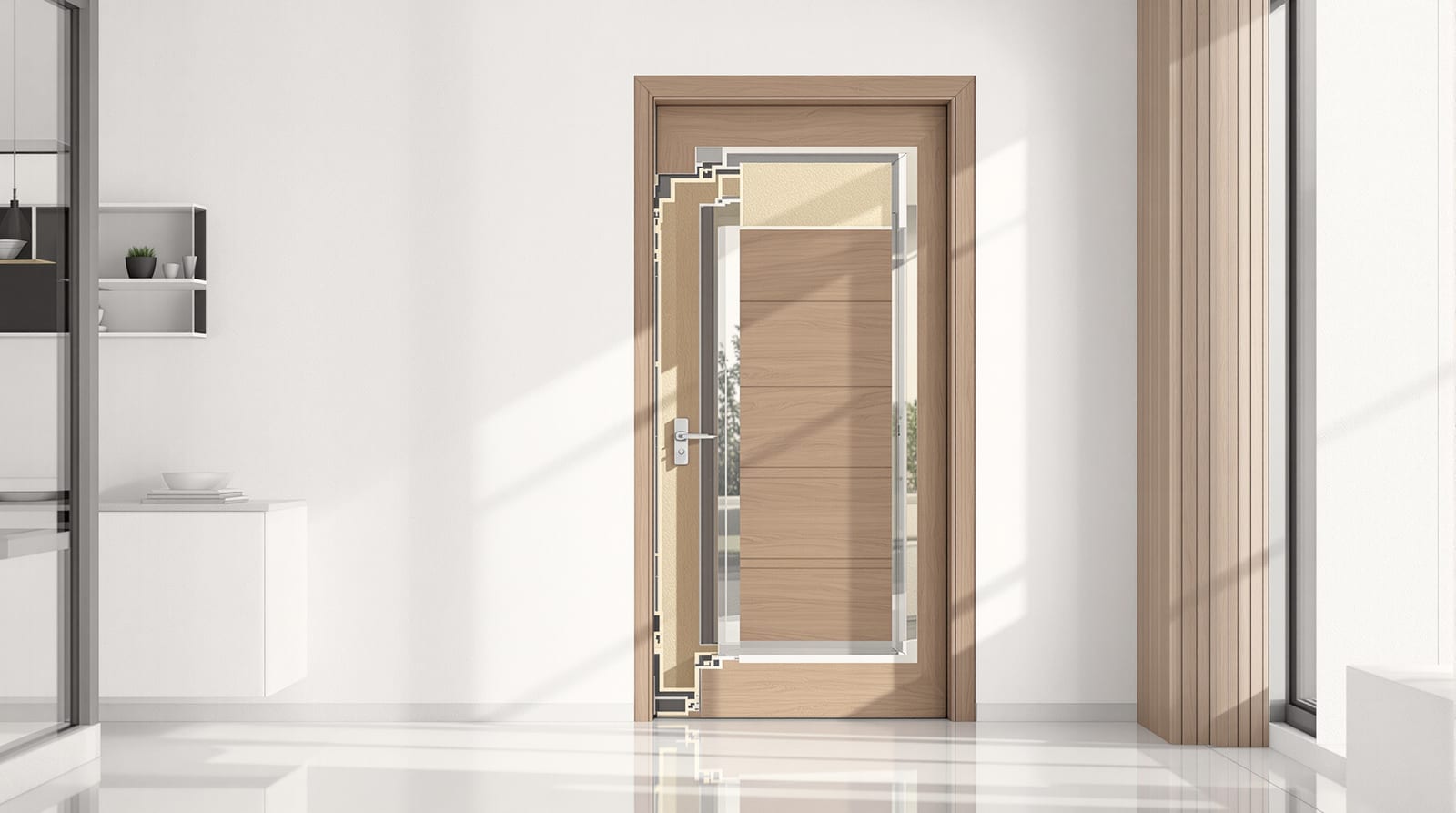
Three elements decide how well a door insulates: the core, the seals, and (for glazed doors) the glazing. The diagram below shows a section through a typical insulated external door and where each element does its job.
The core
The core is the heart of the door. Rigid polyurethane (PU) foam is the best insulator commonly available — it gives the lowest U-values and is standard in insulated metal and premium uPVC doors. EPS / XPS foam boards are cheaper and still very effective. Honeycomb (kraft-paper or cardboard) cores in flush doors are lighter and add modest insulation plus rigidity, but they are nowhere near foam — a honeycomb flush door is mid-table, not a true thermal door. A solid timber door insulates better than a hollow door but worse than a foam-cored one of the same thickness. For the full U-value picture across materials, see door U-value guide and the wider door thermal performance pillar.
The seals
A perfectly insulated slab is useless if air leaks around it. Continuous perimeter weatherstripping plus a threshold or drop-down bottom seal stop conditioned air escaping and hot, humid air entering. In India's monsoon and coastal zones this also blocks driven rain. Sealing is the cheapest, highest-return part of the upgrade — see door seals and weatherstripping.
The glazing
For glazed insulated doors, the panel matters as much as the slab. A single-glazed door has a U-value above 5 and undoes the core; a double-glazed / IGU panel drops it to roughly 1.5-2.8, and a Low-E or tinted coating cuts the solar heat gain (SHGC) that drives AC load in hot India — see solar heat gain doors.
U-values by door type
U-value (W/m²K) measures heat transfer — lower is better. The bands below are indicative; always ask a supplier for a tested figure for the exact product.
| Door type | Indicative U-value (W/m²K) | Insulation level |
|---|---|---|
| Hollow flush / honeycomb core | 3.0 – 4.0+ | Poor |
| Solid timber | 2.0 – 3.0 | Moderate |
| Single-glazed door | 5.0+ | Very poor |
| Insulated uPVC (foam-filled) | 1.2 – 1.8 | Good |
| Insulated metal / FRP (PU core) | 1.0 – 1.8 | Very good |
| Double-glazed / Low-E IGU door | 1.5 – 2.8 | Good |
For reference, India's Eco-Niwas Samhita (ENS) 2018 residential envelope code uses an overall thermal-transfer metric (RETV) rather than a single door U-value, but a lower-U door directly helps a home meet it. Aluminium doors are a special case: aluminium conducts heat fast, so they need a thermal break (a polyamide strip) to perform — covered in thermal break doors. Without one, even a glazed aluminium door bridges heat and can sweat with condensation.
Where insulated doors pay off in India
An insulated door is not worth it everywhere. Its payback depends on how big the temperature gap is across the door and how many hours a day you run heating or cooling. The matrix below sets out where the premium makes sense.
| Situation | Climate zone | Insulated door worth it? | Why |
|---|---|---|---|
| AC bedroom / living room (external door) | Hot-dry, composite, warm-humid | Strongly | Less AC load, faster cooling, lower bills |
| Hill station / cold home | Temperate, cold | Strongly | Keeps heat in; cuts heating + condensation |
| Coastal / cyclone-exposed | Warm-humid coastal | Yes (FRP/uPVC) | Insulation + rot/salt resistance together |
| Internal door between rooms | Any | Rarely | Little temperature gap to insulate against |
| Shaded, non-AC, mild climate | Temperate | Marginal | Low swing means slow payback |
| Main entrance to AC interior | Any AC home | Yes | The biggest single leak in the envelope |
The broad pattern: insulated doors pay back fastest on external openings into conditioned space and in extreme climates (very hot or genuinely cold). For non-AC interiors in mild zones, the comfort gain is small and the money is better spent on sealing and shading. For the homeowner-level overview of the whole topic, start with energy-efficient doors.
Cost versus savings
Insulated doors carry a premium over a basic flush door, and GST is 18%. As a rule of thumb, expect an insulated uPVC or foam-cored metal/FRP door to cost a multiple of a hollow flush door, with glazed and thermally-broken aluminium units at the top. The saving comes from reduced AC/heating runtime, faster cooling, and durability — a sealed, rot-resistant external door also lasts longer, and durability is itself a saving. Payback is quickest where the door faces hot sun and protects an AC room run many hours a day; slowest on shaded, mild, non-AC openings. Model your own numbers with the door energy savings calculator, and check the slab itself with the door U-value calculator.
A few honest caveats. A tested U-value beats a marketing claim — ask for it. The seal and installation matter as much as the slab; a foam core fitted with gaps wastes most of the benefit. And for glazed doors in hot India, prioritise a Low-E coating to control solar gain, not just a thicker pane. The cheapest way to start is almost always sealing what you already have, then upgrading the slab where the temperature gap is largest.
Choosing an insulated door
Work through four questions. First, is it external and into conditioned space? If not, an insulated door is rarely justified. Second, what is your climate? Hot-dry and composite favour a foam-cored slab with Low-E glazing and shading; cold/hill stations favour the lowest U-value you can get; coastal favours FRP or uPVC for rot and salt resistance. Third, glazed or solid? A solid foam-cored slab gives the lowest U-value; a glazed door needs a double-glazed Low-E IGU to avoid undoing the core. Fourth, is the perimeter properly sealed and the frame thermally sound? Specify continuous weatherstripping and, for aluminium, a thermal break. Anchor the whole decision against the complete door guide and the door thermal performance pillar.
Frequently asked questions
What is a thermal insulated door?
It is a door built to resist heat transfer, typically by sandwiching a low-conductivity core (rigid PU/EPS foam or honeycomb) between two skins and sealing the perimeter. The result is a low U-value, so less heat crosses the door — keeping AC rooms cooler and heated rooms warmer than an ordinary hollow or single-skin door would.
Are insulated doors worth it in India's hot climate?
Yes, where the door is external and protects an air-conditioned room. In hot-dry and composite zones an insulated external door cuts AC load and speeds cooling, so the premium pays back through lower bills and comfort. For shaded, non-AC interiors in mild zones the gain is small and sealing is the better spend.
Which insulated door has the lowest U-value?
As a rule of thumb, a foam-cored (rigid PU) insulated metal or FRP door reaches the lowest U-values, roughly 1.0-1.8 W/m²K, followed by foam-filled uPVC. Glazed doors depend on the panel: a double-glazed Low-E IGU performs well, while single glazing undoes the core. Always ask for a tested figure for the exact product.
Do insulated doors help in hill stations and cold homes?
Strongly. In temperate and cold zones the temperature gap across the door is large, so an insulated, well-sealed door keeps expensive heat indoors and reduces condensation on the cold inner face. Pair the foam core with continuous perimeter seals and, on aluminium, a thermal break.
Does the door need special glazing to insulate well?
For a glazed door, yes. Single glazing has a U-value above 5 and cancels the core's benefit. Use a double-glazed/IGU panel, and in hot India add a Low-E or tinted coating to cut solar heat gain (SHGC) as well as conduction. A solid foam-cored slab avoids the glazing problem entirely.
Is sealing or the core more important?
Both, but sealing is the cheapest, highest-return step. A foam core fitted with leaky gaps still bleeds conditioned air, so continuous perimeter weatherstripping and a threshold/drop seal are essential. As a rule of thumb, seal first, then upgrade the slab where the temperature gap across the door is largest.
Export this guide
Related Guides — Deep-dive reading
Door Thermal Performance: U-Value & Heat Loss (India 2026)
How doors gain and lose heat in Indian homes, what U-value really means, and what makes a door thermally good enough to cut your AC bill.
Home Doors & EntrancesEnergy-Efficient Facades in India: How the Building Skin Cuts Your Cooling, Heating & Lighting Bills
How a building facade drives cooling, heating and lighting energy in India, the three levers of solar-heat-gain control, insulation and daylighting, U-value, SHGC, VLT and WWR in plain terms, ECBC and Eco-Niwas expectations, and real Indian green buildings.
Building FacadesEnergy Efficient Windows Explained: The Whole-System Guide for Indian Homes
Treat the window as an energy device — frame, glass, seals, shading, install and rating — and learn why low SHGC and shading beat chasing a cold-climate U-value in hot India.
Windows & GlazingRelated Tools — Try Free
Window Energy Savings Calculator
Compare standard glazing vs Low-E and DGU windows — annual cooling savings, 10-year savings and payback.
Window CalculatorCurtain Thermal Calculator
Estimate the solar heat-gain a curtain or blind cuts by orientation, glass and treatment — and the cooling saving.
Thermal ToolMaterial Decision Framework (M-Score)
Score 30+ Indian construction materials across cost, durability, climate fit, maintenance, and sustainability.
Materials