
Door Air-Tightness & Infiltration Control (India 2026)
How gaps around a door leak conditioned air, dust and noise, the air-permeability classes that matter, and how seals cut infiltration.
Good door air-tightness is the quietest, cheapest performance gain in the whole building envelope, and the one most often ignored. Every uncontrolled gap around a door leaf is a two-way leak: your air-conditioned air escapes into the 40°C afternoon, and hot, humid, dust-laden outdoor air pours back in, dragging street noise and insects with it. A door can have an excellent insulated core and still behave like a much worse one if a 4-5 mm gap runs all the way round it. In India's hot-dry, warm-humid and composite zones — and especially near dusty arterial roads or coastal salt air — air leakage often costs more comfort and energy than conduction through the leaf itself. This guide explains how infiltration works, the air-permeability classes and blower-door context that quantify it, and how perimeter weatherstrip plus a threshold or drop-down seal close the leak. The takeaway for any specifier: airtight equals efficient and quiet.
How a door leaks: the infiltration paths
Air does not move through a door in one place — it finds every gap. A door leaf that swings, slides or pivots needs operating clearance, and that clearance is exactly where conditioned air escapes unless it is sealed. The main paths, in rough order of how much they leak, are:
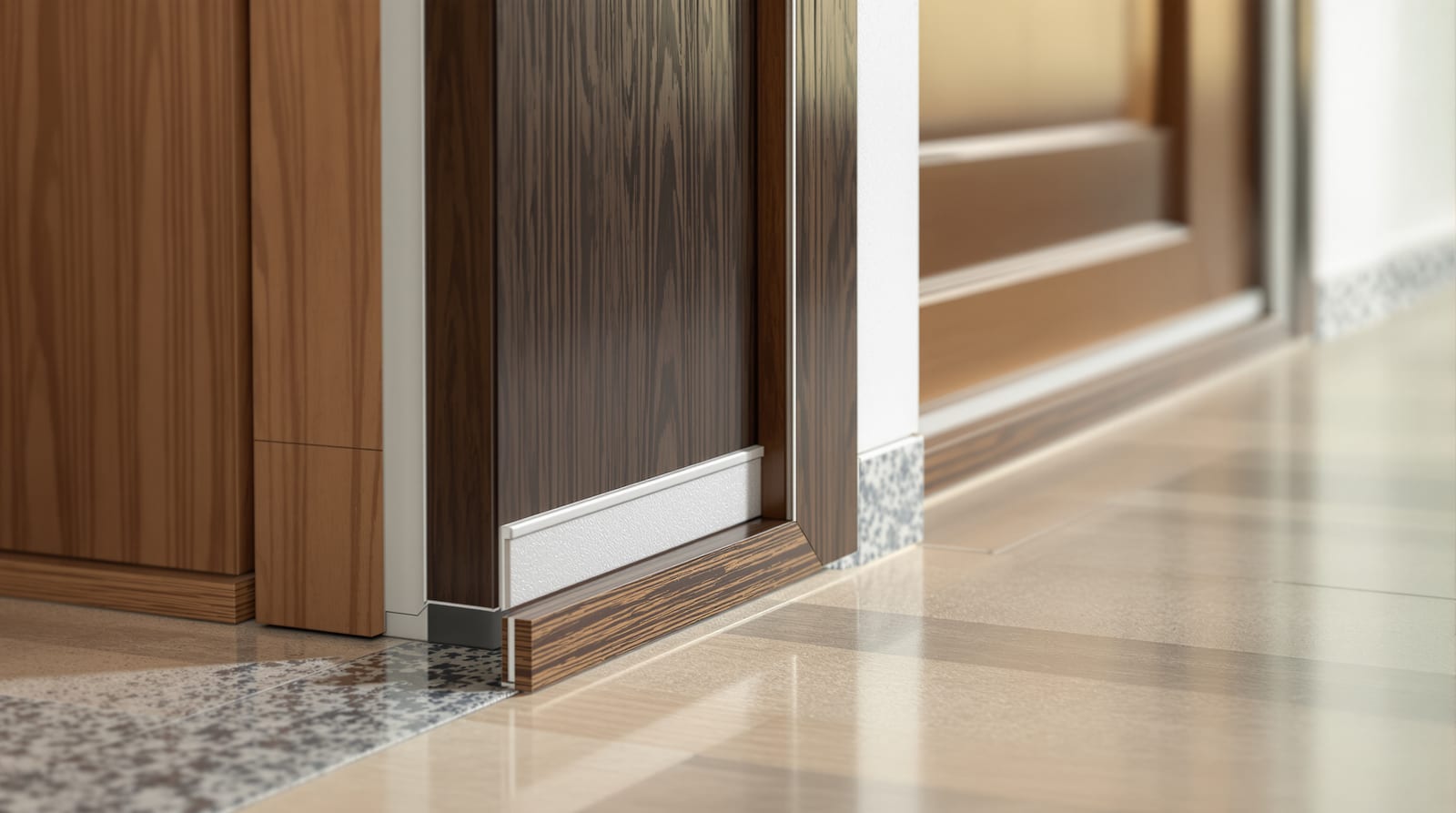
- The threshold gap — the undercut between the bottom of the leaf and the floor. Usually the single largest leak, and the one that lets in dust, water splash and crawling insects.
- The perimeter (head and jamb gaps) — the meeting line between leaf and frame on the latch, hinge and top edges.
- The meeting stile — on double-leaf or French doors, the central vertical joint where the two leaves meet.
- Keyholes, letter-plates and undersized cut-outs — small but persistent point leaks.
- The frame-to-wall junction — gaps behind the frame where it meets the masonry, often hidden under architrave and forgotten at installation.
A driving pressure makes the air move: wind on the facade, the stack effect in multi-storey buildings, and the negative pressure created by exhaust fans and chimneys. The bigger the pressure difference and the bigger the gaps, the more air leaks. This is why a tower flat on a windy upper floor leaks far more through the same door than a ground-floor unit. Sealing the threshold and perimeter, in that order, captures most of the loss.
Quantifying air leakage: classes, units and ACH
Air leakage is measurable, not just a feeling of draught. Two framings matter for doors in India.
First, the air permeability of the door itself — how much air passes through the closed door per unit area at a reference pressure, expressed in m³/h·m² at a stated pressure (commonly 50 Pa, sometimes 100 Pa). International door and window standards classify this; the European EN 12207 air-permeability classes are the most widely cited benchmark, and many performance doors sold in India quote against them. There is no Indian-law equivalent class for doors, so treat EN 12207 as a reference, not a code.
| Air-permeability class (EN 12207) | Leakage behaviour | Suited to |
|---|---|---|
| Class 0 / unclassified | Leaky — typical unsealed flush or framed door | Avoid for AC or external use |
| Class 1 | Basic | Mild, low-pressure internal use |
| Class 2 | Moderate | Standard external doors |
| Class 3 | Good | AC homes, noisy/dusty sites |
| Class 4 | Best (tightest) | Passive House, clinics, studios |
Second, the whole-home air-tightness, measured by a blower-door test and reported as air changes per hour at 50 Pa (ACH50) — how many times the home's full air volume leaks out and in per hour under a 50-pascal pressure. A leaky Indian home can sit well above 5-10 ACH50; an airtight, sealed-envelope home aims much lower, and Passive House targets around 0.6 ACH50. Doors and windows are usually the largest controllable leakage paths in that whole-home figure, which is why door seals move the needle on a blower-door result. Air-tightness and thermal performance are partners, not rivals — see door thermal performance, where air leakage is one of the three heat paths.
How air leaks around a door
The diagram below shows the leakage paths around a closed external door and where seals intervene to close them.
Notice that the seals are continuous: a weatherstrip with a missing corner or a drop seal that does not fully deploy leaves a path open, and air finds it. Continuity matters more than the grade of the gasket.
Closing the leak: weatherstrip and threshold seals
The fix is mechanical and inexpensive relative to the door. Two seal families do the work.
| Seal type | Where it goes | What it closes | Notes for India |
|---|---|---|---|
| Perimeter weatherstrip (compression / brush / fin) | Head and both jambs, on the frame rebate | Head and jamb gaps | EPDM/silicone gaskets outlast cheap foam in heat and UV |
| Threshold weather bar + door sweep | Floor line under the leaf | Threshold gap | Pair with a weather bar for monsoon water as well as air |
| Automatic drop-down bottom seal | Mortised into the leaf bottom | Threshold gap, with no floor track | Best for accessibility and acoustic doors |
| Meeting-stile seal | Central joint of double leaves | Meeting-stile gap | Needed on French / double doors |
Compression and silicone gaskets keep their seal far better than cheap self-adhesive foam, which hardens and cracks in Indian summer heat and UV within a season or two. The threshold is where the discipline pays off most: an automatic drop-down seal lifts clear as the door opens and presses down as it closes, giving an airtight, dust-tight, step-free line without a raised track to trip on. The same seals that stop air also stop airborne sound, which is why air-tightness and acoustics travel together — see acoustic door seals and door draught-proofing performance for the seal-by-seal detail.
Why airtight equals efficient, quiet and cleaner
Air-tightness pays back on four fronts at once, which is what makes it such a high-value, low-cost intervention.
- Energy — every cubic metre of conditioned air that leaks out is air the AC paid to cool and now has to cool again. Closing the perimeter and threshold cuts that infiltration load directly; estimate the saving for a specific door, gap and tariff with the door air-leakage calculator, and the rupee energy saving with the door energy savings calculator.
- Comfort — sealing kills the felt draught near the door and stabilises the indoor temperature and humidity, which matters in warm-humid coastal homes where infiltrating moist air loads the AC and risks condensation.
- Quiet — airborne sound rides through the same gaps as air; an airtight perimeter and threshold lift a door's effective sound insulation noticeably. The link to ratings is covered in door sound insulation.
- Cleaner and pest-free — sealed gaps keep out street dust (a real burden on arterial roads), pollen and crawling insects, lowering cleaning effort and improving indoor air quality.
In India's energy codes, infiltration is part of the envelope story: a sealed, tight envelope helps a home meet the Eco-Niwas Samhita (ENS) intent of limiting unwanted heat gain, and for high-performance projects air-tightness is a credit-bearing measure under doors for green buildings and a prerequisite for Passive House. Treat air-tightness not as an add-on but as a baseline spec, and it threads back into the whole envelope decision in the complete door guide. A quality seal kit costs a fraction of the door, carries 18% GST, and typically pays back fast in units saved and comfort gained.
Frequently asked questions
How much air does an unsealed door actually leak?
It depends on the gap size and the driving pressure, but the threshold undercut alone — often 4-8 mm across a metre-wide door — can be the single largest leak in a room. Under wind or stack pressure in a tower flat, an unsealed external door can dominate the home's blower-door (ACH50) result. There is no single fixed figure; model it for your gap and pressure with the door air-leakage calculator, but as a rule of thumb the threshold and perimeter together account for most of a door's loss.
What air-permeability class should I specify for an Indian AC home?
There is no Indian-law class for doors, so EN 12207 is the usual reference. As a rule of thumb, aim for Class 3 for an air-conditioned home on a normal site and Class 4 for clinics, recording studios, very dusty or windy sites, and Passive House work. A Class 0 or unclassified unsealed door should be retrofitted with perimeter and threshold seals before it is acceptable for AC use.
Does sealing a door also make it quieter?
Yes, markedly. Airborne sound leaks through the same perimeter and threshold gaps as air, so a door that is airtight is also far better at blocking noise. Adding continuous compression weatherstrip and an automatic drop-down bottom seal is one of the most cost-effective ways to raise a door's real-world sound insulation, which is why air-tightness and acoustic sealing are specified together.
Will tighter seals cause condensation or stuffiness?
Sealing the door does not seal the home — controlled ventilation (windows, exhaust fans, fresh-air provision) still moves air where you want it, rather than uncontrolled through gaps. In fact, stopping humid infiltration at the door reduces condensation risk near cold metal frames in warm-humid zones. The principle is build tight, ventilate right: close the unwanted leaks and provide deliberate ventilation instead.
How does a blower-door test relate to my doors?
A blower-door test pressurises the whole home and reports air changes per hour at 50 Pa (ACH50). Doors and windows are usually the largest controllable leakage paths in that figure, so sealing door perimeters and thresholds is one of the highest-impact ways to improve a blower-door result. For Passive House (around 0.6 ACH50) and net-zero targets, airtight, well-sealed doors are essential rather than optional.
Export this guide
Related Guides — Deep-dive reading
Soundproof Doors in India: How Doors Leak Sound, STC Ratings, Seals & Real Costs
A door is the weakest acoustic link in any wall - and it usually leaks through the gaps, not the panel - so here is how to actually quieten a bedroom, home theatre or street-facing room, from a 1,500-rupee seal kit to a proper acoustic door.
Home Doors & EntrancesDoor Draught-Proofing Performance: Air Leakage (India 2026)
How to measure and rate how well a door resists draughts and air leakage, what good looks like in m3/h.m2 at 50 Pa, and the AC-efficiency and comfort payoff.
Home Doors & EntrancesDoor Thermal Bridging: Detailing It Out (India 2026)
Where heat short-circuits the envelope at door frames, jambs, thresholds and lintels — and how to detail thermal breaks, insulated reveals and continuous insulation to stop heat loss and condensation.
Home Doors & EntrancesRelated Tools — Try Free
Cross-Ventilation Analyzer
Estimate airflow and air changes per hour (ACH) from room size, window areas, layout, and local wind — with NBC 2016 Part 8 compliance check.
Ventilation CalculatorAcoustic Privacy (STC) Visualizer
Indian healthcare acoustic visualizer — compare wall assemblies and noise sources, see received SPL after STC attenuation, and check FGI 2018 / IS 1950 / NABH speech-privacy compliance with live dual-canvas waveform.
Acoustic ToolAcoustic Window Calculator
Estimate how much outside noise a window blocks and the resulting indoor dB level and comfort.
Window Tool