
Thermal Break Doors in India: Stop Heat & Sweat (India 2026)
Why a polyamide thermal break transforms an aluminium door — cutting heat conduction and condensation in AC and coastal homes across India.
Thermal break doors solve a problem that surprises most Indian homeowners the first monsoon or winter after they install large aluminium doors: bare aluminium conducts heat straight through the frame, fights the air-conditioning, and on humid or cool mornings the inside of the frame runs with water. A thermal break — an insulating polyamide strip sandwiched between the inner and outer halves of the aluminium profile — interrupts that heat path. The result is a frame that stays closer to room temperature, loses far less conditioned air, and is much less likely to sweat. In India's warm-humid coast, composite plains and air-conditioned apartments, a thermally broken aluminium door is not a luxury upgrade; it is the difference between a frame that performs and one that wastes energy and breeds mould. This guide explains what the break is, why it matters, and when it earns its premium.
What a thermal break actually is
Aluminium is wonderful for doors — strong, slim, corrosion-resistant when anodised or powder-coated, and ideal for large glazed openings. It has one serious flaw: it is an excellent conductor of heat, roughly a thousand times more conductive than the polyamide used to break it, and far more than timber or uPVC. A solid aluminium frame is effectively a metal bridge connecting the hot outdoor air to your cool indoor air.
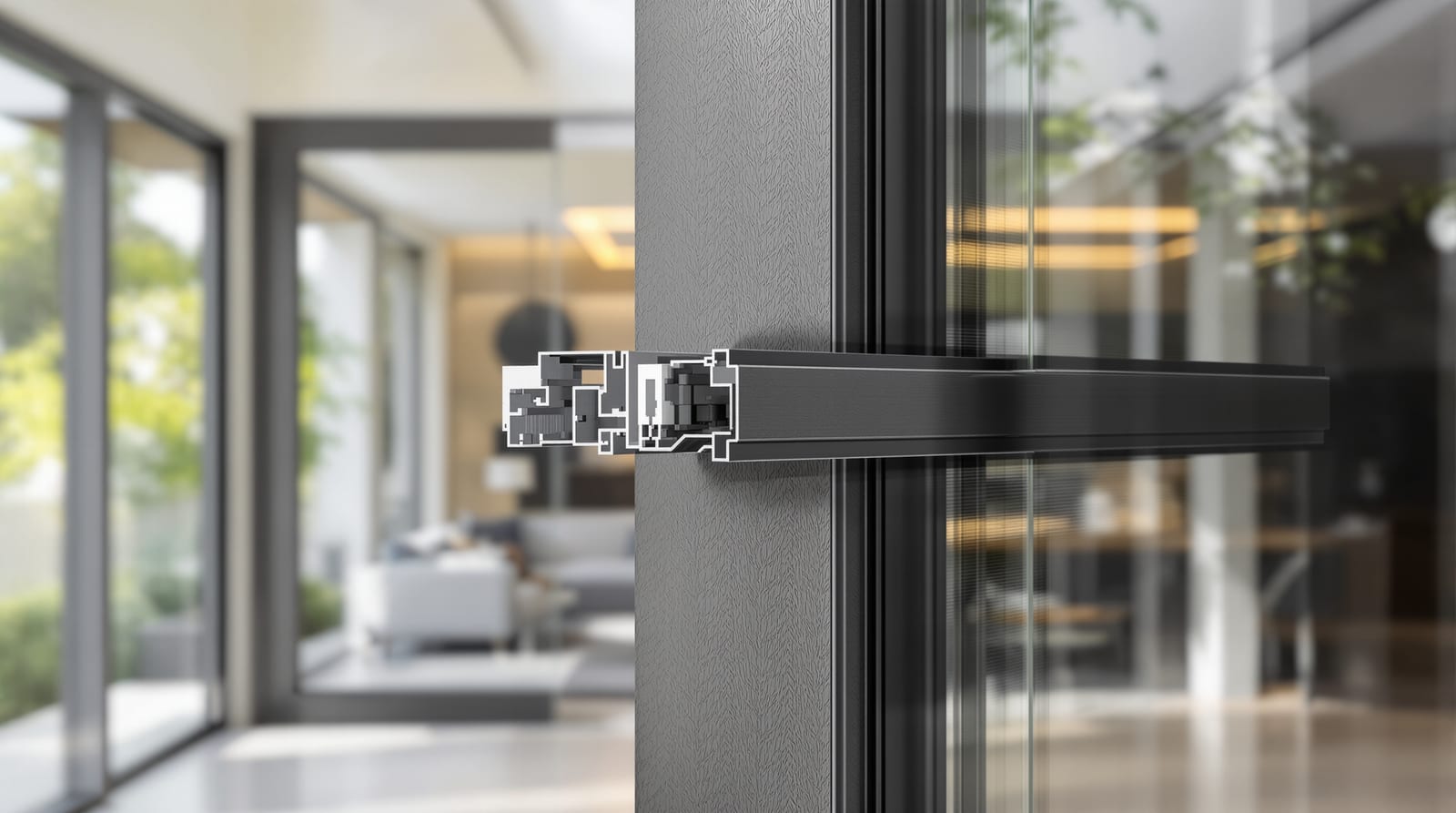
A thermal break cuts that bridge. During manufacture the aluminium profile is made in two halves — an outer face and an inner face — and a strip of reinforced polyamide (nylon), typically glass-fibre-filled PA66, is mechanically crimped or poured between them. Polyamide barely conducts heat, so it isolates the indoor aluminium from the outdoor aluminium. Heat can no longer take the metal shortcut; it has to cross the insulating strip, which it does very slowly. The same principle applies to the glazing: a thermally broken door is normally paired with double glazing or an insulated panel, so the whole door — frame and infill — resists heat flow together.
The diagram below shows the cross-section and the broken heat path.
Why bare aluminium conducts heat and sweats
Two distinct problems follow from aluminium's conductivity, and the thermal break fixes both.
Heat conduction. In a Chennai or Mumbai summer the outdoor frame might sit at 38–42°C while your room is held at 24°C. A solid aluminium frame conducts that outdoor heat indoors continuously, so your air-conditioner runs longer and your electricity bill climbs. In a cold-zone winter (Shimla, parts of the north) the flow reverses and the frame leaks your heating outward. The frame is acting as a thermal short-circuit — exactly what our door thermal bridging guide describes at frames and junctions.
Condensation (sweating). Because the bare inner frame is chilled by the outdoor cold or AC, its surface temperature can fall below the dew point of the indoor air. Warm, humid Indian air touching that cold metal gives up its moisture, and droplets form on the frame — "sweating." In warm-humid coastal homes this is routine and, left unchecked, leads to staining, mould and corroded fittings. The thermal break keeps the inner face warm enough to stay above dew point, so condensation largely disappears. Our door condensation control guide covers the dew-point mechanics in depth; you can also test a specific frame with the door condensation risk checker.
| Problem with bare aluminium | What you notice | What the thermal break does |
|---|---|---|
| Heat conduction | Higher AC load, hot frame to touch | Interrupts the metal path; frame stays nearer room temperature |
| Condensation / sweating | Water droplets on inner frame, mould | Keeps inner surface above dew point |
| Energy loss | Rising electricity bill | Cuts conducted heat gain/loss through the frame |
| Corroded fittings, stains | Rust, peeling, mould marks | Dry frame protects hardware and finish |
Thermally broken vs standard aluminium
The two doors can look almost identical from across the room, so it is worth knowing what separates them on performance. Frame U-values below are indicative bands — "as a rule of thumb," lower is better — and the whole-door figure depends on the glazing too.
| Feature | Standard aluminium door | Thermally broken aluminium door |
|---|---|---|
| Frame construction | Single solid aluminium profile | Two halves split by polyamide strip |
| Frame U-value band (W/m²K) | High (~5–7) | Much lower (~2.5–4) |
| Typical glazing | Single glazing common | Double glazing / IGU standard |
| Condensation risk | High in AC / humid homes | Low |
| AC energy efficiency | Poor — conducts heat | Good — interrupts heat flow |
| Coastal / monsoon suitability | Sweats, corrodes fittings | Stays dry, protects hardware |
| Cost premium | Baseline | Roughly 25–60% more |
| Best for | Dry, non-AC, budget openings | AC homes, coastal, humid, large glazed doors |
The thermal break does not change the corrosion story on its own — that still comes from a good anodised or powder-coated finish, which matters most on the coast. But it transforms the thermal and condensation behaviour. For the wider U-value picture across all door types, see door U-value guide, and model a specific assembly with the door U-value calculator.
Where a thermal break is essential in India
The upgrade is not universally necessary — in a dry, non-air-conditioned room in a mild climate, a standard aluminium door may be perfectly fine. The break earns its premium in these situations:
- Air-conditioned homes — anywhere you spend money cooling the room, a conducting frame works against you all day. This is the single biggest reason to specify a break.
- Warm-humid and coastal belts — Mumbai, Chennai, Kochi, Goa, coastal Andhra and Odisha: high humidity plus AC means frequent sweating on bare frames. The break keeps them dry.
- Large glazed sliding and patio doors — big aluminium sections have a lot of frame to conduct through; the break matters more as the door grows.
- Cold-climate homes — Himalayan and high-altitude areas where you heat indoors and the frame would otherwise leak heat out and condense.
- Energy-rated and green-building projects — to meet Eco-Niwas Samhita (ENS) 2018 residential envelope targets (RETV), or to earn IGBC / GRIHA envelope credits, a thermally broken frame with good glazing is often the only way an aluminium door qualifies. See doors for green buildings.
If your alternative to aluminium is a fully insulated door, weigh it against thermal insulated doors and the broader door thermal performance overview, then anchor the decision in the complete door guide.
Cost, finish and getting it right
A thermally broken aluminium door typically costs 25–60% more than an equivalent standard aluminium door, before 18% GST, driven by the twin profiles, the polyamide insert and the double glazing that usually accompanies it. The payback comes from lower AC bills, no condensation damage, healthier (mould-free) frames and protected hardware — and in a green-rated home, from meeting envelope code without changing material.
A few practical points so the break actually delivers:
- Specify a genuine PA66 break, not a thin or token strip; ask the fabricator for the profile's frame U-value and the polyamide grade.
- Pair it with double glazing or an insulated panel — a thermally broken frame around single glazing wastes half its benefit, because the glass becomes the weak point.
- Keep the perimeter sealed — gaskets and weatherstripping stop air leakage that would undo the thermal gain; a tighter door is also quieter.
- Choose anodised or powder-coated marine-grade aluminium on the coast for corrosion resistance — the break handles heat, the finish handles salt.
Get those four right and a thermal break door will run dry, cool the room cheaply, and last decades — which is itself the sustainable choice.
Frequently asked questions
What is a thermal break in an aluminium door?
It is an insulating strip — usually glass-fibre-reinforced polyamide (PA66 nylon) — fitted between the inner and outer halves of the aluminium profile. Aluminium conducts heat extremely well, so without the break the frame carries outdoor heat (or cold) straight indoors. The polyamide barely conducts, so it interrupts that path and keeps the inner frame closer to room temperature.
Why does my aluminium door sweat, and will a thermal break stop it?
Bare aluminium chilled by the AC or outdoor cold can drop below the dew point of the indoor air, so humid air touching it condenses into water — "sweating." A thermal break keeps the inner frame warmer, above dew point, so condensation largely stops. It is one of the most noticeable benefits in warm-humid Indian homes.
Is a thermal break worth the extra cost in India?
In an air-conditioned home, on the coast, in humid zones, or for large glazed doors — yes. The 25–60% premium pays back through lower cooling bills, no condensation damage or mould, and protected hardware. In a dry, non-AC room in a mild climate, a standard aluminium door may be enough.
Does a thermal break stop aluminium from corroding on the coast?
No — that is a separate job. Corrosion resistance comes from a good anodised or powder-coated marine-grade finish. The thermal break handles heat conduction and condensation; the finish handles salt and moisture. On the coast you want both.
How much does a thermal break lower the door's U-value?
Indicatively, a standard aluminium frame sits around 5–7 W/m²K, while a thermally broken frame falls to roughly 2.5–4 W/m²K — a large improvement, lower being better. The whole-door figure also depends on the glazing, which is why a break is normally paired with double glazing.
Export this guide
Related Guides — Deep-dive reading
Aluminium Doors in India: Profiles, Glazing, Cost & uPVC vs Steel (2026)
Framed glazed aluminium doors — sliding, openable and French-style — for balconies, utility and modern facades: powder-coat vs anodised vs wood-finish profiles, IS 733/1285 sections, thermal-break options and ₹/sq ft costs.
Home Doors & EntrancesDoor Condensation Control: Stop Sweating Doors (India 2026)
Why metal and glass doors sweat in AC rooms and the monsoon, the mould risk it creates, and how thermal breaks, insulated cores and Low-E glazing stop it.
Home Doors & EntrancesDoor Thermal Performance: U-Value & Heat Loss (India 2026)
How doors gain and lose heat in Indian homes, what U-value really means, and what makes a door thermally good enough to cut your AC bill.
Home Doors & EntrancesRelated Tools — Try Free
Aluminium Door Cost Calculator
Estimate an aluminium door cost by opening size, profile grade, finish, glazing and type, with fitting and GST.
Door CalculatorWindow Cost Calculator
Estimate window price plus installation by type, frame material, size, glass and quantity.
Window CalculatorHealing View Impact Calculator
Evidence-Based Design dashboard quantifying the recovery impact of nature view + daylight factor on analgesic use, length of stay, and HCAHPS patient-experience uplift. Calibrated against Ulrich 1984 (Science), Park & Mattson 2008, and the CHD EBD evidence base.
EBD Calculator