
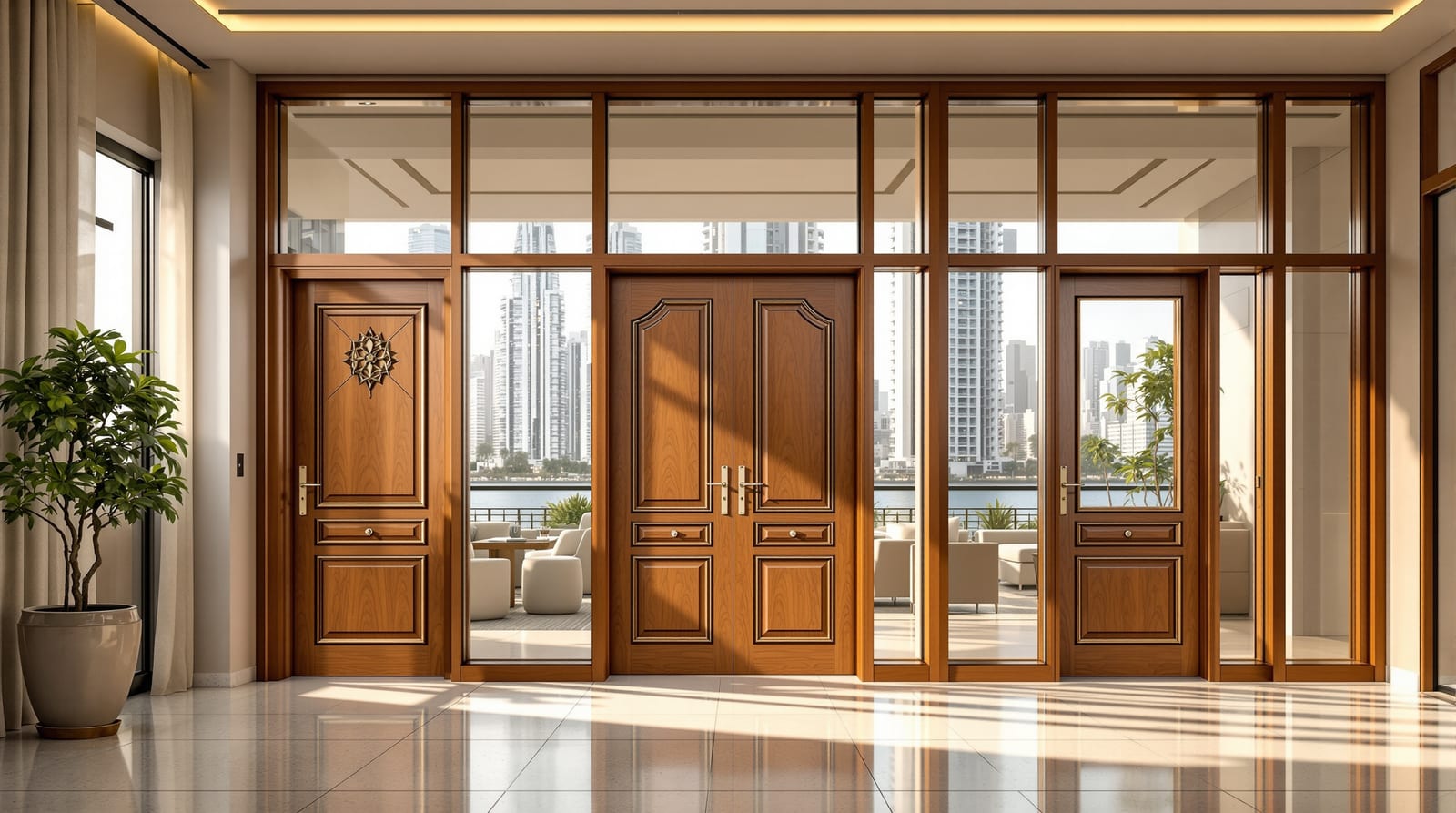
Door Cost in Mumbai (2026): Real Rates, GST & Markets
What flush, WPC, teak and main doors actually cost in Mumbai in 2026 — worked examples at the 1.20 city index, plus GST and where to buy.
The door cost in Mumbai runs roughly 20% above the national average — and that single number explains most of the sticker shock buyers feel here. Mumbai carries a city cost index of 1.20 against the pan-India baseline of 1.00, the highest of any major Indian city. So a door that averages ₹4,000 elsewhere is closer to ₹4,800 in Mumbai before you even add 18% GST. This guide translates that index into real, material-by-material rates for flush, WPC, teak and main doors, with worked examples, the markets where Mumbaikars actually buy, and the coastal-humidity and high-rise quirks that should shape your choice. For the national benchmark these numbers are built on, see the 2026 door cost guide; to compare across metros, see door cost by city.
How the Mumbai 1.20 index works
Every price below starts from the pan-India supply-only average for one standard 7×3 ft (2.1×0.9 m) leaf, then multiplies by 1.20. "Supply-only" means the door slab alone — frame, fitting, hardware and GST are separate line items, and quotes vary by dealer, finish and quantity. Treat these as indicative ranges, not firm quotes.
| Door type | Pan-India avg (₹) | Mumbai ~×1.20 (₹) |
|---|---|---|
| Hollow-core flush (commercial) | 1,800–3,000 | 2,160–3,600 |
| Solid-core flush (BWR) | 3,000–5,500 | 3,600–6,600 |
| Laminate / membrane flush | 4,000–7,000 | 4,800–8,400 |
| WPC door | 4,500–7,500 | 5,400–9,000 |
| PVC door (bathroom) | 1,800–4,000 | 2,160–4,800 |
| uPVC door | 8,000–16,000 | 9,600–19,200 |
| Sal / hardwood panel | 9,000–16,000 | 10,800–19,200 |
| Teak panel / carved | 22,000–45,000+ | 26,400–54,000+ |
| Designer main door | 30,000–80,000+ | 36,000–96,000+ |
These are slab prices only. The supporting line items also carry the Mumbai loading:
| Line item | Pan-India avg (₹) | Mumbai ~×1.20 (₹) |
|---|---|---|
| Door frame (sal, per door) | 2,000–3,500 | 2,400–4,200 |
| Fitting / installation (per door) | 1,000–2,500 | 1,200–3,000 |
| Basic hardware set | 1,200–2,500 | 1,440–3,000 |
Worked examples at Mumbai rates
The quickest way to read the index is to price a few real doors end to end, including 18% GST. Wooden and flush doors fall under HSN 4418; uPVC and PVC under HSN 3925 — both attract 18% GST. See door GST and HSN codes for the detail.
A solid-core flush internal door (bedroom): A BWR solid-core flush slab that averages ₹4,000 nationally runs about ₹4,800 in Mumbai before GST. Add a sal frame (~₹3,200), fitting (~₹2,000) and a basic hardware set (~₹2,200) and you reach roughly ₹12,200 supply-and-install. With 18% GST, that's about ₹14,400 per internal door fully fitted.
A WPC bathroom/utility door: A mid-range WPC slab at ₹6,000 nationally is around ₹7,200 in Mumbai. WPC is moisture-proof, so many Mumbai buyers use it for bathrooms and balcony-facing doors. With frame, fitting and hardware, expect roughly ₹11,000–₹13,000 installed before GST, or about ₹13,000–₹15,300 with GST. See WPC door price in India.
A teak main door: A modest carved teak panel at ₹30,000 nationally is about ₹36,000 in Mumbai. A genuine Burma/CP teak main door with a heavier frame and quality hardware commonly lands at ₹45,000–₹70,000 installed before GST — closer to ₹53,000–₹83,000 with GST. Compare with the teak door cost guide and the main door cost guide.
For a whole 3BHK flat with 10–14 doors, a sensible Mumbai budget is ₹1.6L–₹4.5L+ depending on whether you go flush-everywhere or splurge on a designer main door.
What drives door prices in Mumbai
Mumbai's premium is not random. The biggest driver is real-estate and showroom cost — retail space in the city is among the costliest in the country, and that overhead is baked into every slab. Skilled carpentry rates are high because labour and living costs are steep. Transport matters too: most timber and finished doors arrive from outside the city, and last-mile delivery into congested areas adds up. Finally, society and high-rise constraints quietly raise installed cost — service-lift bookings, restricted working hours, and gated-society access rules all slow a fitting crew down, and slow work costs more. Read more in why door prices vary by city.
Where to buy doors in Mumbai
Mumbai has well-established hubs for doors, timber and hardware. A few that buyers genuinely use:
- Reay Road / Darukhana timber market (eastern dockland belt): one of the city's oldest concentrations of timber and sawmills, where contractors source sal, hardwood and frame sections.
- Crawford Market and the Lohar Chawl / Kalbadevi area (South Mumbai): dense old-city trading streets for hardware, locks, hinges and fittings, with Lamington Road nearby long known as an electronics-and-hardware belt.
- Kurla and the Andheri–Sakinaka industrial belt: flush-door, WPC and laminate dealers and warehouses serving the suburbs.
- Suburban showroom belts in Andheri, Goregaon, Mulund and Thane / Navi Mumbai: branded uPVC and designer-door showrooms (Fenesta, Aparna Venster and similar) cluster along the western and central suburbs and into Navi Mumbai.
For most flats, a suburban dealer near your site beats trekking to South Mumbai once you factor in delivery and fitting coordination. To weigh shop versus screen, see door showroom vs online and the broader where to buy doors in India guide. Whichever route you take, always get a written, itemised quote — the door quotation guide shows what to insist on.
The coastal-humidity factor
Mumbai's salt-laden, humid coastal air is hard on doors, and this shapes what locals buy. Solid timber can swell and stick in the monsoon, and ordinary MDF or low-grade flush doors can delaminate near bathrooms and balconies. Practical Mumbai choices:
- WPC and uPVC for bathrooms, utility, balcony and external openings — both shrug off moisture and don't warp. See WPC doors and uPVC doors.
- Marine-grade (BWP) flush doors rather than basic BWR where exposure is high.
- Stainless or treated hardware — sea air corrodes cheap mild-steel fittings fast.
The upgrade adds a little to upfront cost but saves on early replacement, which matters when society rules make swapping a door a hassle. For the material trade-offs, see best door material in India and door materials comparison.
High-rise society fitting in Mumbai
Most Mumbai homes are flats, so installation is rarely as simple as it sounds. Many co-operative societies require prior intimation for door work, restrict working hours, charge a refundable deposit, and insist that fittings use the service lift rather than the passenger lift. Main-door changes can need committee approval because the corridor face is treated as common-area aesthetics. Budget for possible lift-booking fees, debris-removal charges and a fitting crew that may need two visits. Confirm the society's rules before you finalise a delivery date, and factor the friction into the installation line — it's a real, Mumbai-specific cost. The door installation cost guide covers the fitting side in detail.
To turn all of this into your own numbers, the door cost by city calculator applies the 1.20 Mumbai index automatically, and the door GST calculator adds the 18% for you.
Frequently asked questions
Why is the door cost in Mumbai higher than in other cities?
Mumbai sits at a 1.20 cost index — about 20% above the national average and the highest among major Indian cities. The premium is driven mainly by expensive showroom and real-estate overheads, high skilled-labour rates, transport into a congested city, and the extra effort of fitting doors in high-rise societies.
What does a fully fitted internal flush door cost in Mumbai?
For a BWR solid-core flush door, budget roughly ₹12,000–₹13,000 supply-and-install before GST (slab around ₹4,800, plus frame, fitting and hardware), or about ₹14,000–₹15,500 with 18% GST. Laminate-finish doors sit a little higher.
Which door material is best for Mumbai's humid coastal climate?
For wet or exposed areas — bathrooms, utility, balcony and external openings — WPC and uPVC are the safest bets because they don't warp or rot. For main doors, use well-seasoned teak or hardwood with quality joinery, and choose marine-grade (BWP) flush over basic grades where exposure is high.
Where do people actually buy doors in Mumbai?
Contractors source timber from the Reay Road / Darukhana belt, hardware from Lohar Chawl and the Crawford Market / Lamington Road area, and finished flush, WPC and branded uPVC doors from suburban dealers and showrooms across Andheri, Goregaon, Mulund, Thane and Navi Mumbai.
Do I need society permission to change my flat's door in Mumbai?
Often, yes. Many societies require advance intimation for door work, restrict working hours, ask for a refundable deposit, and route material through the service lift. Main-door changes may need committee sign-off because the corridor face counts as common-area aesthetics, so check your society's rules before scheduling delivery.
Is GST included in Mumbai door quotes?
Not always — many supply-only quotes are shown before tax. Doors attract 18% GST (HSN 4418 for wooden/flush, HSN 3925 for uPVC/PVC), so ask whether the figure is inclusive and get an itemised quotation that lists slab, frame, fitting, hardware and tax separately.
Export this guide
Related Guides — Deep-dive reading
Door Cost in Hyderabad: Prices, Markets, GST Guide 2026
What doors really cost in Hyderabad in 2026 — city index 1.05, worked examples with 18% GST, and the markets where people actually buy.
Home Doors & EntrancesDoor Cost in Jaipur (2026): Prices, Markets & Buying Guide
What doors really cost in Jaipur in 2026 — city index 0.95, worked examples with 18% GST, real timber markets and the carved-wood heritage premium.
Home Doors & EntrancesCoastal Region Door Buying in India 2026: Salt-Air Guide
Why cheap flush and MDF doors fail near the sea, and which water-resistant materials and corrosion-proof hardware actually last.
Home Doors & EntrancesRelated Tools — Try Free
Door Cost Calculator
Estimate the all-in cost of a door — leaf, frame, hardware, fitting and GST — by type, material and size.
Door CalculatorDoor Material Comparison Tool
Compare 2–4 door materials on cost, durability, maintenance, security and moisture resistance.
Comparison ToolFalse Ceiling Cost Estimator
Live ₹/sqft across 8 ceiling types — POP, gypsum, designer, metal, PVC, wooden — with cove and spot lighting for 20 Indian cities.
Cost Calculator