
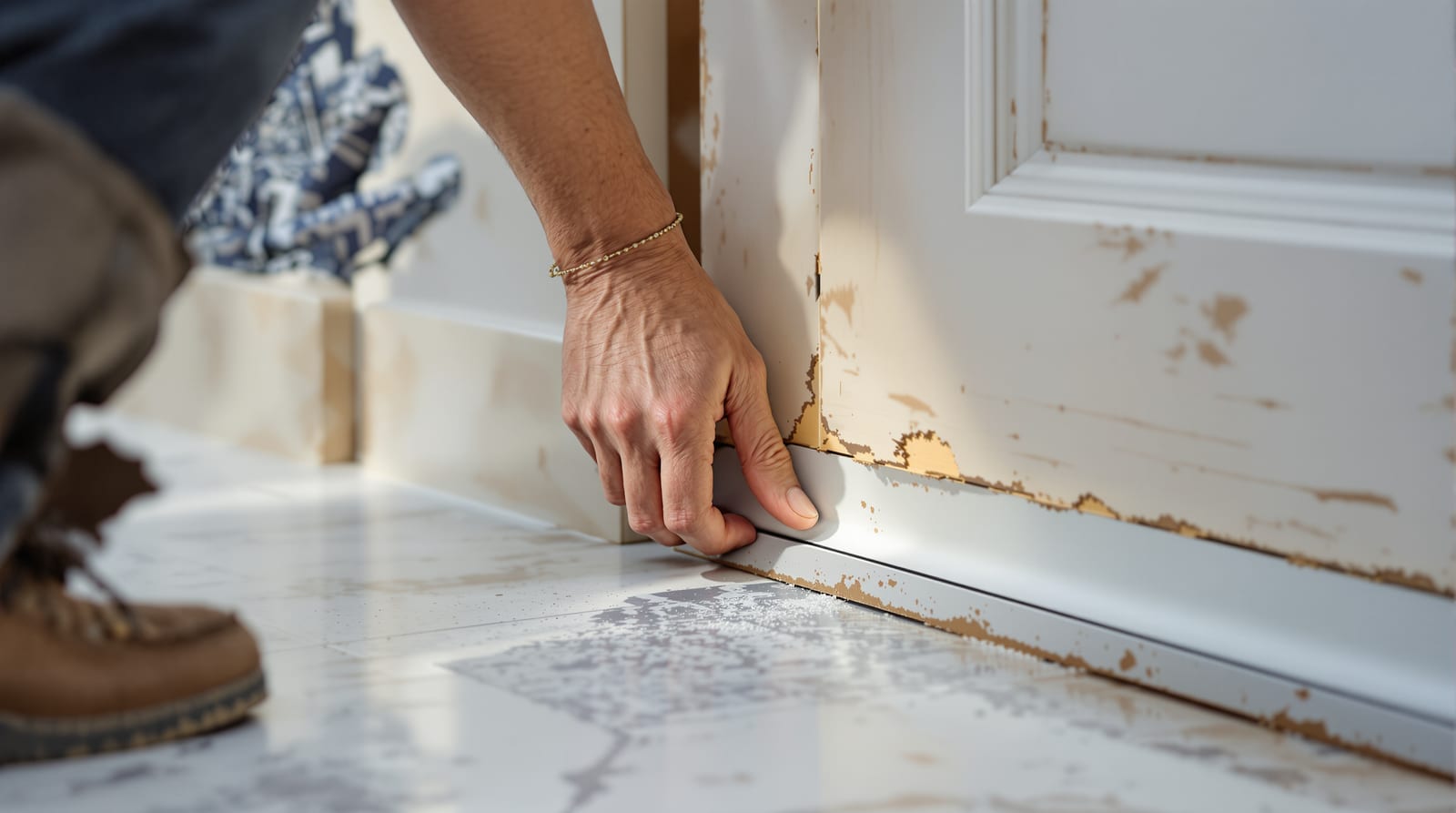
Door Draught-Proofing Performance: Air Leakage (India 2026)
How to measure and rate how well a door resists draughts and air leakage, what good looks like in m3/h.m2 at 50 Pa, and the AC-efficiency and comfort payoff.
Most Indian homes lose a surprising amount of cooled air through the thin gaps around their doors, yet almost nobody measures it. Door draught-proofing performance is the spec-sheet answer to a simple question: how well does this door, with its seals fitted, actually resist air leaking past it? It is a measured property — not a marketing adjective — expressed as an air-leakage rate, and it directly decides how hard your AC works, how dusty your rooms get, and how quiet they feel. This guide is about the performance and measurement angle: how leakage is quantified, how seals are rated, how to test your own door, and what a genuinely draught-tight door looks like in numbers. If you want the DIY fix or the products themselves, start instead with our companion pieces and come back here for the metrics.
What "draught-proofing performance" actually measures
A draught is uncontrolled air moving through gaps because of a pressure difference — wind outside, stack effect, or the suction of an exhaust fan or AC. The performance of a door against that draught is captured as an air-leakage rate: the volume of air (in m3/h) that passes through each square metre of the door at a reference pressure difference, usually 50 pascals (Pa). So the unit you will see is m3/h.m2 at 50 Pa. Lower is better; a perfectly sealed door would read zero.
Three things matter:
- Air permeability measures leakage through and around the closed door assembly as a whole — the slab, the perimeter gaps, the threshold and the frame junctions.
- The reference pressure matters because leakage rises with pressure. Quoting a figure without its Pa value is meaningless.
- "With seals fitted" matters, because draught-proofing performance is a property of the whole sealed assembly, not the bare slab. A solid door with no perimeter seal can leak as badly as a hollow one.
Internationally this is graded under EN 12207 (air permeability classes 1-4, higher class = tighter) and tested per EN 1026; whole-house leakage is measured by a blower-door test (EN ISO 9972). In India there is no consumer door-leakage label yet, but the Eco-Niwas Samhita (ENS) 2018 residential envelope code treats air-tightness as part of envelope performance, and good specifiers borrow the EN classes as benchmarks. Treat any EN class on an imported door's spec sheet as a useful guide, not Indian law.
What good looks like: leakage performance bands
There is no Indian standard band table for single doors, so as a rule of thumb the following ranges describe what you can expect. Figures are indicative air-leakage performance for the closed, sealed assembly.
| Door condition | Indicative leakage (m3/h.m2 at 50 Pa) | EN 12207 sense | What it feels like |
|---|---|---|---|
| Old door, no seals, worn gaps | 30+ | Class 0 / fail | Visible daylight, dust streaks, AC never catches up |
| Standard door, no perimeter seal | 15-30 | Class 1 | Noticeable draught at edges, conditioned air leaks |
| Perimeter weatherstrip fitted | 6-15 | Class 2 | Edges sealed, gap under door still leaks |
| Perimeter + threshold or brush seal | 3-9 | Class 2-3 | Good comfort, AC holds temperature better |
| Perimeter + drop-down bottom seal, quality frame | 1-4 | Class 3-4 | Tight, quiet, energy-efficient; near-Passive-House territory |
The single biggest variable is the gap under the door. A typical 8-12 mm under-door gap is, on its own, often the largest leak path in the whole house. Closing it well is what moves a door from "some seals" to genuinely high performance.
How seals deliver performance (and how they are rated)
Draught-proofing performance is the result of how completely the perimeter is closed. Each seal type contributes differently, and their effectiveness depends on compression (a seal only works when the door squeezes it) and durability (a seal that goes hard or tears stops sealing).
| Seal location | Type | Relative effectiveness | India durability note |
|---|---|---|---|
| Head and jambs (sides/top) | EPDM / silicone bulb gasket in the frame rebate | High and consistent; best per rupee | EPDM resists UV, ozone and monsoon better than cheap foam, which crushes flat in a season |
| Head and jambs | Self-adhesive foam tape | Moderate; cheap, short-lived | Peels in heat and humidity; a stop-gap, not a performance solution |
| Bottom (under-door) | Brush / fin strip | Moderate; bridges large gaps | Lets some air through; good on uneven floors |
| Bottom | Drop-down (automatic) bottom seal | Highest; seals on close, lifts on open | The performance choice; protects the floor finish; higher cost |
| Threshold | Weather bar + seal (external) | High for rain and air together | Essential on external doors in driven-rain coastal zones |
For the products and how to choose between them, see acoustic door seals (the same perimeter and drop-down seals that cut air leakage also cut noise) and our overview of weatherstripping. The key performance point: a continuous, uninterrupted seal line around all four edges is what produces a low leakage number. One un-sealed corner or a worn drop-seal can undo the rest.
How to test your door's draught performance
You do not need a lab to grade your own door. Work from cheapest to most rigorous:
The daylight and paper tests
With the door closed, look for daylight around the edges and under the slab in a darkened room — visible light means a direct air path. Then close the door on a sheet of paper; if it slides out with no drag, the seal at that point is doing nothing.
The smoke and incense test
On a windy day, or with the AC and an exhaust fan both running to create a pressure difference, hold a lit incense stick or smoke pencil along the door perimeter and threshold. Where the smoke is pulled sideways or wavers, air is leaking. This maps where your performance is failing, which is what a seal upgrade should target.
The blower-door test (the real measurement)
A blower-door test depressurises the whole home to 50 Pa with a calibrated fan and measures total air-leakage; pairing it with a smoke pencil or thermal camera isolates the door's share. This is how the m3/h.m2 figures above are actually obtained. In India, blower-door testing is mostly used on IGBC / GRIHA-rated and Passive-House projects rather than ordinary homes, but it is the only way to get a true rated number. Our free door air leakage calculator lets you estimate a door's leakage and the conditioned air lost from its gap dimensions before you pay for any test.
Why the performance matters: AC, comfort, dust and noise
A leaky door is not just a comfort niggle; it is a continuous energy bill. Every m3 of conditioned air that leaks out is replaced by hot, humid outdoor air your AC then has to cool and dehumidify again. As a rule of thumb, infiltration through envelope gaps can account for a meaningful slice of a home's cooling load in India's warm-humid and composite zones; tightening doors is among the cheapest ways to claw it back. The payoffs are linked:
- AC efficiency: a draught-tight door holds the set temperature, so the compressor cycles less and the room cools faster. This is the same physics covered by our broader door air-tightness and door energy rating pieces.
- Comfort: no cold-spot draughts at the feet, no warm gusts when a fan runs.
- Dust and pests: India's dust, pollen and insects ride the same air paths; a sealed perimeter cuts them dramatically.
- Noise: the gaps that leak air also leak sound, so a draught-tight door is measurably quieter — see door sound insulation.
For the wider envelope view, the door thermal performance pillar and the complete door guide put air-tightness alongside U-value and SHGC. To put a rupee figure on the savings, our door energy savings calculator estimates the annual AC saving from a tighter door.
A specification checklist for a draught-tight door
When you want genuinely high draught-proofing performance, specify the assembly, not just the slab:
- A door slab that stays flat and stable (warped doors break the seal line) — solid or insulated cores hold their shape better.
- A continuous EPDM or silicone bulb gasket in the frame rebate around head and both jambs, sized so the closed door compresses it.
- A drop-down automatic bottom seal (or a quality threshold-plus-seal) to close the under-door gap.
- A square, true frame set without twist — a poorly fitted frame leaks however good the seals are.
- For external doors, a weather bar and threshold seal rated for driven rain, not just air.
- A plan to re-check and replace seals every few years; in India's heat and UV, gaskets are a maintenance item, and a hardened seal quietly returns the door to leaky.
Durability is itself part of performance: the door that keeps its low leakage number for fifteen years beats the one that tests well on day one and crushes its foam flat by the next summer.
Frequently asked questions
What is a good air-leakage number for a door?
As a rule of thumb, an old unsealed door leaks 30+ m3/h.m2 at 50 Pa, a perimeter-sealed door drops to roughly 6-15, and a door with perimeter gaskets plus a drop-down bottom seal can reach 1-4 (EN 12207 Class 3-4). Lower is better. There is no Indian consumer door label yet, so these EN-based bands are benchmarks, not legal grades.
How is draught-proofing performance different from just buying weatherstripping?
Weatherstripping is the product; draught-proofing performance is the measured result of fitting it well to the whole assembly. A door with seals can still leak badly if the under-door gap is open, the frame is twisted, or a seal has gone hard. This guide is about the rated outcome; for the products see door seals and weatherstripping, and for the quick DIY fix see our stop-draughts how-to.
Can I measure my door's leakage without expensive equipment?
Yes, qualitatively. Use the daylight test, the paper-drag test, and an incense stick or smoke pencil on a windy day or with an exhaust fan running to find where air pulls through. These show where you are leaking. Only a blower-door test gives a true m3/h.m2 number, and that is mainly done on IGBC/GRIHA and Passive-House projects.
Does the gap under the door really matter that much?
Yes. A typical 8-12 mm under-door gap is often the single largest leak path in the whole house, because it is a continuous slot across the full door width. Closing it with a drop-down bottom seal usually delivers the biggest single jump in draught-proofing performance.
Will a draught-tight door make my room stuffy?
No, if ventilation is designed in. A tight door stops uncontrolled leakage; you still ventilate deliberately through windows, vents or mechanical ventilation. The aim is controlled fresh air, not random infiltration. Bathrooms and kitchens still need their exhaust paths.
How much can a draught-tight door save on my AC bill?
It varies with climate zone, AC hours and how leaky the door was, so treat any figure as indicative. In warm-humid and composite zones with heavy AC use, cutting door infiltration is one of the cheapest comfort-per-rupee upgrades. Use the door energy savings calculator to model your own case.
Export this guide
Related Guides — Deep-dive reading
Door Air-Tightness & Infiltration Control (India 2026)
How gaps around a door leak conditioned air, dust and noise, the air-permeability classes that matter, and how seals cut infiltration.
Home Doors & EntrancesSoundproof Doors in India: How Doors Leak Sound, STC Ratings, Seals & Real Costs
A door is the weakest acoustic link in any wall - and it usually leaks through the gaps, not the panel - so here is how to actually quieten a bedroom, home theatre or street-facing room, from a 1,500-rupee seal kit to a proper acoustic door.
Home Doors & EntrancesDoor Sound Insulation: Improve It Step by Step (India 2026)
The physics of mass, sealing and decoupling — and how to upgrade an ordinary Indian door to genuinely cut the noise coming through it.
Home Doors & EntrancesRelated Tools — Try Free
Cross-Ventilation Analyzer
Estimate airflow and air changes per hour (ACH) from room size, window areas, layout, and local wind — with NBC 2016 Part 8 compliance check.
Ventilation CalculatorWindow Energy Savings Calculator
Compare standard glazing vs Low-E and DGU windows — annual cooling savings, 10-year savings and payback.
Window CalculatorFuture Home Comfort Score
Score your home 0 to 100 on daylight, ventilation, thermal and acoustic comfort and find the weak link.
Window Tool