
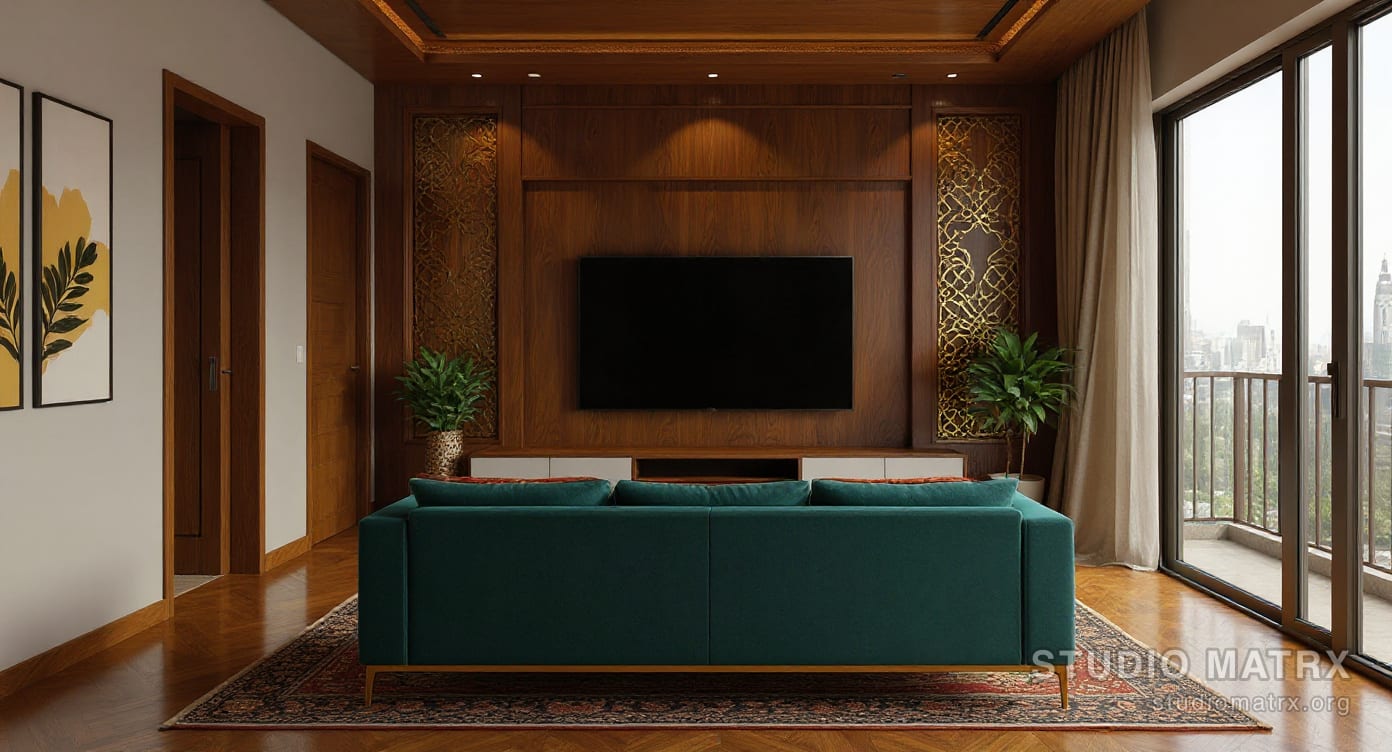
Indo-Contemporary Interiors — A 2026 Style Guide for Indian Homes
Modern shell, Indian warmth · Teak, brass, jaali · The urban India favourite
Indo-Contemporary is what happens when a clean, modern Indian home stops apologising for being Indian. It keeps the uncluttered lines, the open plans and the calm neutral shell of contemporary design, then warms that shell with a few deliberate Indian gestures — a carved teak console, a brushed-brass pendant, a jaali screen filtering afternoon light. In 2026 it is, by a wide margin, the most-requested look in urban Indian homes: it photographs beautifully, it suits compact apartments and sprawling villas alike, and it lets families honour heritage without living inside a museum. This guide is about the styling of that look for homeowners — palette, materials and room-by-room choices — not the architecture of it.
What Indo-Contemporary Is (and Isn't)
Indo-Contemporary is a modern base plus curated Indian accents. The base does the heavy lifting: neutral walls, restrained furniture silhouettes, generous negative space, and good lighting. The Indian accents do the storytelling: craft, warmth, colour and a sense of place.
It is not full traditional. A traditional Indian interior layers ornament on ornament — every surface carved, every textile patterned, every wall a deep jewel tone. Beautiful, but maximal. Indo-Contemporary edits that down to a handful of signature pieces.
It is also not cold modern. The all-grey, all-glass, accent-free apartment can feel like a showroom or an airport lounge — efficient but emotionally flat, and oddly anonymous in an Indian context. Indo-Contemporary is the corrective: it keeps the discipline of modern design and reintroduces soul through teak, brass, handloom and hand-craft.
The simplest mental model: build a quiet modern room, then add three or four Indian things that you genuinely love. If you find yourself adding a fifth and sixth, you have probably drifted toward traditional. If you have added none, you have a hotel room.
Five Principles
1. Start with a modern shell
Everything begins with restraint. Keep walls in a warm neutral (sand, oatmeal, soft greige), choose furniture with clean lines and slim legs, and protect negative space — empty wall, empty floor, empty tabletop are features, not failures. The shell should look calm and almost minimal on its own. That calm is the canvas; the Indian accents are the paint. Get the shell wrong (too much furniture, too many finishes) and no amount of brass will rescue it.
2. Edit your Indian accents ruthlessly
The skill in this style is subtraction. Pick a small, confident set of heritage elements per room rather than a little of everything. One carved cabinet beats three. One striking dhurrie beats a rug, a runner and a wall hanging. Curated means each Indian piece has room to breathe and reads as intentional — a choice, not a collection. When in doubt, remove one thing.
3. Treat jaali as your signature
The jaali — the perforated, patterned screen carved in wood, cut in stone or laser-cut in metal — is the single most recognisable Indo-Contemporary move. It does real work: it divides open-plan space without blocking light, it throws beautiful patterned shadows across the day, and it instantly signals "Indian" in an otherwise modern room. Use it as a partition between living and dining, as a pooja-room enclosure, as a balcony screen, or as a single framed panel on a feature wall. One well-placed jaali can carry an entire room.
4. Build warmth from brass and teak
Warm metal and warm wood are the temperature controls of this style. Brushed (not shiny, mirror-finish) brass on taps, handles, light fittings and accents adds a soft golden glow that grey-and-white schemes badly need. Teak — or a good teak-toned wood — in furniture, shutters and a single statement piece brings depth and the unmistakable patina of Indian craftsmanship. Together they pull a cool modern shell back toward something that feels like home.
5. Layer texture through handloom
Indian textiles are the easiest, most affordable way to make a room feel collected and warm. Handloom cotton and linen, ikat and block-print cushions, a chunky cotton dhurrie, a kantha throw, raw-silk drapes — these add tactile depth and gentle pattern without the commitment of paint or carpentry. Texture is also where you can be playful: rotate cushions and throws by season or festival and the room stays alive without a renovation.
The Indo-Contemporary Palette
The palette is a warm neutral foundation lifted by one or two saturated Indian accents. Keep roughly 70% neutral, 20% wood/metal warmth, 10% colour pop.
| Tone | Hex | Where to use | Indian reference |
|---|---|---|---|
| Sand | #e7dcc6 | Walls, large upholstery, the calm base of every room | Raw cotton, undyed khadi, sandstone |
| Warm teak gold | #c19a5b | Brass fittings, wood accents, lamp light, frames | Brushed brass, aged teak, marigold-season warmth |
| Teal | #1f6f6b | One accent wall or feature, cushions, a single statement chair | Peacock blue, Pichwai greens, glazed Khurja pottery |
| Dark teak brown | #6b4a2b | Furniture, jaali screens, flooring tone, grounding pieces | Burma teak, rosewood carving, temple woodwork |
A reliable formula: sand on the walls, dark-teak furniture, warm-gold brass accents, and teal used sparingly as the one colour your eye lands on. Resist adding a fourth or fifth accent colour — discipline is what separates this from a busy traditional scheme.
Materials & Craft Elements
These are the building blocks. Source craft pieces from makers who do them well rather than mass-produced "ethnic-look" imitations — the difference is immediately visible.
| Element | Role | Indian sourcing note |
|---|---|---|
| Jaali screen | Signature divider, light filter, feature panel | Carved teak/sheesham from Saharanpur and Jodhpur workshops; sandstone jaali from Rajasthan; laser-cut MDF/metal from local fabricators for a crisp modern edge |
| Brushed brass | Fittings, lighting, hardware, accents | Moradabad is the brass capital; ask for brushed/antique finish over high-shine for a contemporary look |
| Teak | Furniture, shutters, statement carpentry | Burma and plantation teak via established timber merchants; vet for seasoned, low-moisture stock with good carpenters |
| Handloom textile | Cushions, drapes, upholstery, throws | Handloom cotton and linen from weaving clusters; block-print from Bagru/Sanganer; ikat from Pochampally |
| Dhurrie / rug | Floor anchor, texture, colour cue | Flat-weave cotton dhurries and hand-knotted wool rugs; Bhadohi and Rajasthan are major sources |
| Terracotta | Accents, planters, sculptural objects | Khurja and local potters; unglazed terracotta adds earthy texture against polished surfaces |
Room by Room
Each room follows the same recipe: quiet modern base, then one or two grounding Indian accents — usually a jaali, a brass piece, or a teak element.
Living Room
The living room is where the style does its best work. Start with a low, clean-lined sofa in sand or oatmeal, slim-leg side tables and an uncluttered media wall. Then ground the room with one strong Indian gesture: a carved teak jaali partition between living and dining, or a single teak console with brushed-brass hardware. Add a flat-weave dhurrie under the seating, a pair of block-print or ikat cushions, and a brass floor lamp for that warm golden glow. Keep the coffee table nearly bare — one terracotta object, not ten.
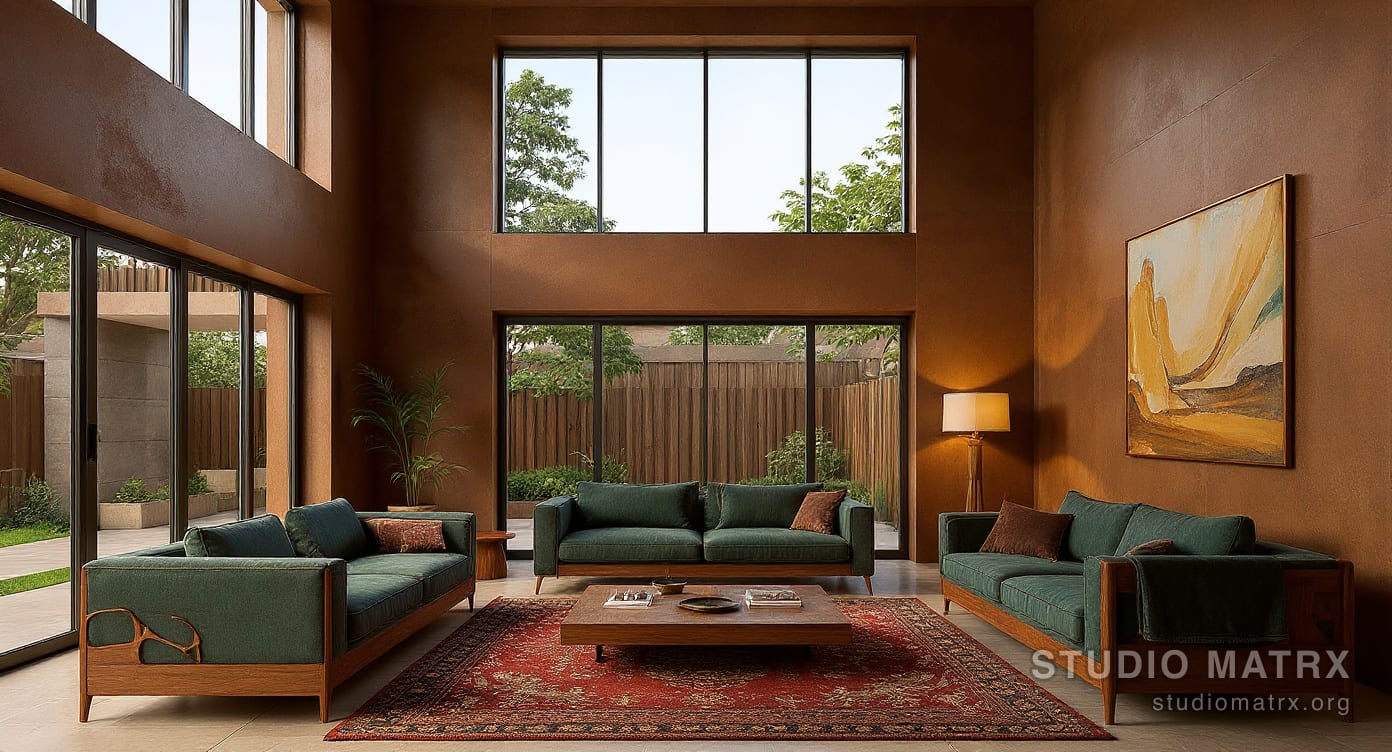
In a larger villa living room the same logic scales up: a taller jaali screen, a bigger statement rug, and a generous teak credenza, with the negative space growing rather than the clutter.
Kitchen
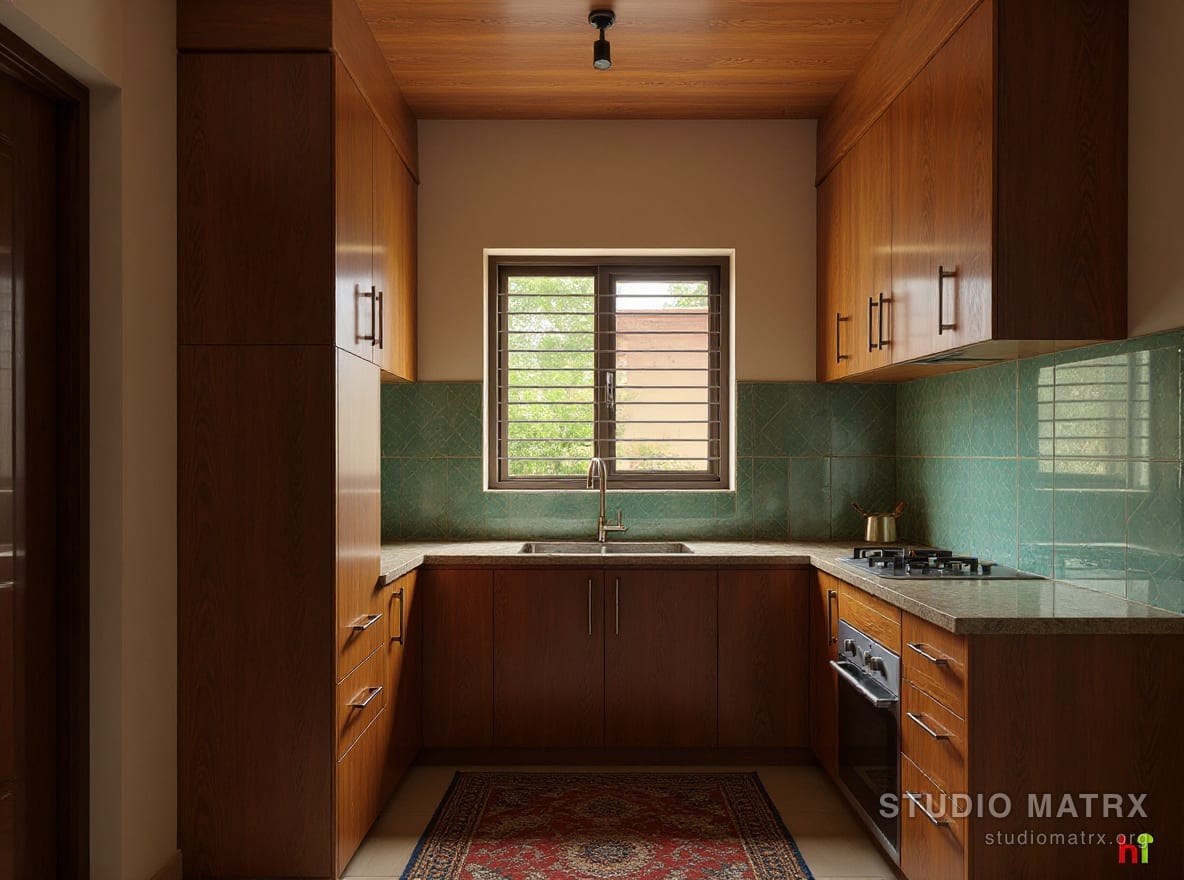
The Indian kitchen has to be hard-working first and pretty second. Keep cabinetry modern and handleless or slim-handled in a warm neutral or muted teal, with a durable stone or quartz counter. The Indo-Contemporary grounding move here is brass: brushed-brass tap, brushed-brass cabinet pulls, and warm pendant lights over the counter or breakfast bar. A teak open shelf for everyday brass and copper vessels turns functional storage into a quiet display. Avoid heavy carving near cooking zones — grease and ornament do not mix.
Master Bedroom
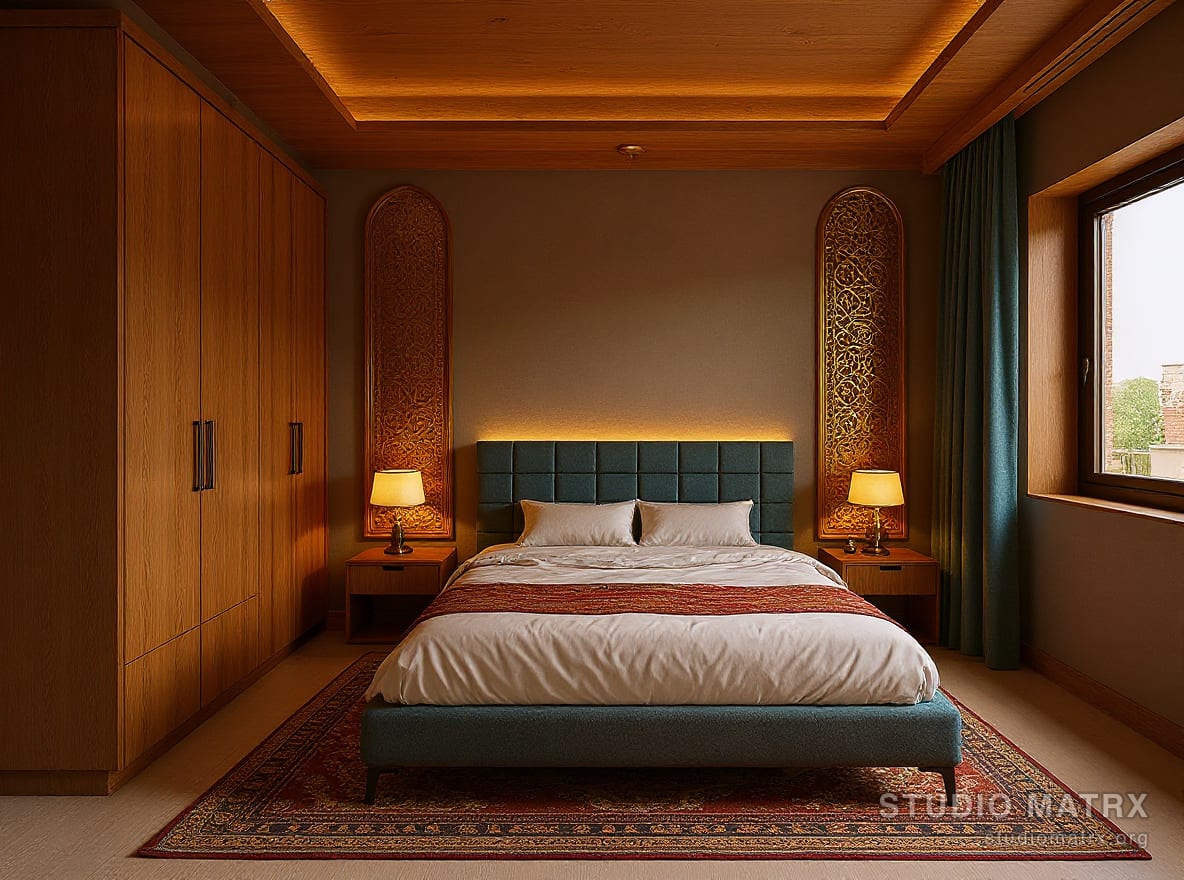
Bedrooms reward calm. Use a sand or soft greige wall, a low platform or upholstered bed, and restrained bedside tables. Ground the room with a teak headboard or a single carved teak side cabinet, and layer the bed with handloom cotton, a kantha quilt and ikat cushions for texture. A jaali screen makes an elegant headboard backdrop or a soft divider for a reading nook, and brushed-brass bedside reading lights finish the warmth. Keep colour to the textiles — one teal throw is enough.
Bathroom
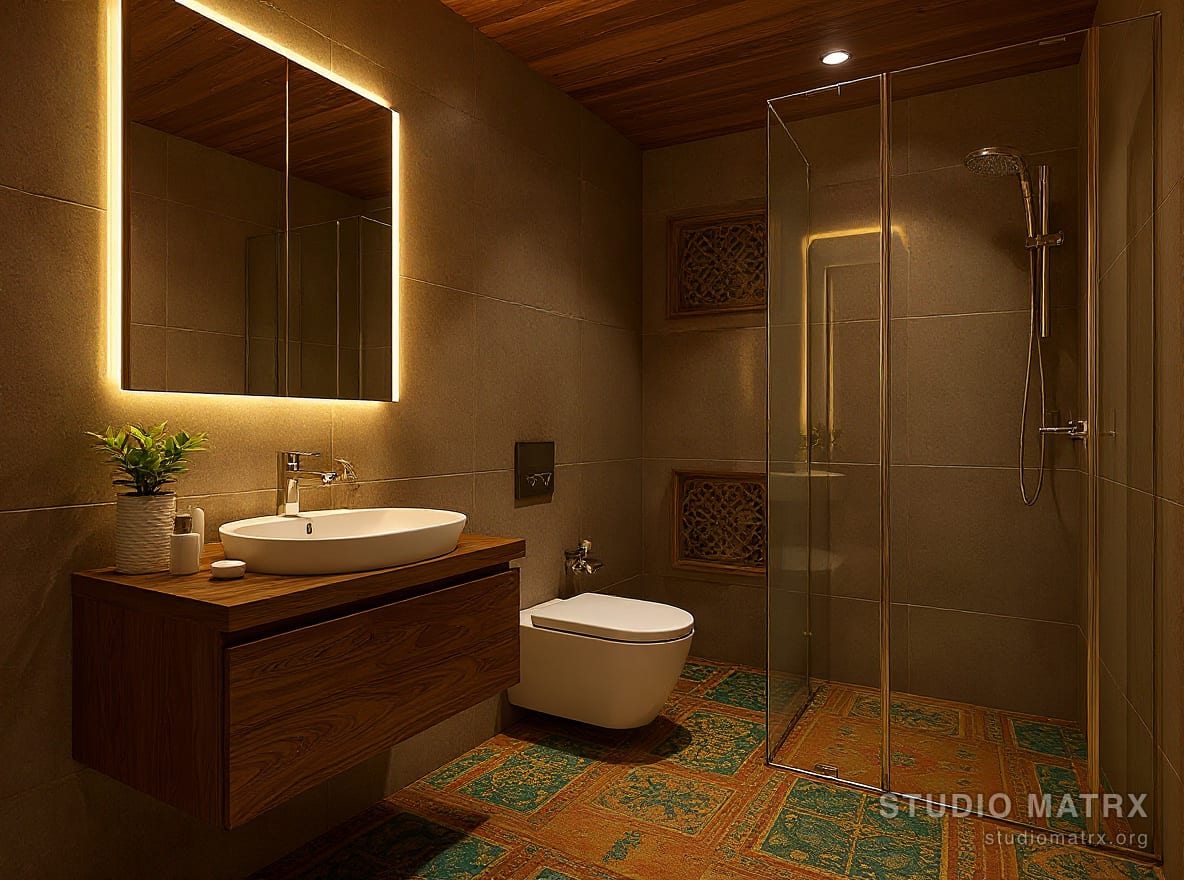
Bathrooms are where brass earns its keep. Pair large-format neutral or stone-effect tiles with brushed-brass taps, shower fittings and a mirror frame for an immediate lift from builder-standard chrome. A teak (marine-grade or well-sealed) vanity or stool adds warmth against cool tile, and a small stone jaali or perforated screen for ventilation doubles as a decorative panel. Keep it spa-quiet: warm metal, warm wood, neutral stone, nothing fussy.
Dining
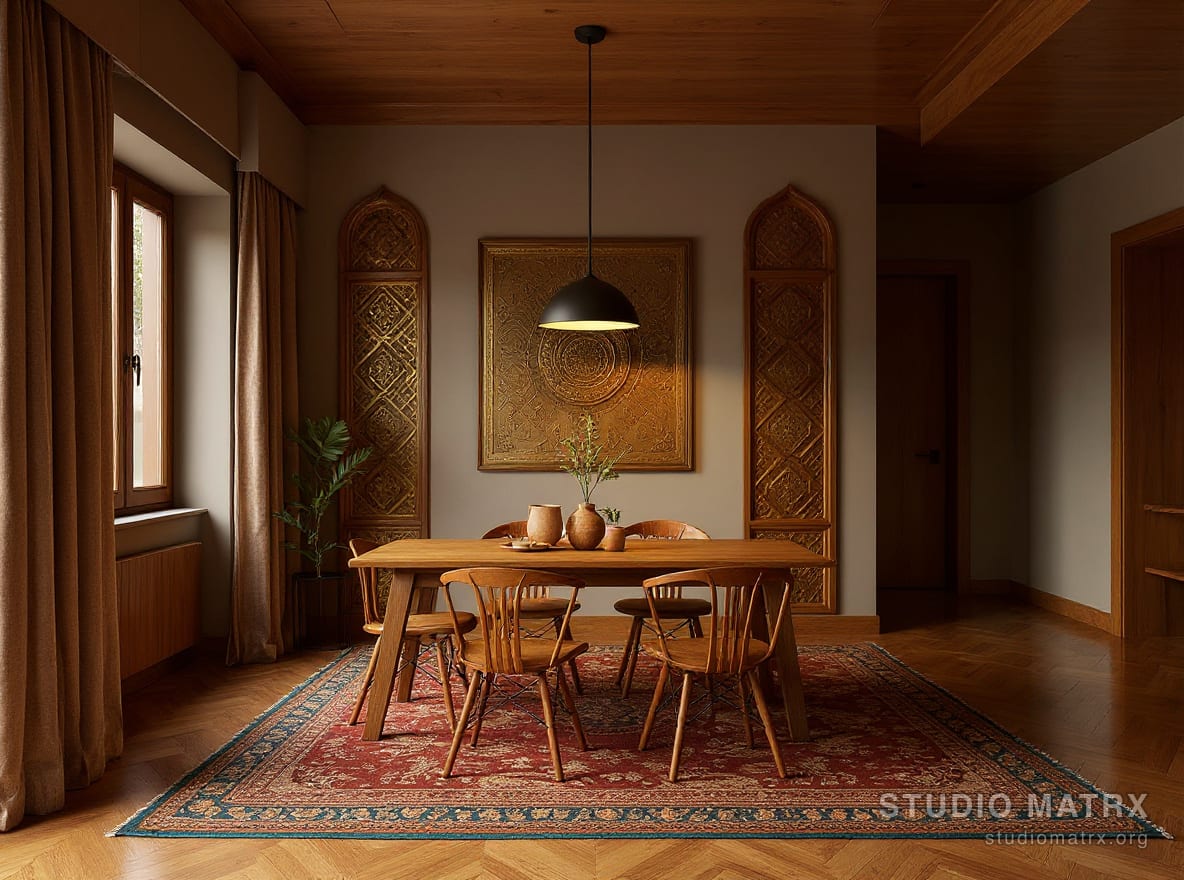
A solid teak dining table is the natural anchor here — clean lines, honest grain, no heavy carving. Pair it with modern chairs (upholstered in handloom or simple cane-back) and a single brass or brass-and-rattan pendant centred above. A jaali screen separating dining from living or kitchen reinforces the open-plan flow while marking the zone. A flat-weave runner and a terracotta or brass centrepiece complete the look without crowding the table.
Pooja
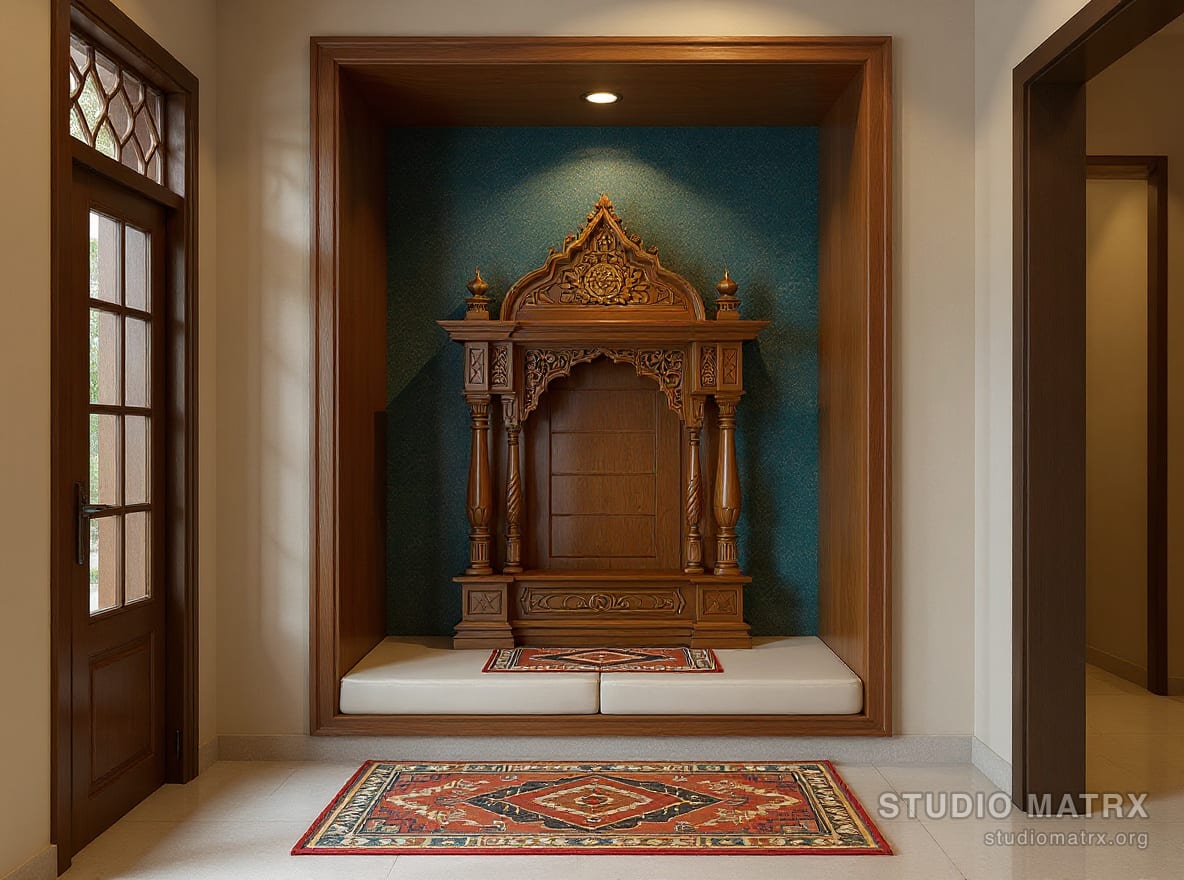
The pooja space is where Indo-Contemporary feels most natural, because the jaali is both functional and devotional. A carved teak jaali enclosure or sliding screen gives the space privacy and sacred separation while staying open to light and air. Keep the mandir itself in clean teak with brushed-brass fittings and a warm hidden light; let the jaali pattern be the ornament. Sand walls and a small terracotta or brass lamp keep it serene rather than ornate.
Budget — What It Costs in India
Indicative styling budgets for furnishing and accenting a 2–3 BHK in this look (excluding civil/structural work and full modular kitchens). Costs vary widely by city, materials and whether you buy bespoke or off-the-shelf.
| Tier | Approach | Indicative range (2–3 BHK) |
|---|---|---|
| Entry | Modern base furniture you may already own; add jaali-look panels, handloom cushions, a dhurrie, brass-look accents and a few teak pieces | ₹1.5 – 4 lakh |
| Mid | A real teak console/dining table, a custom jaali partition, genuine brushed-brass fittings, designer textiles, one or two statement pieces | ₹5 – 12 lakh |
| Premium | Bespoke carved teak joinery, custom stone/teak jaali screens, premium brass hardware throughout, high-end designer furniture and rugs, designer-led styling | ₹15 lakh and above |
These are styling/furnishing ranges, not turnkey renovation figures. Always take site-specific quotes.
Where to Source in India
A mix of established retailers and local artisans gives the most authentic result.
- Fabindia — handloom textiles, cushions, throws and affordable accent furniture.
- Good Earth — premium textiles, tableware and decor with a refined Indian sensibility.
- Gulmohar Lane — contemporary furniture with an Indian soul; sofas, beds and consoles.
- Phantom Hands — modern Indian furniture, including beautifully made cane and teak pieces.
- Jaipur Rugs — hand-knotted rugs and flat-weave dhurries direct from weaving communities.
- Sarita Handa — high-end textiles, upholstery and home furnishings.
- Local jaali and brass artisans — for custom screens and fittings, source from craft clusters (Saharanpur/Jodhpur for wood, Moradabad for brass) or a trusted local fabricator for laser-cut work.
- Teak carpenters — a good local carpenter working with seasoned teak is essential for bespoke joinery, headboards and consoles.
Buy your hero pieces (the jaali, the teak console, the rug) from makers who specialise in them, and fill in the rest with reliable retailers.
Ten Common Mistakes
1. Overdoing the motifs. Paisley cushions, a paisley rug, paisley wallpaper and paisley crockery is one paisley too many. Pick one pattern moment per room.
2. The theme-park ethnic room. Cramming every Indian element you own into one space turns soulful into kitsch. Edit hard.
3. Mismatched woods. Three different wood tones — light oak floor, teak table, dark walnut shelf — fight each other. Anchor on one warm wood tone.
4. Too much brass. Brass taps, brass legs, brass frames, brass lamps and brass everything reads gaudy. Brass is a seasoning, not the main dish.
5. High-shine brass. Mirror-polished gold instantly looks dated and bling. Choose brushed or antique finishes for a contemporary feel.
6. Skipping the modern shell. Adding Indian accents to an already-busy, over-furnished room just compounds the clutter. The shell must be calm first.
7. Fake "ethnic-look" mass furniture. Machine-pressed "carved" panels and printed-on jaali patterns look cheap beside real craft. One genuine piece beats five imitations.
8. No negative space. Filling every wall and surface kills the modern half of the equation. Leave room to breathe.
9. Colour overload. Teal and gold and magenta and emerald all at once becomes a traditional scheme by accident. Hold to one or two accents.
10. Forgetting maintenance. Untreated teak in a wet bathroom or unlacquered brass that tarnishes fast leads to regret. Specify the right finishes for each room.
FAQ
What is Indo-Contemporary style?
Indo-Contemporary (also called Modern Indian Fusion) is an interior style that combines a clean, modern shell — neutral walls, restrained furniture, open space — with a curated selection of Indian craft elements such as jaali screens, brushed brass, teak and handloom textiles. The result feels modern and uncluttered while staying warm and distinctly Indian.
Indo-Contemporary vs traditional Indian — what's the difference?
Traditional Indian interiors are maximal: layered ornament, rich jewel colours, heavy carving and pattern on most surfaces. Indo-Contemporary is the edited version — it keeps a minimal modern base and adds only a few signature Indian accents, so the room reads calm and current rather than ornate.
How do I add Indian elements to a modern home?
Start small and confident. Pick one signature gesture per room — a jaali partition, a teak console, a striking dhurrie — and add brushed-brass fittings and handloom cushions for warmth. Keep your walls and large furniture neutral and modern, and resist the urge to add more than two or three Indian pieces per space.
Is jaali still in style in 2026?
Yes. The jaali remains the defining Indo-Contemporary element in 2026, valued for the way it divides space and filters light while signalling Indian craft. Contemporary versions — laser-cut metal, crisp geometric teak, slim stone screens — keep it feeling current rather than dated.
Does Indo-Contemporary work in small apartments?
It works especially well in compact homes. The modern, uncluttered base maximises a sense of space, a jaali divides open-plan rooms without blocking light, and warm wood and brass accents stop a small flat from feeling cold or generic. The trick is restraint — fewer, better Indian pieces.
Indo-Contemporary endures because it resolves a real tension in urban Indian life: the wish to live in a clean, modern, easy-to-keep home without letting go of the warmth, craft and identity that make a house feel Indian. Build the quiet shell, add the few things you truly love, and the style takes care of the rest. To go further, browse curated Moodboards, compare looks across our Interior Styles guides, or let DesignAI restyle your own rooms in this aesthetic.
Last verified: June 2026 · Next verify: June 2027.
Export this guide
Related Guides — Deep-dive reading
Earthy Interior Palette — A 2026 Style Guide for Indian Homes
Rooted · Regional · Biophilic · Indian craft-anchored
Design StylesBohemian Interiors — A 2026 Eclectic Style Guide for Indian Homes
Collected, layered, alive · Rust and jewel tones · Curated eclecticism, never clutter
Design StylesTraditional Indian Interiors — A 2026 Style Guide for Homes
Living heritage, not a museum · Carved wood, brass, jewel tones · The pooja room as heart
Design StylesRelated Tools — Try Free
Full-Room BOQ — Living, Bedroom, Kitchen, Bath
Room-wise BOQ across living, bedrooms, kitchen, utility, and bathrooms with line-item pricing.
Full-Room BOQApartment Furniture Size Chart
Standard furniture dimensions for Indian apartments — sofas, beds, tables, dining, storage.
Reference ChartApartment vs Villa Interior Planning Guide
Compare ceiling height, structural flexibility, lighting, storage, and services between apartments and villas.
Planning Guide