

The Construction Agreement With Your Contractor: A Homeowner's Guide (India, 2026)
What a good written contractor agreement should contain so you are protected: scope, price, stage-linked payment milestones, retention, timeline, specifications and the clauses that settle a dispute before it starts.
The moment you hand a contractor an advance, the balance of power quietly shifts. A good written agreement is how you keep it even: it fixes what will be built, for how much, paid when, to what standard, and what happens when something goes wrong. This guide explains, in plain language, what that agreement should contain so a homeowner is genuinely protected, and where the numbers are only indicative.
Read this as a guide, not as legal advice. Studio Matrx explains what a sound contractor agreement covers so you know what to insist on. The binding wording of your contract must be drafted or vetted by a lawyer, and the technical calls belong to your architect or engineer. Every payment percentage, retention figure and defects period below is indicative and varies with your city, project scale and the professional you engage. Do not copy a template off the internet and sign it: have a qualified advocate adapt it to your project.
Why the agreement matters more than the handshake
Most home-building disputes in India are not caused by dishonest people. They are caused by things that were never written down: an assumption about a brand of tile, a "we will adjust it later" on an extra room, a payment that ran ahead of the actual work. When memories differ, the party with nothing in writing loses.
So the first rule is the simplest, and the hardest to follow with a contractor you like and trust: put everything in writing, and never rely on a verbal deal. A friendly relationship is not a substitute for a clear document; the document is what protects the friendship when money is tight and the schedule slips.
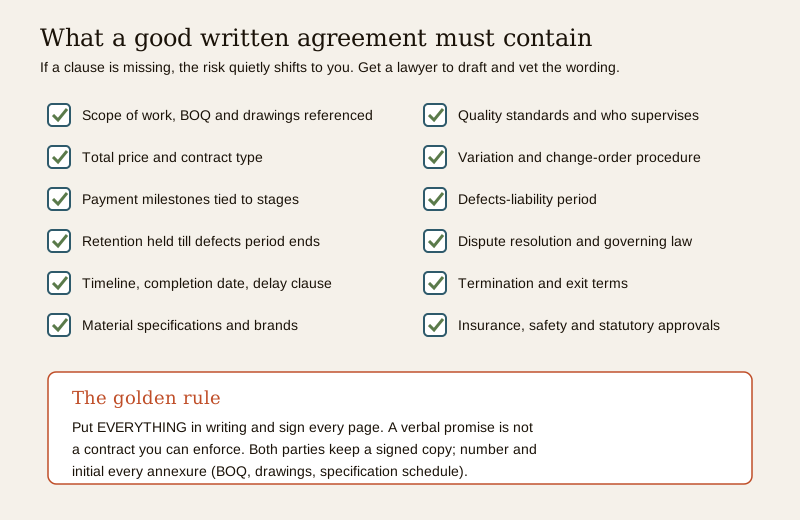
Scope of work, drawings and the BOQ
The agreement must say precisely what is being built. In practice this is done by reference: the contract names, and physically attaches as annexures, the approved drawings and the bill of quantities (BOQ). The BOQ is the itemised list of every element and quantity that makes up the job; if you are new to it, read what a BOQ is and how to read one first.
Two things protect you here. First, list what is included and, just as important, what is excluded (compound wall, water tank, external development, statutory deposits are common exclusions that surface later as "extras"). Second, initial and date every page of the drawings and BOQ so nobody can swap a sheet later. If the scope is written loosely, every gap becomes a paid variation.
Total price and the type of contract
The agreement must state the total contract value and, crucially, how that price is arrived at, because the contract type decides who carries the risk of quantities and rate changes. The three common structures are labour-only, item-rate (measured), and turnkey (lump-sum) - compared in detail in labour contract vs item-rate vs turnkey. Whichever you choose, the price clause should make clear whether GST is included, whether rates are fixed or subject to escalation, and what the rate is for any item measured later. Cross-check the figure against a real quotation using our guide to reading a construction quotation and a sanity-check with the house construction cost calculator.
Payment milestones: pay for work done, not work promised
This is where homeowners lose the most money. The single principle is: never let payments run ahead of physical progress on site. If you have paid 60 per cent and only 40 per cent of the work is standing, the contractor now has little incentive to finish, and every leverage has moved to them.
The defence is a milestone schedule that ties each release to a completed, inspected stage. The table below is an indicative pattern for a house build; your architect or PMC should adapt the stages and percentages to your project, and the advance in particular should be kept modest.
| Stage / milestone | Trigger for release | Indicative share of contract |
|---|---|---|
| Mobilisation advance | Signing plus site setup, materials ordered | About 10 per cent |
| Foundation and plinth | Footing, plinth beam and back-filling done, inspected | About 20 per cent |
| Superstructure | Columns, slabs, walls and roof cast up to terrace | About 25 per cent |
| Plaster, services and finishes | Plastering, electrical and plumbing rough-in, flooring | About 25 per cent |
| Snag-free handover | Punch list cleared, keys and completion documents given | About 15 per cent |
| Retention (see below) | Released after the defects-liability period | About 5 per cent held back |
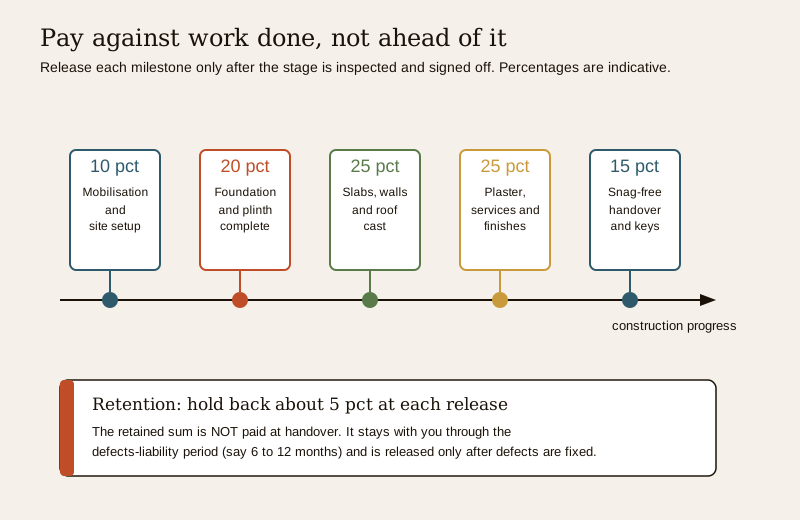
Note that the percentages sum to a whole with the retention carved out of the releases, not added on top. Insist that each release requires a joint inspection and a signed certificate that the stage is complete - not merely that time has passed.
Retention: the money that guarantees the finish
Retention (also called retainage) is a small slice - often around 5 per cent - held back from each payment and not paid at handover. It stays with you through the defects-liability period and is released only after any defects that appear are put right. This single clause is your strongest lever for getting snags fixed: a contractor who has been paid in full has moved on; a contractor still owed retention comes back. Spell out the retention percentage, when it is released, and that it is forfeited towards rectification if the contractor fails to attend to defects.
Timeline, completion date and delay clauses
The agreement should carry a clear start date and a target completion date, ideally with a short milestone programme so slippage is visible early rather than at the end. Where possible, include a gentle liquidated-damages (delay) clause - a pre-agreed, capped amount per week of unjustified delay - together with a fair list of grounds for extension of time (your own delays in decisions or payments, force majeure, exceptional weather). Delay clauses are only enforceable if they are reasonable and mutual, which is one more reason to have a lawyer set the number; a penalty that is punitive can be struck down.
Material specifications, quality and supervision
"Good quality tiles" is not a specification; "brand X, size 600 by 600, first quality, shade to be approved" is. The agreement should attach a specification schedule naming materials, brands or approved equivalents, and grades, so there is no ambiguity about what "as per sample" means. It should also state the quality standard the work must meet and who supervises - your architect, a project management consultant, or you. If you are doing the oversight yourself, read managing your contractor and site supervision before you start, and agree an approval process for samples and hidden work (reinforcement, waterproofing) that must be inspected before it is covered up.
Variations and change orders
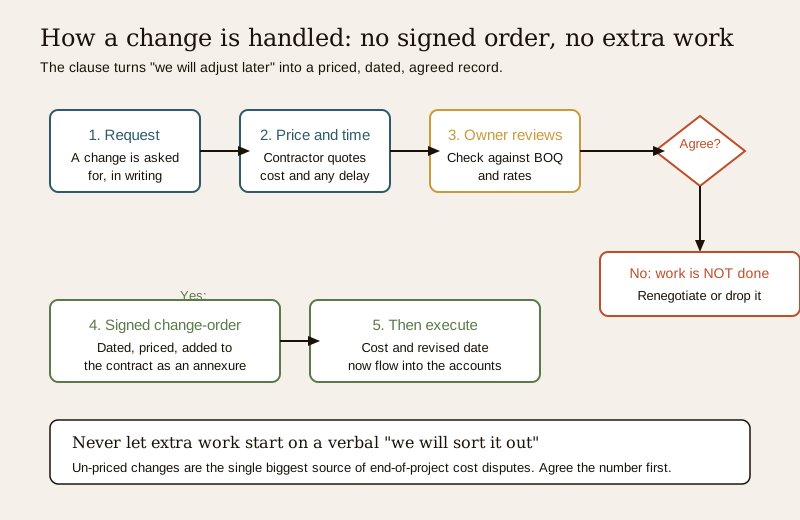
Almost every project changes as it goes. The danger is not change itself but un-priced change. The agreement should set out a simple procedure: any variation is requested in writing, the contractor quotes the cost and any time impact, you review it against the BOQ rates, and only a signed, dated change order authorises the work. No signed order, no extra work, and no surprise bill at the end.
Defects-liability, disputes and termination
Three clauses handle the end of the relationship, whether it ends well or badly.
- Defects-liability period. A defined window after handover (often 6 to 12 months) during which the contractor must fix defects at their own cost. This is the clause the retention money backs.
- Dispute resolution. How disagreements are settled - typically negotiation, then mediation or arbitration, with the seat, language and governing law named. A clear escalation path is far cheaper than litigation.
- Termination and exit. The grounds on which either party can end the contract, notice periods, how work-in-progress and materials on site are valued and paid for, and what happens to the retention. Knowing you can leave, cleanly, is itself a protection.
The clause-by-clause checklist below is your final read-through before signing.
| Clause | What it must nail down | Why it protects you |
|---|---|---|
| Scope of work | BOQ and drawings attached; inclusions and exclusions listed | Stops "that was extra" claims |
| Price and contract type | Total value, GST, escalation, rate basis | Fixes who carries quantity and rate risk |
| Payment milestones | Each release tied to an inspected stage | Payment never runs ahead of work |
| Retention | Percentage held, when released | Guarantees defects get fixed |
| Timeline | Start and completion dates, delay and extension terms | Makes slippage visible and costed |
| Specifications | Brands, grades, approved equivalents | Prevents downgrading of materials |
| Supervision and quality | Who inspects, standard to meet, hidden-work sign-off | Quality is checked, not assumed |
| Variations | Written, priced, signed change orders only | No un-priced extras at the end |
| Defects liability | Period and contractor's fix obligation | Post-handover problems are covered |
| Dispute resolution | Negotiation, mediation or arbitration, governing law | Cheaper, faster settlement |
| Termination | Grounds, notice, valuation of work done | A clean, fair exit is possible |
| Insurance and statutory | Site insurance, safety, who obtains approvals | Liability does not fall on you |
Before you engage anyone, run through the red flags when hiring a contractor and the wider steps in how to hire a building contractor. The best contract in the world cannot rescue a bad choice of contractor.
Key takeaways
- Put everything in writing and never rely on a verbal deal; a signed agreement protects the relationship, it does not distrust it.
- Have a lawyer draft or vet the binding wording, and your architect or engineer settle the technical clauses - every percentage here is indicative.
- Attach the BOQ, drawings and specification schedule as signed, dated annexures so scope cannot drift.
- Tie payment milestones to inspected stages so you never pay ahead of the work standing on site.
- Hold retention through the defects-liability period - it is your strongest lever for getting snags fixed.
- Insist that every variation is a signed, priced change order before any extra work begins.
- Make sure the agreement covers timeline, quality and supervision, disputes and termination before you sign.
References
- Council of Architecture (CoA) - guidance on architect engagement and standard conditions of engagement, coa.gov.in.
- Real Estate (Regulation and Development) Act, 2016 (RERA) - context on written agreements and buyer protections where applicable, in your State RERA portal.
- Studio Matrx guide: labour contract vs item-rate vs turnkey - choosing a contract type.
- Studio Matrx guide: how to read a construction quotation - checking the price before you contract.
- Studio Matrx guide: BOQ explained - the document your agreement should reference.
This guide is general educational information, not legal advice. All payment percentages, retention figures and defects periods are indicative and vary with your city, project scale and professional. Have a qualified advocate draft or vet your agreement and have your architect or engineer confirm the technical clauses before you sign.
Export this guide
Related Guides — Deep-dive reading
Understanding Construction Contracts & Retainage in India
A homeowner-protective guide to the contract and payment structure behind every interiors or build project — the contract types and when each fits, how to stage payments so your money trails the work, and the retention clause that quietly protects you more than any other.
Cost & MoneyContractor Red Flags: Warning Signs When Hiring in India (2026)
A homeowner's plain-language guide to the warning signs before you sign and while work is on site - and the practical safeguard for each. Even-handed: most contractors are honest, and these habits protect you against the minority who are not.
Hiring ProfessionalsManaging Your Contractor and Site Supervision in India (2026)
A homeowner's playbook for overseeing the build once work starts - the rhythm of site visits, what to check at each stage, and how to release payments only against verified, measured work.
Hiring ProfessionalsRelated Tools — Try Free
Interior Contract Clause Checklist
16 sections and 98 checkboxes covering scope, BOQ, milestones, penalties, warranty, and disputes.
Contract ChecklistContract Studio
AI generates professional architecture service agreements with milestones and scope.
ArchitectAIInterior Contract Template — India
Legally-refined contract template with payment milestones, timeline, warranty, and jurisdiction fields.
Contract Generator