

Commercial Safes and Vault Rooms in India (2026): Cash Safes, Time-Delay Locks and Rated Strongrooms
A professional planning guide to commercial safes and vault rooms for shops, jewellers, offices, hotels and banks — cash and deposit safes, drop slots, time-delay and dual-control locks, cash ratings that set the insured limit, and RCC vault rooms with rated doors that must be built and rated by specialists.
A commercial safe is not a bigger version of a home safe. It answers a business risk — takings on the counter at close, a jeweller's stock overnight, a hotel's daily float, cash in transit to the bank — and it is chosen against a cash rating that an insurer reads as the overnight cash limit it will cover. The controls change too: staff who cannot be trusted with a combination need a drop slot; a shop that fears a robbery under duress wants a time delay; a cash office that must stop a single insider wants dual control. And at the top of the range the safe becomes a room — an RCC strongroom with a rated vault door, which is a specialist structural and security build, not a purchase. This guide helps a professional specify, size and place commercial safes and vault rooms in India and, crucially, route the vault build and its rating to the right specialists.
It builds on the home-safe fundamentals — how a safe is anchored and where it goes are the same physics at any scale (see the complete guide to home safes in India and safe installation and anchoring), and the fire-rated versus burglary-rated distinction still governs whether you are protecting cash and jewellery from a thief or documents and media from a fire. What is new at commercial scale is the operating model: who may open the safe, when, and with whom watching.
Scope & how to read this. This is planning and specification guidance for professionals, not a build manual. It is strictly defensive: it helps you choose, size and coordinate — it never explains how to defeat a safe or vault. Cash ratings, insured limits, the vault structure and its door rating are set by the certificate, your insurer and the specialists you engage; verify every figure with them. Where a real number belongs, get a written quote and confirmation — this guide invents none.
Match the safe to the business risk
Start from the money and the threat, not the catalogue. A shop with an evening cash peak, a jeweller with high-value stock, a hotel front desk with a rolling float and a corporate cash office each have a different profile: how much is at risk, when, who handles it, and whether the main fear is opportunist theft, an inside job, a smash-and-grab or an armed robbery under duress. That profile drives four choices — the type of safe, its cash rating, its locking and control features, and how it integrates with the alarm and CCTV.
| Business | Typical risk | Safe type to consider | Control feature that fits |
|---|---|---|---|
| Retail shop | Evening cash build-up; staff deposits | Deposit / cash safe with drop slot | Drop slot so takings go in without opening |
| Jeweller | High-value stock overnight; robbery | Jewellers' safe or strongroom, high cash/valuables rating | Time delay plus dual control |
| Restaurant / hotel | Rolling float; many staff, shifts | Deposit safe, front-of-house drop | Drop slot; audit trail on openings |
| Corporate cash office | Insider risk; reconciliation | Cash safe or in-room safe | Dual control; time-window opening |
| Bank / large custody | Bulk cash and valuables | Vault room with rated door | Dual control, time lock, monitored |
The rule of thumb: put the least cash for the shortest time in the smallest rated container that suits, bank frequently, and let the safe's rating and controls carry the residual risk overnight. A safe is a delay device that buys time for a response — it is not a substitute for banking your takings.
Commercial safe types and the controls that define them
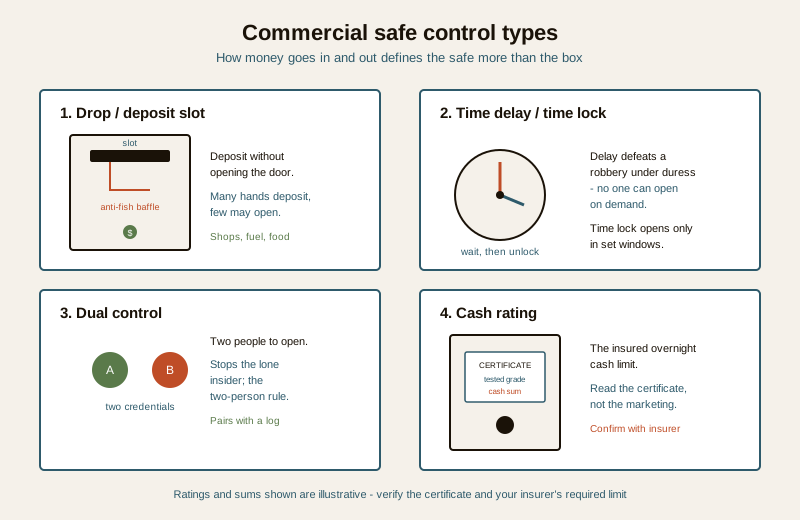
Commercial safes are distinguished less by their box and more by how you get money in and out. Four control ideas do most of the work.
Drop / deposit slots — deposit without opening
A deposit or "drop" safe has a slot, chute or rotary hopper that lets staff post cash into the body without ever opening the door. It removes the day's biggest weakness — a till operator holding the safe combination — and shrinks the cash on the counter as the evening builds. Deposits are one-way: the anti-fish baffle stops a deposited envelope being retrieved through the slot, and only a holder of the main lock (often the manager or the cash-collection service) opens the body. Drop safes suit shops, fuel stations, restaurants and any site where many hands make deposits but few should open.
Time-delay and time-lock safes — defeat robbery under duress
A time delay lock imposes a fixed wait (set by the owner) between entering the correct code and the safe unlocking. It is the single most effective control against an armed robbery under duress: a robber cannot force a staff member to open the safe on demand because nobody can, and the delay both deters the attempt and buys time for a response. A time lock is different — it only permits opening inside pre-set windows (for example, business hours), so the safe is mechanically shut at night regardless of who has the code. Signage that a time delay is fitted is itself a deterrent. These features suit any cash-handling site with a robbery exposure, and are standard in banking custody.
Dual control — two people to open
Dual control requires two independent credentials — two keys, two combinations, or a key plus a code held by different people — so no single person can open the safe alone. It directly targets insider risk and enforces the "two-person rule" for cash reconciliation and vault access. Combined with a time delay and an opening log, it gives a clean audit trail: who opened, with whom, and when.
Cash ratings — the number your insurer reads
A commercial safe carries a cash rating (and often a separate, higher valuables rating) expressed as a dependent monetary figure. This is the amount an insurer will typically cover as overnight cash in that safe — it is an insurance limit as much as an engineering grade. Ratings come from recognised burglary-resistance test systems (for example the UL "RSC" family and the European EN 1143-1 grades used across the industry), and the certificate on the safe states the tested grade and the cash/valuables sums the manufacturer and certifier attach to it. The single most important commercial step is to confirm the required rating with your insurer before you buy: the insurer sets the cash limit it will cover for your location and trade, and the safe must meet or exceed it. Do not rely on any figure quoted here or in marketing — read the certificate and get the insurer's requirement in writing.
Jewellers' safes and strongrooms
Jewellery concentrates very high value in a small volume, so jewellers sit at the top of the safe range and often cross into strongroom territory. A jewellers' safe carries a high burglary and valuables rating, heavy relocking and anti-drill protection, and usually a time delay and dual control as standard. Where stock value exceeds what any single safe's valuables rating will cover, the answer is a strongroom — a purpose-built rated enclosure — rather than several safes. At that point two things become non-negotiable: the insurer's survey drives the specification (rating, alarm grade, response), and the fit-out (anchoring, floor loading, the approach the CCTV must cover) is a coordinated professional job. Treat the jeweller's insurer as a co-author of the spec, not an afterthought.
Vault rooms are a specialist build — route them correctly
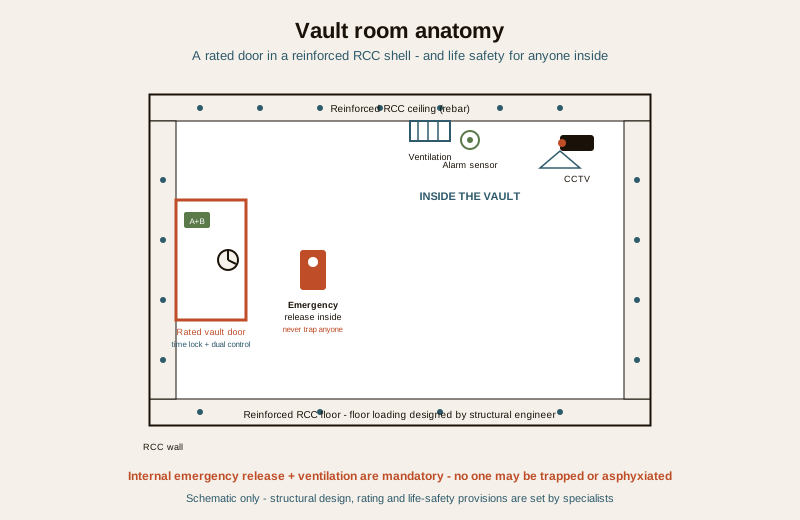
A vault room (strongroom) is a reinforced concrete enclosure — walls, floor and ceiling — closed by a rated vault door. It is the highest tier of physical custody and it is emphatically not a product you install; it is a building element you design, build, rate and certify with a team of specialists. Anyone specifying one must route the work correctly and resist the temptation to treat it like fitting a large safe.
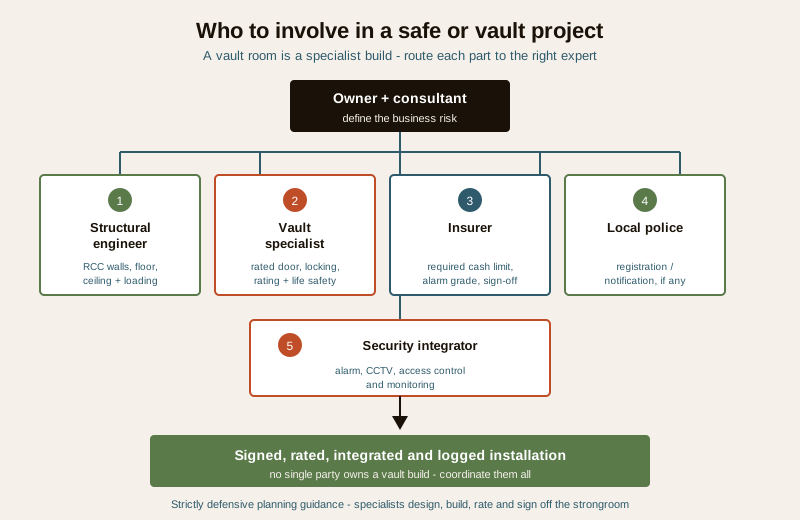
Who must be involved
- A structural engineer designs the reinforced RCC walls, floor and ceiling — the concrete grade, the reinforcement, the wall thickness and the floor loading the room and door impose on the building. This is a structural design problem with real load and buildability consequences; it is not something to eyeball.
- A vault specialist / safe manufacturer supplies and rates the vault door and frame, the locking (typically time lock plus dual control), the relocking devices and the door's certified resistance grade — and confirms how the door integrates with the RCC opening.
- The insurer surveys and sets the required rating, the alarm grade and the response arrangement; the sum insured is what the whole build must satisfy, and the insurer signs off the specification.
- The local police may have registration or notification requirements for cash and valuables custody at commercial scale; confirm what applies in your jurisdiction and comply.
- A security integrator ties the vault into the intrusion alarm, CCTV, access control and monitoring so the room is watched, alarmed and logged.
Life safety inside the vault — nobody may be trapped
A vault is designed to be extremely hard to open from outside, which makes the inside a life-safety concern the moment a person can be in it. Two features are mandatory and belong in the brief from day one:
- Emergency internal release / egress — an internal door release (and, where required, a secondary escape provision) so a person who is inside when the door closes can always get out. A vault must never be able to trap someone.
- Ventilation — air supply so a person inside is not asphyxiated, and to manage humidity in the Indian climate (a sealed RCC box will sweat and rust stock without it).
These are not optional extras; they are the difference between a strongroom and a hazard. They are specified by the vault specialist and, where fire and life safety are engaged, checked against the National Building Code (NBC = SP 7:2026) and the fire officer.
Integrate the safe or vault with the wider system
A rated container buys delay; the response is what converts delay into a caught or deterred offender. Integration is therefore part of the specification, not a later add-on.
- Intrusion alarm — the safe or vault is a protected zone with its own detection (seismic/vibration on the body or walls, a door contact, and a duress/hold-up signal linked to any time-delay bypass attempt). Grade the alarm to the insurer's requirement.
- CCTV — cameras cover the safe, the vault approach and the deposit point, with the field of view set so the opening and the faces of those opening are recorded. Retention and privacy are governed by the Digital Personal Data Protection Act, 2023 — footage identifying people is personal data.
- Access control — the door to the cash office or vault lobby is access-controlled and logged, so entry to the approach is itself a record.
- Monitoring — an alarm without a monitored response is a bell nobody answers. Confirm who receives the signal, how fast they respond, and how a hold-up/duress alarm is escalated.
- Guards — where manned guarding is part of the response, the agency must be PSARA-licensed (Private Security Agencies Regulation Act, 2005) and the guards trained and verified.
Operating controls turn hardware into security
The best safe is undone by a sloppy routine. Operating discipline is where a specifier hands the owner a working security posture, and it belongs in the handover.
- Dual custody — enforce the two-person rule for opening a cash office safe or vault; no solo access.
- Time windows — open only inside agreed windows; a time lock enforces this mechanically.
- Least cash, banked often — keep the overnight balance under the insured cash limit and bank frequently; the rating protects the residual, not the whole day's turnover.
- Logs — record every opening: who, with whom, when and why. A log plus CCTV plus access control gives a clean reconstruction.
- Credentials hygiene — change combinations when staff leave, never share codes, and hold spare keys off-site under control.
- Lockout recovery — if you are locked out, contact the manufacturer or a licensed safe technician with proof of ownership. Never attempt to drill, force or bypass the safe yourself, and never brief anyone to — that is both dangerous and outside the law.
What to specify — a checklist
| Item to specify | Decide / confirm | Who confirms it |
|---|---|---|
| Business risk profile | Cash peak, timing, threat (theft/insider/robbery) | Owner + consultant |
| Safe type | Deposit/drop, cash, jewellers', or vault room | Consultant |
| Cash / valuables rating | Required insured limit for site and trade | Insurer (in writing) |
| Control features | Drop slot, time delay, time lock, dual control | Consultant + owner |
| Anchoring & floor loading | Fixing method, floor capacity | Structural engineer / installer |
| Vault structure (if any) | RCC walls/floor/ceiling design | Structural engineer |
| Vault door & rating | Certified door, locking, relocking | Vault specialist |
| Life safety | Internal emergency release, ventilation | Vault specialist + fire officer |
| Integration | Alarm grade, CCTV, access control, monitoring | Security integrator |
| Guarding (if any) | PSARA-licensed agency, trained guards | Owner + agency |
| Operating model | Dual custody, time windows, logs | Owner (in the handover) |
How it connects
Commercial custody scales up the same fundamentals covered for homes. The physics of anchoring and placement are shared with safe installation and anchoring; the choice between protecting valuables from a thief and protecting documents or media from a fire is the fire-rated versus burglary-rated decision at commercial scale; and the buyer's fundamentals — ratings, siting and honest expectations — are set out in the complete guide to home safes in India. For the wider set of guides on choosing, siting and coordinating safes and strongrooms, see the Safes & Vaults library.
Key takeaways
- Choose a commercial safe from the business risk — cash peak, timing, threat — not from a catalogue; the type, rating and controls all follow from it.
- Drop slots deposit without opening, time delays defeat robbery under duress, dual control stops the lone insider, and the cash rating is the insured overnight limit — confirm the rating with your insurer in writing before you buy.
- Jewellers sit at the top of the range and often cross into strongroom territory, with the insurer's survey driving the spec.
- A vault room is a specialist build, not a purchase: a structural engineer for the RCC shell, a vault specialist for the rated door, the insurer for the limit and sign-off, the police for any registration, and an integrator for alarm and CCTV.
- Internal emergency release and ventilation are mandatory — a vault must never trap or asphyxiate anyone inside.
- Integrate with alarm, CCTV, access control and monitoring, and hand the owner an operating model — dual custody, time windows, least cash banked often, and logs.
- If locked out, call the manufacturer or a licensed safe technician with proof of ownership; never attempt to defeat a safe.
References
- Underwriters Laboratories (UL) — burglary-resistant safe and RSC test classifications; read the certificate on the unit for the tested grade and any cash/valuables sums attached to it.
- EN 1143-1 (secure storage units — burglary resistance grades) — the European cash-rating grade system widely referenced by manufacturers and insurers; verify the certified grade on the certificate, not from marketing.
- Your insurer / their surveyor — the authoritative source for the required cash and valuables rating, alarm grade and response for your site and trade; get the requirement and any sign-off in writing.
- Safe and vault manufacturers' technical guidance — for the door rating, locking (time delay, time lock, dual control), relocking devices and the vault door's interface with an RCC shell.
- Private Security Agencies (Regulation) Act, 2005 (PSARA) — where manned guarding forms part of the response, the agency must be licensed and the guards trained and verified.
- National Building Code of India (NBC), current edition (SP 7:2026) — for anything touching fire and life safety in a vault room, including egress and ventilation; verify with the code and the fire officer.
- Digital Personal Data Protection Act, 2023 — CCTV footage identifying people is personal data; set retention, access and signage accordingly. Confirm local police registration or notification requirements for commercial cash and valuables custody in your jurisdiction.
This is indicative, educational planning guidance, not a build manual, legal advice or an engineering specification. Cash ratings, insured limits, the vault structure and its door rating are set by the certificate, your insurer and the specialists you engage — verify the value at risk, the certificate and your insurer, and have a structural engineer, a vault specialist and a security integrator design, build and sign off any strongroom. Strictly defensive: this guide never explains how to defeat a safe or vault.
Export this guide
Related Guides — Deep-dive reading
Security Fire Alarm Integration in India (2026): Smart Alerts, Certified Systems, Fail-Safe Egress
The most important sentence a smart-home designer can say about fire is also the least profitable: a smart-home smoke sensor or fire notification is a helpful add-on, not a substitute for a certified fire-alarm system. This guide draws the line hard — life-safety detection and alarm belongs to the NBC-governed certified system — and then covers the genuinely useful, correctly-scoped automations the smart layer can add on a verified fire signal: unlock for egress, open the gate for the fire tender, light the escape path, stop the away-scene, and notify everyone loudly. All of it fail-safe. None of it in the way of the system that actually saves lives.
SecurityDoor and Window Security Assessment for Indian Homes
Go opening by opening and rate the hardware itself — leaf and frame, hinges and locks, strike plates, grilles, glazing and latches — so you can grade each door and window's real resistance while never trapping anyone behind it.
SecurityHow to Choose a Fire Alarm in India (2026): A Life-Safety, Code-Governed Buying Guide
A fire alarm is not shopped on price or looks. It is specified to the National Building Code and the local fire officer, built from listed and certified parts, and installed by a licensed contractor. This guide shows a homeowner, manager or architect how to choose and verify one correctly.
SecurityRelated Tools — Try Free
Cross-Ventilation Analyzer
Estimate airflow and air changes per hour (ACH) from room size, window areas, layout, and local wind — with NBC 2016 Part 8 compliance check.
Ventilation CalculatorEmergency-Egress Checker
A life-safety self-check that access-controlled doors on escape routes still let people out in an emergency.
Egress CheckCCTV Placement Compliance Checker
A quick DPDP-grounded privacy and safety self-check for where a camera is pointed — flags the items to fix.
Compliance