
Childrens Privacy and CCTV in India (2026): Protecting the Youngest
Cameras keep a child safe, but a child also has a growing right to privacy and dignity. Here is how to use home and community CCTV around children lawfully, gently and only as far as their safety genuinely needs.
A camera by the front door that sees your toddler wander toward the stairs is a genuinely loving thing. A camera trained on a ten-year-old's bedroom, or a nursery feed that ends up on a family WhatsApp group, is something else entirely. Childrens privacy and cctv live in the same house, and the difference between protection and intrusion is almost always in the details — where the lens points, who can see the footage, and whether it quietly outlives the reason you installed it.
Children are more vulnerable and less able to speak up for themselves, so the care we owe them is higher, not lower. A child also has a developing right to privacy that grows as they do: what is right for an infant is wrong for a teenager. The goal is simple — let cameras do the narrow job of keeping a child safe, and nothing more.
Scope & how to read this. This is practical, dignity-first guidance grounded in the spirit of the Digital Personal Data Protection Act, 2023 (DPDP Act), not legal advice. India treats children's personal data with extra protection, and this guide reflects that ethic. For anything with legal weight — a school policy, a custody matter, a data breach, a dispute — take professional legal advice, and always choose the least-intrusive option that still keeps the child safe.
Why children need extra protection
Footage of a child is unusually sensitive personal data. It can reveal where they live, the route they walk to school, when the house is empty, and who cares for them. In the wrong hands it enables stalking, grooming, identity misuse or embarrassment a child cannot consent to and cannot undo — and a face captured today can be re-shared or profiled for years.
The DPDP Act singles out children's data for stronger safeguards. In plain terms, the ethic is: collect as little as possible, keep it as briefly as possible, and never process a child's data in ways that could harm them or track and profile them. At home, the ordinary camera principles — a clear lawful purpose, notice, minimisation, short retention, tight security and accountability — apply with an extra thumb on the scale toward the child's protection.
There is also the child's own dignity. Privacy is not something a person earns at eighteen; it develops through childhood, and a young person who grows up watched everywhere learns that being watched is normal. The broader principles here sit inside the section privacy hub.
At home: baby monitors, nanny cams and growing up
Most home cameras near children are well-intentioned. The care is in keeping them proportionate as the child grows.
Baby monitors and the infant years
A baby monitor watching a sleeping infant is a legitimate safety tool. The child cannot yet call out, and a parent's job is to hear them. Keep it sensible:
- Secure the feed. A monitor is a camera on your network. Change the default password, keep firmware updated, and prefer a device that keeps video on your own network rather than an unknown cloud. An unsecured baby cam is the classic privacy horror story, and it is entirely avoidable.
- Point it at the cot, not the room. The narrow view you need is the sleeping baby, not the whole nursery and everyone who enters it.
- Turn it off when it is not needed. A monitor is for nap-time and night, not a permanent record of the room.
When a nanny cam is care, and when it becomes surveillance
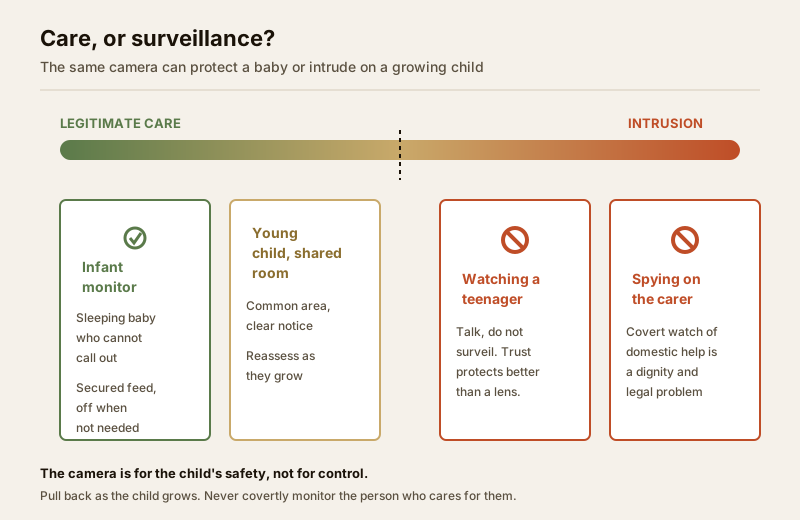
A camera in a common area of the home so a parent can check on a very young child is defensible. The moment to pause is when that same camera becomes a way to watch an older child continuously, or to monitor the adult who cares for them.
- The camera is for the child's safety, not to spy on the carer. If domestic help minds your child, a camera in a shared living area under clear notice is very different from a hidden camera placed to catch them out. Covert recording of a worker is a dignity and legal problem, not a parenting tool. The full duty you owe the person who works in your home is covered in the domestic worker privacy guide — read it alongside this one.
- Never in private spaces. A carer's room, a bathroom, or anywhere anyone changes clothes is off-limits, full stop.
- As the child grows, pull back. What is reasonable for a toddler is intrusive for a nine-year-old and unacceptable for a teenager.
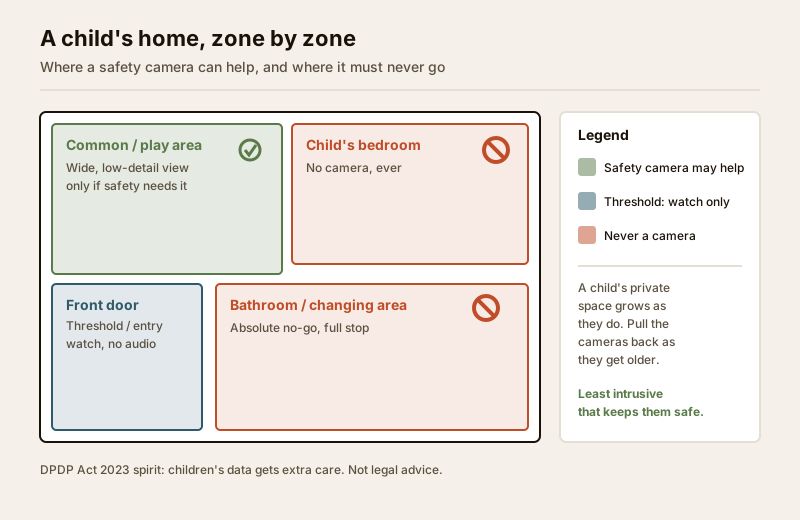
No cameras in a child's bedroom or bathroom
This is the firm line. A child's bedroom, bathroom, or changing area should never have a camera — no exceptions as they grow into the age where those are their private spaces. A bedroom is where a child is meant to feel unobserved; a camera there teaches the opposite. The section where not to install CCTV sets out these no-go zones for the whole household.
Respecting a teenager's privacy
Adolescents are forming their independence, and privacy is part of that. A teenager who discovers they are being recorded at home usually experiences it as a breach of trust. Talk to them; do not surveil them. If there is a genuine safety worry, address it as a family, openly, not through a hidden lens. Trust protects a young person far better than a camera does.
Keeping children's footage secure — and off social media
Once footage exists, protecting it is its own duty.
- Lock it down. Strong unique passwords, updated firmware, encrypted apps, and the fewest people with access. Treat a child's footage as the sensitive data it is.
- Keep it briefly. Storage limitation is a DPDP principle: do not keep footage of a child forever. Set a short retention window and let it auto-delete. Keep a clip only if there is a specific, current reason.
- Never post it publicly. A cute clip of your child shared to a family group can be forwarded, screenshotted and scattered beyond your control. A child cannot meaningfully consent to being a public figure. Sharing another family's child from your camera is worse still. When in doubt, do not share.
A child's dignity and rights. Under the DPDP ethic, a child's personal data deserves extra care, and a parent or guardian acts as the custodian of that data — a role of protection, not ownership. As children grow, involve them: explain what a camera is for, listen when they object, and let their reasonable wish for privacy shape what you do. Custodianship means guarding the child's interests, including their privacy, not overriding them.
In the community: RWA, playground and school gate
Beyond the front door, children pass through shared spaces watched by cameras nobody child-proofed. This is where minimisation matters most, because no single parent controls the system.
| Situation | Do this | Avoid this |
|---|---|---|
| Society playground / play area | Wide, low-detail coverage only for genuine safety; short retention | Close-up tracking of individual children; long storage |
| School gate / drop-off | Minimal footage, tight access, clear purpose | Publishing gate footage; sharing clips on parent groups |
| RWA facial recognition | Keep AI analytics off for children | Face-matching or profiling children at all |
| Children's images online | Keep them off notice boards, websites and WhatsApp | Forwarding or posting identifiable children without consent |
| Retention of children's footage | Shortest window that meets the safety need | Indefinite archives of children coming and going |
A few points deserve emphasis:
- No facial recognition or AI profiling of children. Face recognition is error-prone and, on children, simply should not be deployed. Building a face database of the children in a society is a serious over-reach with no place in ordinary residential security — the reasons are set out in the facial recognition and privacy guide. Switch such features off.
- Do not publish or forward children's images. RWA cameras exist for safety, not for a WhatsApp channel of who is at the gate. A clip of a child on a group chat can travel anywhere. Shared-community camera duties, including these, are covered in the CCTV in apartments guide.
- Minimise on play areas. A camera overlooking a playground for genuine safety is one thing; one that zooms and follows individual children is another. Keep the view wide and the detail low, and keep footage briefly.
Parental consent and a child's own voice
Under the DPDP ethic, a child's data is generally handled with a parent or guardian's involvement — the adult stands in as the protector of the child's interests. Two things follow that are easy to forget:
- Consent is not a licence to over-collect. Being the parent does not make constant surveillance appropriate. The consenting adult is meant to protect the child's privacy, including from over-broad monitoring at home or by a community system.
- A child's own dignity grows. The older the child, the more their own views should count. A teenager's wish not to be recorded at home is not defiance to be overridden; it is a reasonable claim on their own privacy.
If a school or RWA is collecting children's data — images, biometrics, attendance — parents are entitled to ask why, how long it is kept, who can see it, and to raise a grievance. Proportionate systems welcome those questions.
A proportionality test for any camera near children
Before a camera watches a child, run these four checks. If you cannot answer all four cleanly, reconsider.
1. Real purpose. Is this camera solving a genuine safety need for the child, or just a habit or convenience.
2. Least intrusive. Is this the narrowest view, the shortest retention and the fewest viewers that still meets the need. Would a wider angle, or no camera, work as well.
3. Right space. Is it out of every private zone — bedroom, bathroom, changing area — and does it respect an older child's growing privacy.
4. Protected data. Is the footage secured, briefly kept, never posted, and never fed to face-recognition or profiling.
Protecting a child's privacy — the checklist
- Default to less. Fewer cameras, narrower views, shorter retention around children.
- Keep private spaces camera-free — bedrooms, bathrooms, changing areas — and honour them more as the child grows.
- Secure every device — unique passwords, current firmware, tight access, encrypted apps.
- Set short auto-deletion for any footage that includes children.
- Talk to older children and teenagers; explain, listen, and respect a reasonable wish for privacy.
- Remember a carer is not the target — a child-safety camera under notice is not a tool to spy on domestic help.
- Ask your RWA and school how children's footage is used, stored and shared, and expect honest answers.
Never do this with children's footage
- Never place a camera in a child's bedroom, bathroom or changing area.
- Never post or forward identifiable images of any child — yours or another family's — to social media or group chats.
- Never run facial recognition or AI profiling on children at home or in the community.
- Never keep children's footage indefinitely, or let a nanny-cam quietly become continuous surveillance of an older child.
- Never use a child-safety camera to covertly monitor the domestic worker who cares for the child.
- Never override a teenager's reasonable privacy with a hidden camera instead of a conversation.
When to get legal or professional advice
For a camera scheme built around the child's own safety — safe rooms, supervision, emergency response — pair this privacy guide with the children's safety guide. And for anything with legal weight — a school or RWA that collects children's biometrics, a custody or family-law question, a suspected breach exposing a child's footage, or a dispute with a neighbour or society — take qualified legal advice. Treat everything here as a caring starting point, not a legal ruling. No section numbers, penalties or retention periods are invented in this guide, because those specifics belong with a professional who knows your facts.
Key takeaways
- Children get extra protection, not less. They are more vulnerable, and the DPDP ethic treats their data with special care — collect little, keep it briefly, never profile them.
- A baby monitor is care; a bedroom camera is not. Keep cameras out of every private space and honour a child's growing privacy as they age.
- The camera is for the child's safety, never to spy on a carer — covert monitoring of domestic help is a dignity and legal problem.
- Keep children's footage secure and off social media, and set it to auto-delete on a short window.
- In the community, minimise: wide low-detail coverage only, no facial recognition of children, and never forward their images.
- This is guidance, not legal advice — for schools, biometrics, custody or breaches, consult a qualified lawyer.
References
- Digital Personal Data Protection Act, 2023 — provides for stronger safeguards on children's personal data; process a child's data only for clear, protective purposes, with a guardian's involvement, minimisation and short retention. Verify the current text and rules before relying on it.
- Right to privacy (Constitution Article 21; K.S. Puttaswamy) — recognises privacy as a fundamental right at a general level, which extends to children and grows with them; seek qualified legal advice for any specific situation.
- Manufacturer and platform documentation — confirm how a baby monitor or camera secures its feed, where footage is stored, and how to disable facial recognition and set automatic deletion.
This is an educational, dignity-first overview, not legal advice. How you may lawfully use cameras around children depends on your exact facts — consult a qualified lawyer for anything with legal weight, and always choose the least-intrusive option that keeps the child safe.
Export this guide
Related Guides — Deep-dive reading
CCTV Remote Access in India (2026): Watch From Your Phone, Safely
How to view your own cameras from anywhere without leaving the front door open to the internet — change the defaults, use strong credentials and 2FA, keep firmware current, prefer the vendor's secure cloud relay or a VPN, segment the camera network, and treat footage as personal data.
SecurityDomestic Worker Privacy in India (2026): Security With Dignity
Maids, cooks, drivers, nannies and live-in help are people with rights, not permanent suspects to be watched. Use home cameras for real security, and never as a tool to monitor, control, shame or pressure the person who works in your home.
SecuritySecurity Privacy Assessment for Indian Homes
Getting the privacy side of home security right: camera placement ethics and limits, notice and consent, the extra caution audio demands, and treating footage as personal data you store, retain and delete responsibly under India's DPDP Act 2023 direction.
SecurityRelated Tools — Try Free
CCTV Camera Coverage & Count Calculator
Estimate how many CCTV cameras you need, the NVR channels, storage in TB for your retention period, and an indicative all-in cost with GST.
CCTV CalculatorApartment Video Door System Planner
Enter flats, entrances, floors and guard desk for a first-pass building intercom plan — door stations, indoor monitors, guard station, the right architecture and an indicative cost band.
Building PlannerCCTV Placement Compliance Checker
A quick DPDP-grounded privacy and safety self-check for where a camera is pointed — flags the items to fix.
Compliance