
Carpet Area vs Built-Up vs Super Built-Up Area — What You Actually Pay For
The three numbers that describe the same flat — and the loading factor that decides how much usable space your rupees really buy.
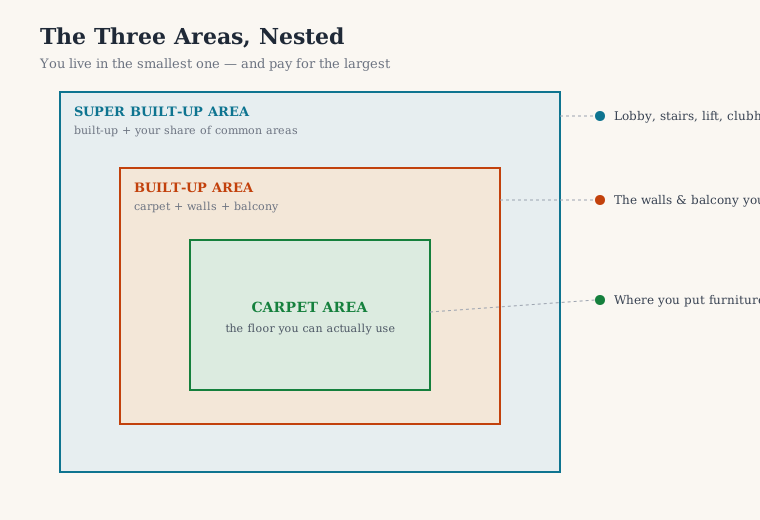
Three numbers describe the same flat, and they can differ by a third or more. The carpet area is the floor you can actually walk on and furnish. The built-up area adds the walls and the balcony. The super built-up area adds your share of the lobby, staircase, lift and clubhouse — and it is usually the number the brochure shouts. Understand the gap between them and you will never overpay for "1,300 sq ft" that lives like 1,000 again.
The three definitions, in plain words
Carpet area is the net usable floor area inside your flat — the area where you could, quite literally, lay a carpet. Under the Real Estate (Regulation and Development) Act, 2016 (RERA), it is the floor area within the inner walls of the apartment, including internal partition walls but excluding the external walls, the shaft, the balcony and any open terrace. This is the honest number.
Built-up area is the carpet area plus the thickness of the walls (internal and external) plus the balcony and any utility ledge. Walls and balconies typically add 10–15% over the carpet area, so a 1,000 sq ft carpet becomes roughly 1,100–1,150 sq ft built-up.
Super built-up area (also called "saleable area") is the built-up area plus a proportionate share of the building's common areas — the lobby, the staircase, the lift well, the corridors, the generator room, and amenities like the clubhouse, gym or pool. Because every flat shares these, the builder divides their total area across all flats and adds each flat's slice. This inflates the number by another 15–35% depending on how amenity-heavy the project is.
| Area type | What it includes | Typical size (for a 1,000 sq ft carpet flat) |
|---|---|---|
| Carpet area | Usable floor inside the flat | 1,000 sq ft |
| Built-up area | Carpet + walls + balcony | ~1,100–1,150 sq ft |
| Super built-up area | Built-up + share of common areas | ~1,250–1,350 sq ft |
What actually counts — a flat plan
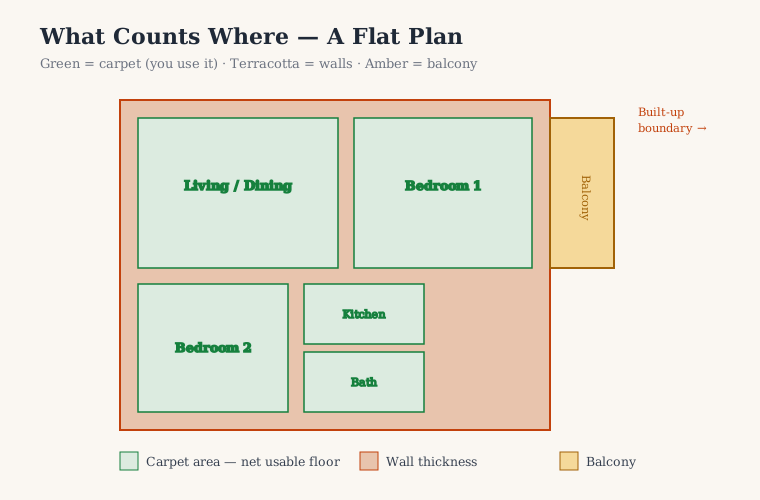
The green is yours to use; it is the carpet area. The terracotta band is the wall thickness, and the amber strip is the balcony — both are part of built-up area but you cannot furnish a wall. Nothing in this drawing is super built-up area; that share lives outside your front door, in spaces the whole building uses.
The loading factor — the number to ask for
The single most useful figure a buyer can demand is the loading factor (or "loading"): how much the super built-up area is inflated over the carpet area.
Loading factor = (Super built-up area − Carpet area) ÷ Carpet area
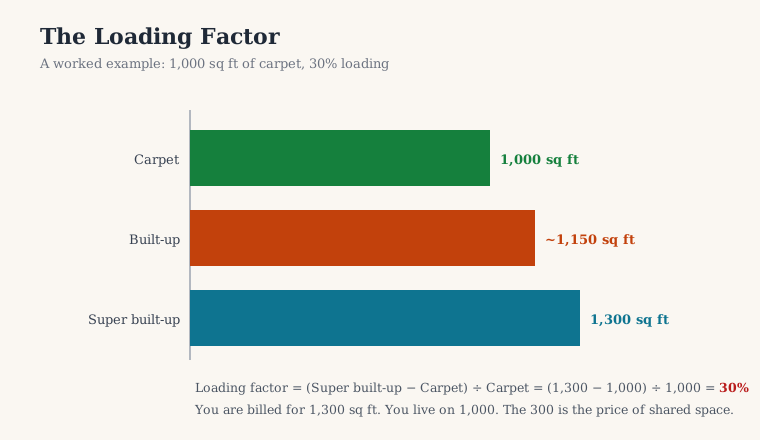
A loading of 25–30% is common in Indian cities. Amenity-light projects may be 15–20%; lavish gated communities with sprawling clubhouses can cross 40%. A lower loading means more of every rupee buys floor you actually use. Two flats quoted at the "same" 1,300 sq ft can hand you 1,080 sq ft of carpet (20% loading) or 930 sq ft (40% loading) — a difference of an entire bedroom.
| Loading factor | Carpet you get from 1,300 sq ft "saleable" | Verdict |
|---|---|---|
| 20% | ~1,083 sq ft | Efficient |
| 30% | ~1,000 sq ft | Typical |
| 40% | ~929 sq ft | Amenity-heavy / inefficient |
What RERA changed (and why it matters)
Before 2016, builders routinely advertised and priced on super built-up area, so the rate per square foot looked low while the usable space shrank. RERA now requires that flats be sold on the basis of carpet area — the carpet area must be disclosed, and pricing must reference it. The super built-up figure can still appear in marketing, but the legally meaningful number on your agreement is carpet area.
Practically, this means: when you compare two projects, compare carpet area and the per-sq-ft rate on carpet, not the glossy super built-up rate. A ₹8,000/sq ft "super built-up" price can be a far higher real price per usable foot than a ₹9,500/sq ft "carpet" price. Our RERA guide for homebuyers covers your other disclosure rights; for the broader idea of how permissible floor area is computed for the whole building, see FSI / FAR computation.
How to verify before you sign
1. Ask for the carpet area in writing — it must be in the RERA-registered agreement, not just the brochure.
2. Ask for the loading factor explicitly, and compute it yourself from carpet and super built-up.
3. Re-base every price on carpet area. Divide the total price by carpet area to get the true rate per usable foot, then compare projects on that.
4. Measure on possession. You are entitled to the carpet area you paid for; a shortfall beyond the RERA tolerance is a refundable deviation.
5. Don't pay amenity loading you won't use — a huge clubhouse you'll visit twice a year is floor area you fund forever.
Run the real numbers through the cost calculator and, if you're financing, the EMI calculator so the loan is sized to the price you're actually paying. Before you commit, the checklist in how to evaluate a builder floor before buying and the cost of registration in the stamp duty guide and home-loan affordability guide round out the picture.
The one-line takeaway
You live in carpet area, you own built-up area, and you pay for super built-up area. Keep those three straight, always ask for the loading factor, and re-price every flat on carpet — and the brochure can never inflate your way into a smaller home.
Disclaimer: Definitions follow RERA 2016 and common Indian industry practice; exact inclusions and tolerances vary by state RERA rules and the project agreement. Verify the carpet area and loading in your registered sale agreement, and consult a property lawyer for your specific case.
Interactive · What you actually get
1,200 sqft quoted · 30% loading
Typical loading is 25–40%; above ~45% is aggressive.
Real carpet area (what you live in)
923 sqft
You pay on the longest bar; you live in the top one.
RERA requires the sale agreement to state carpet area. Loading factor and the ~10% wall allowance vary by builder — treat built-up as indicative. Verify against your agreement.
Export this guide
Related Guides — Deep-dive reading
RERA Buyer Rights: A Homeowner's Guide (2026)
What RERA actually gives you as a home buyer -- registered projects, sale on carpet area, an escrow rule that curbs fund diversion, defined possession dates with delay compensation, a defects-liability period, and a real complaint route -- plus how to check a project on your state RERA portal before you pay a rupee.
Building RegulationsThe Truth About Cost Per Square Foot
Why a ₹/sqft interior quote is the most misleading number in Indian home costing — and how to convert it into a real BOQ
Cost & MoneyApartment Security in India: The Resident's Security Guide
Securing a flat is a shared job. This guide draws the line between what you control from your own front door inward and what the society, RWA or facility manager runs outside it — the flat-specific threats, the checklist by zone, and how to raise security at the AGM. India-grounded, renter-aware.
SecurityRelated Tools — Try Free
Pre-Possession Inspection Checklist
Inspect your flat before registration — 10 categories, 70+ checkpoints across legal, carpet area, structure, finishes, and deviations.
Homebuyer ChecklistStamp Duty Calculator — All Indian States
Stamp duty + registration charges for all 28 states and 8 UTs — gender concessions, urban/rural variants, metro cess built in.
Stamp DutyApartment Video Door System Planner
Enter flats, entrances, floors and guard desk for a first-pass building intercom plan — door stations, indoor monitors, guard station, the right architecture and an indicative cost band.
Building Planner