
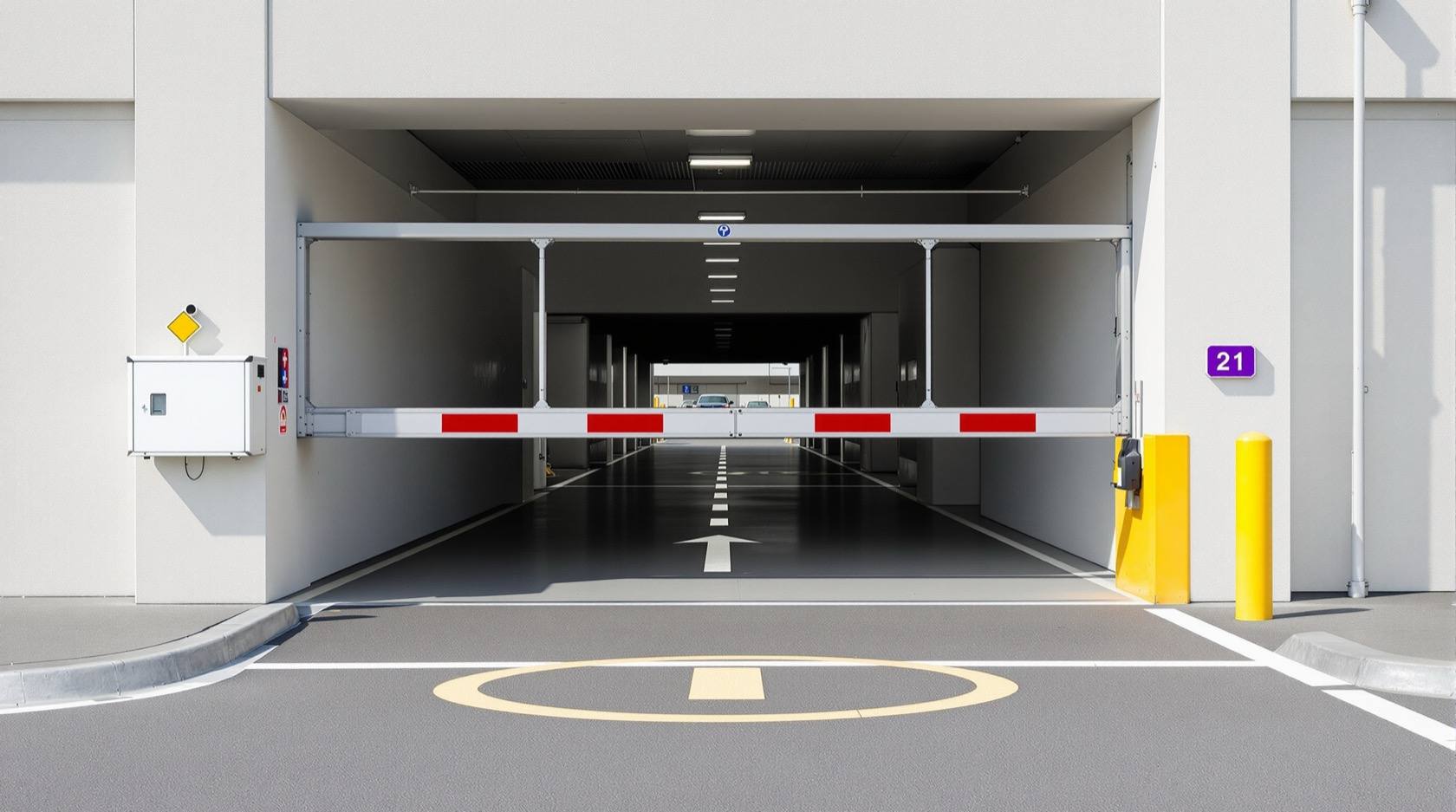
Boom Barrier Maintenance in India (2026): Keeping a High-Cycle Entrance Barrier Working
A facility and security team's upkeep routine for the boom barrier at an apartment, office or parking entrance — the arm, spring balance, drive, safety photocell and loop, controller and backup battery, and triggers — with the DIY-safe versus technician split and the manual release that must never trap a vehicle or block a fire lane.
A boom barrier is one of the hardest-working machines on your site. Unlike a gate that opens a few times a day, an entrance barrier at a busy apartment, office or paid-parking lane cycles up and down hundreds of times a day, every day, in heat, dust, monsoon and grid dips. It is a small motor, a balancing spring and a length of arm asked to do an enormous number of duty cycles — and that is exactly why it wears, and why a barrier that was smooth last year now strains, droops or refuses to lift. The failure is never convenient. A barrier stuck down traps a queue of vehicles and, far worse, can block an ambulance or a fire tender in a lane that is often the only way in. A barrier stuck up leaves the entrance wide open and defeats the reason it was installed.
Most of that is preventable with a routine. The commonest reasons a barrier lets you down are dull and mechanical: a spring that has lost tension so the motor is overworked, a photocell blinded by dust or spider-web, a loop connection loosened by vibration, a backup battery that quietly died months ago, or a coupling bolt that shook loose. None of these announce themselves — they are found the day the barrier drops on a car or refuses to rise for the fire tender. This guide is the upkeep routine that finds them first: what to check, how often, who does it, and the one test you must never skip.
Scope & safety. This is a preventive-maintenance and upkeep guide for facility managers, RWA committees and security supervisors — not an installation or repair manual. It draws a firm line between simple checks a facility or security person can safely do (cleaning photocells, clearing the loop area, checking the arm and reflective strip, testing the manual release and the anti-crush stop, swapping a remote battery, keeping a log) and work that is strictly for a qualified barrier technician or your AMC provider (spring tension, motor and gearbox internals, loop-detector tuning, limit and force settings, and all mains electrical work). Never open the motor housing or adjust the spring yourself — a boom spring is under real tension and can injure. Above all, know where the manual release is and how to use it, so a stuck boom never traps vehicles or blocks emergency access. This is not a price or a buying guide; for choosing a barrier see the buying material, and budget for an AMC on a device that cycles this hard.
Safety first: the manual release, before anything else
Before you learn to maintain a barrier, learn to defeat it by hand. Every boom barrier has a manual release — usually a keyed lock or lever on the cabinet that disengages the motor from the arm so the boom can be raised (and locked up) by hand. This is the single most important thing every guard on every shift must know, because it is what turns a dead barrier from an emergency into an inconvenience.
The scenarios are real and they happen in India regularly: a power cut with a flat backup battery, a controller that hangs, a motor that fails mid-cycle. If the boom is down and the release is unknown, the lane is blocked — and if that lane is the fire-tender path or the ambulance route, a maintenance oversight becomes a life-safety failure. So:
- Every guard is trained on the manual release on induction, and it is re-shown at every shift handover. Knowing it exists is not enough; they must have done it.
- The release key lives at the guard post, on a known hook, never in a drawer in the manager's locked office.
- On any power cut or fault, the drill is: release the boom, raise and secure it, keep the lane open, then call the technician. An open entrance you can staff manually beats a sealed one nobody can move.
Life-safety — do not skip. A boom barrier sits across what is often the only vehicle access, and that access doubles as the fire and ambulance lane. A barrier that cannot be opened in a cut or a fault must never be allowed to seal that lane. The manual release, a working backup battery and a trained guard are not optional extras — they are the difference between a queue and a blocked emergency. Egress and emergency access come before access control, always.
What a boom barrier is made of, and what wears
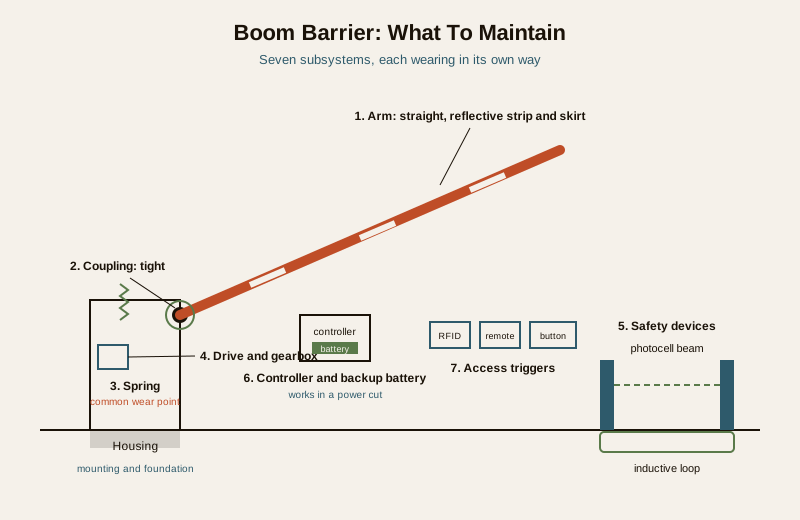
To maintain it you need to know what is in it. A boom barrier is a handful of subsystems, and each wears in its own way:
- The boom arm — the visible bar, usually aluminium or a composite, carrying a reflective strip and often a hanging skirt or a fixed rest support. It should be straight and true, its reflective strip intact and visible at night, and its coupling to the drive shaft tight.
- The spring balance — a counterbalance spring inside the cabinet that offsets the weight of the arm so the motor only has to move it, not lift its full dead weight. This is the most common wear point. As the spring ages and loses tension, the motor works harder on every cycle, heats up, and fails early. Getting the balance right is the heart of barrier longevity.
- The drive and gearbox — the motor and its reduction gearing (electromechanical on most Indian barriers; some are hydraulic). This does the raw work and, on a high-cycle barrier, wears fast without lubrication and attention.
- The safety devices — a photocell (an infrared beam across the lane) and/or a vehicle loop detector (an inductive loop cut into the road that senses a vehicle over it). Their job is to stop the boom coming down on a vehicle. These are safety-critical.
- The controller — the electronic board that reads the triggers, drives the motor and enforces limits and timings — with a backup battery so the barrier works through a power cut.
- The access triggers — whatever tells the barrier to open: RFID/FASTag readers, remotes, a loop that auto-raises for exit, a push button or intercom release at the guard post.
- Limits, mounting and foundation — the position settings that tell the boom where fully-up and fully-down are, and the bolts and concrete base holding the whole cabinet steady against the arm's leverage.
Understanding the duty cycle is the key mental model. A barrier rated for, say, a high number of cycles per day on a light arm is a different animal from the same unit run past its rating with a long, heavy arm on a paid-parking lane. Match the maintenance interval to the actual traffic, not the calendar — a barrier doing thousands of cycles a day needs attention on a far tighter loop than one at a quiet society gate.
The maintenance schedule
Upkeep is a rhythm, not a one-off. The table below is a starting frame for a moderately busy entrance; shorten every interval for a high-cycle parking or commercial lane, and lengthen slightly for a quiet gate. Adjust to your unit's manual and your AMC terms.
| Task | Frequency | Who |
|---|---|---|
| Clean photocell lenses; clear spider-web and dust from the beam path | Weekly | Facility / security staff |
| Clear the loop area of metal debris, standing water and parked bikes | Weekly | Facility / security staff |
| Visual check: arm straight, reflective strip and skirt intact, no droop | Weekly | Facility / security staff |
| Test the manual release; confirm the release key is at the post | Weekly | Facility / security staff |
| Test the anti-crush safety stop (boom must NOT lower on a vehicle) | Weekly | Facility / security staff |
| Confirm every trigger works: RFID, remote, exit loop, push button | Weekly | Facility / security staff |
| Listen through a full cycle for grinding, straining or new noise | Weekly | Facility / security staff |
| Check controller indicator lights and any fault codes | Monthly | Facility / security staff |
| Replace remote / transmitter batteries when weak | As needed | Facility / security staff |
| Test the backup battery: run several cycles on battery in a simulated cut | Monthly | Facility / security staff (observe) |
| Check and tighten the arm coupling and visible cabinet bolts | Monthly | Facility / security staff |
| Lubricate drive and moving parts per the manufacturer's schedule | Quarterly | Barrier technician |
| Measure and reset spring tension / arm balance | Quarterly / annual | Barrier technician |
| Inspect motor and gearbox; check for wear, heat and play | Quarterly / annual | Barrier technician |
| Tune loop detector sensitivity; check limit and force settings | Quarterly / annual | Barrier technician |
| Replace the backup battery on schedule (they age silently) | Annual / per rating | Barrier technician |
| Full electrical inspection: wiring, earthing, contactors | Annual | Barrier technician / electrician |
| Check foundation, mounting and cabinet levelling | Annual | Barrier technician |
Keep the weekly and monthly rows genuinely weekly and monthly — they are cheap, safe and catch most failures before they strand you. The quarterly and annual rows are where the technician earns the AMC.
The safety-critical test: the boom must not come down on a vehicle
Of everything in the schedule, one test outranks the rest, and it is the one people skip because the barrier "seems fine": verify that the boom will not lower onto a vehicle. A barrier's whole safety case rests on its photocell and loop detecting a vehicle in the lane and holding the arm up — or reversing it — instead of dropping a heavy bar onto a car, a windscreen, a two-wheeler rider or a pedestrian.
There are two protective mechanisms, and ideally both are present and both are tested:
- The photocell — an infrared beam across the lane. If something breaks the beam, the boom must not descend, and a descending boom must stop or reverse. Test it by holding an object in the beam as the boom tries to close: it must refuse to come down.
- The vehicle loop — an inductive loop in the road that senses a car over it. While a vehicle sits on the loop, the boom must stay up. Test it by having a vehicle (or, safely, a large metal object) over the loop and confirming the boom will not close on it.
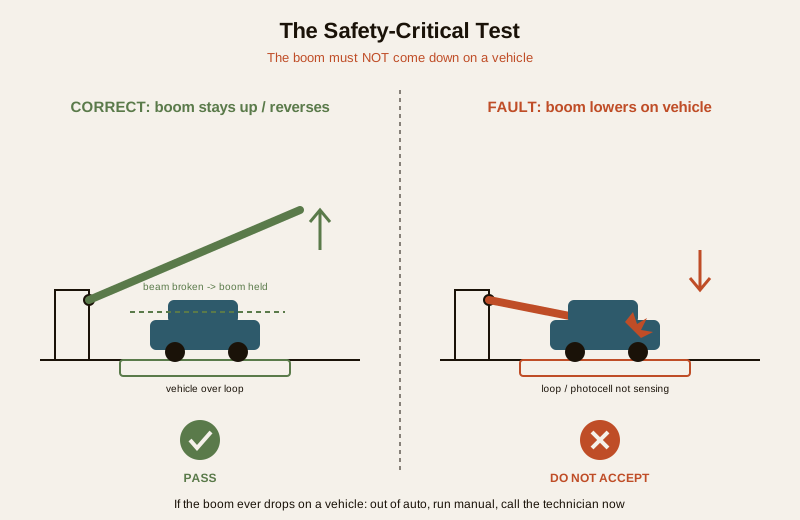
Do this test on a set schedule, weekly for a busy lane, and the moment a barrier ever drops on or toward a vehicle, take it out of automatic operation, run it manually, and call the technician. A boom that closes on a vehicle is not a nuisance to live with until the next service visit — it is a live hazard. The usual causes are a dirty or misaligned photocell, a mistuned or failed loop detector, or a controller/limit fault; the first is often fixable by cleaning, the rest are technician work.
Call a professional. Cleaning the photocell and clearing the loop area are yours. But if the anti-crush behaviour is still wrong after a clean — if the boom closes on a vehicle, closes too hard, or the loop does not hold it up — stop and call a qualified barrier technician. Loop-detector tuning, limit positions and closing-force settings are calibrated adjustments inside live equipment, not a facility-team task.
Signs of trouble: reading a failing barrier
A boom barrier telegraphs its decline. Learn the signs and you fix a Rs few-hundred cause before it becomes a Rs many-thousand replacement or a blocked lane:
- Slow or straining movement — the boom rises or falls sluggishly, or the motor labours and heats up. Classic sign of a spring that has lost tension so the motor carries weight it should not, or of a drive needing lubrication or wearing out.
- Not fully raising or lowering — the boom stops short of vertical or does not seat fully down. Usually a limit/position setting drifted, a balance problem, or an obstruction. Technician for the settings; you can check for physical obstruction.
- Arm droop — the arm sags below level when up, or bounces. A spring-balance symptom, and technician work to retension.
- Dropping on or toward a vehicle — the safety fault above. Immediate. Out of auto, manual operation, technician now.
- New noise — grinding, knocking, squealing that was not there last month. Something is wearing, loose or dry. Investigate before it seizes.
- Erratic triggers — RFID or remote works sometimes, or the boom opens or closes on its own. Could be a weak remote battery (yours to swap), a loop fault, or a controller issue (technician).
- Fails in a power cut — the barrier is dead when the grid drops. The backup battery has aged out; test monthly, replace on schedule.
The DIY-safe versus technician split
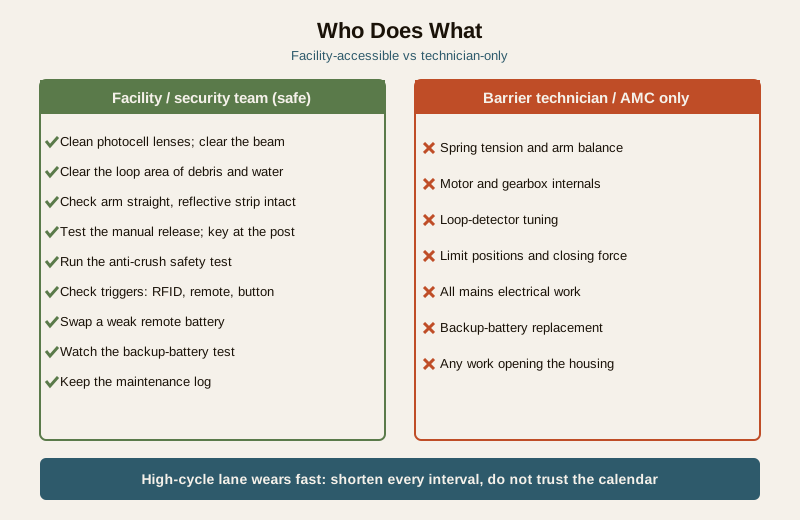
The line is simple: anything you can do without opening the housing, touching mains, or adjusting a calibrated setting is yours; everything else is the technician's. Getting this line right keeps your team safe and your barrier alive.
Facility and security team can safely do:
- Clean the photocell lenses with a soft, dry cloth; clear the beam path of web and dust.
- Clear the loop area of metal debris, standing water and parked two-wheelers.
- Check the arm is straight and the reflective strip and skirt are intact and visible.
- Test the manual release, and confirm the key is at the guard post.
- Run the anti-crush safety test — confirm the boom will not close on a vehicle.
- Confirm every trigger (RFID, remote, exit loop, push button) works.
- Swap a weak remote or transmitter battery.
- Watch the backup-battery test cycle and note whether it held.
- Read the controller's indicator lights and note any fault code — to report, not to fix.
- Keep the maintenance and fault log.
Strictly for a qualified barrier technician / AMC provider:
- Measuring and adjusting spring tension and arm balance — the spring is under dangerous tension.
- Opening and servicing the motor and gearbox.
- Loop-detector tuning and sensitivity setting.
- Setting limit positions and closing force.
- All mains electrical work — wiring, earthing, contactors, the controller board.
- Replacing the backup battery (unless your provider has shown you a safe user-swap).
- Any work needing the housing opened or the barrier partly dismantled.
Records and AMC for a high-cycle device
A barrier that cycles this hard earns a paper trail. A simple maintenance log — date, task, who did it, what was found — turns vague "it's been playing up" into a pattern a technician can act on, and it is your proof of diligence if a safety incident is ever questioned. Log every weekly check, every fault, every service visit, and every battery change.
For anything past the weekly and monthly rows, an annual maintenance contract (AMC) with a competent barrier or gate-automation firm is the sensible model for a high-cycle device — it puts the spring, motor, loop and electrical work on a scheduled footing and gives you someone to call when the boom drops on a car at 9pm. Budget for it as a running cost, not a surprise; a barrier run to failure costs far more than one serviced on time. Where the barrier holds vehicle-linked personal data — RFID/FASTag records, ANPR images, entry logs — remember that servicing that data is still personal-data handling under the DPDP Act 2023; agree with your AMC provider who may access logs and footage during a service call.
If the barrier has already failed
This is a preventive guide — its whole point is to stop failures before they strand you. If your barrier is already not operating — dead, stuck, opening but not closing, or closing but not opening — that is a diagnostic problem, and the first move is always the manual release to keep the lane open. For a structured fault walk-through, see the companion guide on a boom barrier not operating. For choosing and understanding barriers in the first place, see boom barriers in India.
Key takeaways
- The manual release is the most important thing on the barrier — every guard, every shift, must know it, and the key lives at the post, so a stuck boom never blocks the fire or ambulance lane.
- The spring balance is the commonest wear point — a spring that loses tension overworks the motor and shortens its life; a drooping or straining boom is the tell.
- Run the anti-crush test on schedule — the boom must never close on a vehicle; if it ever does, take it out of auto, run it manually and call the technician immediately.
- Match the interval to the traffic — a high-cycle parking lane wears fast; shorten every interval rather than trusting the calendar.
- Keep the DIY-safe line firm — clean photocells, clear the loop, check the arm, test the release and the safety stop, swap a remote battery, keep the log; leave spring, motor, loop tuning, limits and mains to the technician.
- Test the backup battery monthly — it dies silently, and the day you notice is the day the grid drops and the boom won't move.
- Log everything and keep an AMC — a hard-cycling device needs a paper trail and a firm on call.
Where to go next
- Boom barrier not operating and boom barriers in India — troubleshooting a failed barrier and understanding the device.
- Gate automation maintenance — the closely related upkeep routine for automated swing and slide gates.
- Security maintenance calendar and the security system maintenance guide — fitting the barrier into a whole-site upkeep schedule.
- The maintenance sub-hub, plus the main security hub.
References
- National Building Code of India (SP 7), Bureau of Indian Standards — vehicle access, fire-tender access and means of egress: a boom barrier across an access lane must never compromise emergency-vehicle access or escape. Verify the current edition (SP 7:2026) via the BIS catalogue: https://www.services.bis.gov.in/
- Manufacturer's installation and maintenance manual — the authoritative source for your specific barrier's duty-cycle rating, spring-tension procedure, limit settings, backup-battery type and service intervals. Always follow it over any general schedule.
- Digital Personal Data Protection Act, 2023 — RFID/FASTag records, ANPR images and entry logs held by a barrier are personal data; agree who may access them during servicing and how long they are retained.
This is an educational preventive-maintenance overview for facility managers, RWA committees and security supervisors — not an installation or repair manual, and not a price or buying guide. Spring tension, motor and gearbox work, loop tuning, limit and force settings and all mains electrical work are strictly for a qualified barrier technician or AMC provider. Never let a barrier seal the only emergency-access lane; train every guard on the manual release, and verify any standard's current status via the BIS catalogue before relying on it.
Export this guide
Related Guides — Deep-dive reading
Boom Barrier Not Operating (2026): Diagnose a Stuck or Dead Parking Gate Arm
A calm, ordered diagnostic path for a facility or security team when an apartment, office or parking boom barrier will not raise or lower, is stuck up or down, or will not respond — starting with the manual release so a jammed arm never traps a vehicle or blocks a fire lane, then power, trigger, safety loop and mechanical causes, and a clear line between safe checks and technician-only work.
SecurityGate Automation Maintenance in India (2026): Keep a Sliding or Swing Gate Working and Safe
A homeowner's upkeep guide for an automatic sliding or swing gate — clearing the track, lubricating rollers and hinges, testing the safety photocells and manual release, caring for the controller and its backup battery, and knowing exactly where the DIY line stops and a qualified technician begins.
SecurityAccess Control Maintenance in India (2026): Readers, Locks and Fail-Safe Egress
How to keep a card, keypad, fingerprint or face access-control system reading reliably and locking securely — and, above everything, how to test that its doors still release on a fire alarm and on power loss, so an access-controlled door never becomes a life-safety trap.
SecurityRelated Tools — Try Free
Access-Control Battery-Backup Calculator
Size the standby battery so an access system keeps running through a power cut, with an egress life-safety note.
Battery BackupApartment Video Door System Planner
Enter flats, entrances, floors and guard desk for a first-pass building intercom plan — door stations, indoor monitors, guard station, the right architecture and an indicative cost band.
Building PlannerGate Access Planner
Size a vehicle gate or boom barrier — lanes needed at peak and the right credential speed (RFID, ANPR, manual).
Gate Flow