
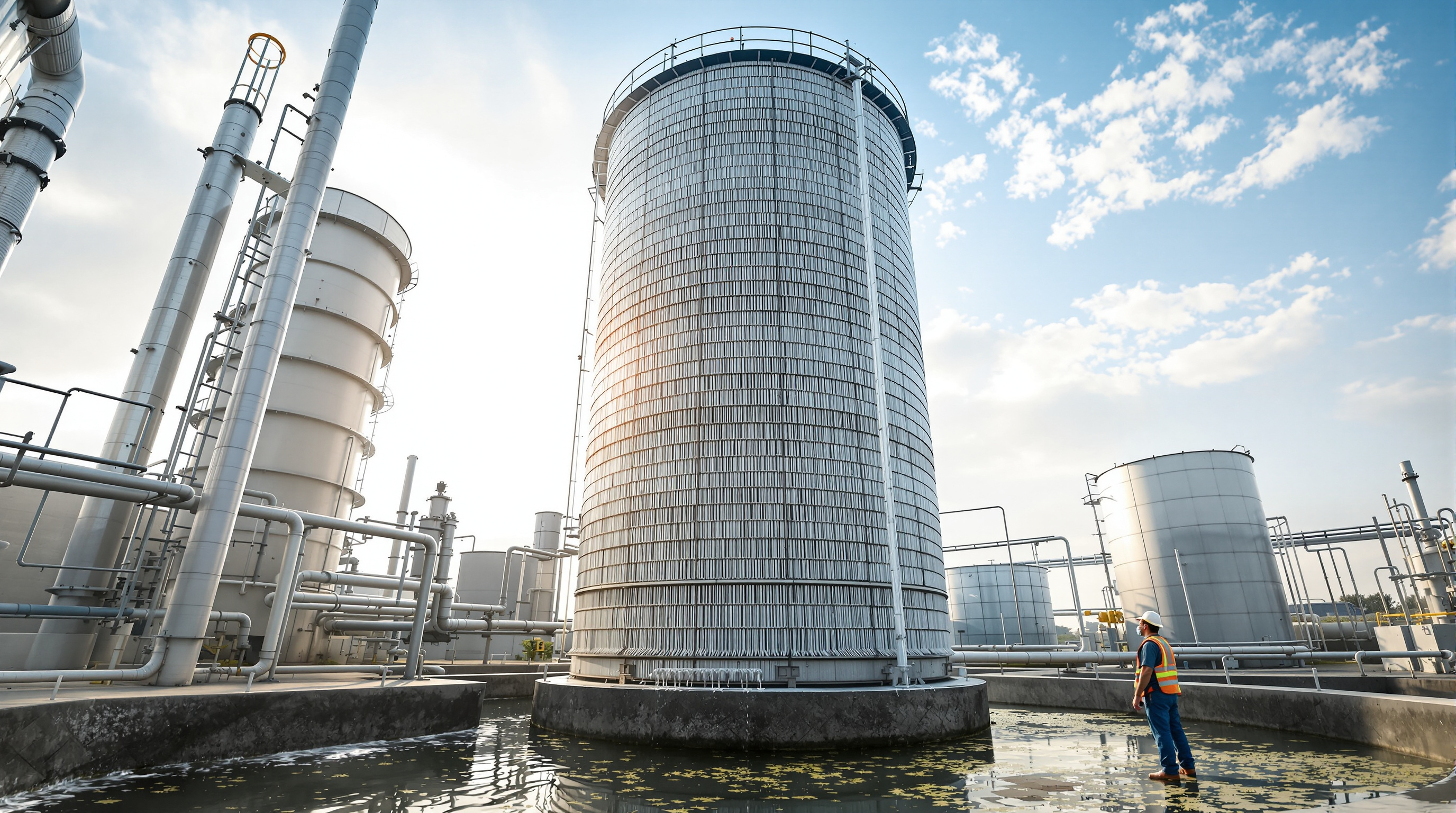
Bio Tower Systems: Packed-Media Trickling Towers for High-Load Treatment
The tall, packed-media cousin of the trickling filter, explained: how a bio tower trickles wastewater over deep plastic media to strip out heavy organic load with almost no energy, why industries lean on it as a roughing stage, and where it fits against ASP and MBBR.
Most people picture a sewage plant as a set of squat tanks bubbling away at ground level. But walk into the effluent yard of a dairy, a brewery or a food-processing unit in India and you may see something different: a tall cylindrical tower, several metres high, packed to the brim with plastic media, with wastewater raining gently down through it from a rotating arm on top. That tower is doing the same biological job as an aeration tank — but standing up, and with almost no electricity. It is a bio tower.
This guide explains what a bio tower actually is, how trickling water and rising air combine to clean it, why the packing media is the whole story, and where a bio tower earns its place — usually in front of high-strength industrial waste that would overwhelm a conventional plant. If you are new to biological treatment, start with the Sewage Treatment Plants guide library; this one assumes you know the basic idea that bacteria eat the pollution, and zooms in on one particularly elegant way of housing them.
A bio tower is gravity doing the work of a blower. Wastewater trickles down through a deep column of plastic media coated in living biofilm; air rises through the gaps on its own. The microbes eat the organic load on the way down — no aeration tank, no churning, barely any power.
What a bio tower actually is
A bio tower is a high-rate, packed-media trickling filter built tall instead of wide. It belongs to the same family as the classic trickling filter — both are attached-growth systems, where the treatment bacteria live as a slimy biofilm fixed on a surface rather than floating loose in the water. The difference is depth and media.
An old-style trickling filter is a shallow bed of stones, perhaps 2 metres deep, that clogs easily and treats a modest load. A bio tower swaps the stones for engineered plastic media with enormous void space, and stacks it 4 to 12 metres deep inside a tower shell. That combination — a lightweight, high-void, high-surface-area media in a deep column — is what lets a bio tower take a punishing organic load in a small ground footprint, which is exactly what a factory with limited land and strong effluent needs.
The essentials of the system are simple:
- A tower shell — usually RCC, FRP or a steel frame with cladding — holding the media.
- A distribution system on top — a rotary arm or fixed spray nozzles — that spreads wastewater evenly over the whole media surface.
- The packing media itself, the working heart of the tower.
- An underdrain and collection sump at the base that catches the treated water and sloughed biofilm.
- A recirculation pump that returns some treated water to the top to keep the media wet and dilute strong influent.
How a bio tower works
The process is almost entirely passive, which is its charm. Screened, de-gritted wastewater is pumped to the top of the tower and released through the distributor, which sprinkles it evenly across the media. From there, four things happen at once as the water trickles down:
1. The water spreads into a thin film over the media surfaces, wetting the biofilm that coats every piece.
2. The biofilm eats the pollution. Aerobic bacteria in the film absorb the dissolved organic matter as the water passes — driving down BOD and COD with every metre of descent.
3. Air rises through the voids. Because the biofilm consumes oxygen, the air inside the tower warms slightly and rises, drawing fresh air up from the open base — a natural-draft chimney effect. In most bio towers this passive airflow supplies all the oxygen the microbes need, with no blower at all. Larger or heavily loaded towers may add a forced-draft fan for insurance.
4. Old biofilm sloughs off. As the film thickens, its inner layer starves and lets go, and the trickling water washes this shed biomass down to the base.
The treated water and sloughed solids collect in the sump. Because a bio tower does not settle its own solids, that water almost always flows on to a clarifier to drop out the biofilm before the next stage. A portion is recirculated to the top — both to keep the media continuously wet and to dilute strong incoming effluent so the biofilm is never shocked.
The media is the whole story
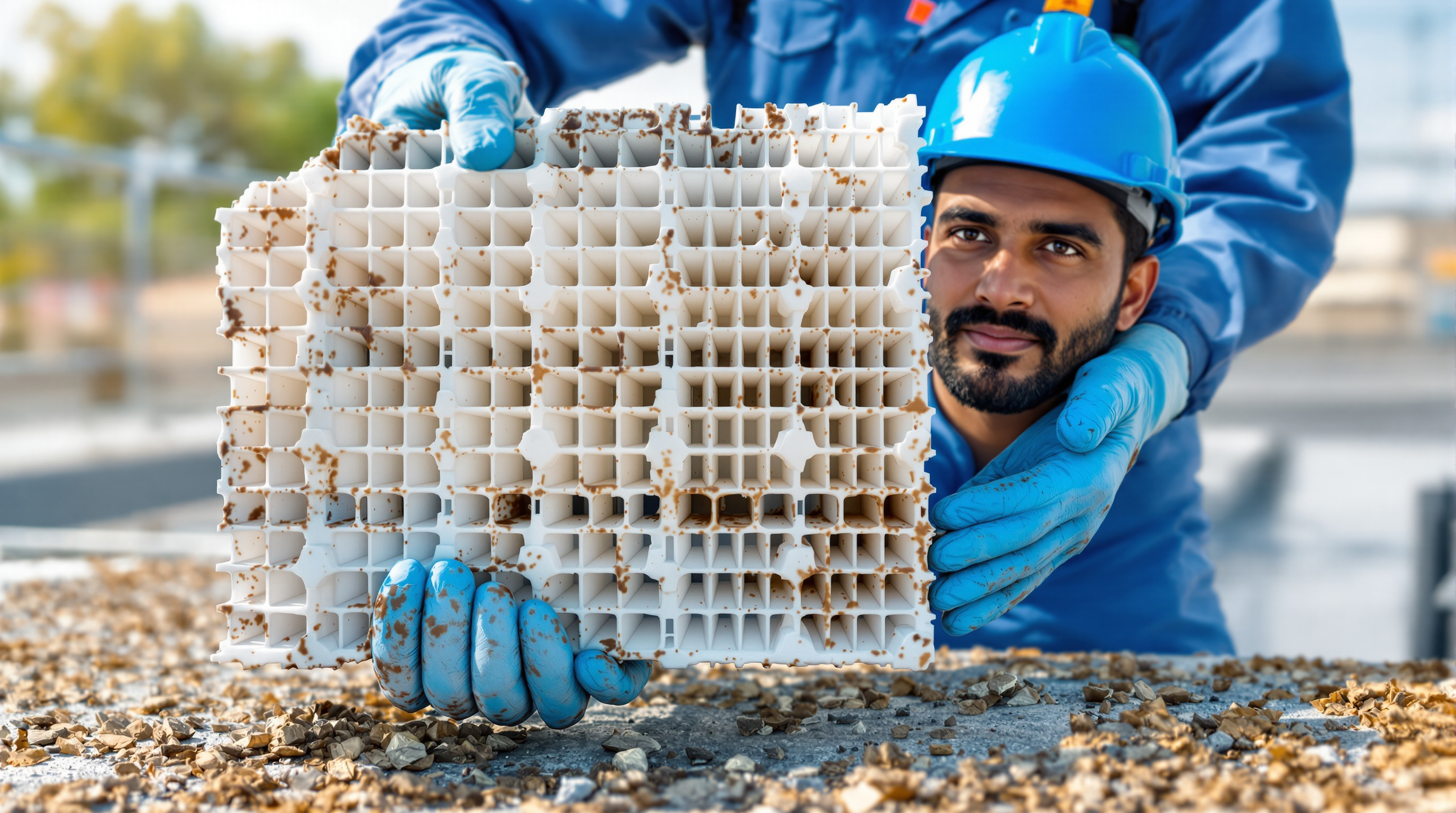
Everything a bio tower can do comes down to what is stacked inside it. Modern bio tower media is HDPE or PVC, moulded into one of two forms:
- Cross-flow or vertical-flow structured sheets — corrugated plastic sheets bonded into rigid modular blocks that stack like bricks. These give very high surface area with an open, self-ventilating structure that resists clogging.
- Random dumped media — loose plastic shapes (rings, spheres, saddles) tipped in to fill the shell.
Two properties decide whether media is any good, and they are the same two that matter for the carriers in a moving bed biofilm reactor (MBBR):
- High specific surface area — square metres of biofilm-growing surface packed into each cubic metre of media. More surface means more bacteria means more treatment per cubic metre of tower.
- High void ratio — typically well above 90%. Big gaps mean air flows up freely, water films down without pooling, and sloughed biofilm washes out instead of clogging the bed. This open structure is precisely what the old stone media lacked, and it is why bio towers can carry loads a rock-filled filter never could.
Where bio towers earn their place
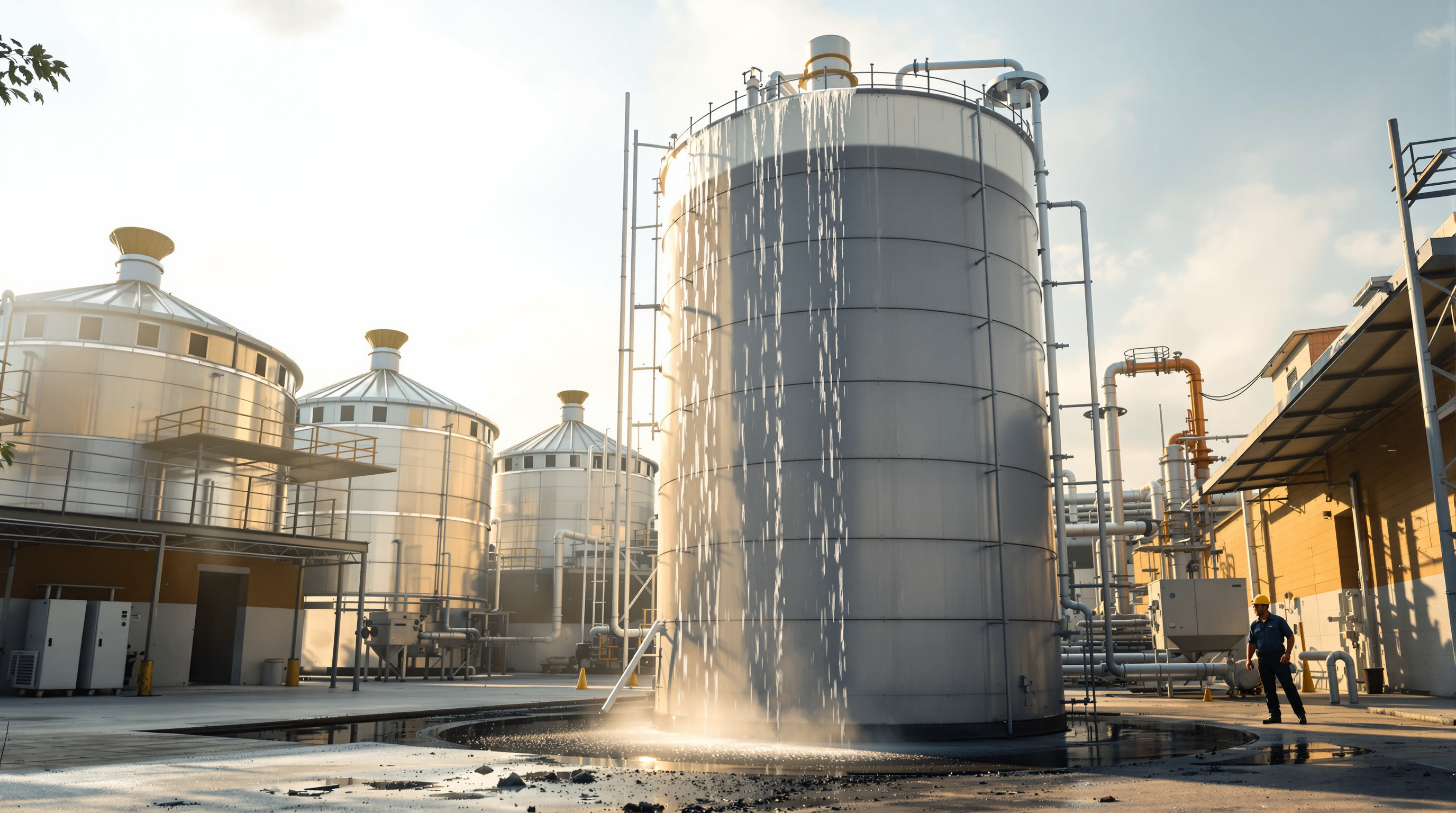
Bio towers are rarely the whole plant. Their sweet spot is as a roughing stage — a first, brutal knock-down of very high organic load, ahead of a polishing process that finishes the job. This is why you find them on high-strength industrial effluent far more than on domestic sewage:
- Dairies, breweries and distilleries — wastewater with BOD in the thousands, where a bio tower can shave off 50–70% of the load cheaply before a downstream biological stage.
- Food and beverage processing — sugar, fruit pulp, starch and slaughterhouse wastes with heavy, fluctuating organic loads.
- Pulp, paper and chemical units — as a pre-treatment that protects and unloads the main treatment train.
In a domestic STP a bio tower is uncommon, but the principle shows up in hybrid trains — a bio tower or trickling stage feeding an activated-sludge or MBBR polishing tank. If you are weighing which biological route suits your project, the STP Technology Selector is a quick way to narrow the field, and the STP Capacity Calculator gives you the flow figure every design starts from.
Bio tower vs the alternatives
A bio tower trades away polish and control in exchange for ruggedness and near-zero running cost. Here is how it sits against the technologies it competes with.
| Factor | Bio tower (trickling tower) | ASP (activated sludge) | MBBR |
|---|---|---|---|
| Biomass | Attached (fixed biofilm) | Suspended (floating) | Attached (on floating carriers) |
| Aeration energy | Very low (natural draft) | High (continuous blowers) | High (blowers) |
| Ground footprint | Small (builds upward) | Large | Compact |
| Handles high BOD load | Excellent (as roughing stage) | Moderate | Good |
| Shock-load resilience | Excellent | Poor | Excellent |
| Effluent quality alone | Moderate — needs polishing | Good | Good |
| Operating complexity | Low | Moderate | Low |
| Best fit | High-strength industrial pre-treatment | Large plants with land and steady load | Compact retrofits, apartments |
The short version: choose a bio tower when the load is heavy, the land is tight, the power tariff hurts, and you have a downstream stage to polish the water. Choose the activated sludge process or an MBBR when you need reuse-grade water out of a single biological stage.
The honest limitations
- It rarely stands alone. A bio tower knocks the load down but seldom hits discharge norms by itself — budget for a clarifier and usually a polishing stage.
- Clogging and ponding. If the media void ratio is wrong or the distributor uneven, biofilm bridges the gaps, water ponds on top, and the tower goes septic. Distribution and media choice are everything.
- Odour and filter flies. Attached-growth trickling systems are prone to nuisance odour and Psychoda filter flies if the biofilm is neglected — a real siting and maintenance concern near occupied buildings.
- Cold and low load. In cool weather or at very low flow the natural draft weakens and the biofilm slows; recirculation and sometimes forced draft are needed to keep it healthy.
The bottom line
A bio tower is the trickling filter reimagined for muscle: swap loose stones for deep, high-void plastic media, build it tall, and let gravity trickle the wastewater down while air rises on its own. That one arrangement buys a huge, load-hungry biofilm in a small footprint with barely any electricity — which is why bio towers are a favourite roughing stage for the strong, swinging effluent that Indian dairies, breweries and food plants produce. Understand it as one specialised tool in the kit: rugged, cheap to run, and best paired with a polishing process that carries the water the last mile. To place it against its relatives, read the trickling filter guide and the MBBR guide, then return to the Sewage Treatment Plants library to see how the stages fit together.
Export this guide
Related Guides — Deep-dive reading
Trickling Filter Systems in Wastewater Treatment: How Attached-Growth STPs Work
The trickling filter treats sewage by dripping it over a bed of media coated in living biofilm — a low-power, low-maintenance workhorse. Here is how it works, where it fits in India, and how it stacks up against activated sludge.
Sewage Treatment PlantsMoving Bed Biofilm Reactor (MBBR): Media, Working & Benefits
The most popular STP technology in Indian apartments, explained: how thousands of free-floating plastic carriers grow a living biofilm, why that packs high treatment into a small tank, what the media fill ratio means, and how MBBR compares to ASP and MBR.
Sewage Treatment PlantsBiological Culture Management in an STP: The Heart of Good O&M
The microbes in your aeration tank do the actual work of cleaning sewage. Keep them healthy — the right MLSS, food, oxygen and nutrients — and everything else falls into place. Here is how operators manage the living culture, diagnose bulking and foaming, and recover after a crash.
Sewage Treatment PlantsRelated Tools — Try Free
Population Equivalent (PE) Calculator
Convert an organic pollution load into Population Equivalent from flow and BOD concentration — the BOD load in kg/day and equivalent number of people.
STP CalculatorApartment STP Planner
Plan an apartment complex sewage treatment plant from flats and occupancy — get population load, sewage flow, recommended STP capacity in KLD, treatment technology and approximate space.
PlannerCross-Ventilation Analyzer
Estimate airflow and air changes per hour (ACH) from room size, window areas, layout, and local wind — with NBC 2016 Part 8 compliance check.
Ventilation Calculator