
Bamboo & Woven-Wood Blinds: Natural Shade for Indian Homes (2026)
The chik reborn — how woven-wood and reed blinds filter light, catch a breeze and weather Indian sun, rain and humidity, with honest costs and best uses.
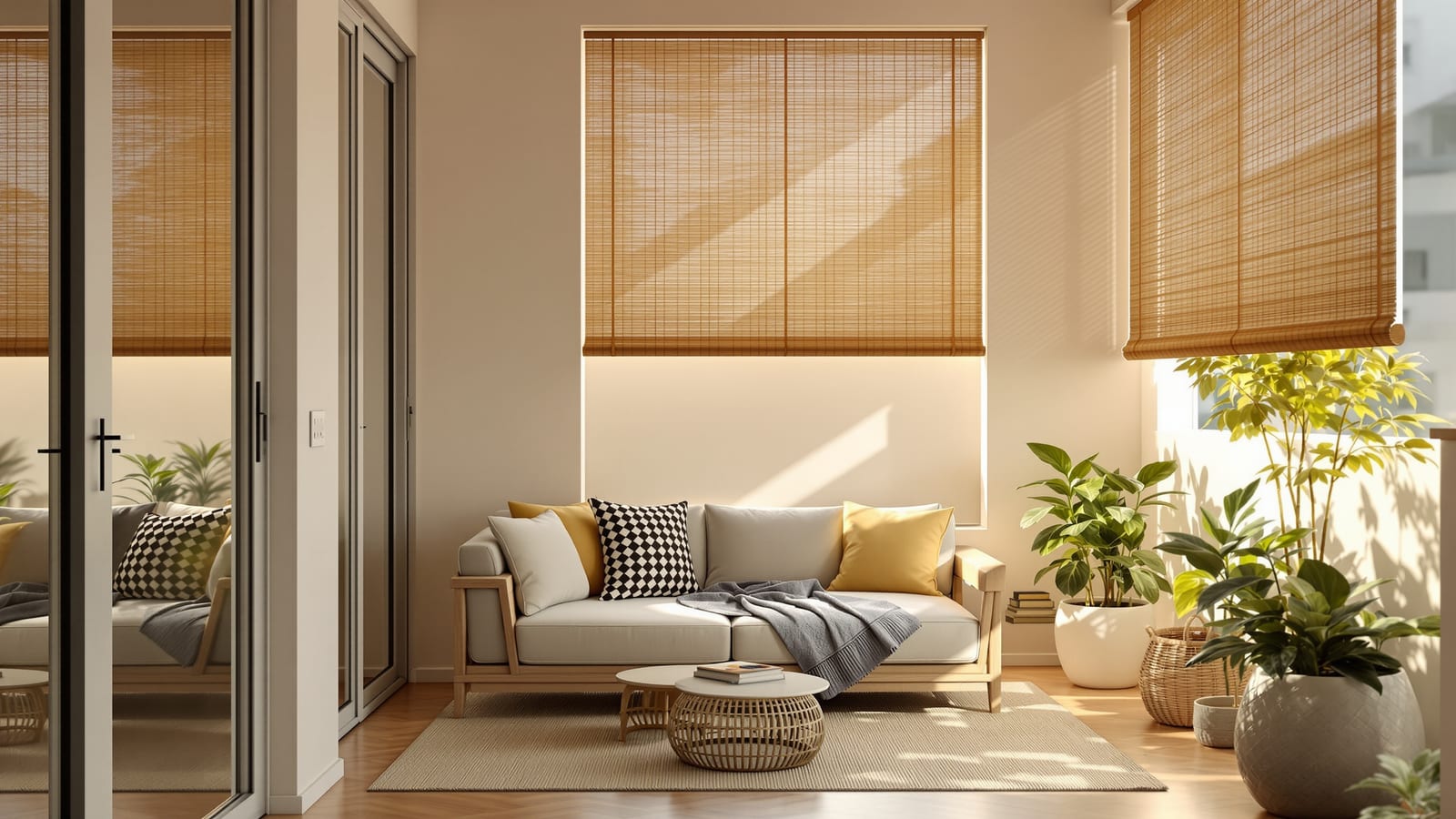
Long before roller shades and motors, the Indian window had a chik — a rolled-up screen of split bamboo or reed, hung from the lintel, dropped against the afternoon sun and rolled back at dusk. You still see it on old verandahs, in summer-house porches and on the balconies of bungalows. It never went away because it solved a genuinely hard problem better than glass: how to keep the sun out while letting the breeze, and a soft slatted light, come in. That same idea is now reborn indoors as the woven-wood blind, a refined, lined, designer cousin of the rough outdoor chik.
This guide separates the two — because they look related but solve different jobs — and tells you honestly how bamboo and woven-wood blinds filter light, breathe, weather the monsoon, and what they cost.
A chik is not a curtain that happens to be made of bamboo. It is a breathing screen: it trades total darkness and total privacy for airflow, daylight and a connection to the outdoors that no fabric blind can match.
What "bamboo blind" actually means
The category covers three closely-related things:
- Bamboo chik (outdoor) — split bamboo sticks or thicker rods strung together, often with a roll-up cord. The traditional, weatherable, breezy screen for balconies, verandahs and porches.
- Woven-wood blind (indoor) — finer reeds, grasses, jute and bamboo woven into a textured Roman-style or roll-up blind, usually with a fabric or blackout liner option. The interior-design version.
- Reed / matchstick blind — the thin, economical roll-up screen, the lightest and cheapest of the three, good for a quick filter on a shaded window.
The single biggest mistake buyers make is putting an indoor woven-wood blind on an exposed balcony, or a rough outdoor chik in a styled living room — they are not interchangeable. Use the table below to keep them straight.
Indoor woven-wood vs outdoor bamboo chik
| Feature | Indoor woven-wood blind | Outdoor bamboo chik |
|---|---|---|
| Best location | Living room, bedroom, study windows | Balcony, verandah, porch, terrace |
| Material | Fine reeds, grass, jute, thin bamboo | Split bamboo sticks, thicker rods |
| Light control | Soft filter; near-blackout with a liner | Strong shade, slatted daylight |
| Privacy | Good by day; add a liner for night | Day privacy; silhouettes show at night |
| Weather tolerance | Indoor only — keep out of rain | Built for sun and splash; still ages |
| Breeze | Moderate (blocked by liner) | Excellent — designed to breathe |
| Finish | Lined, tailored, decorator-grade | Rustic, utilitarian, charming |
| Indicative cost | Higher (₹600–₹2,500+/sq ft) | Lower (₹150–₹600+/sq ft) |
The honest summary: choose woven-wood indoors when you want texture, warmth and the option of darkness; choose a bamboo chik outdoors when you want shade and airflow on an open balcony and accept that it will weather. If you are weighing these against fabric or hard blinds in general, the curtains vs blinds comparison and the broader types of window blinds guide set the wider field.
Light, breeze and the thing fabric can't do
A bamboo or woven-wood blind filters light rather than blocking it. Even fully lowered, an unlined chik glows — daylight comes through the gaps between reeds as a warm, dappled wash. This is its whole charm and its whole limitation:
- Light filtering — you get bright, soft, non-glaring daylight with the harshness and heat of direct sun cut away. West and south windows that bake in the afternoon become liveable without going dark.
- Breeze — the gaps that let light through also let air through. On a balcony in a Chennai or Mumbai summer, a chik shades you while the sea breeze still reaches the room. No fabric roller or blackout curtain does this.
- The trade-off — that same breathability means a plain woven-wood blind will not darken a bedroom and will not give night privacy. The fix is a liner: an indoor woven-wood blind can be ordered with a fabric or blackout backing that drops the light (and the airflow) when you want sleep or privacy, and lifts away when you want the open weave.
If darkness is the real goal, pair the blind with a roller blind or a blackout layer rather than fighting the weave.
The eco and sustainability case
This is where bamboo genuinely shines, and not as marketing. Bamboo is one of the fastest-growing plants on earth, regenerating in three to five years against the decades a hardwood takes, and it is harvested without killing the plant. For a homeowner who wants a solid-wood look with a far lighter footprint, woven-wood and bamboo are the natural-material answer:
- Renewable — a true rapidly-renewable resource, not a slow-growth timber.
- Low embodied energy — minimal processing compared with metal, PVC or engineered slats.
- Biodegradable — at end of life it composts rather than sitting in landfill like vinyl.
- Naturally cool — the material itself does not radiate heat the way metal blinds can.
It is a quietly green choice that also happens to look warm and handcrafted — a rare combination.
Durability: sun, rain and Indian humidity
Here is the caveat no showroom will lead with. Natural fibre is beautiful and it is mortal. How long a bamboo blind lasts depends almost entirely on where you hang it and how you treat it.
- Sun — UV slowly bleaches and embrittles bamboo; an outdoor chik in full western sun fades and grows brittle faster than one under a deep chajja or shaded balcony.
- Rain — direct monsoon driving rain is the real enemy. Repeated soaking and drying warps reeds, loosens the stringing and invites mildew. An outdoor chik should be under an overhang, not fully exposed, and rolled up during heavy storms.
- Humidity — coastal and monsoon damp encourages mould on untreated fibre. Ventilation and the occasional dry-out matter.
How to extend life: buy chiks that are lacquered, oiled or sealed for outdoor use; re-coat them every year or two before the season; roll them up in the worst storms; and accept that an outdoor chik is partly a consumable — re-stringing or replacing it every few years is normal and cheap, much like repainting a fence. An indoor woven-wood blind, kept dry and out of direct rain, lasts far longer — many years with only dusting. Treat outdoor and indoor lifespans as different planets.
What they cost in India
Prices vary with material grade, weave fineness, size, lining and whether you buy ready-made or custom, so treat these as honest ranges, not quotes:
- Outdoor bamboo chik — the most economical, often ₹150–₹600 per square foot, with rough roll-up market chiks cheaper still and treated, finished ones higher.
- Indoor woven-wood blind — decorator-grade, typically ₹600–₹2,500+ per square foot, climbing with fine weaves, branded fittings and a blackout liner.
- Liners and motorisation — a fabric or blackout liner adds to the woven-wood price; cordless or motorised lift mechanisms add more.
Against a custom curtain or a premium hard blind these are often the cheaper natural-look option, especially outdoors. To size a window and sanity-check a quote across treatments, run the Curtain Cost Calculator — it works fabric and width arithmetic that translates directly to per-window pricing.
Best uses — and where to skip them
Reach for bamboo / woven-wood when:
- You have a balcony, verandah or porch that needs shade without losing the breeze — the classic chik job.
- You want warm, textured, handcrafted character indoors that fabric can't give.
- You want a genuinely eco-friendly, renewable material.
- A west or south window bakes and you want to cut heat while keeping daylight.
Skip them, or add a liner, when:
- The room must go fully dark (bedroom) — only a lined woven-wood, or a separate blackout layer, will do.
- You need strong night privacy — silhouettes show through an unlined weave after dark.
- The window is fully rain-exposed with no overhang — natural fibre will not survive an open monsoon.
- The setting is a formal, polished interior where rustic texture would feel out of place.
For the rest of the window-treatment picture — fabric, fullness, layering and motorisation — the complete curtain and window treatment guide and the Window Treatments hub tie every option together.
The bottom line
Bamboo and woven-wood blinds are the most under-rated treatment in the Indian home: cheap and breezy outdoors as the traditional chik, warm and texture-rich indoors as the lined woven-wood, and genuinely sustainable either way. Buy the right one for the right place — outdoor chik for the balcony breeze, lined woven-wood for the styled room that may need to go dark — keep it out of driving rain, and treat the outdoor version as a happy consumable.
Not sure if a chik suits your window? Answer a few questions in the Window Treatment Selector to match light, privacy and weather needs to the right blind, then go deeper with the complete window treatment guide.
Export this guide
Related Guides — Deep-dive reading
Curtains vs Blinds: The Complete Comparison for Indian Homes (2026)
Light, privacy, heat, noise, cleaning, cost and looks — a head-to-head verdict on curtains and blinds, plus the under-rated answer most good designers actually use: both.
Window TreatmentsBathroom Window Treatments: Privacy & Moisture (India 2026)
Why fabric curtains fail in the bathroom, the moisture-proof covers that actually last, how to get privacy without killing daylight, and how to keep mould and rust away — for the humid, hard-water Indian bathroom.
Window TreatmentsBlackout Curtains: The Complete Guide for Indian Homes (2026)
What “blackout” really means, how dark you actually get, the light-gap problem nobody warns you about, and how to choose, seal and care for them in Indian conditions.
Window TreatmentsRelated Tools — Try Free
Window Treatment Selector
Curtains, blinds or a layered system? Answer five questions about your room and get a specific recommendation.
SelectorCross-Ventilation Analyzer
Estimate airflow and air changes per hour (ACH) from room size, window areas, layout, and local wind — with NBC 2016 Part 8 compliance check.
Ventilation CalculatorCurtain Cost Calculator
Get the fabric metres you need plus the total curtain cost by window size, fabric, pleat, lining and hardware.
Curtain Calculator