
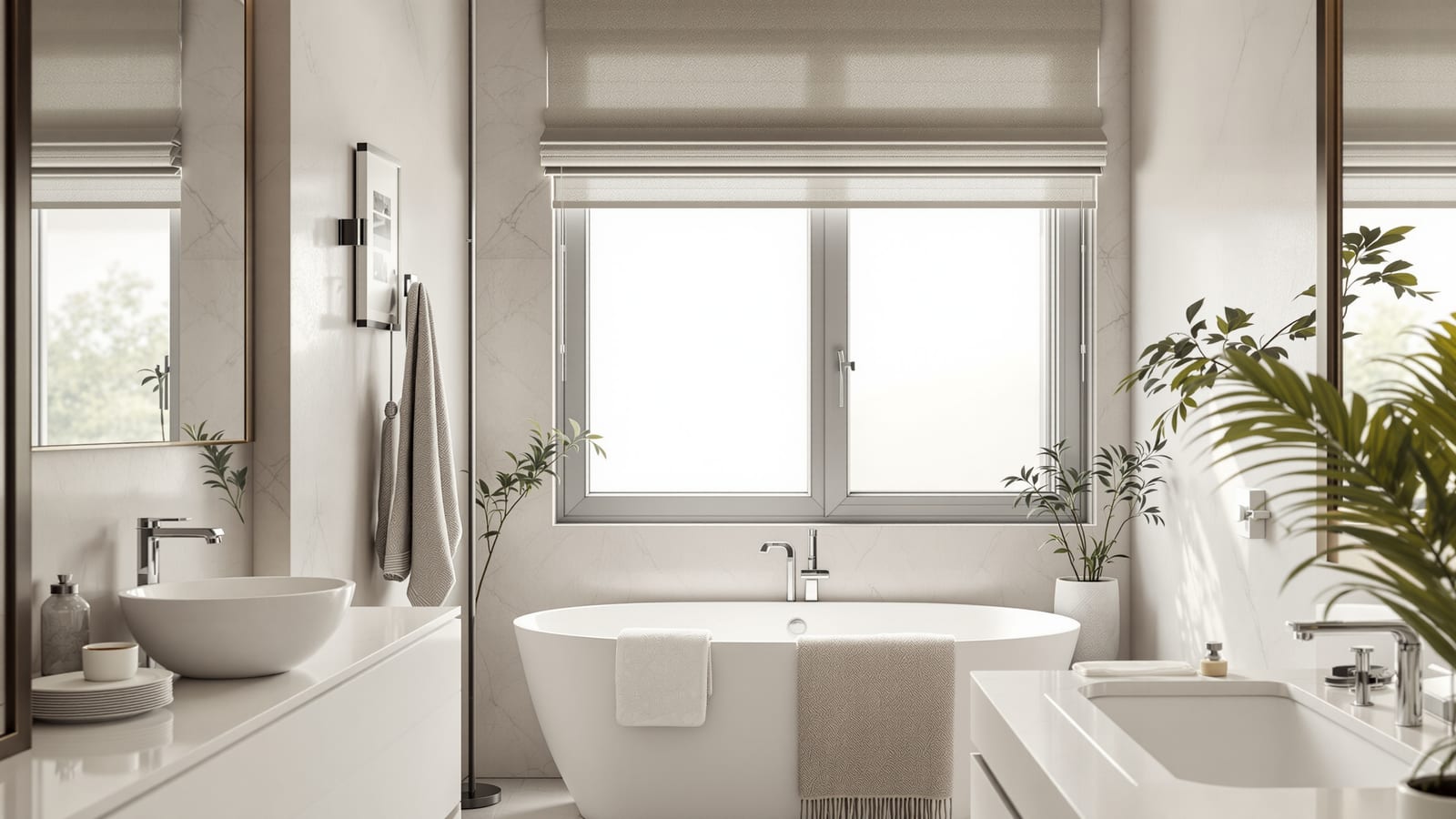
Bathroom Window Treatments: Privacy & Moisture (India 2026)
Why fabric curtains fail in the bathroom, the moisture-proof covers that actually last, how to get privacy without killing daylight, and how to keep mould and rust away — for the humid, hard-water Indian bathroom.
The bathroom window is the hardest window in the house to dress, and the one most people get wrong. It is small, usually set high, and it lives in a permanent fog of steam, splash and hard-water spray. On top of that it has the strictest privacy job of any window in the home, while still needing to let in light and — critically — let out moist air. Hang the wrong thing here and within a couple of monsoons you have a damp, blotchy, mildew-smelling strip of cloth that you are too squeamish to touch. This guide is about getting it right the first time.
A bathroom window cover has one extra rulebook the rest of the house ignores: it must survive being wet, over and over, for years. Anything that holds water against itself is already failing — you just cannot see it yet.
If you are dressing the whole home and want the full picture, the complete curtain and window-treatment guide is the pillar this sits under. For the bathroom specifically, the rules are different enough to deserve their own read.
Why fabric curtains fail in a bathroom
A normal cotton, linen or polyester curtain is built to do everything the bathroom punishes. Cloth is absorbent by design, so it soaks up steam every single shower and dries slowly in a room that is rarely well ventilated. Damp cloth in warm, still air is the exact recipe for mould — and once mildew gets into the weave, no amount of washing truly removes the stain or the smell.
There is a second, quieter problem: hard water. Most Indian municipal and borewell supplies are mineral-heavy. Spray and condensation leave white, chalky scale marks on fabric that no detergent shifts. Add the long monsoon, when nothing in the bathroom dries properly for weeks, and a fabric curtain is on borrowed time from the day you hang it.
The honest verdict: skip cloth at the actual wet window. If you love the soft look, a fabric curtain can hang at a dry bathroom window far from the shower — but for the typical small, splash-zone Indian bathroom window, you want a wipeable, non-absorbent cover instead.
The moisture-proof options that actually last
The whole bathroom shortlist is built from materials that do not drink water. Here are the covers worth your money:
| Option | Material | Privacy | Lets light in | Moisture verdict |
|---|---|---|---|---|
| PVC / faux-wood venetian blind | Solid plastic or vinyl slats | High (tilt to adjust) | Yes, tiltable | Excellent — wipes clean |
| Waterproof roller blind | PVC-coated or solar fabric | Medium–High | Yes | Excellent — no folds to trap damp |
| Frosted / privacy window film | Adhesive film on the glass | Very high (permanent) | Yes, diffused | Excellent — nothing to rot |
| Bottom-up / top-down shade | Cellular or fabric, raised from sill | High at the lower glass | Yes, from the top | Good (choose moisture-rated cloth) |
| Aluminium venetian blind | Anodised metal slats | High | Yes, tiltable | Good — but watch for rust at cut edges |
PVC or faux-wood venetian blinds are the workhorse choice: solid waterproof slats you tilt for privacy-with-daylight, and you simply wipe them down. Genuine timber blinds warp and stain in here, so insist on faux-wood (a PVC or composite that looks like wood) — never real wood. The venetian blinds guide covers slat sizes and tilt mechanics in depth.
Waterproof roller blinds are the minimalist option: a single PVC-coated or solar sheet with no slats and no folds, so there is nothing to trap damp. They suit small windows beautifully and roll away to nothing. See the roller blinds guide for the fabric families — for a bathroom you want the wipeable, water-tolerant ones, not a soft dim-out cloth.
Frosted window film is the cheapest, lowest-maintenance answer of all. It is a peel-and-stick film that obscures the glass permanently while still passing soft, diffused daylight — there is literally nothing hanging there to rot, rust or clean. The trade-off is that it is fixed: you cannot open it for a clear view. For a high, view-less bathroom window that you only want light from, film is often the smartest spend in the house.
For a side-by-side of every blind type, the types of window blinds guide is the catalogue.
Privacy without killing your daylight
The bathroom is the one room where privacy is non-negotiable, but you still need light — a dark bathroom feels grim and stays damp longer. The trick is choosing a cover that separates privacy from blackout:
- Tilt, do not just lower. A venetian or zebra blind lets you angle the slats so light pours in over the top while no one sees in at eye level. You get a bright room and full privacy at once.
- Frost the bottom, free the top. Apply privacy film only to the lower two-thirds of the glass, or use a bottom-up shade that rises from the sill. The lower glass — the part that matters for privacy — is covered, while the upper glass stays clear for sky light.
- Mind the night switch. Like sheers elsewhere, a translucent film or light blind that hides you by day can silhouette you against a bright bathroom light at night. If the window faces a neighbour or a corridor, choose a properly opaque cover or a denser frost for the lower glass.
If you are torn between a soft cover and a hard one for the room, the curtains vs blinds comparison lays out the trade-offs cleanly — for a wet bathroom window, blinds and film almost always win.
Do not block the ventilation
Here is the mistake that turns a good blind into a mould factory: covering the window so completely that moist air cannot escape. Most Indian bathrooms rely on that small window — often plus a humble exhaust fan — to vent steam. A treatment that seals the opening traps humidity inside, and now the room grows mould instead of the curtain.
So keep the window workable. Choose a cover you can open or tilt fully — a roller you raise after a shower, a venetian you angle wide, a film that leaves an openable pane clear. Run the exhaust fan during and after a bath, and crack the window when you can. The cover should manage privacy and light; it must never become an airtight lid on a steamy room.
Keeping mould and rust away
Even the right material needs the right habits in Indian humidity:
- Wipe, do not soak. After a steamy bath, a quick wipe of the slats or roller with a dry cloth clears condensation before it settles. A weekly wipe with mild soapy water handles soap scum and hard-water scale.
- Choose the right metal — or skip it. Aluminium venetians resist rust far better than steel, but cut edges and cheap fittings can still corrode. For a heavy splash zone, PVC and faux-wood are safer than any metal. If you do go aluminium, check that brackets, chains and weights are rust-resistant.
- Beware hidden steel. The chain, the bottom weight bar and the wall brackets are where rust shows up first. Ask for stainless or nylon hardware, not bare mild steel.
- Let it dry. Mould needs moisture plus stillness. Good ventilation and the occasional wipe-down between them defeat it — that is the entire maintenance routine.
What it costs in India
Prices vary with window size, brand and city, so treat these as honest ranges, not quotes. Bathroom windows are usually small, which keeps costs low:
- Frosted privacy film — the cheapest fix, often a few hundred rupees for a small pane done yourself; a clean, lasting solution for a view-less window.
- Waterproof roller blind — typically the low-to-mid hundreds of rupees per square foot of PVC or solar fabric, so a small bathroom window lands modest.
- PVC / faux-wood venetian blind — a little more than a plain roller for the same window, for the tilt control and wipeable slats.
- Aluminium venetian blind — broadly similar to PVC; the saving is small and the rust risk is real, so most people pick PVC for a wet window.
For a real per-window number on a fabric or blind cover, run your measurements through the curtain cost calculator — it sizes the material and prices it from your window dimensions in seconds.
How to choose, in four moves
1. Rule out cloth at the wet window. Absorbent fabric and a steamy, hard-water bathroom do not mix.
2. Match the cover to the window's job. View-less and light-only? Frost the glass. Want to open it and adjust privacy? PVC venetian or a waterproof roller.
3. Split privacy from daylight. Tilt slats or frost only the lower glass so you stay private and bright.
4. Protect the ventilation and the metal. Keep the window openable, run the fan, and pick PVC or rust-resistant hardware.
Do those four and the bathroom window — usually the most neglected in the house — quietly becomes one of the easiest to live with.
Find your bathroom window's best cover with Studio Matrx. Answer a few questions in the window treatment selector to match the right moisture-proof option to your window, then size and price it with the curtain cost calculator. For the full picture, the complete curtain and window-treatment guide is the pillar that ties every room together.
Export this guide
Related Guides — Deep-dive reading
Wooden Blinds Guide: Real Wood vs Faux-Wood for Indian Homes (2026)
The warmth of timber slats versus the humidity-proof sense of faux-wood — how to choose horizontal wooden blinds that survive Indian monsoons, coastal damp and west-sun heat.
Window TreatmentsCurtains vs Blinds: The Complete Comparison for Indian Homes (2026)
Light, privacy, heat, noise, cleaning, cost and looks — a head-to-head verdict on curtains and blinds, plus the under-rated answer most good designers actually use: both.
Window TreatmentsTypes of Window Blinds: The Complete Guide for Indian Homes (2026)
Roller, roman, venetian, vertical, zebra, honeycomb, wooden, bamboo and smart blinds — every type compared on privacy, light, room fit and real Indian cost, so you pick once and pick right.
Window TreatmentsRelated Tools — Try Free
Window Treatment Selector
Curtains, blinds or a layered system? Answer five questions about your room and get a specific recommendation.
SelectorWindow Material Comparison Tool
Compare uPVC, aluminium, wood, steel and composite windows on cost, life, upkeep and insulation.
CompareCurtain Cost Calculator
Get the fabric metres you need plus the total curtain cost by window size, fabric, pleat, lining and hardware.
Curtain Calculator