
Roller Blinds: The Complete Guide for Indian Homes (2026)
How roller blinds work, the four fabric families that change everything, chain vs spring vs motorised, inside vs outside mount, sizing, the best rooms and honest Indian costs — the one read before you order.
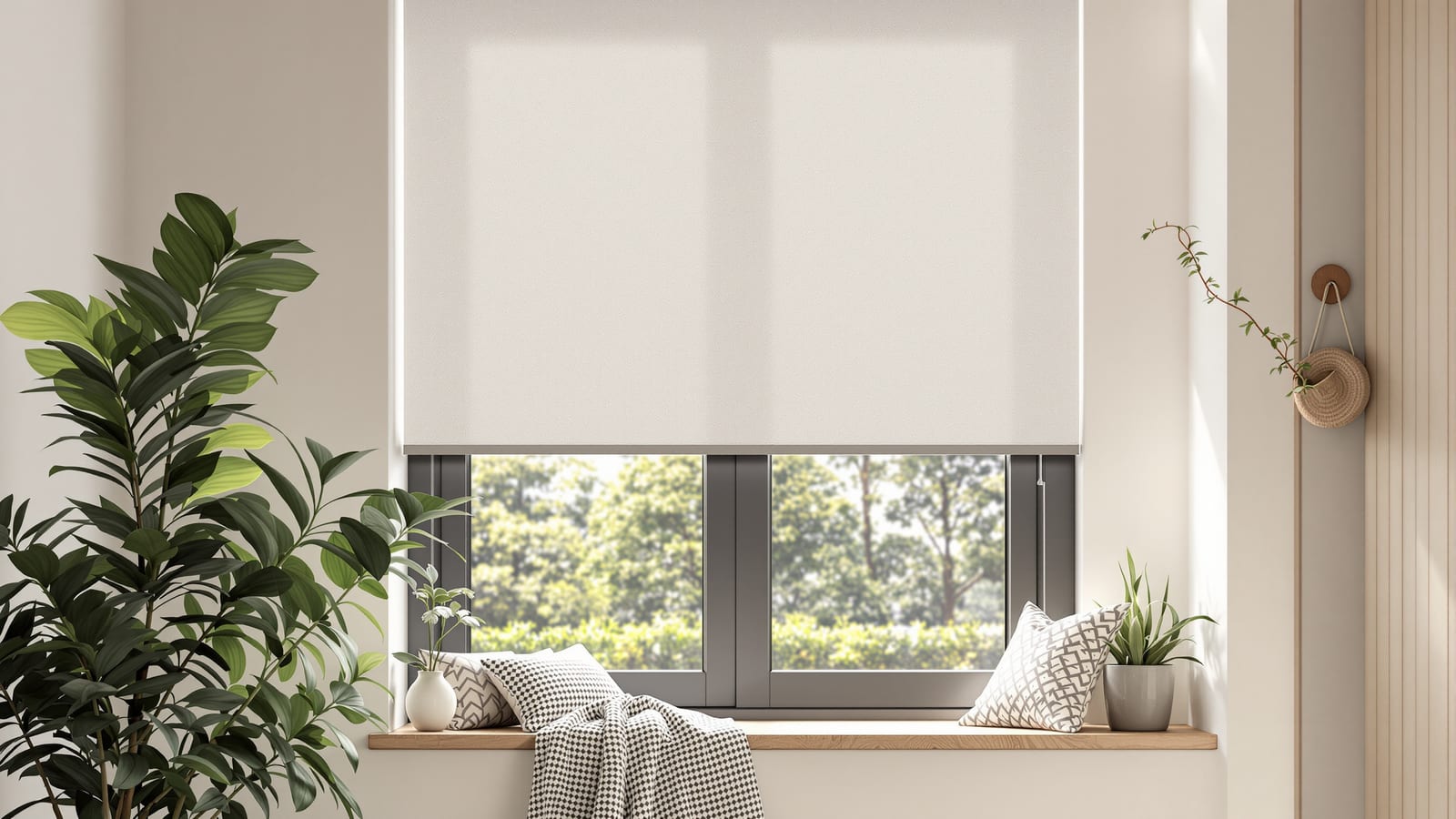
A roller blind is the most honest window treatment you can buy. It is a single sheet of fabric wound around a tube at the top; pull it down and it covers the glass, raise it and it disappears into a tidy roll. No pleats, no slats, no folds to hold dust. That simplicity is exactly why it has become the default tidy window cover in modern Indian homes — and why, on the wrong window, it quietly disappoints. The whole game is choosing the right fabric and the right mount, and that is what this guide is about.
A roller blind hides nothing about itself. The fabric you pick is the blind — there is no lining, no fullness, no second layer to rescue a wrong choice. Get the cloth right and everything else is easy.
If you are still weighing roller blinds against curtains or other blinds entirely, the curtains vs blinds comparison is the fork in the road; this piece assumes you are leaning roller and want to do it well. For the full window-treatment picture, the complete curtain and window-treatment guide is the pillar.
How a roller blind actually works
Every roller blind is the same three parts: a tube (the roller) at the top, a flat sheet of fabric wound around it, and a control that turns the tube. Lower the blind and fabric unwinds down the window; raise it and the fabric winds back up onto the tube, where it sits as a slim cylinder behind a neat fascia or cassette.
Because there is only one flat layer, a roller has no "stack" of folds eating into the glass when raised, and nothing for dust to settle into — a real advantage in Indian conditions. The trade-off is equally simple: a roller is either down, up or somewhere in between, with no slat-tilt and no day-night graduation. For that graded control you want a zebra (day-night) blind or a roman blind instead. The roller's strength is clean, minimal, low-maintenance coverage — and that lives or dies on the fabric.
The four fabric families — the only choice that matters
People agonise over colour and miss the decision that actually decides how the blind performs: which fabric family it is cut from. There are four, and they do genuinely different jobs.
| Fabric family | What it does | Daytime view out | Best rooms |
|---|---|---|---|
| Translucent / light-filter | Lets soft daylight through, glows the room, no see-through | Diffused, no clear view | Living rooms, kitchens, gentle daylight |
| Sunscreen / solar | Open weave that cuts UV and glare while keeping a view out | Clear-ish view out, screened in by day | Studies, offices, balconies, hot windows |
| Dim-out | Heavily blocks light without total darkness; some leak at edges | None | Bedrooms wanting darker, TV rooms |
| Blackout | Coated fabric that stops light almost completely | None | Bedrooms, nurseries, home theatres |
A few honest notes. Translucent is the soft, glowy everyday choice but gives privacy only by day — switch the lights on at night and it becomes a lit stage to the street, the same trap that catches sheer curtains. Sunscreen (also called solar) fabric is the under-rated hero for India: its open micro-weave is rated by an "openness factor" (3–5% is typical for homes — lower numbers screen more glare), and it keeps an outward view while cutting UV and screen glare, which is why it owns home offices and bright balconies. Dim-out darkens well but is not total. Blackout is the only one that truly kills light, and even then a roller leaks a thin halo down each side of the window — the limitation of a flat sheet narrower than the wall, which the mount solves.
Chain vs spring vs motorised: the control
The three ways to raise and lower a roller blind feel small on paper and matter every single day in practice.
- Chain-operated (clutch) — a continuous bead chain on one side spins the tube; the blind holds at any height you stop it. This is the workhorse default: reliable, cheap, repairable, and it holds heavy or wide blinds without strain. The bead chain is the one to flag if you have young children — insist on a safety break-away connector or a tensioned cleat, or skip to a wand or motor.
- Spring-operated (spring roller) — a tensioned spring inside the tube; a gentle tug-and-release snaps it up like an old projector screen. No dangling chain (cleaner and child-safer), but it is fiddlier to stop at a precise height and the spring weakens over years. Best on small, light windows.
- Motorised — a tubular motor inside the roller, driven by remote, app, voice or schedule. The premium option, and the one that turns a roller into genuine comfort — a blind that drops itself against the 3 pm west sun, or lifts at dawn, on the windows you use most. Choose rechargeable battery motors to retrofit anywhere without wiring, or wired motors (planned during construction) for the windows you will never want to recharge.
Motorisation is worth it selectively — the living room, the main bedroom, and any window that is high or awkward to reach. For the full automation picture, ecosystem choices (Alexa, Google Home, Matter) and whether the spend pays off, see smart blinds.
Inside vs outside mount — and how to size it
This single decision changes both the look and the performance, and it is the one most people get wrong.
Inside (recess) mount sits the blind inside the window opening, flush with the wall. It looks crisp and tidy — the cleanest modern look — and is the natural choice when the recess is deep and square. The catch: the fabric is necessarily a little narrower than the opening, so light leaks down both sides. Fine for a study or kitchen; a real problem for a blackout bedroom.
Outside (face / wall) mount fixes the blind on the wall above and beyond the opening, overlapping the glass on all sides. It is the answer for blackout (the overlap kills the side-light halo), for shallow or out-of-square recesses, and for making a small window look larger. It reads a touch less minimal but performs better where darkness or coverage matter.
Sizing rules that prevent most regrets:
- Inside mount: measure the recess width in three places (top, middle, bottom) and use the narrowest; the maker deducts a small clearance so the blind runs free. Check the recess is at least deep enough for the tube and bracket.
- Outside mount: add 10–15 cm of overlap each side and a similar amount above, so the blind genuinely covers and (for blackout) seals the edges.
- Decide the drop to sill, just below sill, or to the floor for tall windows — and always note which side you want the chain or motor.
When in doubt, outside-mount a blackout bedroom and inside-mount everything else. If you would rather not measure and choose blind by blind, the window treatment selector maps your room, orientation and priorities to the right fabric, mount and control in a couple of minutes.
The best rooms for a roller blind
Rollers are not a whole-home answer — they are brilliant in some rooms and second-best in others.
- Kitchen — the roller's home turf. A wipeable translucent or sunscreen roller stays clean near grease and steam, has no folds to trap dust, and keeps fabric clear of the flame. The single most sensible kitchen window cover.
- Home office / study — a sunscreen roller is purpose-built here: it kills screen glare and harsh afternoon light while keeping a view out, so the room never goes cave-dark.
- Balcony / utility — a moisture- and weather-tolerant sunscreen or PVC-coated roller takes the heat, dust and occasional rain spray better than fabric.
- Bedroom — a blackout roller works only if you outside-mount it for the side overlap; inside-mounted, it leaks a halo of dawn light. For total dark, pair it with a dress curtain.
- Bathroom — a small PVC or moisture-resistant roller suits the damp far better than cloth.
The room a roller is weakest in is a formal living room you want to feel warm and tall — there a softer roman blind, or a roller hidden behind a floor-length dress curtain, reads more finished.
Roller blinds vs the alternatives
Quick honest positioning so you know what you are trading:
- vs curtains — the roller is cheaper, cleaner, far more minimal and easier near moisture; the curtain is warmer, taller-looking, better for acoustics and night privacy. The smartest living rooms use both: roller at the glass, curtain beside it. (More in curtains vs blinds.)
- vs zebra blinds — a zebra blind gives you the roller's clean look plus graded day-night control as its sheer and opaque bands slide over each other; it costs a bit more and is the upgrade when you want adjustability.
- vs venetian / other blinds — for the full menu of blind types and where each wins, types of window blinds is the catalogue read.
What roller blinds cost in India
Roller blinds are usually the cheapest tidy per-window option, but the range is wide because the fabric and the control swing the price hugely. Treat these as honest brackets, not quotes:
- Plain translucent / light-filter rollers are the cheapest entry, often the lowest cost of any custom blind per window.
- Sunscreen / solar and dim-out sit a step up — you pay for the technical weave or coating.
- Quality blackout rollers cost more again for the coated, light-tight fabric.
- Motorisation is the big multiplier: a tubular motor (and optional hub) adds a meaningful per-window cost on top, with wired installs costing more in labour and battery motors more per unit.
The cost drivers people underestimate are fabric grade and motorisation, not size. To put rupees on it, the curtain cost calculator sizes fabric and price from your window dimensions, and the curtain cost guide breaks down ready-made versus custom and the hidden costs across the whole window-treatment category.
Care, and the honest caveats
Roller blinds are the lowest-maintenance treatment you can own, which is half their appeal. Keep them simple: a regular dust with a dry microfibre cloth or a vacuum brush; spot-clean fabric rollers with a damp cloth and mild soap (test a corner first); wipe PVC and sunscreen rollers down directly. Never machine-wash a coated blackout or sunscreen blind — the coating and the dead-flat hang both suffer. Keep the chain and the roller end-caps clean so the tube runs true, and on a motorised blind keep the rail clear and the battery charged.
Two India-specific honesty notes. Sun and dust are the real enemies: on a bright west window, lightweight translucent fabrics can yellow and weaken over years of hard UV — favour fade-rated sunscreen or quality blackout on the harshest glass, and expect more frequent dusting in dusty cities. And every cost and dimension here is indicative — measure your own windows and price fabrics locally before you commit, and treat any Vastu colour or direction preference as cultural guidance, never a reason to block needed light or heat control.
The five-move summary
1. Pick the fabric family first — translucent for soft daylight, sunscreen for glare-plus-view, dim-out or blackout for darkness.
2. Match it to the room — kitchen and office love rollers; bedrooms need blackout and an outside mount.
3. Choose the control — chain for the workhorse default, spring for small light windows, motor for the windows you use most.
4. Decide the mount — inside for the clean look, outside for blackout and full coverage; size with the right overlap.
5. Price it honestly — fabric grade and motorisation move the cost far more than size.
Do those five in order and the roller blind becomes the easy, reliable, low-fuss window cover it is meant to be.
Let Studio Matrx pick your blind for you. Answer a few questions in the window treatment selector for a fabric, mount and control matched to your room and orientation — then read the complete curtain and window-treatment guide and explore the rest of the Window Treatments cluster.
Export this guide
Related Guides — Deep-dive reading
Curtains vs Blinds: The Complete Comparison for Indian Homes (2026)
Light, privacy, heat, noise, cleaning, cost and looks — a head-to-head verdict on curtains and blinds, plus the under-rated answer most good designers actually use: both.
Window TreatmentsRoman Blinds: The Complete Guide for Indian Homes (2026)
The soft fabric blind that folds up in neat stacks — flat vs hobbled folds, lining and blackout, fabrics, cord vs chain vs motor, costs and cleaning, decoded for Indian rooms.
Window TreatmentsAutomated Window Treatments: The Complete Guide (India 2026)
The umbrella overview of every motorised covering — curtains, roller, zebra and honeycomb shades — the motor and ecosystem stack, the real benefits versus the hype, planning during construction or as a retrofit, honest costs, and how to start small.
Window TreatmentsRelated Tools — Try Free
Cross-Ventilation Analyzer
Estimate airflow and air changes per hour (ACH) from room size, window areas, layout, and local wind — with NBC 2016 Part 8 compliance check.
Ventilation CalculatorCurtain Cost Calculator
Get the fabric metres you need plus the total curtain cost by window size, fabric, pleat, lining and hardware.
Curtain CalculatorWindow Treatment Selector
Curtains, blinds or a layered system? Answer five questions about your room and get a specific recommendation.
Selector