
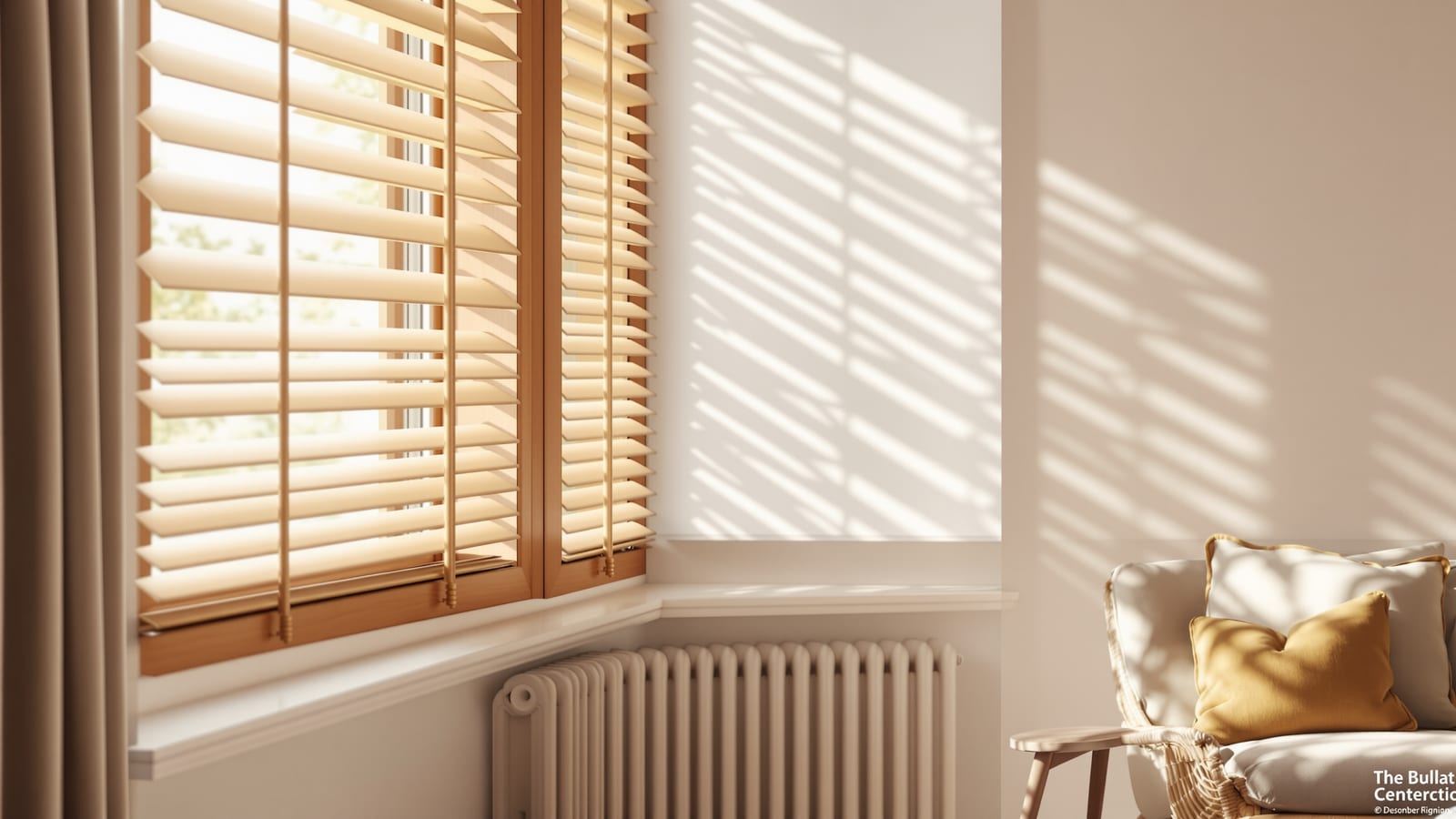
Wooden Blinds Guide: Real Wood vs Faux-Wood for Indian Homes (2026)
The warmth of timber slats versus the humidity-proof sense of faux-wood — how to choose horizontal wooden blinds that survive Indian monsoons, coastal damp and west-sun heat.
Few window treatments do for a room what wooden blinds do. The horizontal slats throw soft, banded light, the timber grain warms up an entire wall, and a well-fitted wooden blind reads as quietly expensive in a way no roller shade ever will. They are the natural choice for living rooms, studies and dry bedrooms where you want character, tilt-control over light, and a finish that looks built-in rather than bought.
But wooden blinds carry one decision that matters more in India than almost anywhere: real wood or faux-wood? Get this wrong and the slats that looked perfect in the showroom will bow, warp and discolour through your first monsoon. Get it right and you have a treatment that lasts a decade. This guide is built around that single fork in the road.
Real wood is the look; faux-wood is the insurance. In a humid Indian climate the smart move is rarely "the prettier one" — it is matching the material to how wet that particular room actually gets.
What "wooden blinds" actually means
Wooden blinds are horizontal slat blinds — flat timber (or timber-look) slats strung on cords or tapes, which you tilt to control light and raise to clear the window. Tilt the slats and you go from full daylight to near-private dimness without moving the blind at all. That tilt-and-band light is their signature, and it is why they suit rooms you live in rather than just sleep in.
They are a close cousin of Venetian blinds — in fact a wooden blind is a Venetian blind made of wood rather than aluminium. The difference is material and mood: aluminium Venetians are crisp, light and office-like; wooden blinds are warm, heavier and homely — they belong in homes. If you are weighing slat materials broadly, the types of window blinds overview maps where wooden, roller, Roman and bamboo all sit.
Real wood vs faux-wood: the honest comparison
This is the whole guide in one table. "Faux-wood" means a slat moulded from PVC, vinyl or a wood-composite with a printed grain; "real wood" is usually basswood (the global standard — light, stable, fine-grained) or sometimes cedar or other hardwoods.
| Factor | Real wood (basswood/cedar) | Faux-wood (PVC/composite) |
|---|---|---|
| Look & warmth | Best — genuine grain, depth, character | Good — convincing but flatter, slightly "printed" |
| Weight | Light, easy to lift on wide windows | Heavier; large windows feel weighty |
| Humidity & monsoon | Risk — can warp, bow, swell, discolour | Excellent — waterproof, will not warp |
| Coastal / bathroom / kitchen | Avoid | Ideal — built for it |
| Fade in direct sun | Can lighten/yellow over years | Holds colour better |
| Cleaning | Dust only; never soak | Wipe with a damp cloth, fully washable |
| Cost | Higher | Lower (often 30–50% less) |
| Lifespan in dry rooms | Excellent with care | Excellent |
The pattern is clear: real wood wins on looks and weight; faux-wood wins on durability, moisture and price. Everything below is about reading your own rooms against that trade-off.
The India humidity caveat — read this before you buy
This is the part showrooms skip. India's climate is hostile to natural timber slats in a way temperate countries never deal with. The monsoon pushes indoor humidity to saturating levels for weeks; coastal cities like Mumbai, Chennai, Kochi and Goa stay damp for much of the year; and a wooden slat sitting in a bathroom, an unventilated kitchen or against a window that gets driven rain will absorb moisture, swell unevenly, and bow or warp permanently. Once a real-wood slat has bowed it does not recover.
So the rule is simple and non-negotiable:
- Wet, humid or coastal rooms → faux-wood, always. Bathrooms, kitchens, balcony-facing windows, any room in a high-humidity coastal city, and any window that catches monsoon rain. Faux-wood is waterproof and will shrug all of it off.
- Dry, sheltered rooms → real wood is safe and worth it. Living rooms, studies, formal bedrooms, dining rooms in non-coastal cities, away from direct splashing — here the warmth of real basswood pays off.
If you are unsure how humid a room really runs, default to faux-wood. It is the lower-regret choice, and modern composites look good enough that almost no guest will know the difference. The window-treatment selector factors room and climate into its recommendation if you want a second opinion.
Slat sizes — and what they do to a room
Slat width changes the whole character of the blind, not just the view.
- 25 mm (1 inch) — fine, delicate, busiest look. Best for small windows and where you want maximum privacy when closed. More slats means more cords and more dusting.
- 50 mm (2 inch) — the all-rounder and most popular size in Indian homes. Balanced proportions, clear view-through when tilted open, suits most living rooms and bedrooms.
- 63 mm / 64 mm (2.5 inch) — bold, architectural, the cleanest open view with the fewest slat-lines. Best for large windows and contemporary rooms; it looks generous and expensive.
A working rule: the bigger the window, the wider the slat should be. A 50 mm slat on a small bathroom window looks chunky; a 25 mm slat on a wide living-room window looks fussy and cluttered. For most rooms, 50 mm is the safe, handsome default.
What wooden blinds cost in India
Treat these as honest ranges — price swings with material, slat size, window dimensions, city and whether you go ready-made or custom-fitted:
- Faux-wood (PVC/composite) — typically ₹150–₹400 per sq ft of window, the value choice. A standard 4×5 ft window often lands in the ₹3,000–₹8,000 range fitted.
- Real wood (basswood) — typically ₹350–₹800+ per sq ft, climbing with premium timbers and finishes. The same window commonly runs ₹7,000–₹16,000+ fitted.
- Add-ons — cordless/child-safe lift mechanisms, motorisation, and decorative cloth tapes (ladder tapes that hide the cord holes) all add to the base price.
So faux-wood routinely costs 30–50% less than real wood for the same window — another reason it wins for the rooms where looks matter least. To budget a whole house of windows against curtains and other blinds, the curtain cost calculator gives quick per-window comparisons, and the curtain cost guide breaks down where the money actually goes across treatment types.
Best rooms for wooden blinds
- Living room — the showcase room. Real wood (in a dry city) for warmth, 50 mm or 63 mm slats, tilted to band the afternoon light. This is where timber earns its premium.
- Study / home office — excellent: tilt the slats to kill screen glare without going fully dark. Real wood if the room is dry; faux-wood if it shares a damp wall.
- Dry bedrooms — wooden blinds give privacy and dimming, but note they are not true blackout — light leaks between slats and through the cord holes. Pair with curtains or a blackout layer if deep sleep matters.
- Bathroom / kitchen — faux-wood only. Real wood will not survive the steam and splashing.
- Coastal-city homes — faux-wood throughout, regardless of room, unless a room is genuinely sealed and air-conditioned year-round.
For windows that need both softness and full darkness, many Indian homes layer a wooden blind with a curtain — the curtains vs blinds comparison covers when to combine them, and the complete curtain guide covers the curtain half of that pairing.
Care: making them last
- Dust regularly — slats are dust magnets. A microfibre cloth, a soft duster or the brush attachment of a vacuum, slats tilted flat, takes two minutes.
- Real wood: never wet it. No damp cloths, no sprays, no soaking — moisture is exactly what warps it. Dust only; for marks, a barely-damp cloth wiped dry immediately at most.
- Faux-wood: wipe freely. A damp cloth or mild soapy water is fine; this is its whole advantage. You can even take some faux-wood blinds down and rinse them.
- Tilt closed when the room is empty in peak sun to slow fading on real wood.
- Check the lift cords every few months; frayed cords are the usual failure point. Cordless mechanisms avoid this and are the safer choice around children.
Wooden blinds vs the close cousins
Three treatments sit right next to wooden blinds, and the differences decide which you actually want:
- Versus Venetian (aluminium) blinds — same horizontal-tilt mechanism, different soul. Aluminium is lighter, cheaper, fully waterproof and office-crisp; wood is warmer and more residential. Choose aluminium for utility windows and wood for living spaces.
- Versus bamboo blinds — bamboo (and woven-wood) blinds are a different look entirely: natural, textured, roll-up rather than tilt-slat, with a relaxed organic feel. They suit verandahs and casual rooms; wooden blinds are more tailored and architectural.
- Versus curtains — blinds give precise tilt-control of light in a slim, hard-edged package; curtains give softness, insulation and blackout. Most well-dressed Indian rooms end up with one of each.
How to choose, in four moves
1. Read the room's humidity. Wet, coastal or monsoon-exposed → faux-wood, no exceptions. Dry and sheltered → real wood is on the table.
2. Decide if the look is worth the premium. Living rooms and studies reward real basswood; back rooms and utility windows do not.
3. Pick the slat size — 50 mm for most rooms, 63 mm for large windows, 25 mm for small ones.
4. Plan for blackout separately if it is a bedroom — blinds dim, they do not fully darken; add a curtain.
Do those four in order and the only thing left is choosing a grain you love.
Choose the right blind for every window with Studio Matrx. Let the window-treatment selector match wooden, faux-wood or another blind to each room's light, privacy and humidity — then read the complete window treatment guide to see where wooden blinds fit alongside curtains, shades and the rest of your home's windows.
Export this guide
Related Guides — Deep-dive reading
Venetian Blinds Explained: Slats, Materials & Light Control (India 2026)
Horizontal-slat blinds decoded for Indian homes — aluminium, real wood and faux-wood, the 25/35/50 mm slat sizes, the tilt mechanism that gives precise light and privacy, honest pros and cons, real rupee costs and dust-smart care.
Window TreatmentsCurtains vs Venetian Blinds: Precision vs Softness (India 2026)
Tilt-precise venetians or warm, quiet curtains? A room-by-room, rupee-by-rupee verdict for Indian homes — including the dust and wind caveats nobody mentions, and the combo that beats both.
Window TreatmentsCurtains vs Blinds: The Complete Comparison for Indian Homes (2026)
Light, privacy, heat, noise, cleaning, cost and looks — a head-to-head verdict on curtains and blinds, plus the under-rated answer most good designers actually use: both.
Window TreatmentsRelated Tools — Try Free
Window Treatment Selector
Curtains, blinds or a layered system? Answer five questions about your room and get a specific recommendation.
SelectorCurtain Cost Calculator
Get the fabric metres you need plus the total curtain cost by window size, fabric, pleat, lining and hardware.
Curtain CalculatorCross-Ventilation Analyzer
Estimate airflow and air changes per hour (ACH) from room size, window areas, layout, and local wind — with NBC 2016 Part 8 compliance check.
Ventilation Calculator