

Acoustic Glass for Homes in India: Quieting Road, Rail and City Noise
How laminated acoustic-PVB glass in an asymmetric DGU cuts traffic, rail and city noise, what the decibel ladder really delivers, and why sealing the whole window matters more than pane count.
If you live within earshot of a flyover, a railway line, an airport approach or a market street, you already know the cost of noise: broken sleep, raised voices, a home that never quite feels like a refuge. Acoustic glass is the most effective single upgrade you can make to a window to fight that noise, but it is widely misunderstood. It is not a magic pane, and it is not "thicker glass." This guide explains what acoustic glass actually is, how much quiet it buys in decibels, where it is worth the premium, and the one thing most people get wrong: the glass is only as good as the seal around it.
What "acoustic glass" really is
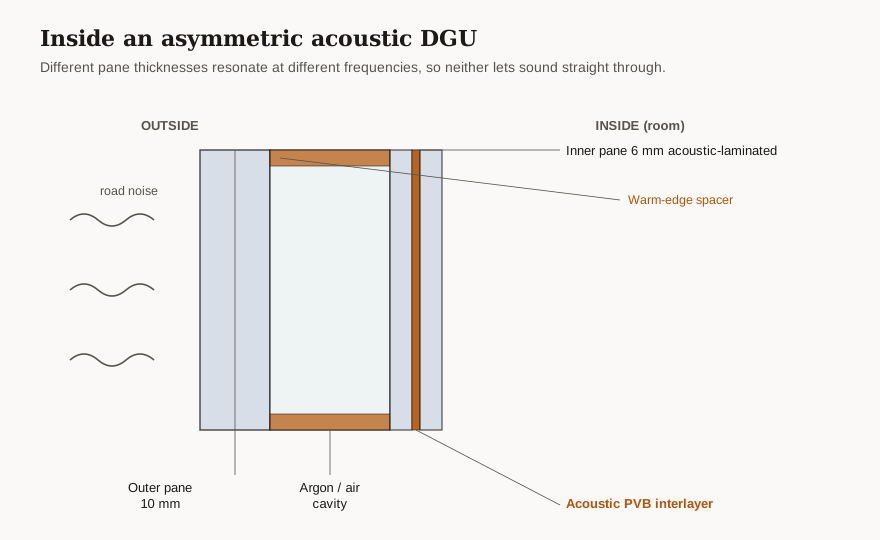
Acoustic glass is laminated glass made with a special acoustic PVB interlayer. Ordinary laminated glass bonds two panes with a polyvinyl butyral (PVB) interlayer for safety and security; acoustic-grade PVB is a softer, more visco-elastic version that is far better at converting sound-wave energy into tiny amounts of heat instead of letting it pass through. That damping layer is what does the work.
For serious results, acoustic glass is then assembled into an asymmetric double-glazed unit (DGU): two panes of different thicknesses (say a 6 mm acoustic-laminated pane and a 10 mm pane) separated by a spacer and a sealed air or argon cavity. The asymmetry matters. Any pane resonates and lets sound through most easily at its own "coincidence frequency." If both panes are identical, they share that weak spot. Make them different thicknesses and their weak points fall at different frequencies, so one pane plugs the gap the other leaves. That is the single cleverest idea in acoustic glazing.
The trick is not more glass. It is mismatched glass plus a soft interlayer plus an airtight seal.
The decibel ladder: how much quiet you actually buy
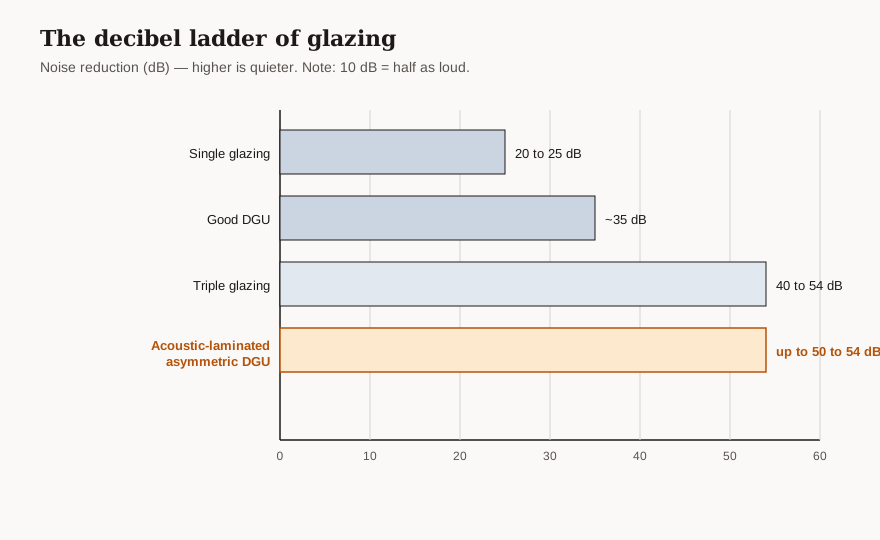
Sound reduction is measured in decibels (dB); the scale is logarithmic, so a 10 dB reduction is heard as roughly "half as loud." Here is the realistic ladder for window glazing, from the addendum.
| Glazing build | Typical noise reduction | Felt as |
|---|---|---|
| Single glazing (one pane) | about 20 to 25 dB | Baseline; traffic clearly audible |
| Good DGU (two plain panes, air or argon) | about 35 dB | Noticeably calmer room |
| Triple glazing (three panes) | about 40 to 54 dB | Strong, but heavy and costly |
| Acoustic-laminated asymmetric DGU | up to about 50 to 54 dB | The quietest practical home window |
The headline: for noise specifically, an acoustic-laminated asymmetric DGU usually beats a plain triple-glazed unit, while being lighter and cheaper, because the acoustic PVB and the pane asymmetry attack sound directly rather than just adding mass. A plain triple wins on thermal insulation, not on quiet. (See the differences in our triple-glazed windows guide.)
What matters more than the number of panes
This is the part the marketing leaves out. The factors that decide how quiet your window is, roughly in order of impact:
- Thickness and mass of the glass (heavier panes block more sound).
- The acoustic-PVB lamination (damps the resonance, especially mid and high frequencies, and kills the coincidence dip).
- Asymmetry between the two panes (different coincidence frequencies).
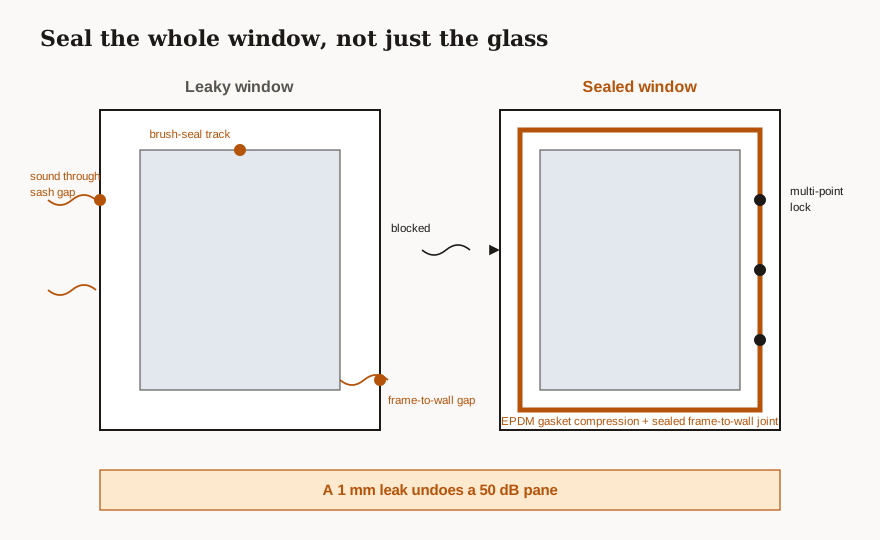
- Air-tight sealing of the whole window — the gaskets, the frame-to-glass seal, the frame-to-wall seal.
- Pane count comes last. A well-sealed acoustic DGU outperforms a leaky triple.
Sound behaves like water: it finds every gap. A 1 mm air leak around a sash can undo the benefit of a 50 dB pane, because the sound simply flows around the glass. This is why casement windows, which compress onto a continuous gasket when shut, outperform sliding windows for acoustics — sliders leave a brush-seal track that leaks both air and sound. If you are buying acoustic glass, insist on multi-point locking, EPDM gaskets, and a properly sealed frame-to-wall joint. The glass is one link in a chain.
Where it is worth the premium
Acoustic glass is a targeted upgrade, not a whole-home default. Spend it where the noise is.
| Situation | Recommended build | Worth it? |
|---|---|---|
| Bedroom facing a busy arterial road or flyover | Acoustic-laminated asymmetric DGU on the noise-facing wall | Strongly yes |
| Home near a railway line or metro viaduct | Acoustic DGU, thicker outer pane for low-frequency rumble | Yes |
| Apartment under an airport approach path | Acoustic DGU plus tight casement seals | Yes |
| Flat above a market, temple street or event ground | Acoustic DGU on the affected rooms | Yes |
| Quiet interior rooms, low-noise streets | Plain DGU is plenty | No, save the money |
A practical strategy in a multi-room home: put acoustic glass on the bedrooms and study facing the noise source, and standard DGU elsewhere. Low-frequency rumble (trains, heavy trucks) is the hardest to stop and benefits most from a thicker outer pane.
Cost: priced on top of the frame
Acoustic glass is bought as the glass package that sits on top of your frame cost (uPVC, aluminium, wood). Indicative June 2026 figures, which vary by city, brand and size — always confirm with itemised fabricator quotes, and add 18 per cent GST:
| Glass build (glass only, on top of frame) | Indicative add-on |
|---|---|
| Plain DGU (air-filled) | about ₹250 to 450 per sqft |
| Plain DGU with argon and Low-E | about ₹400 to 650 per sqft |
| Acoustic-laminated asymmetric DGU | about ₹600 to 1,200 per sqft |
The premium over a plain DGU is real but bounded — you are paying for the acoustic PVB and the thicker, mismatched panes. Because acoustic glass is laminated, you also get its side benefits for free: it blocks about 99 per cent of UV and holds together when broken, giving safety and security. (More on that in our laminated glass guide — acoustic glass is laminated glass, just with the acoustic-grade interlayer instead of standard PVB.)
Realistic expectations
Set them honestly before you spend:
- No window makes a room silent. A great acoustic window turns intrusive traffic into a soft, distant hush — it does not delete it.
- Glass alone is not enough. If the frame, gaskets and wall joint leak, the dB rating on the brochure is fiction. Seal the whole window.
- Low frequencies are stubborn. Truck and train rumble is hardest to stop; expect good improvement, not magic.
- Walls and doors matter too. If your wall is thin or you have a hollow door, the window may stop being the weakest link. Acoustic glazing pays off most when the window is genuinely the worst offender.
How acoustic glass relates to your other glass choices
Glass, frame and window shape are three separate decisions. Acoustic glass is a glass choice: you can specify it in almost any frame and most operable window types (casement seals best). It also stacks with thermal coatings — an acoustic DGU can carry a Low-E coating for heat control too, which matters in Indian summers. For the full menu of glass options and where each fits, start at our glass pillar, types of glass for windows in India. To pick the frame that carries the glass, see window frame materials compared.
In short: if noise is your problem, acoustic-laminated asymmetric DGU is the answer — but buy the sealed window, not just the pane.
References
- Glass and window solutions for homes (Saint-Gobain India): https://in.saint-gobain-glass.com/knowledge-center/glass-and-windows
- Best glass for windows in India 2026 (IndiFrame): https://indiframe.com/blog/best-glass-for-windows-in-india
- Types of Low-E and solar control glass (FG Glass India): https://fgglass.com/blogs-details/types-of-low-e-glass
- IS 1081, code of practice for fixing and glazing of metal doors and windows (BIS): https://law.resource.org/pub/in/bis/S03/is.1081.1960.pdf
- Eco-Niwas Samhita 2018 (BEE/ECBC): https://ecbc.in/econiwas.html
Export this guide
Related Guides — Deep-dive reading
Soundproof Doors in India: How Doors Leak Sound, STC Ratings, Seals & Real Costs
A door is the weakest acoustic link in any wall - and it usually leaks through the gaps, not the panel - so here is how to actually quieten a bedroom, home theatre or street-facing room, from a 1,500-rupee seal kit to a proper acoustic door.
Home Doors & EntrancesTypes of Home Windows in India (2026): Complete Comparison and How to Choose
Every window type compared on ventilation, cost and best use, plus a frame, glazing and climate framework to choose right.
Windows & GlazingDoor Sound Insulation: Improve It Step by Step (India 2026)
The physics of mass, sealing and decoupling — and how to upgrade an ordinary Indian door to genuinely cut the noise coming through it.
Home Doors & EntrancesRelated Tools — Try Free
Window Material Comparison Tool
Compare uPVC, aluminium, wood, steel and composite windows on cost, life, upkeep and insulation.
CompareAcoustic Window Calculator
Estimate how much outside noise a window blocks and the resulting indoor dB level and comfort.
Window ToolGlass Selection Tool
Single vs double (DGU) vs triple glazing and the right glass type for your climate, priority and sun.
Window Tool