

Joseph Allen Stein
The American who made India's greenest modernism
Movements
Signature works
- India International Centre, New Delhi
- India Habitat Centre, New Delhi
- Triveni Kala Sangam, New Delhi
- Ford Foundation building, New Delhi
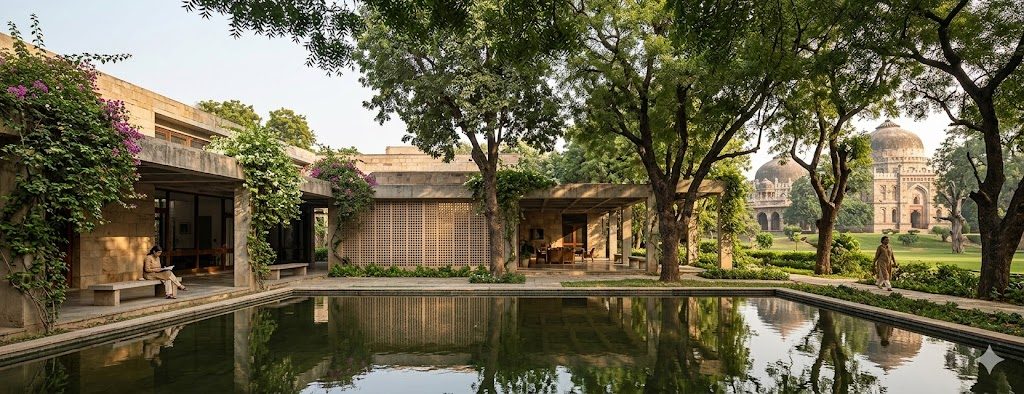
Walk along the southern edge of Delhi's Lodi Gardens on a hot April morning and the city's roar suddenly drops away. You pass through a low gate, under a deep stone-flagged verandah, and into the India International Centre — and the temperature seems to fall with the noise. Light is filtered through a pierced concrete screen; a pool lies still in a planted court; a great old tree leans over the terrace; and the building, low and grey-stoned and quietly self-effacing, gives every appearance of having grown out of the garden rather than having been set down upon it. It is impossible to say where the architecture ends and the landscape begins. That, exactly, was the point.
The man who made this place was Joseph Allen Stein — an American, born in Omaha, Nebraska, in 1912, who came to India in 1952 and never really left, spending nearly half a century making a gentle, green, humane modernism that belongs to Delhi as surely as the tombs of the Lodis next door. By the time he died in 2001 he had given the city a whole cluster of buildings so identified with him that Delhiites affectionately call the quarter around Lodi Gardens "Steinabad."
Stein's conviction was that a building and its garden are one thing, not two — that in a hot land architecture should be conceived together with climate, water, shade and growing plants, at a calm and human scale. Long before the words were fashionable, he built the most thoroughly biophilic, climate-responsive and human-centred modernism in India, and he proved that an outsider could root himself so deeply in a place that the place would claim him as its own.
The idea: the building and the garden as a single design
Most architects design a building and then decide what to plant around it. Stein worked the other way. For him the garden, the courtyard, the pool, the pergola and the tree were not landscaping applied afterwards but parts of the plan itself, drawn at the same time and on the same sheet as the walls and the roofs. A Stein building is porous: you move through it from shaded court to deep verandah to planted terrace, never quite leaving the open air, the way one moves through a garden.
This was an environmental philosophy as much as an aesthetic one. Stein had learned, in California, to read the sun and the wind, and he carried that habit to the punishing climate of the North Indian plain. His buildings cool themselves by shape and by green before they ever reach for a machine. Bioclimatic courtyards trap shade and channel breeze; deep verandahs and pergolas throw long shadows across the facades; jali screens — the pierced screen of Indian tradition, reborn in concrete — filter the glare while letting air pass; water sits in the courts to cool the air by evaporation; and indigenous planting, chosen to thrive in Delhi rather than to impress a visitor, threads through it all.

The materials matched the mood: local stone in warm greys and ochres, exposed concrete used quietly rather than as muscle, deep eaves, restrained detail. Nothing shouts. Where his great Indian contemporaries could be monumental, Stein chose a deliberately low, human scale — rooms and courts sized to the body, to conversation, to a slow walk in the shade. His was a modernism without ego, designed to be lived in and grown old in rather than admired from a distance. It is the architecture of comfort in the deepest sense: shade, air, water, green and quiet, assembled with great care into a place that simply feels good to be in.
Life and path
Joseph Allen Stein was born on 10 April 1912 in Omaha, Nebraska, in the American Midwest. He studied architecture at the University of Illinois, then went on to the Cranbrook Academy of Art in Michigan, that remarkable crucible of mid-century American design, where he came under the influence of the Finnish master Eliel Saarinen. Cranbrook taught a modernism that was warm rather than doctrinaire — attentive to craft, to landscape and to the total designed environment — and that warmth never left Stein's work.
He then went to California, and California made him. In the years before and around the Second World War the West Coast was inventing a softer, sun-aware modern architecture, open to garden and climate in a way the International Style was not. Stein absorbed the lessons of Richard Neutra, whose Californian houses dissolved the wall between inside and out, and worked in the orbit of the landscape architect Garrett Eckbo, who insisted that buildings and gardens be designed as one continuous environment. Out of this came Stein's lifelong creed: that climate and landscape are not constraints on architecture but its very substance. He was, in the language of a later generation, an environmental modernist — green decades before the word was claimed by anyone.
In 1952 a different path opened. Stein accepted an invitation to come to India and head the Department of Architecture at the Bengal Engineering College, near Calcutta, in a young republic hungry for builders and teachers. What might have been a posting became a homecoming. After Bengal he moved to Delhi, settled there permanently, and built his life and his practice in the city he would spend the next half-century shaping. He practised in partnership as Stein, Doshi & Bhalla — with Jai Rattan Bhalla and others — a firm whose name became shorthand in Delhi for a particular kind of gracious, landscape-bound public building.

The decision to stay was the decisive one of his career. Many foreign architects passed through Nehru's India, left a monument and departed — Le Corbusier at Chandigarh, Louis Kahn at Ahmedabad. Stein did the opposite. He sank roots, learned the place across decades, and let his architecture mature slowly into something neither American nor borrowed but genuinely of Delhi. India was not an episode in his life; from 1952 onward it was his life entire.
The signature works
Stein's Indian work is concentrated, mostly in Delhi, and grows in ambition across his career — from an early arts centre to a vast civic complex completed when he was past eighty. A handful of buildings carry the argument.
| Work | Place & dates | Why it matters |
|---|---|---|
| Triveni Kala Sangam | New Delhi, 1950s–60s | An arts centre of terraced courts, galleries and gardens — an early demonstration that culture in Delhi could be housed in light, shade and green rather than grandeur. |
| India International Centre | New Delhi, 1962 | His most beloved building: a low, stone-faced retreat beside Lodi Gardens, dissolving into pool, court and tree. The clearest statement of building-as-garden. |
| Ford Foundation building | New Delhi | A restrained, climate-tuned headquarters in the same Lodi-area idiom — deep shade, screens and planting in the service of quiet civic work. |
| India Habitat Centre | New Delhi, completed 1993 | His magnum opus: interlinked bioclimatic courtyards shaded by great steel pergolas, a city-block of green public space — biophilic modernism at full scale. |
| Himalayan and Kashmir projects | Northern India | Work carried into the mountains, adapting his climate-and-landscape method to cooler, steeper country. |
The India International Centre (1962) is the heart of it, and the building Stein loved most. Set against the edge of the sixteenth-century Lodi Gardens, it had to be a good neighbour to one of Delhi's most beautiful historic landscapes — and Stein answered by making the architecture almost recede. The IIC is low and horizontal; its grey local stone echoes the old tombs; its rooms open onto courts, pools and a great existing tree that the plan was bent to preserve. Deep verandahs and a pierced screen filter the harsh light. To sit on its terrace at dusk is to feel the building and the garden breathing as one — exactly the seamlessness Stein had first glimpsed in California, now perfected for Delhi.
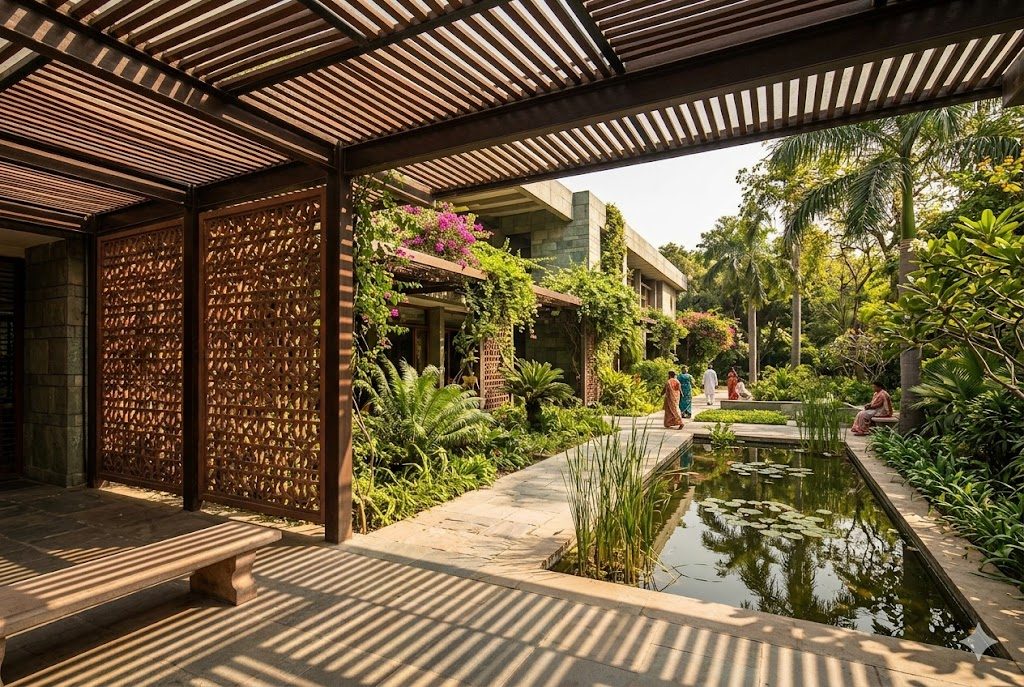
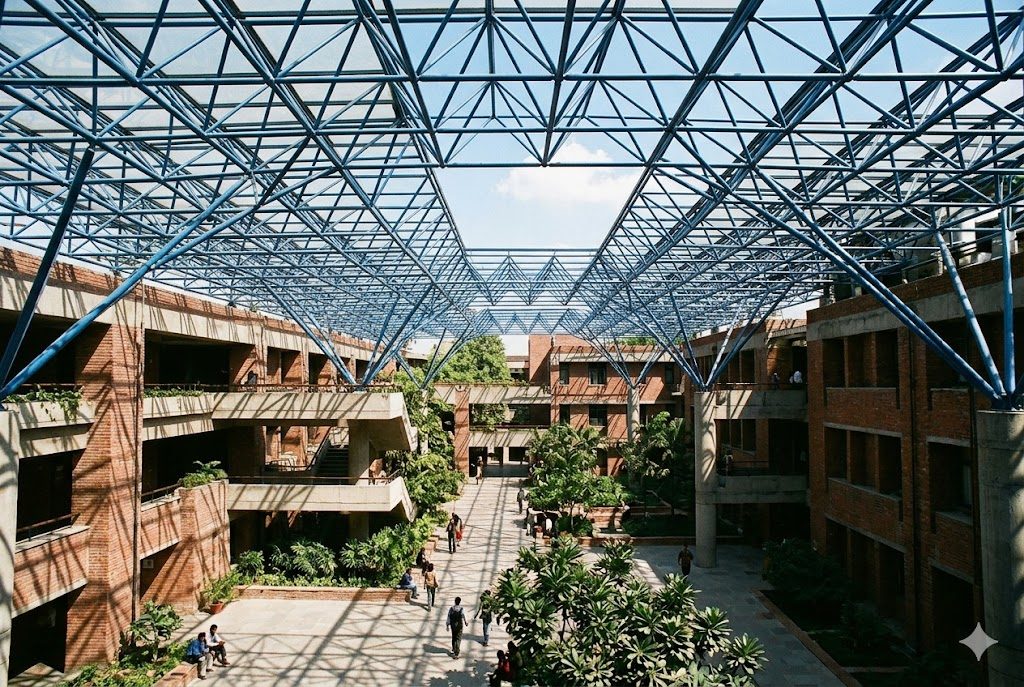
The India Habitat Centre, completed in 1993 when Stein was eighty-one, is the grand culmination of his method. Where the IIC is a single jewel, the Habitat Centre is a whole quarter — a dense block of offices, institutions and public rooms organised around a sequence of interlinked courtyards. The masterstroke is the shading: enormous steel pergolas, fitted with blue glazed inserts, are stretched across the courts high overhead, throwing patterned shade onto the spaces below and turning what could have been hot, hard plazas into cool, dappled, usable outdoor rooms. It is a bioclimatic city in miniature, and it remains one of Delhi's most loved public places — proof that the principles of a small garden building could be scaled up to serve thousands.
Triveni Kala Sangam, from earlier in his career, set the template: an arts centre of stepped terraces, intimate galleries and small gardens where Delhi's cultural life could unfold in the shade. And the Ford Foundation building carried the same Lodi-area language into the world of institutions. Together with the IIC, these buildings clustered so tightly around Lodi Gardens, and bore his signature so unmistakably, that the neighbourhood earned its affectionate nickname — "Steinabad," a corner of Delhi quite literally named for an architect.
The philosophy
Stein is one of the purest exponents of biophilic architecture — the idea that human beings have an innate need for contact with nature, and that buildings should satisfy it rather than wall it out. For Stein this was never decoration. The court, the pool, the tree, the planted terrace and the filtered light were the structure of his plans and the source of their comfort. He designed, in effect, inhabited gardens, and he did so two generations before "biophilic design" became a movement with a name.
That same instinct made his work a model of human-centred design. Stein measured his buildings by how it feels to be in them — the relief of stepping into shade, the ease of a low and unhurried scale, the pleasure of a breeze across water. He refused monumentality in favour of the body's actual experience of warmth, light and air, designing for the slow, sociable, climate-following rhythm of daily life rather than for the photograph or the grand gesture.
And though he came from abroad, Stein belongs squarely to the story of critical regionalism — the conviction that good modern architecture must resist a placeless international style and root itself in local climate, material and culture. He did not import California to Delhi; he let Delhi's heat, its light, its stone and its tradition of the jali screen reshape what he had learned, until the result was unmistakably of its place. His career is a striking demonstration that regionalism is about depth of attention, not accident of birth.
In Stein's work the building and the garden were never two designs but one — architecture conceived, from the first line, as a piece of inhabited landscape.
His method connects directly to the climate logic Studio Matrx explores in its guide to courtyard homes and climate-responsive design in India: the shaded court as a working room, cooled by water and green, is the very heart of how Stein built.
India
For Joseph Allen Stein, India was not a footnote to an American career — it was the entire arc of his mature life and the whole of his legacy. He arrived in 1952, settled in Delhi, married into the country, built almost everything that matters in his oeuvre on Indian soil, and was buried, in spirit and in influence, a Delhi architect. Few foreign-born designers have ever so completely become part of the place they chose.
His gift to Delhi was a new kind of public space. Before Stein, civic and cultural buildings in the capital tended toward either colonial grandeur or the hard, sun-struck plazas of early modernism. Stein offered something gentler and more usable: the shaded court, the planted terrace, the verandah open to a garden — places designed for a hot city's people to gather, linger and breathe. The India International Centre and the India Habitat Centre are not merely admired buildings; they are among the most-loved rooms in the city, woven into the intellectual and social life of Delhi. That a single architect's idiom should so dominate one quarter that it became "Steinabad" is a measure of how thoroughly he made the place his own.
His influence on Indian practice runs deep and quiet. Working in the same decades as Charles Correa and Balkrishna Doshi, Stein shared and reinforced their central insight — that Indian modernism had to begin from climate, landscape and human comfort rather than from imported style. Where Correa gave it the open-to-sky terrace and Doshi the layered, low-energy campus, Stein gave it the green courtyard and the building dissolved into garden. His firm, Stein, Doshi & Bhalla, trained a generation of Delhi architects in the discipline of designing landscape and building as one. He also carried his method beyond the plains, into projects in the Himalayas and Kashmir, testing his climate-and-landscape philosophy against the cooler, steeper conditions of the north.
His work is the living embodiment of the principles Studio Matrx returns to again across its guides — the shaded court, the cooling pool, the breathing verandah — and a reminder that the greenest architecture India has produced was, in part, the gift of a man from Omaha who decided to stay.
Legacy and what we can learn
Stein died on 6 October 2001, having spent forty-nine years building in India. His legacy is partly a set of beloved buildings and partly a way of thinking that has only grown more urgent. In an age of glass towers cooled by ever-hungrier machines, his quiet, green, self-shading architecture reads not as nostalgia but as a roadmap — a demonstration that comfort in a hot climate can come from shade, water, green and good orientation long before it comes from electricity.
The first lesson is the one his whole career insists on: design the building and the garden together. Do not treat planting, water and shade as a finishing touch. Let the court, the tree, the pool and the pergola shape the plan from the first sketch, so that the landscape does real work — cooling the air, softening the light, making the outdoors habitable through the heat of the day. The India Habitat Centre's pergola-shaded courts prove this can be done at the scale of a city block, not just a private house.
The second lesson is about scale and ego. Stein chose, deliberately, to make buildings that recede — low, calm, stone-warm, sized to the human body and to slow companionable use. He showed that an architecture can be ambitious in its care and modest in its presence, and that such buildings are often the ones a city ends up loving most. His example is a standing rebuke to the idea that significance requires height or spectacle.
His principles are exactly the ones we encode in DesignAI — letting shade, orientation, water and planting shape a home before machines ever do — and you can test the green logic of your own design with the biophilic score.
References
- Stephen White, Building in the Garden: The Architecture of Joseph Allen Stein in India and California (Oxford University Press).
- Jon T. Lang, A Concise History of Modern Architecture in India — on Stein's place in the Indian modern movement.
- Jon Lang, Madhavi Desai & Miki Desai, Architecture and Independence: The Search for Identity — India 1880 to 1980.
- William J. R. Curtis, Modern Architecture Since 1900 — on regionalism and climate in post-independence Indian architecture.
- India International Centre and India Habitat Centre — institutional histories and architectural descriptions of the Lodi-area buildings.
- Archives and obituaries on Joseph Allen Stein (1912–2001) documenting the "Steinabad" cluster and the Stein, Doshi & Bhalla practice.
Explore the philosophies Stein championed — biophilic architecture, human-centred design and critical regionalism — alongside his great contemporaries Charles Correa and Balkrishna Doshi, study the courtyard homes of climate-responsive India, and measure the green logic of your own design with the biophilic score.
Philosophies they championed