
The reference shelf← Back to the Academy
Student Resources
The reference shelf you come back to all through the degree — the software and hardware stack in learning order, downloadable templates, a reading and watching list, a timeline of Indian architecture, career pathways and a glossary.
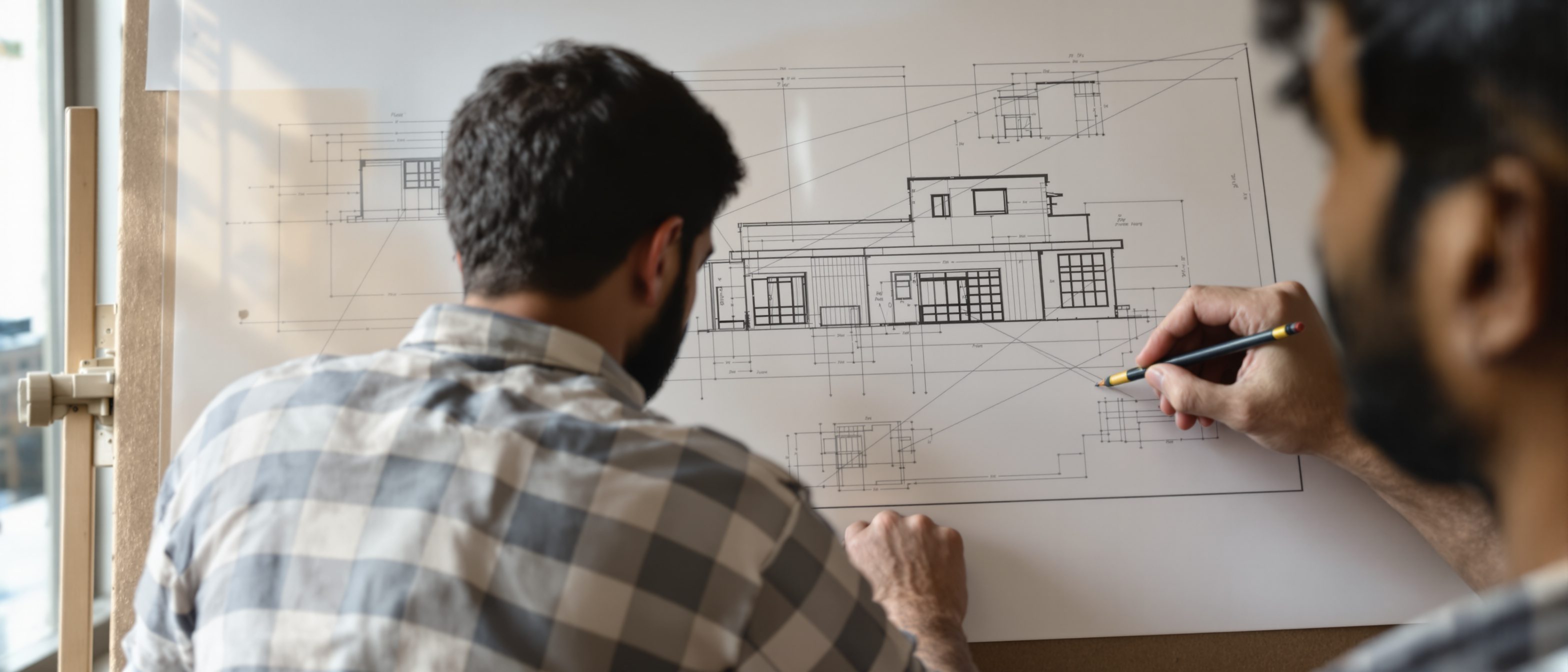
Free curated resources for architecture and interior-design students in India — software stack with Indian licensing, downloadable templates, reading list, career pathways, and a working studio glossary. Built by practitioners who remember being students.
The Software Stack
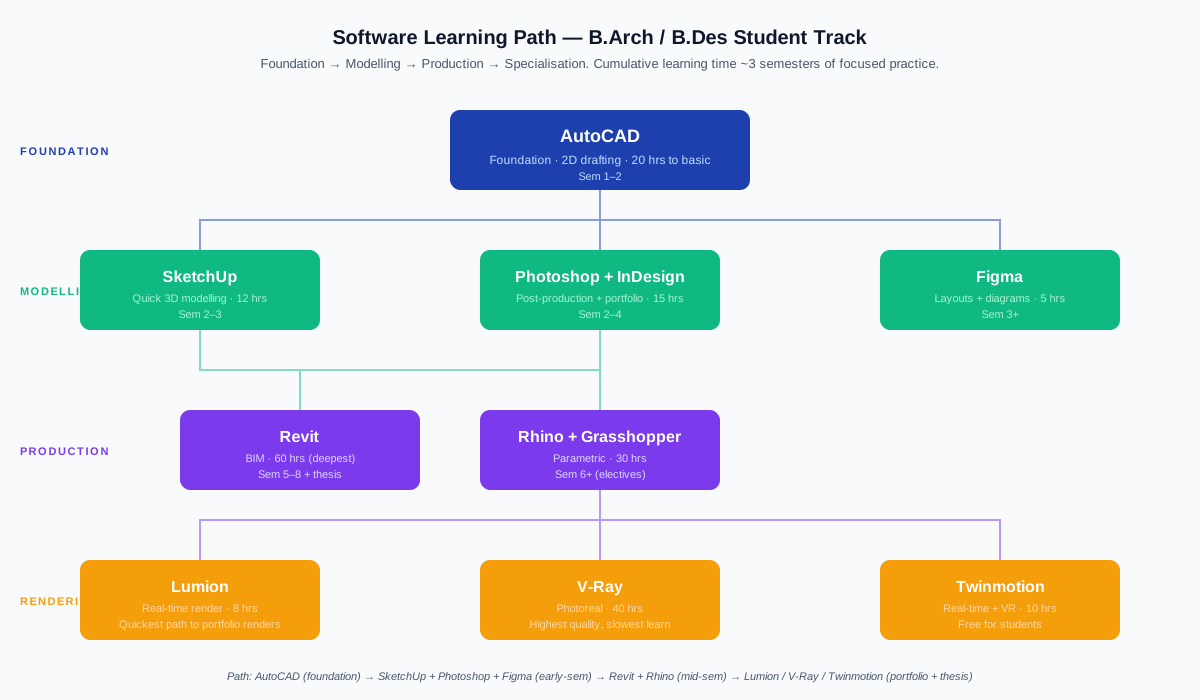
Section 01 · Learn in order 1 → 9The 9-software toolkit for an Indian B.Arch / B.Des student in 2026 — with free vs paid Indian licensing, learning-time-to-basic, and what to use each tool for. Learn them in this order: 1 → 9.
| # | Software | Category | Free Option | Commercial | Time to basic | Use for |
|---|---|---|---|---|---|---|
| 1 | AutoCAD | 2D drafting | Student licence (3 yrs, free) | ₹1,30,000/yr commercial | 20 hrs | Working drawings, plan/section/elevation, dimensioning |
| 2 | SketchUp | 3D modelling | Free Web version | ₹40,000/yr Pro | 12 hrs | Massing, quick concept models, interior visualisation |
| 2 | Adobe Photoshop & InDesign | Post-production / portfolio layout | 7-day trial | ₹1,675/mo Creative Cloud (Indian student rate ~₹880/mo) | 15 hrs | Render post-processing, portfolio + CV layout, presentations |
| 3 | Revit | BIM | Student licence (1 yr, free) | ₹2,00,000/yr commercial | 60 hrs | BIM coordination, schedules, MEP integration |
| 3 | Figma | Diagramming + portfolio prototyping | Free Starter (3 files); free Education plan | ₹810/editor/mo Professional | 5 hrs | Portfolio web design, diagrams, panel layouts |
| 4 | Rhino + Grasshopper | Parametric / NURBS | 90-day trial; ₹15,000 student edu licence | ₹85,000 commercial | 30 hrs | Complex geometry, parametric design, fabrication |
| 5 | Lumion | Real-time rendering | Student licence (1 yr, free) | ₹1,80,000 Pro | 8 hrs | Quick high-quality exterior + interior rendering |
| 5 | Twinmotion | Real-time rendering (Unreal-based) | Free for personal/student use | Commercial licence under Unreal terms | 10 hrs | Real-time walkthroughs, VR-ready presentations |
| 6 | V-Ray (3ds Max / SketchUp) | Photoreal rendering | Student licence (1 yr, free) | ₹70,000/yr | 40 hrs | High-end photoreal rendering, material studies |
Pro tip on Indian licensing
Always use the student licence — Autodesk (AutoCAD, Revit), Lumion, V-Ray, and Twinmotion all offer 1-3 year free education licences for verified .edu.in / college-issued email addresses. Never download cracked software — Autodesk and other vendors track usage and your future commercial-licensing eligibility can be affected. The Adobe Creative Cloud Indian student rate is roughly 50% of the regular price (~₹880/mo) and includes Photoshop + InDesign + Illustrator, sufficient for portfolio and presentation work.
Downloadable Templates
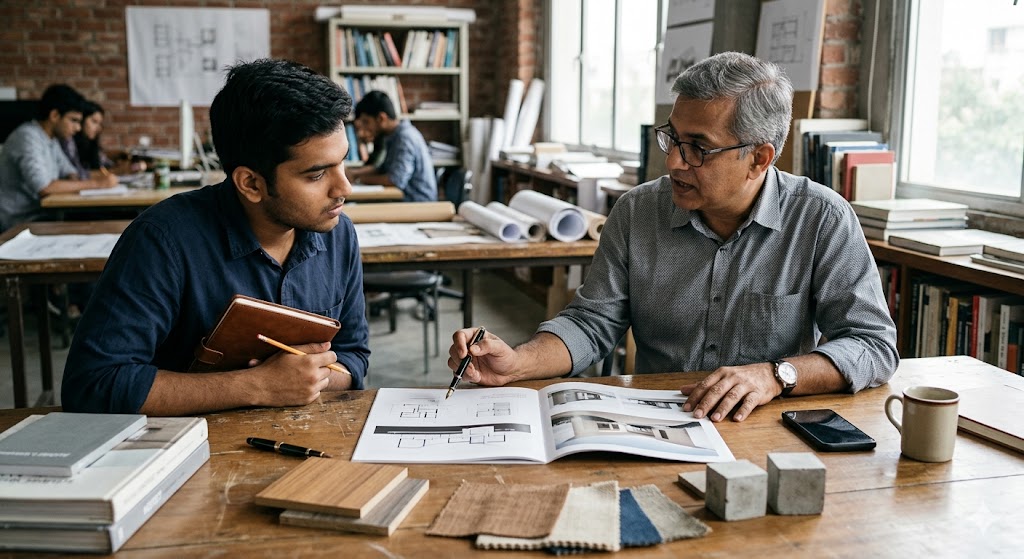
Section 02 · 4 starter sheetsFour starter templates you can adapt for studio submissions, portfolio pages, drawing sheets, and site-analysis presentations. Right-click → Save image as → use as a layout reference for your own work.
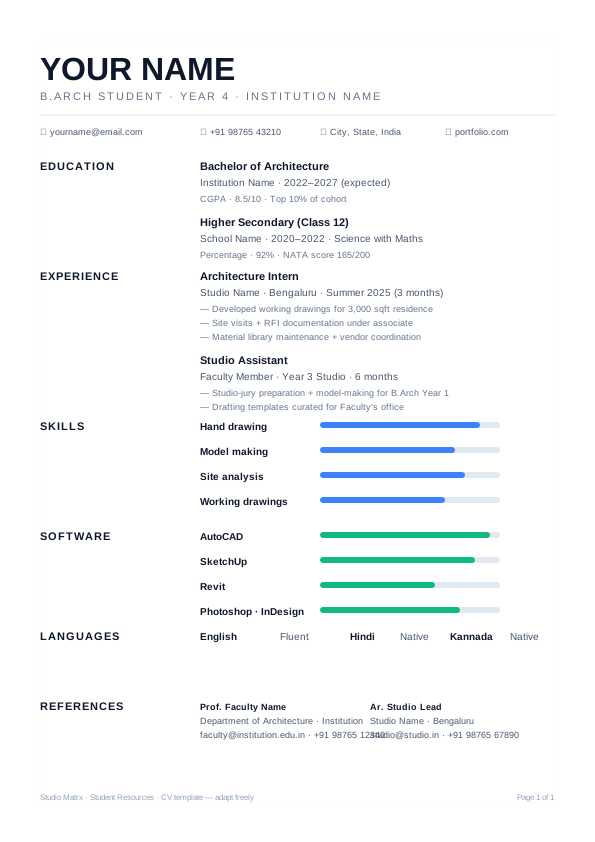
CV / Resume Template
Clean single-page architecture CV layout — header, education, experience, skills, software, references. A4 portrait.
Download SVG
Portfolio Cover & Spread
A3 landscape portfolio spread template — cover, project intro page, drawing-grid layout for plans/sections/photos.
Download SVG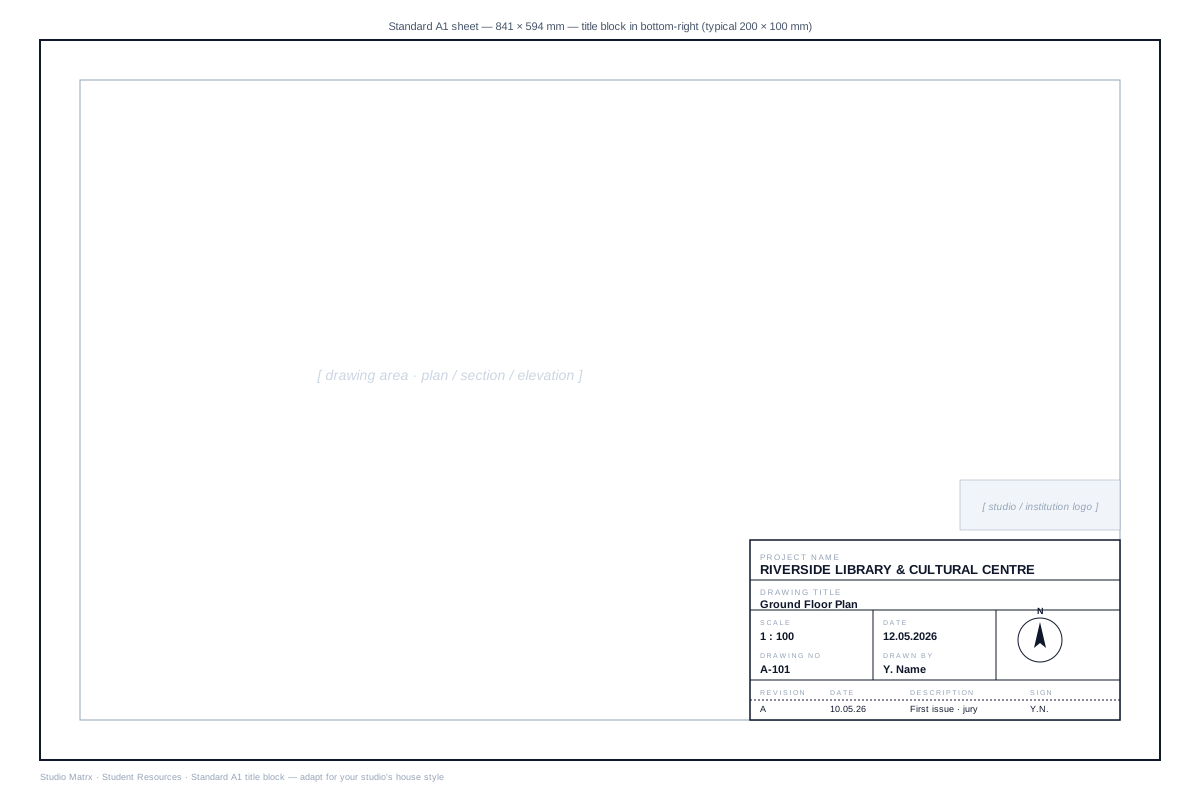
Drawing Title Block
Standard A1 drawing title block — project info, drawing title, scale, north arrow, revision table, signature block.
Download SVG
Site Analysis Sheet
Structured A2 site analysis layout — context, climate, sun-path, wind, vehicular/pedestrian, vegetation, services, opportunities/constraints.
Download SVGReading, Watching, Listening
Section 03 · Books · films · podcastsA curated student reading list — Indian books, global classics, films, podcasts, journals, and accounts to follow. Aim to finish 1 book + 1 film + 1 podcast episode per month over your 5-year B.Arch / 4-year B.Des.

Indian Architecture — Essential Books
| Title | Author | Why read it |
|---|---|---|
| An Architectural Approach to Indian Architecture | Aman Nath, Francis Wacziarg | Survey of historic Indian buildings, photo-rich, foundational reference |
| Architecture in India since 1990 | Rahul Mehrotra | The most-cited contemporary Indian architecture survey — written by India's most influential practising critic-architect |
| The Architecture of India: Buddhist & Hindu | Satish Grover | Standard temple-architecture reference; widely prescribed in B.Arch syllabi |
| Charles Correa: A Place in the Shade | Charles Correa | Selected writings of India's most influential post-Independence architect — an essential read on Indian climate and culture in design |
| Balkrishna Doshi: Architecture for the People | Vastushilpa Foundation (Pritzker monograph) | Doshi's complete works through 60+ years; the 2018 Pritzker laureate's process and philosophy |
| Vernacular Architecture of India | K. Jaisim | Region-by-region survey of India's vernacular building traditions |
| An Architectural Pilgrimage to India | Geoffrey Bawa (paraphrased; multiple authors on Bawa) | Bawa's tropical-modernist work in Sri Lanka — directly relevant to Indian climate-responsive design |
| Modern Architecture in India | Kanika Singh, Jon Lang | How India's modernist architecture evolved post-1947 — Chandigarh, Ahmedabad, the IITs, the temple-tradition revival |
Global Classics
| Title | Author | Why read it |
|---|---|---|
| Architecture: Form, Space, and Order | Francis D. K. Ching | The single most-prescribed B.Arch textbook globally; the visual grammar of architecture |
| A Pattern Language | Christopher Alexander | 253 patterns for designing buildings, neighbourhoods, towns; a humanist alternative to formalist modernism |
| Towards a New Architecture | Le Corbusier | The foundational manifesto of modernist architecture; understand what 20th-century architects were arguing for or against |
| The Eyes of the Skin | Juhani Pallasmaa | On architecture as a multisensory experience, not just a visual one |
| Thinking Architecture | Peter Zumthor | Short, lyrical essays from a Pritzker-winning Swiss architect on how to design with material honesty |
| How Buildings Learn | Stewart Brand | Why some buildings adapt over decades and others become obsolete — essential for sustainable practice |
| Operative Design / Conditional Design | Anthony di Mari, Nora Yoo | Architectural verbs — bend, pierce, twist, nest — as design generators. Excellent for studio sketch work. |
| Drawing for Architects | Natascha Meuser | Hand-drawing techniques, conventions, and exercises for the digital-native generation |
Films & Documentaries
My Architect
2003
Nathaniel Kahn's documentary on Louis Kahn (architect of IIM Ahmedabad and the Indian Institute of Management). Essential India connection.
Visual Acoustics
2008
On Julius Shulman, the photographer who shaped how the world saw mid-century modernism
Pritzker Prize: Doshi (Acceptance Speech & Lecture)
2018
Hour-long Doshi lecture available free on Pritzker site; foundational for Indian architects
Cathedrals of Culture
2014
Six directors film six iconic buildings; meditative and observational
Sketches of Frank Gehry
2005
Sydney Pollack on Gehry's design process — how a sketch becomes a building
Coast Modern
2012
On the Pacific Coast modernist tradition, climate-and-place-responsive design
Citizen Architect: Samuel Mockbee and the Spirit of the Rural Studio
2010
Architecture for the poor — Auburn University's Rural Studio; foundational social-architecture viewing
Podcasts
About Buildings + Cities
Hosted by Luke Jones, George Gingell
Long-form, historically grounded conversations on architecture; great for late-night studio sessions
99% Invisible
Hosted by Roman Mars
Design + architecture stories told as narrative journalism; very accessible to non-architects
Scratching the Surface
Hosted by Jarrett Fuller
Designers and writers on design history, criticism, and practice
The Modern House Podcast
Hosted by Modern House (UK)
Conversations with contemporary residential architects; useful for Stage-2 thinking
BUILD Podcast (Mumbai)
Hosted by Indian architects, rotating
Indian-context conversations with practising architects on building science and practice
Architectural Detail
Hosted by Various
Construction-detail focused; useful for site-stage learning
Journals & Magazines
| Name | Type | Why follow |
|---|---|---|
| Architecture+Design (A+D) | Magazine — India | India's longest-running architecture magazine; project features and practice profiles |
| Indian Architect & Builder | Magazine — India | Project documentation, practice news; widely read by students and practitioners |
| DOMUS India | Magazine — India | International quality journalism on Indian architecture; design culture |
| Architecture - Time, Space & People | Journal — Council of Architecture (India) | Peer-reviewed monthly; essential for practice-side awareness |
| Architectural Review (AR) | Magazine — UK / international | The reference international architecture magazine; long-form criticism |
| El Croquis | Monograph series — Spain | Single-architect deep dives; the most-collected architectural publication globally |
| DETAIL | Magazine — Germany | Construction-detail focused; bilingual; the gold standard for technical drawing learning |
Online Accounts to Follow
@architecturaldigestindia
Indian residential and commercial projects; useful for material/style awareness
@archdaily
Instagram + Web
Daily project-feed; the largest architecture publication globally; submission-friendly for student work
@dezeen
Instagram + Web
Design-and-architecture journalism; trend-aware and well-curated
@studio_mehrotra
Rahul Mehrotra's studio (RMA Architects); contemporary Indian practice
@vastushilpaconsultants
BV Doshi's studio archive — essential viewing
30X40 Design Workshop
YouTube
Eric Reinholdt's small-firm practice channel — covers software, drawing, and small-practice management
The Architect's Newspaper
Web + newsletter
American architecture news, but globally informative
Indian Architecture — The Working Timeline
Section 04 · ~5,000 years · 9 erasNine eras spanning ~5,000 years. Use this as the scaffold for your architectural-history coursework, your case-study selection, and your design-studio precedent reading. The 'Key Idea' column is what to take into your own design vocabulary.
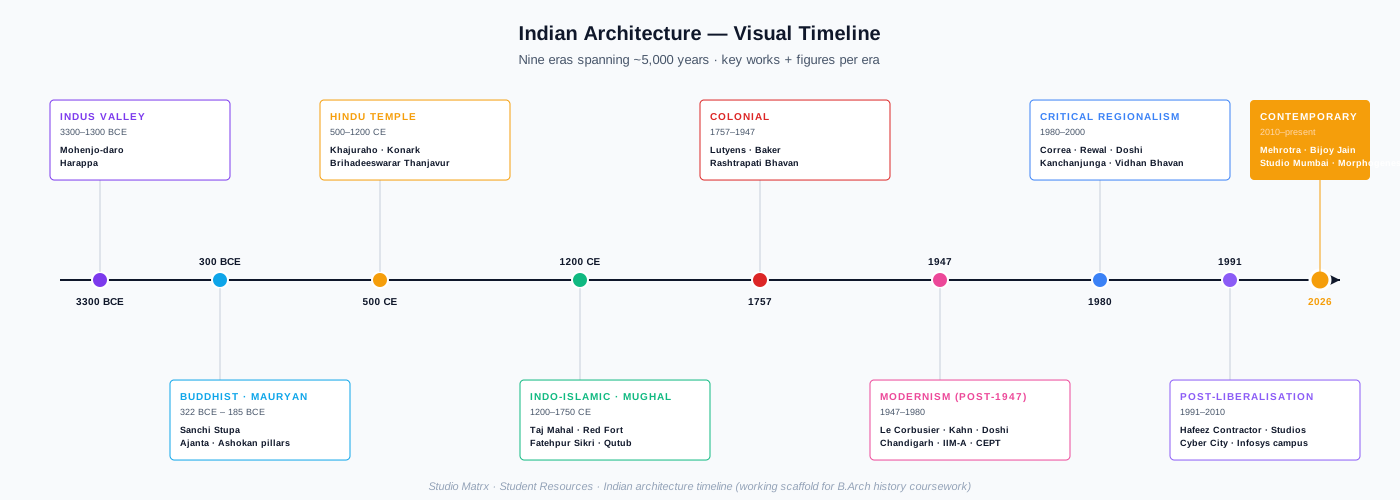
| Era | Period | Key Works | Architects / Figures | Key Idea |
|---|---|---|---|---|
| Indus Valley | c. 3300–1300 BCE | Mohenjo-daro, Harappa — planned cities, baked-brick housing, public granaries, drainage | Anonymous | Grid-planned cities millennia before Hippodamus; standardised brick sizing; advanced sanitation |
| Buddhist & Mauryan | c. 322 BCE – 185 BCE | Sanchi Stupa, Ajanta Caves (early phase), Ashokan pillars | Ashoka the Great (patron); anonymous master-craftsmen | Stupa typology; rock-cut architecture; the chaitya hall; the symbolic mandala plan |
| Hindu Temple Architecture | c. 500–1200 CE | Kailasa Temple Ellora, Khajuraho, Kandariya Mahadev, Brihadeeswarar Temple Thanjavur, Konark Sun Temple | Anonymous master-craftsmen; Sthapati lineages | Nagara (north Indian) and Dravida (south Indian) styles; the shikhara; the mandapa-garbhagriha sequence; mandala-based planning |
| Indo-Islamic & Mughal | c. 1200–1750 | Qutub Minar, Taj Mahal, Red Fort, Fatehpur Sikri, Humayun's Tomb | Ustad Ahmad Lahauri (Taj), Mirak Mirza Ghiyas | Charbagh garden geometry; iwan + dome + minaret; integration of Persian and indigenous Indian craftsmanship |
| Colonial | c. 1757–1947 | Victoria Terminus Mumbai, Rashtrapati Bhavan, India Gate, the New Delhi imperial axis | Edwin Lutyens, Herbert Baker, F. W. Stevens | Indo-Saracenic style — fusion of Gothic Revival, Mughal, and Indian classicism; the imperial planning idiom |
| Post-Independence Modernism | c. 1947–1980 | Chandigarh (Le Corbusier), IIM Ahmedabad (Louis Kahn), CEPT Ahmedabad (BV Doshi), Sangath (Doshi), India International Centre Delhi (Stein) | Le Corbusier, Louis Kahn, BV Doshi, Charles Correa, Joseph Allen Stein, Achyut Kanvinde | Indian appropriation of modernism; climate-responsive concrete; the role of the state architect; Nehruvian institutional building |
| Critical Regionalism | c. 1980–2000 | Kanchanjunga Apartments (Correa), Asian Games Village (Raj Rewal), MRF Tower Chennai, Vidhan Bhavan Bhopal (Correa) | Charles Correa, Raj Rewal, BV Doshi, Romi Khosla, Anant Raje | Synthesis of vernacular and modern; tropical adaptation; the cultural authenticity question |
| Post-Liberalisation | c. 1991–2010 | DLF Cyber City Gurgaon, Hiranandani Powai, ITC Green Centre Gurgaon, Infosys Mysore campus | Hafeez Contractor, Talati & Panthaky, Sanjay Puri, Studio Lotus (founders) | Glass-and-steel commercial architecture; first wave of LEED India; corporate campus typology; suburban gated community |
| Contemporary | c. 2010–present | Hathigaon Jaipur (Mehrotra/RMA), Pearl Academy Jaipur (Morphogenesis), House of MG Ahmedabad, Niyo Apartments (Studio Mumbai), CIDCO Headquarters (Charles Correa Foundation) | Rahul Mehrotra, Bijoy Jain (Studio Mumbai), Sonali Rastogi (Morphogenesis), Sameep Padora (sP+a), Anupama Kundoo, Studio Lotus, Stapati | Material-honest contemporary architecture; craft-driven practice; passive sustainability; small-firm-driven excellence |
Career Pathways After B.Arch
Section 05 · 4 directionsFour directions — practice, M.Arch India, M.Arch abroad, and parallel/alternative careers. Each has its own timeline, cost, and fit. There is no single 'best' path; the right choice depends on your portfolio, financial position, family situation, and what you discover in your final two B.Arch years.
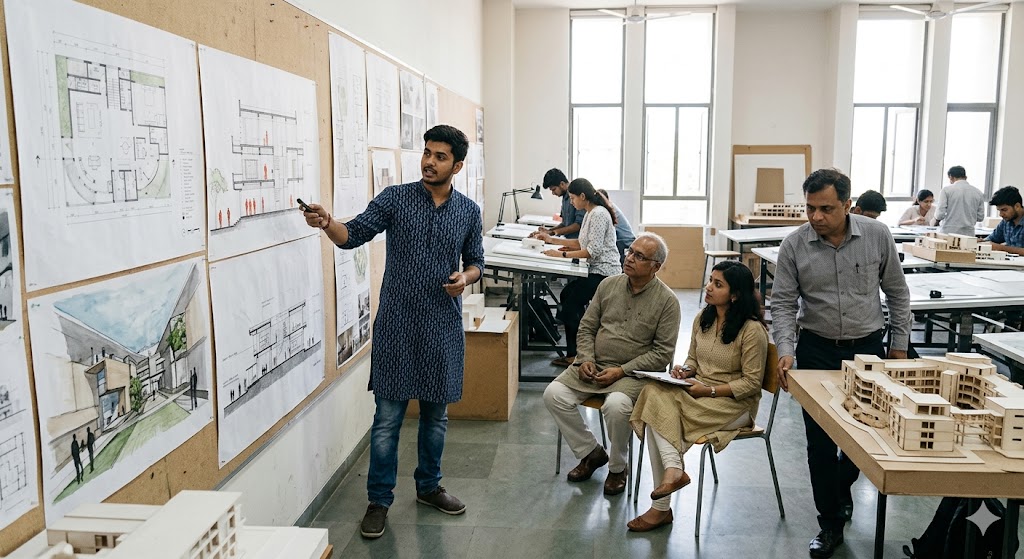
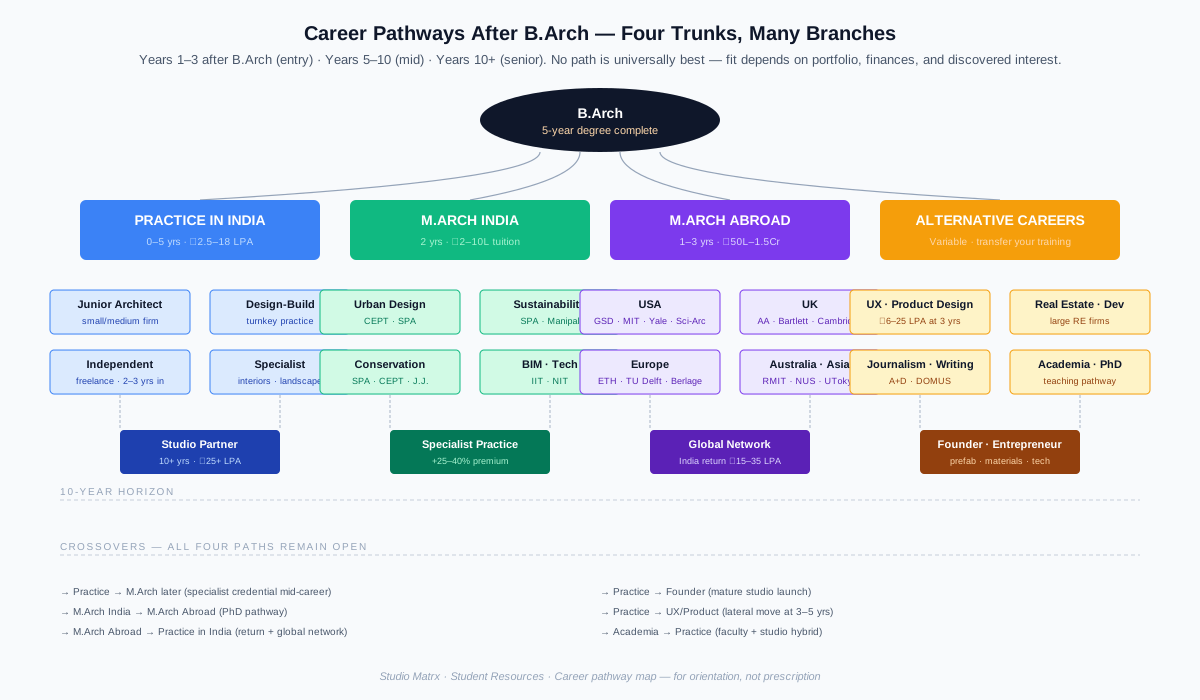
Practice in India
0–5 yrs after B.Arch
Typical steps
Internship (6 mo) → Junior Architect at small/medium firm → independent practice or join design-build firm
Salary range
₹2.5–6 LPA junior; ₹8–18 LPA at 5 yrs; ₹25+ LPA partner-level (Tier-1 cities)
Pros
Immediate industry exposure; build portfolio fast; COA registration straightforward
Cons
Long hours; frequent under-pricing in smaller firms; geographic constraint
Fits if you…
Want to start practising immediately; prefer learning-by-doing over more theory; have local network
M.Arch / Specialisation in India
2–3 yrs (typically 1.5 yrs after B.Arch)
Typical steps
GATE / GRE for top schools; CEPT, SPA Delhi, IIT Roorkee, IIT Kharagpur, NIT Calicut, JJ School Mumbai, Manipal
Salary range
Pre-M.Arch ~₹3 LPA; post-M.Arch ~₹4.5–8 LPA; specialisation premium 25–40%
Pros
Specialisation (urban design, sustainability, conservation, BIM); academic credentialing; teaching pathway
Cons
Cost (₹2–10 lakh tuition); 2-year delay; not all specialisations command salary premium
Fits if you…
Want to specialise (urban design, conservation, BIM, sustainability); aim for academia or large-firm specialist roles
M.Arch / Specialisation Abroad
1–3 yrs
Typical steps
GRE + IELTS/TOEFL + portfolio; Harvard GSD, MIT, Yale, AA London, Bartlett UCL, ETH Zurich, Berlage TU Delft
Salary range
₹50K–1.5L USD/yr abroad post-grad; ₹15–35 LPA on return to India
Pros
Global network; access to research; academic prestige; STEM-OPT pathways in US
Cons
Cost (₹50L–1.5Cr total); visa risk; cultural transition; reverse-culture-shock on return
Fits if you…
Strong portfolio + design-research interest; willing to take 2-year cost-plus-loan risk for global mobility; English-fluent
Parallel & Alternative Careers
Variable
Typical steps
Architecture → UX / product design / UI; → real estate / development; → journalism (architectural writing); → academia (PhD path); → policy / government; → entrepreneurship (design-build, prefab, materials)
Salary range
Wide range — UX/product designers ₹6–25 LPA at 3 yrs; design-led startups variable; academia ₹6–15 LPA
Pros
Architectural training transfers well — systems thinking, craft, visualisation, project management
Cons
Wasted credentialing if you stop practising; longer adjustment period to new field
Fits if you…
Discover during B.Arch you prefer adjacent fields; want to use architecture as a foundation, not a destination
Studio Glossary
Section 06 · 20 termsTwenty terms every B.Arch student encounters in studio crits, lectures, and practice — defined in plain English. Bookmark this page; you'll return to it through your degree.
Parti
The central organising idea of a project; the diagram from which all design decisions descend
Poché
The thickness of walls in plan; figure-ground reading where mass is filled solid
Datum
A line, plane, or volume that organises the composition by reference; e.g., a courtyard datum
Mass and Void
The fundamental architectural pairing — what is solid (massing) vs what is open (void/space)
Figure-Ground
Drawing-analysis technique reducing buildings to filled black shapes against the urban ground; reveals city pattern
Threshold
The transition between two spatial conditions; e.g., outside/inside, public/private. A core architectural concept
Programme
The intended use(s) of the building, expressed as a list of spaces with areas — e.g., '3-bedroom house, 200 sqm'
Brief
The client's articulation of the project — needs, budget, timeline, aspirations. The architect's input source for programme
Charrette
An intensive design workshop, typically 1-2 days; comes from French 'cart' (students would sketch in carts to the jury)
BIM
Building Information Modelling — 3D model with embedded data (materials, schedules, costs); Revit / Archicad / Vectorworks
GFC
Good for Construction — drawings ready for site execution, after all coordination resolved
DD / SD / CD
Schematic Design / Design Development / Construction Documents — the standard three-phase project workflow (US convention)
Massing
The 3D volumetric form of a building before details — the 'block model' phase
Tectonic
The expressive aspect of construction — how a building is made, visible in its surface and joints
Stereotomic
Massive load-bearing construction — stone, brick, masonry. Opposite of tectonic (frame, skin)
Vernacular
Building traditions emerging from local climate, materials, and culture; not designed by a named architect
FAR / FSI
Floor Area Ratio / Floor Space Index — total built-up floor area as a multiple of plot area; the primary planning regulation
Setback
The minimum distance between a building and the plot boundary, mandated by local bylaws
RCC
Reinforced Cement Concrete — concrete with steel reinforcement bars; the dominant Indian structural system
MS / GI
Mild Steel / Galvanised Iron — common Indian metal terminology used on construction documents
Connected to Studio Matrx
Tools & guides that complement these resourcesWhen the Resources Hub points you to a topic, follow through with the in-depth Studio Matrx guides and free utilities.
NATA & JEE B.Arch Entrance Prep
The Class 11/12 entrance reference — tests, calendar, drawing, mocks, counselling
OpenIndian Architecture Schools Shortlist 2026
Tier map, COA recognition, fees, geographic distribution, decision rubric
OpenB.Des Interior Design — Student Track
Parallel-track guide for the B.Des Interior aspirant
OpenModel-Making for Studio Juries
Five model types, scale-to-material map, Indian sources, five-year skill build
OpenHeritage Documentation Studio
Year 3-4 measured-drawing reference — eight typologies, INTACH/ASI framework
OpenArchitecture Competitions Calendar
NASA, IIA, Bee Breeders, YAC, Inspireli, Solar Decathlon — five-year strategy
OpenInternship Interview & Résumé
One-page CV, cover letter, five-stage interview, stipend benchmarks
OpenStudio Burnout & Mental Health
Six warning signs, recovery protocol, where to seek help in India
OpenEssential Digital Skills for Architects
Deep dive on the software stack
OpenEssential Soft Skills
Communication, critique, presentation
OpenScope Boundaries — Architect, IDs & Contractor
Practitioner-side after college
OpenThe Architect's Scope of Services in India
COA Stage 1-9 reference
OpenWinning Clients as a New Architect
First-job and first-client guide
OpenStarting a Design Firm in India
When you're ready to go independent
OpenDesign Brief Generator
Structure your studio briefs at the start of every project
OpenColour Palette Generator
Build moodboard-ready colour palettes for studio work
OpenArchitecture Academy — All Tracks
Bylaws, Contracts, Site, Practice, Sustainability + Student Foundations
Open