
Studio Burnout & Mental Health for Architecture Students
A 2026 Reference for B.Arch and B.Des Students in India — Recognising the Six Warning Signs, the Daily / Weekly / Quarterly Recovery Protocol, the All-Nighter Culture and Why It Damages, the Faculty-Crit Layer, Imposter Syndrome, Where to Seek Help (iCall · Vandrevala · AASRA · Campus Counsellors), and the Long-Horizon Practice of Sustainable Studio Output
Architecture school in India, in 2026, has the highest rate of student burnout among undergraduate professional programmes. Surveys conducted across major B.Arch institutions consistently report 60-75% of students experiencing at least one significant burnout episode during their five-year programme; 30-45% report multiple episodes; and a smaller but non-trivial fraction experience burnout severe enough to require professional mental-health support. These numbers are not an indictment of any one institution — they are structural features of a profession that demands long studio hours, peer-comparison-rich critique, and an economic-stakes environment in which family expectations, financial pressure, and uncertain career outcomes compound.
This guide is the working reference for the student navigating that environment. It is the health counterpart to the eight Student Foundations modules that cover drawing, software, portfolio, jury, internship, thesis, case-study, and career. The orientation throughout is towards Indian B.Arch and B.Des students; the resources and helplines listed are India-specific; the cultural dynamics — family pressure, peer hierarchies, faculty styles — reflect Indian architecture school context.
A note on context: Studio Matrx exists in memory of Amogh N P, the author's son, an architect and polymath whose path was cut short. This guide is published in part because the student-mental-health gap in Indian architecture education is real and urgent, and because the practitioner community has a responsibility to make recovery resources visible, normal, and accessible. If anything in this guide reaches a student who needed to read it, the guide has done its work.
The treatment is structured around four clusters. The map cluster (sections 1-3) covers why architecture school is structurally high-burnout, the six recognisable warning signs, and the all-nighter culture. The recovery cluster (sections 4-6) covers the daily, weekly, and quarterly recovery protocols. The navigation cluster (sections 7-10) covers harsh crits, imposter syndrome, peer dynamics, and family conversations. The help cluster (sections 11-13) covers when and where to seek help in India, the role of campus counsellors, and the long-horizon practice of sustainable studio output.
"You cannot finish five years of architecture school by burning yourself out. Sustainability of effort matters more than peak intensity. The student who learns this in Year 1 graduates well; the student who learns it in Year 4 wishes they had learnt it in Year 1." — Faculty paraphrase, school of architecture wellbeing review
1. Why Architecture School Is Structurally High-Burnout
Architecture school has features that, taken together, produce a high-burnout environment more reliably than other undergraduate programmes. Understanding these features is not an excuse for under-performance — it is the precondition for navigating them well.
1.1 The Five Structural Features
- Studio hours far exceed taught hours. A typical B.Arch week in India contains 16-20 hours of taught contact (lectures + studio crits) but produces 60-80 hours of student work expected. The "extra" hours are studio time, model-making, drawing, software practice — most of it unsupervised. This is unusual among undergraduate programmes.
- Output is open-ended. A medical student preparing for an exam knows how much there is to study. A B.Arch student preparing for jury has no upper bound on the work they can produce — every drawing can be improved, every model can be more refined, every render can be re-rendered. Without external limits, students set internal ones — often unsustainable ones.
- Peer comparison is constant and visible. Studio is a shared space. Other students' work hangs on the walls, sits on the desks, populates the social media feeds. A medical student does not see thirty peer answers to a clinical case in real-time; an architecture student sees thirty peer projects every day. The comparison engine is permanently on.
- Faculty critique can be sharp. B.Arch crits — particularly final-jury crits — can be public and direct. A poorly-received project is critiqued in front of the studio, sometimes harshly. The professional norm of professional architectural critique can read, especially to younger students, as personal.
- Career outcomes are uncertain in a way that pre-amplifies stress. B.Arch graduates face a market where starting salaries are modest (₹2.5-4 LPA at first job), where the long-horizon path requires sustained portfolio building, and where the relationship between school effort and life outcome is loose. Family expectations compound this — particularly for first-generation B.Arch students whose families do not understand the profession.
These features are not unique to Indian architecture schools. They are international features of architectural education. They are amplified, in India, by a few specific cultural dynamics: extended-family conversation about studies, financial pressure on middle-class families investing in private B.Arch tuition, and limited cultural permission for students to discuss mental health openly.
1.2 What This Means for You
If you are reading this guide and feeling under pressure, you are not failing. You are responding predictably to a structurally demanding environment. The recovery framework below is what most senior practising architects learnt — sometimes after a crisis, sometimes earlier. The earlier you learn it, the lower the cost.
2. The Six Warning Signs of Burnout
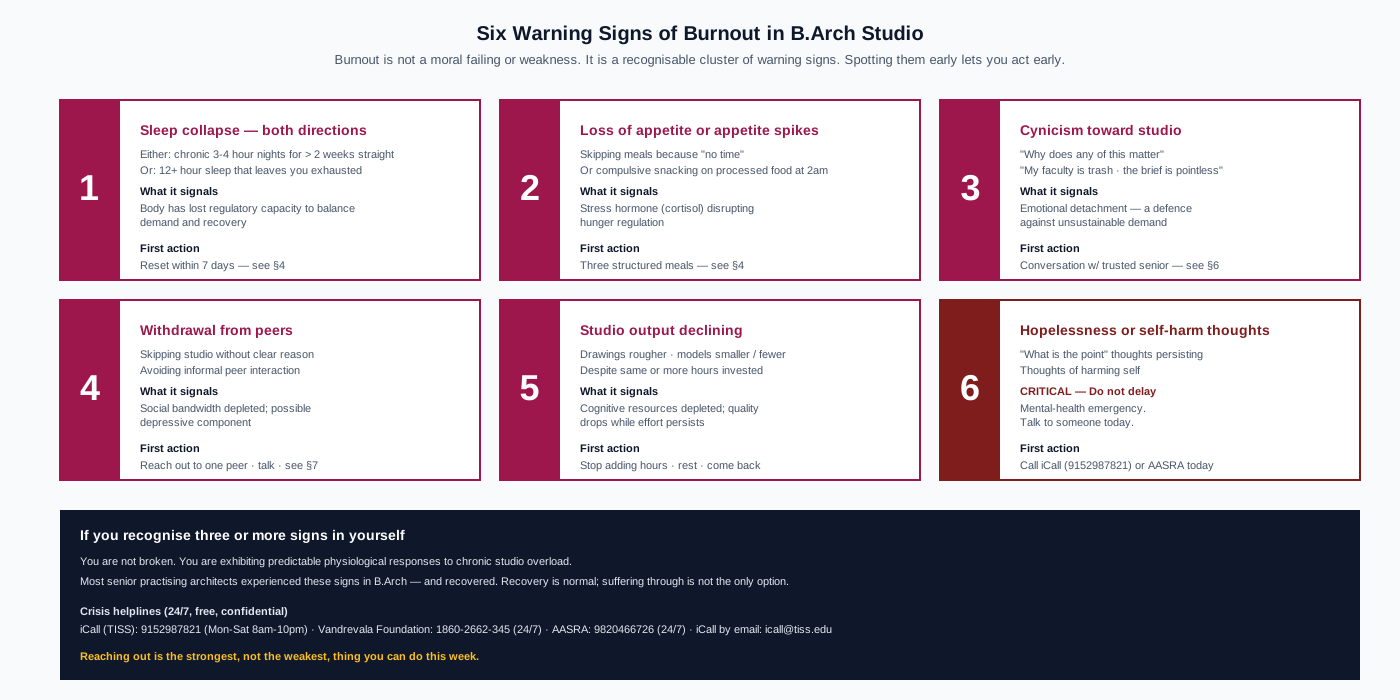
Burnout is not a single event. It is a recognisable cluster of warning signs that build over weeks to months. Spotting them early lets you act early.
2.1 Sleep Collapse — Both Directions
Either chronic 3-4 hour nights for more than two weeks straight, or 12+ hour sleep that leaves you exhausted. Both signal that the body has lost regulatory capacity. The first action: reset within 7 days through the daily protocol in §4.
2.2 Loss of Appetite or Appetite Spikes
Skipping meals because there is "no time" or compulsive snacking on processed food at 2am. Both signal stress hormones (cortisol) disrupting hunger regulation. The first action: re-establish three structured meals, even if small.
2.3 Cynicism Toward Studio
"Why does any of this matter?" "My faculty is trash, the brief is pointless." This thought pattern is not clarity about studio quality — it is a defence mechanism against unsustainable demand. The first action: a conversation with a trusted senior — peer, mentor, faculty, family member.
2.4 Withdrawal from Peers
Skipping studio without clear reason. Avoiding informal peer interaction. Cancelling plans you would normally attend. Withdrawal signals depleted social bandwidth, often with a depressive component. The first action: reach out to one peer, even briefly. Talk.
2.5 Studio Output Declining
Drawings rougher, models smaller or fewer, despite the same or more hours invested. Output decline despite effort signals cognitive resources depleted; quality drops while effort persists. The first action: stop adding hours; rest first; come back fresh.
2.6 Hopelessness or Self-Harm Thoughts
"What is the point" thoughts persisting beyond a single bad day. Thoughts of harming yourself. This is a mental-health emergency. Do not delay. Talk to someone today. Helplines:
| Helpline | Number | Hours |
|---|---|---|
| iCall (TISS) | 9152987821 | Mon-Sat 8am-10pm |
| Vandrevala Foundation | 1860-2662-345 | 24/7 |
| AASRA | 9820466726 | 24/7 |
| iCall by email | icall@tiss.edu | Reply within 24 hours |
If you recognise three or more signs in yourself, you are not broken. You are exhibiting predictable physiological responses to chronic studio overload. Most senior practising architects experienced these signs in B.Arch — and recovered. Recovery is normal; suffering through is not the only option. Reaching out is the strongest, not the weakest, thing you can do this week.
3. The All-Nighter Culture and Why It Damages
The "studio all-nighter" is the most-celebrated and most-damaging cultural artefact of B.Arch life. It is portrayed in studio lore as proof of dedication; the empirical evidence shows it is the single biggest output-quality reducer.
3.1 What the Research Says
| Sleep deprivation | Effect on studio-relevant cognition |
|---|---|
| Single night < 4 hrs | Working memory drops 30-40% · creative-association tasks drop 20-30% · technical accuracy stable |
| Two consecutive nights < 5 hrs | Decision quality at level of 0.05% blood-alcohol · roughly equivalent to mild intoxication |
| One week < 6 hrs avg | Cumulative deficit accumulates · users cannot self-assess accurately · they feel functional while operating at 70% baseline |
| Two weeks < 6 hrs avg | Risk of depressive episode rises sharply · stress-hormone regulation impaired |
The student doing a single all-nighter the day before jury delivers worse work than the same student would have produced on a normal-sleep night. The student doing five all-nighters in jury week delivers work meaningfully below their capability — and pays a recovery cost lasting weeks.
3.2 The Cultural Re-Frame
Senior architects who have practised for 20+ years almost universally describe their B.Arch all-nighter habits as a mistake they would not repeat. The most-cited reflection: the projects that won them recognition were rarely the ones they slept least on. The hours that mattered were the thinking hours, not the grinding hours. Sleep is when much of the thinking happens — sleep deprivation reduces the very capability the all-nighter is intended to support.
3.3 The Practical Alternative
| Replace | With |
|---|---|
| One 36-hour work session before jury | Three 8-10 hour sessions across three days, 7 hrs sleep between |
| 5am studio "burn" with energy drinks | 11pm-6am sleep + 6am-9am clear-headed studio |
| Caffeine as productivity multiplier | Caffeine as small adjuvant (1-2 cups before noon) + actual sleep |
| Skipping meals to gain hours | Three meals + 8-10 hours of focused work outperforms any meal-skipping pattern |
The student who treats the studio jury cycle as a marathon rather than a sprint produces meaningfully better work, more consistently, with lower burnout cost.
4. The Daily Recovery Protocol
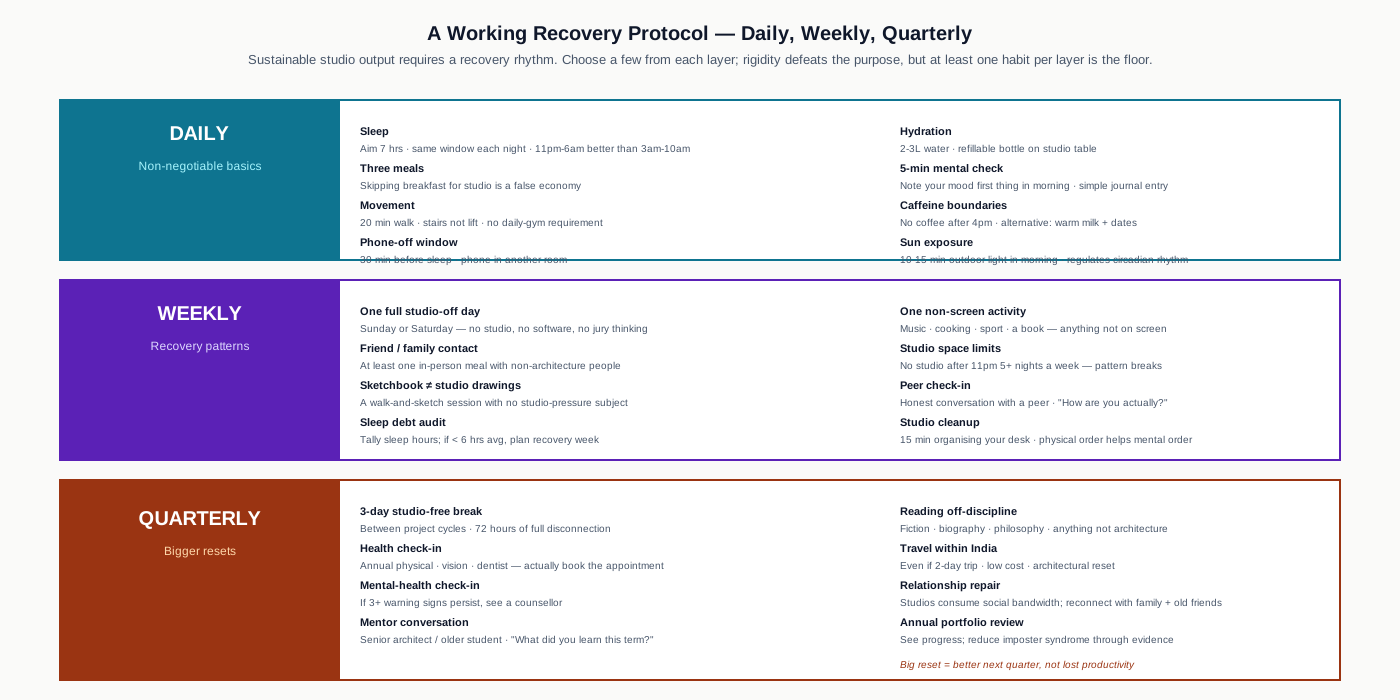
The recovery framework is layered: daily basics, weekly patterns, quarterly resets. Choose a few from each layer; rigidity defeats the purpose, but at least one habit per layer is the floor.
4.1 Sleep — The Single Biggest Lever
Aim for 7 hours per night. Same window each night. 11pm-6am is better than 3am-10am — the body's circadian rhythm rewards consistent timing more than total hours.
The discipline:
- Phone off the bed by 10:30pm. Notifications fragment the wind-down window.
- Studio off at 11pm at the latest for 5+ nights a week. 1-2 late nights per week is workable; 5+ late nights is unsustainable.
- Bedroom dark and cool. 22-25°C ambient temperature for Indian conditions. Eye mask if room cannot be fully darkened.
- Sleep is not a luxury you earn after work. It is an input to good work.
4.2 Three Meals a Day
Skipping breakfast for an extra studio hour is a false economy. The hour is worth less than the meal.
A working B.Arch student meal pattern:
- Breakfast (7-8am): Carbohydrate + protein + fruit. Idli + sambhar + chutney. Paratha + curd + pickle. Oats + nuts + banana. Egg + toast + tea.
- Lunch (12-1pm): Substantial — rice / roti + dal + sabzi + curd. Mess food, packed home, or local thali.
- Evening snack (5-6pm, optional): Tea + biscuit, or a fruit.
- Dinner (8-9pm): Lighter than lunch — soup + roti, or rice + sabzi.
Avoid late-night Maggi as the dominant calorie source. Avoid replacing meals with energy drinks or coffee.
4.3 Movement — 20 Minutes Per Day
A 20-minute walk is the floor. Stairs not lifts. Cycling to studio if your campus permits. The discipline is daily, not intensive — you do not need a gym subscription. Twenty minutes outdoors with sunlight regulates mood, sleep, and stress hormones simultaneously.
4.4 Phone-Off Window
The 30 minutes before sleep, phone in another room. Notifications, social media, and group chats are the primary disruptor of the wind-down phase. Not optional.
4.5 Other Daily Anchors
- Hydration: 2-3L water. A refillable bottle on the studio table is the simplest enforcement mechanism.
- 5-minute mental check in the morning. A simple journal entry: How did I sleep? What is my mood? What is one thing I am looking forward to today?
- Caffeine boundaries: No coffee after 4pm. Switch to warm milk + dates, or simply water, in the late afternoon.
- Sun exposure: 10-15 minutes outdoors in the morning regulates circadian rhythm. Walk to the canteen, sit in the courtyard, take a phone call outside.
5. The Weekly Recovery Pattern
Daily basics maintain steady-state; weekly patterns clear accumulated deficit.
5.1 One Full Studio-Off Day
Sunday or Saturday — no studio, no software, no jury thinking. The candidate who treats every day as a studio day arrives at jury week without reserves; the candidate who keeps one day per week for not-studio arrives at jury week with capacity.
5.2 Friend / Family Contact
At least one in-person meal with non-architecture people each week. Studio bandwidth depletes social bandwidth; non-architecture contact replenishes both.
5.3 Sketchbook ≠ Studio Drawings
A walk-and-sketch session with no studio-pressure subject. A coffee shop. The street. A temple courtyard. The discipline of drawing without grading replenishes the drawing instinct in a way studio drawing cannot.
5.4 Sleep Debt Audit
End of each week: tally sleep hours from the previous 7 days. If the average is below 6 hours, plan a recovery week — earlier bedtimes, fewer late studios, weekend with extra sleep.
5.5 Studio Space Limits
The most useful single rule: no studio after 11pm 5 or more nights a week. The body cannot sustain 11pm+ studio as the norm; the pattern breaks within 6-8 weeks.
5.6 Peer Check-In
Once a week, an honest conversation with a peer: "How are you actually?" Not the casual "I'm fine, you?" but a real check-in. Burnout often goes unnoticed by the person experiencing it; trusted peers spot it earlier.
5.7 Studio Cleanup
15 minutes organising your desk every Friday or Sunday. Physical order helps mental order. The cleanup is also a transition ritual — closing one week before opening the next.
6. The Quarterly Reset
Bigger resets are non-negotiable, even in busy semesters.
6.1 Three-Day Studio-Free Break
Between project cycles, take 72 hours of full disconnection. No software, no studio, no jury thinking. This is when your capacity rebuilds.
6.2 Health Check-In
Once per quarter, book the appointment: annual physical, vision check (essential for design-software use), dentist. Most B.Arch students delay these for years. The discipline is book the appointment now, not plan to book.
6.3 Mental-Health Check-In
If three or more burnout warning signs persist for more than two weeks, see a counsellor. This is not weakness; it is using a resource. Most institutions have campus counsellors; if yours does not, the iCall and Vandrevala helplines provide free remote support.
6.4 Mentor Conversation
Senior architect, older student, family friend in the profession — someone who has been through B.Arch and is willing to listen. "What did you learn this term?" The conversation is for you, not for them.
6.5 Reading Off-Discipline
Fiction, biography, philosophy, anything not architecture. The mind that only reads architecture begins to think only in architectural terms; reading laterally restores the broader thinking.
6.6 Travel Within India
Even a 2-day trip — to a town you haven't been to, to a building you've wanted to see, to family in another city. Low cost. Significant architectural-mind reset.
6.7 Relationship Repair
Studios consume social bandwidth. Family relationships and old friendships drift. The discipline is to re-invest in these once per quarter — a phone call, a meal, a visit.
6.8 Annual Portfolio Review
At the end of each year, look at your portfolio. See the progress. Imposter syndrome thrives on hindsight bias — the tendency to remember only the failures, not the growth. A portfolio review is concrete evidence of growth, and it reduces imposter syndrome through evidence rather than reassurance.
7. Navigating Harsh Faculty Crits
Architectural critique can be sharp. The professional norm of public critique is a feature of architectural education, not a bug — it prepares the future architect for client meetings, design reviews, and competitions where work is openly discussed. But experienced harshly, particularly in early years, it can produce real distress.
7.1 The Working Frame
A critique is a critique of the work, not the person. This frame is easier to state than to feel — it requires practice. The discipline:
- Take notes during the crit. The act of writing focuses attention on the content rather than the delivery.
- Avoid emotional response in the moment. Listen, write, ask one clarifying question, sit down. The emotional processing happens later.
- Within 24 hours, transcribe the crit in clear language. What was the criticism actually about? What is recoverable? What is not?
- Ask a peer for their reading. Sometimes a crit lands harder than it was meant; sometimes it is, in fact, hostile and the peer reading helps you separate the two.
7.2 When a Faculty Member Crosses a Line
Faculty critique that becomes personal — not "this drawing has weak proportion" but "you are not capable of being an architect" — is a line. Faculty who repeatedly cross this line, particularly with the same student, are a problem.
The escalation:
1. Conversation with the faculty member outside the crit context, calmly. Many crossings of the line are unintentional.
2. Conversation with the studio coordinator or year coordinator if the pattern persists.
3. Conversation with the head of department if escalation is needed.
4. Conversation with the institution's grievance committee in extreme cases.
This sequence is rare to need. Most B.Arch faculty in India are good-faith practitioners with imperfect classroom delivery, not hostile actors. But the sequence exists and you have access to it.
7.3 Surviving a Bad Studio Term
Some studio terms simply do not work. The faculty assignment is bad-fit, the brief is poorly framed, the student is exhausted. The discipline in a bad studio term is get through with minimum damage — adequate output, not best output. Save the energy for the next term, where conditions may be better.
8. Imposter Syndrome — The Recurring Tax
Imposter syndrome — the persistent feeling that you are not actually capable, that your achievements are luck or fraud, that everyone else is more competent — is endemic in B.Arch studios.
8.1 Why B.Arch Amplifies It
- Visible peer comparison constant
- Skill-set is broad (drawing, software, model, theory, history) — no one is strong at all of it
- Faculty crits often focus on weaknesses rather than strengths
- Outcome metrics (jury grades, portfolio quality) are subjective
- Many students are first-generation B.Arch — no family reference point
8.2 The Working Counters
- Evidence over feeling. Imposter syndrome is a feeling. The portfolio is evidence. When the feeling rises, look at the evidence.
- Compare to your past self, not your peers. Year-3 you compared to Year-1 you is dramatic growth. Year-3 you compared to a peer with five years of pre-B.Arch art training is unfair self-comparison.
- Articulate one thing you do well. Drawing? Render quality? Concept thinking? Material instinct? Site reading? Naming the strength reduces the imposter feeling.
- Talk about it. Imposter syndrome thrives in silence. Senior architects nearly all report having had it; many still do. Naming it dissolves much of it.
8.3 When Imposter Syndrome Becomes Clinical
Persistent imposter syndrome that interferes with daily function — inability to start work, panic before crits, freezing in studio — has crossed from a normal student experience into something that benefits from clinical support. A counsellor visit is appropriate. The campus counsellor or iCall remote counsellor is the first stop.
9. Peer Dynamics in Studio
Studios produce intense peer relationships — both supportive and competitive. The discipline of navigating peer dynamics is important.
9.1 The Healthy Peer Relationship
- Mutual feedback culture: peers review each other's work honestly
- Shared resources: software tips, material sources, studio space
- Group reviews and informal crits without faculty present
- Joint competition entries where strengths complement
- Honest check-ins on wellbeing
9.2 The Toxic Peer Pattern
- Constant comparison: "How long did you sleep?" "I worked till 5am, you?"
- Status hierarchies based on faculty favour
- Information hoarding: not sharing tips that would help others
- Public mocking of weaker work
- Cliques that exclude
The candidate's discipline is to invest in healthy peer relationships and gently de-engage from toxic ones. You cannot change studio culture single-handedly; you can choose your closest 3-5 peers carefully.
9.3 The Benefit of Out-of-Studio Friendships
Friends from non-architecture programmes — engineering, medicine, management, arts, humanities — provide perspective that all-architect friend groups cannot. The student whose entire social life is in studio loses external reference points; one or two non-architecture friendships keeps the broader perspective alive.
10. Family Conversations
Indian families care about your wellbeing but often do not understand B.Arch. The conversation is hard but essential.
10.1 What Families Often Misunderstand
- "Studio" sounds like a class, but takes 60 hours a week
- Critique culture sounds harsh; family interpretation is often "the faculty is bullying them"
- The portfolio is the credential, not the marks — but families measure marks
- Sleep deprivation is normalised in studio but alarming to families
- Career trajectory is non-linear in architecture; family reference is engineering / medicine
10.2 What to Communicate
- The structure of B.Arch hours (studio + lectures + self-work)
- Your specific term workload and timeline
- What success looks like at each stage (Year 1 different from Year 5)
- Honest signal when you are struggling — without dramatising
- When you need their support: financial, emotional, time
10.3 When Family Pressure Compounds Burnout
Family expectation that a B.Arch student should also score well in some other measure (ranking, salary, marriage timing, post-graduate plans) compounds studio pressure. The discipline is honest conversation:
- "I am working at full capacity right now."
- "I need [specific support / less pressure on this dimension] for the next 6 months."
- "Here is what I am doing, here is what I am not doing, here is why."
Most Indian families respond constructively to honest articulation of where the student is. They escalate only when they feel they have no information.
11. When and Where to Seek Help in India
11.1 The Decision
Seek professional support when:
- Three or more burnout warning signs persist for more than two weeks
- Sleep / appetite / mood is significantly disrupted for more than two weeks
- You have any thoughts of self-harm or hopelessness
- A peer or family member raises concern
- You are unable to start studio work despite sustained effort
- You are using substances (alcohol, drugs) to manage studio stress
- A previous mental-health condition is recurring
11.2 Where to Seek Help
Campus counsellors. Most B.Arch institutions have student counsellors. The visit is typically free, confidential, and does not affect academic record. The counsellor at SPA Delhi, IIT-affiliated counselling centres, NIT student wellness cells, CEPT Student Affairs — start with the campus resource.
Free helplines (24/7 confidential):
| Helpline | Number | Hours | Languages |
|---|---|---|---|
| iCall (TISS) | 9152987821 | Mon-Sat 8am-10pm | English, Hindi, Marathi |
| Vandrevala Foundation | 1860-2662-345 | 24/7 | English, Hindi, regional |
| AASRA | 9820466726 | 24/7 | English, Hindi |
| Roshni Helpline | 040-66202000 | Mon-Sat 11am-9pm | English, Hindi, Telugu |
| Sumaitri (Delhi) | 011-23389090 | Mon-Sat 2-10pm | English, Hindi |
| Sneha (Chennai) | 044-24640050 | 24/7 | English, Tamil |
| Lifeline (Kolkata) | 9088030303 | Mon-Sat 10am-10pm | English, Bengali, Hindi |
Online mental-health platforms (paid, but accessible):
- YourDOST — yourdost.com — chat / video counselling, ₹500-1,500 per session
- MindPeers — chat-based counselling
- The MINDS Foundation — themindsfoundation.org — outpatient and residential support
- Practo / Healthians — for psychiatrist appointments
Public mental-health resources:
- NIMHANS Bengaluru — 080-46110007 (helpline) — national reference for psychiatric care
- PGIMER Chandigarh — psychiatric outpatient
- Most government medical colleges — psychiatry departments
11.3 What Happens at a First Counsellor Visit
- 45-60 minute conversation
- Counsellor asks about studio context, sleep, mood, family, peer relationships
- No medication prescription at first visit (counsellors are not psychiatrists)
- Recommendation may include: regular counselling sessions, psychiatric referral if medication is needed, lifestyle changes, peer/family conversation support
- Confidentiality: counsellors do not share content with faculty, family, or institution unless there is immediate safety concern
11.4 Cost Considerations
- Campus counsellor: typically free
- iCall / Vandrevala / AASRA helplines: free
- Private counsellor in India: ₹1,000-3,000 per session typically
- Psychiatrist consultation: ₹1,500-4,000 per session
- Medication (if prescribed): typical antidepressants ₹200-1,500 per month
Mental-health support is one of the most cost-effective interventions a B.Arch student can invest in. The cost of not seeking help — wasted years, extended programme duration, dropped-out trajectory — is much higher.
12. The Long-Horizon Practice of Sustainable Studio Output
Five years is a long time. The student who treats Year 1 as the same intensity as final-jury week burns out by Year 3. Sustainable studio output is a learnable practice.
12.1 The Marathon Frame
B.Arch is a marathon. Marathon runners do not run at sprint pace for 42 km. They pace themselves, fuel correctly, and recover during the race. The same applies to B.Arch:
- Year 1: Foundation pace. Build habits, build kit, build basic fluency.
- Year 2: Steady pace. Multi-room studios, software fluency.
- Year 3: Increased pace. Internship, more demanding studios.
- Year 4: High pace. Specialised studios, competition entries, internship-to-job.
- Year 5: Thesis pace — focused, intense, but supported by 4 years of pacing.
The student who runs Year 1 at thesis-pace has nothing left for the actual thesis.
12.2 What Senior Architects Tell B.Arch Students
The most-cited reflections from senior practising architects looking back at their B.Arch:
- "Sleep mattered more than I realised. The all-nighters did not produce my best work."
- "The peers I am still in touch with 20 years later were not the ones I competed against. They were the ones I supported and was supported by."
- "I wish I had asked for help in Year 3. I waited until Year 5 and lost momentum."
- "The marks did not matter. The portfolio mattered. The portfolio was made over years, not in jury week."
- "I came back from the brink. So did most of my cohort. The ones who didn't come back were the ones who didn't ask anyone."
12.3 The Practical Synthesis
Sustainable studio output looks like this:
- 7 hours sleep most nights
- Three meals most days
- Movement most days
- One full studio-off day per week
- One peer conversation per week
- Quarterly resets
- Counsellor visit when warning signs persist
- Family conversation when pressure compounds
- Mentor conversation when uncertain
Done consistently across five years, this discipline produces better studio output than the all-nighter pattern, by a meaningful margin.
13. Twelve-Test Self-Diagnostic
Use this diagnostic monthly:
1. Sleep last week. Average above 6.5 hours per night?
2. Three meals. Average 3 meals per day for past 7 days?
3. Movement. At least 4 days of 20+ minutes of walking last week?
4. One studio-off day in the past 7 days?
5. Peer contact. At least one honest peer conversation in the past 7 days?
6. Non-architecture activity. At least one in the past 7 days?
7. Phone-off window before sleep most nights?
8. Studio space limit. No more than 4 nights past 11pm in studio?
9. Caffeine boundary. No coffee after 4pm most days?
10. Self-mood check. Generally manageable, even on bad days?
11. No persistent hopelessness. Bad days but recoverable; not stuck?
12. No self-harm thoughts. No thoughts of harming self?
A "no" to questions 1-9 is a signal to recover the basics. A "no" to questions 10-12 — especially 11-12 — is a signal to seek support today, not tomorrow. Helplines on §11.2.
14. References and Further Reading
Crisis and Helpline Resources (India, 24/7 unless noted)
- iCall (TISS): icallhelpline.org · 9152987821 · email icall@tiss.edu
- Vandrevala Foundation: vandrevalafoundation.com · 1860-2662-345 · 24/7
- AASRA: aasra.info · 9820466726 · 24/7
- NIMHANS Bengaluru (national reference): 080-46110007
- Sumaitri (Delhi), Sneha (Chennai), Lifeline (Kolkata) — regional
Mental Health and Architecture Education Research
- Maslach, C., Leiter, M. P. (2016). The Truth About Burnout. Jossey-Bass. — Foundational burnout reference.
- Schön, D. A. (1983). The Reflective Practitioner. Basic Books. — On the cognitive demands of design education.
- Salama, A. M. (2016). Spatial Design Education: New Directions for Pedagogy in Architecture and Beyond. Routledge.
- NABA Studies (Northern Architects Building Association) — surveys on architect mental health.
- WHO India. Mental health resources.
Sleep, Stress, and Cognitive Function
- Walker, M. (2017). Why We Sleep. Scribner. — Comprehensive sleep-and-cognition reference.
- Sapolsky, R. M. (2004). Why Zebras Don't Get Ulcers. Holt. — Stress physiology classic.
- Kahneman, D. (2011). Thinking, Fast and Slow. Farrar, Straus and Giroux. — Cognitive load and decision-making.
Indian Context — Student Mental Health
- National Mental Health Programme (Government of India). mohfw.gov.in
- NIMHANS publications on student mental health in India.
- TISS publications on student wellbeing and counselling effectiveness.
Companion Studio Matrx Guides
- Studio Jury Survival — managing the high-stress jury cycle.
- Architecture Internship Readiness — the internship is one of the highest-stress B.Arch transitions.
- Career Pathways After B.Arch — the long-horizon framing of architectural careers.
- Architecture Thesis Methodology — thesis is the most-burnout-prone year of B.Arch; the methodology guide reduces the burden.
Author's Note: This guide is published in memory of Amogh N P. Studio Matrx exists to support the next generation of Indian architects — to give them tools that compress learning curves, to give them references that practitioners would once have built up over 20 years, and, in this guide, to give them resources for the harder conversations. If you are reading this because you are struggling, please know: most senior practising architects struggled at some point during their B.Arch. Many of them found a way through with the support of a counsellor, a mentor, a peer, or a family member. The strongest, most-respected architects in India today include people who used the resources in this guide. Reaching out is not weakness — it is the discipline of sustainable practice. Take the first step today.
Disclaimer: This guide is for informational and educational purposes only and is not a substitute for professional medical or mental-health advice. If you are experiencing a mental-health emergency, contact one of the helplines listed in §11.2 immediately. Studio Matrx, its authors, and contributors accept no liability for outcomes based on this guide; we ask only that the resources here reach those who need them.
Export this guide
Related Guides — Deep-dive reading
Security for People Living Alone in India (2026): Calm, Practical Habits When There Is No Second Person to Notice
Living alone is an ordinary and growing part of Indian life - the student in a new city, the working single, the elder whose children are abroad, the person after a separation. It does not call for fear. It calls for a few deliberate habits, because there is no second person in the home to notice trouble, raise the alarm, or catch an accident. This is calm self-reliance, layer by layer.
SecurityInternship Interview Prep & Résumé Content for Architecture Students
The 2026 Working Reference for Indian B.Arch and B.Des Students — Building the One-Page Résumé (Twelve Sections), Writing the Cover Letter That Lands, the Five-Stage Interview Process, the Portfolio Walk-Through, the Sketch Test, Salary Discussion, Offer Evaluation, the Common Failure Modes, and the Sustained Discipline of Internship Application Across Year 3 and Year 4
Student FoundationsStudio Jury Survival — Presentation, Critique, Iteration
Module 4 of the Student Foundations Track — How to Present Your Work, Take Critique Without Defensiveness, Read Jury Feedback for the Underlying Question, Iterate Productively, and Survive Year-1 to Year-5 Studios with Your Architectural Voice Intact
Student FoundationsRelated Tools — Try Free
Circadian Light Meter
Patient-centric circadian lighting visualizer for Indian healthcare design — time-of-day × intensity → CCT, melanopic lux (EML / mEDI), melatonin suppression, and an alertness curve. Calibrated against WELL v2 L03 Circadian Lighting Design, CIE S 026:2018, Brainard 2001, and Lucas et al. 2014.
Circadian ToolAcoustic Privacy (STC) Visualizer
Indian healthcare acoustic visualizer — compare wall assemblies and noise sources, see received SPL after STC attenuation, and check FGI 2018 / IS 1950 / NABH speech-privacy compliance with live dual-canvas waveform.
Acoustic ToolCross-Ventilation Analyzer
Estimate airflow and air changes per hour (ACH) from room size, window areas, layout, and local wind — with NBC 2016 Part 8 compliance check.
Ventilation Calculator