
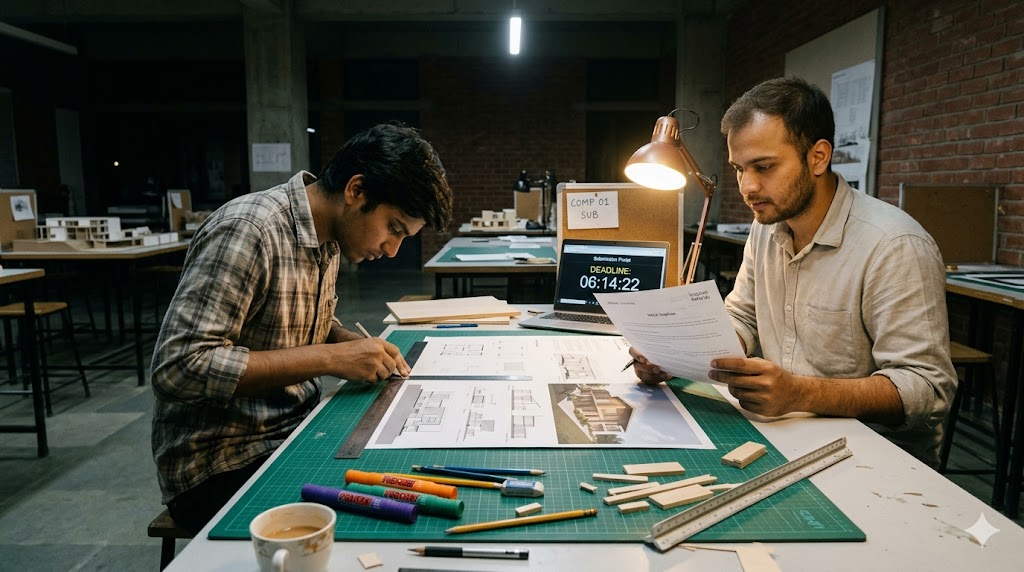
Architecture Competitions — A Working Calendar for Students
The 2026 Reference for Indian B.Arch Students — Annual Indian Competitions (NASA Trophies, IIA Awards, Zonasa), Global Student-Eligible Competitions (Bee Breeders, YAC, ARCHmedium, Inspireli, d3, Velux, Solar Decathlon), Five-Year Strategy, Submission Discipline, Board Production, Team Formation, Cost Map, and the Portfolio Compounding Effect
Architecture competitions are the most under-leveraged opportunity in the Indian B.Arch student's calendar. The student who graduates with five years of studio work but no competition entries has built one half of the portfolio. The student who graduates with five years of studio work and a sustained record of competition entries — with at least two or three shortlistings, mentions, or wins — has built a portfolio asset that compounds in value across first-job interviews, M.Arch admissions, and early independent practice.
This guide is the working calendar of competitions students should know about, the strategy for engaging with them across the five-year programme, and the operational discipline of producing competitive entries. It is the external-facing counterpart to the Building Your Architecture Portfolio guide — that guide tells you how to assemble your work; this guide tells you which competitions are worth feeding work into.
The treatment is structured around three clusters. The map cluster (sections 1-4) covers the Indian competition ecosystem (NASA, Zonasa, IIA, brand-sponsored), the global student-eligible competitions (Bee Breeders, YAC, ARCHmedium, Inspireli, d3, Velux, Solar Decathlon, Lyceum, Berkeley), and the recurring annual calendar. The strategy cluster (sections 5-7) covers the five-year strategy, team formation, and the cost map. The production cluster (sections 8-10) covers brief reading, board production, submission discipline, and the portfolio-compounding effect.
"Competitions are the second studio. Your college studio gives you assignments; competitions force you to formulate them. The student who only does college studios graduates a graded student; the student who also competes graduates a designer." — Faculty paraphrase, Indian school of architecture
1. The Indian Competition Ecosystem
1.1 NASA India — The Flagship
The National Association of Students of Architecture (NASA) is the largest student architecture organisation in India, with chapters at most COA-recognised B.Arch institutions. NASA India operates a comprehensive trophy programme — typically 35+ trophies across categories ranging from sketching and photography to thesis design, urban design, sustainable architecture, and conservation.
| Dimension | NASA Trophies |
|---|---|
| Eligibility | Currently-enrolled B.Arch students at NASA-affiliated institutions |
| Submission cycle | Briefs released April-July; submissions Aug-Sep; results at NASA Annual Convention (Oct-Nov) |
| Categories | 35+ — design (multiple themes), sketching, photography, conservation, urban design, sustainable, thesis trophies, brand-sponsored trophies |
| Format | Mix of individual and team submissions, 2-3 board panels typically |
| Cost | Modest — registration through college NASA chapter |
| Recognition | The most-recognised student award in Indian architecture practice |
The NASA Annual Convention rotates between host institutions across India. Attending the convention as a student — even without a winning entry — is itself a developmental experience: lectures from senior practitioners, exposure to peer work from across the country, and the formation of a national network.
1.2 Zonasa — The Zonal NASA Rounds
Most NASA trophies have zonal qualifying rounds before the national stage. Zonasa events are the regional NASA chapter gatherings (typically 4-6 zones across India — North, East, West, South, Central, Northeast). Zonal rounds are easier to enter and offer feedback before the national submission.
The Year-2 / Year-3 student is well-served by treating Zonasa as the first venue for competition entries — lower stakes, faster feedback loop, more peer-engagement than direct national submissions.
1.3 IIA (Indian Institute of Architects) Annual Awards
The IIA — the largest professional architects' body in India — operates annual awards with multiple categories, including dedicated student categories.
| Dimension | IIA Awards |
|---|---|
| Eligibility | B.Arch students; specific student categories within the broader awards |
| Cycle | Submissions Mar-May; ceremony Jun-Jul |
| Categories (student) | Best student thesis, best student design, urban design, sustainability |
| Cost | Modest student fees |
| Recognition | Strong professional recognition; visible in industry circles |
1.4 Council of Architecture Student Awards
The COA itself, as the statutory body, periodically hosts student awards — typically conservation-themed, urban-design-themed, or sustainability-themed. Less prominent than NASA Trophies or IIA Awards, but worth tracking on the COA website.
1.5 Brand-Sponsored Awards (Indian)
Indian architecture publications and material brands sponsor student awards:
| Award | Sponsor | Theme |
|---|---|---|
| Berger Awards | Berger Paints | Often urban / colour / branding |
| Asian Paints Architecture+ Awards | Asian Paints | Multi-category |
| DA+D Awards (Design Architecture+) | Architecture+Design magazine | Multi-category |
| JK Cement Awards | JK Cement | Architecture practice + select student categories |
| Asia One Awards | Asia One | Multi-category, regional emphasis |
| A'Design Award | International A'Design | Multi-discipline, international student categories |
These awards typically have lower student awareness than NASA and IIA but offer recognition with strong industry visibility. The candidate's discipline is to monitor the publications (A+D, Inside Outside, DesignPataki, DOMUS India) for award announcements through the year.
1.6 College-Internal and University-Level Competitions
Most B.Arch institutions run internal design competitions — annual studio award showcases, course-level competitions, and inter-college competitions. These are the training-wheel venue for competition discipline. Students should treat internal competitions as practice runs for the larger Zonasa and NASA submissions.
2. The Global Student-Eligible Ecosystem
The global competition ecosystem is large, varied, and increasingly accessible to Indian students. Many competitions waive or reduce entry fees for students from less-developed economies; many are explicitly student-only.
2.1 Bee Breeders
| Dimension | Bee Breeders |
|---|---|
| Format | Multiple themed competitions per year (~12-15) |
| Themes | Vary widely — public space, sustainability, hypothetical buildings, conceptual architecture |
| Eligibility | Open to students and professionals (separate categories) |
| Cost | Modest student fee (~$50-100) |
| Cycle | Rolling — new competitions launched monthly |
| Recognition | International jury; awards published online; valuable portfolio asset |
Bee Breeders is the most active platform for student-friendly international competitions. The variety of themes means students can find competitions aligned with their studio interests and use studio work as the basis for refined competition submissions.
2.2 YAC — Young Architects Competitions
| Dimension | YAC |
|---|---|
| Format | Multiple themed competitions per year (~6-8) |
| Themes | Often heritage adaptive reuse, urban regeneration, cultural |
| Eligibility | Students and young architects; team-friendly |
| Cost | Modest entry fee (€60-100) |
| Recognition | High-quality international jury; well-known among young architects globally |
2.3 ARCHmedium
| Dimension | ARCHmedium |
|---|---|
| Format | Multiple competitions per year |
| Eligibility | Architecture and design students (mostly) |
| Cost | Modest fees |
| Recognition | Strong reputation within student architecture circles |
2.4 Inspireli Awards
| Dimension | Inspireli Awards |
|---|---|
| Format | Annual competition with multiple categories |
| Eligibility | Free for students from less-developed economies, including India |
| Cycle | Submissions May-Sep; results late in year |
| Recognition | High visibility, including Indian-relevant exposure |
Inspireli is one of the highest-leverage competitions for the Indian B.Arch student because of the free entry combined with strong international visibility. Students should target at least one Inspireli entry per year from Year 3 onwards.
2.5 d3 Natural Systems
| Dimension | d3 Natural Systems |
|---|---|
| Format | Annual competition focused on biomimicry and natural-systems-inspired architecture |
| Eligibility | Open to students and professionals |
| Cost | Moderate |
| Recognition | Prestigious within sustainability-focused architecture |
2.6 Velux International Daylight Award
| Dimension | Velux Daylight |
|---|---|
| Format | Biennial student competition focused on daylight in architecture |
| Eligibility | Architecture students worldwide |
| Cost | Free for student categories |
| Recognition | Highly prestigious in sustainable-architecture circles |
2.7 Solar Decathlon
| Dimension | Solar Decathlon |
|---|---|
| Format | Major team competition; full-scale built solar-powered house |
| Variants | US DOE Solar Decathlon (biennial), Solar Decathlon Africa, Solar Decathlon India / South Asia, Solar Decathlon Europe |
| Eligibility | University-led teams; multi-disciplinary teams (architecture + engineering + business) |
| Cost | Significant team investment, but typically supported by the university |
| Cycle | Biennial; multi-year project commitment |
| Recognition | The most prestigious student sustainability competition globally |
Solar Decathlon is a multi-year team commitment, not a single-submission competition. Indian institutions including IIT Bombay, IIT Madras, IIT Roorkee, CEPT, and SPA Delhi have fielded teams in past Solar Decathlon events. The candidate at one of these institutions interested in sustainability should treat Solar Decathlon as an opportunity worth committing 12-18 months to.
2.8 Lyceum Fellowship
| Dimension | Lyceum Fellowship |
|---|---|
| Format | Annual writing-based fellowship for architecture students |
| Eligibility | Architecture students worldwide |
| Cost | Free |
| Recognition | Strong academic recognition |
2.9 Berkeley Prize
| Dimension | Berkeley Prize Essay Competition |
|---|---|
| Format | Annual essay competition on socially-engaged architecture |
| Eligibility | Architecture students worldwide |
| Cost | Free |
| Recognition | Strong academic recognition |
2.10 AIA / RIBA Student Awards
The American Institute of Architects (AIA) and Royal Institute of British Architects (RIBA) operate student awards primarily for their member institutions, but Indian students at affiliated programmes (and through some open international categories) may be eligible.
3. The Annual Calendar — Visual
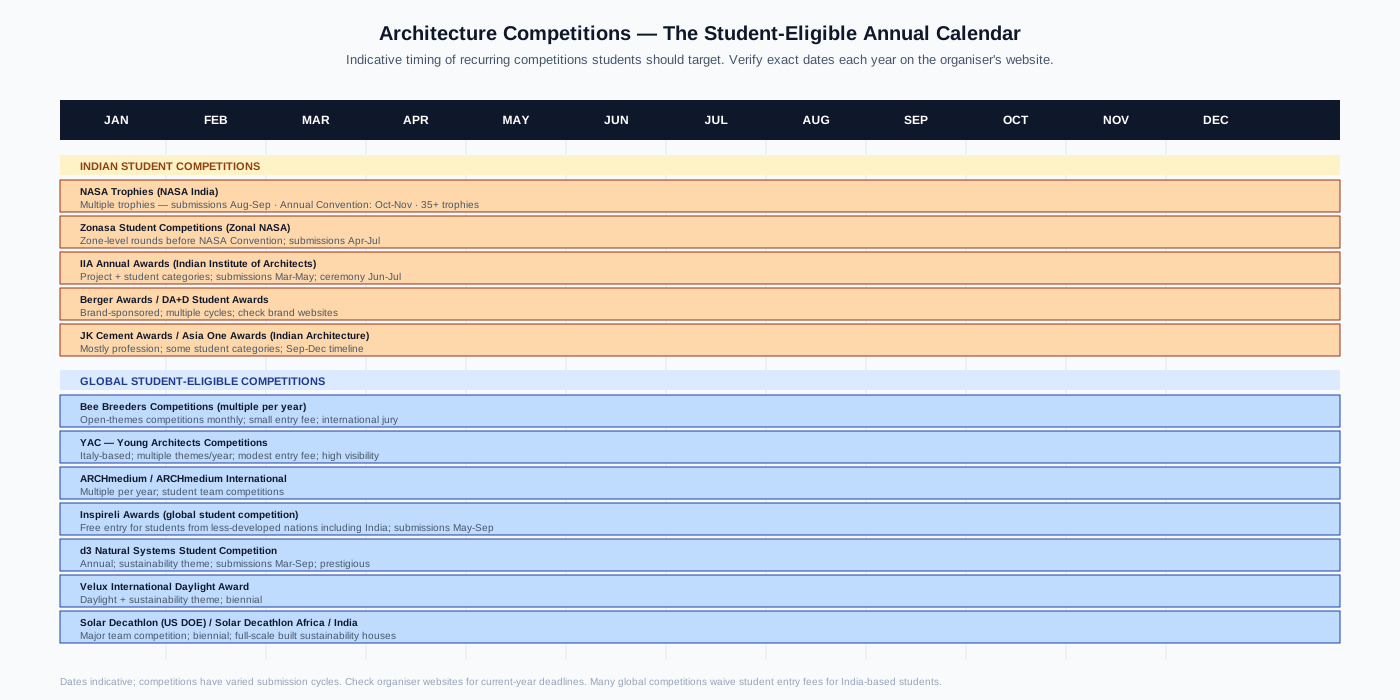
The candidate's discipline is to maintain a competitions calendar — a spreadsheet or wall chart with submission deadlines for at least 8-10 competitions across the year. Critical fields:
| Field | Why |
|---|---|
| Competition name | The label |
| Brief release date | When to start preparation |
| Submission deadline | The dropdead date |
| Eligibility | Student / professional / team / individual |
| Cost | Entry fees + production cost |
| Theme | Match to studio work / interest |
| Format | 2-3 boards / video / report / model |
| Notes | Required disclaimers, submission portal, language |
The competitions calendar pairs with the academic calendar — the student must avoid scheduling competition deadlines in the same week as studio mid-reviews or final submissions.
4. The Five-Year Strategy
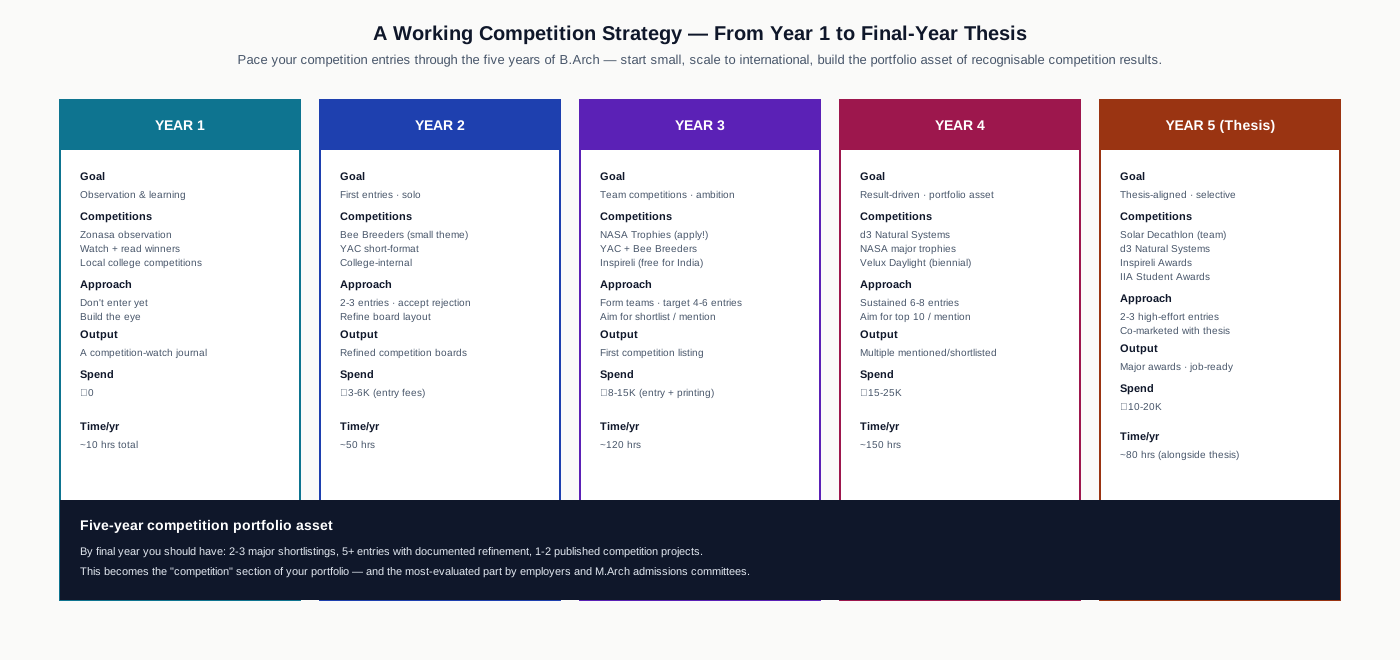
The competition strategy must be paced across the five-year programme. The student who attempts six international competitions in Year 1 is the student who under-prepares each one and burns out; the student who waits until Year 5 to start competing has missed four years of skill-building and portfolio-compounding.
4.1 Year 1 — Observation, Not Entry
The Year-1 student is not yet ready to enter competitions seriously. The right activity is observation:
- Watch winners — read past competition results on Bee Breeders, YAC, NASA NTV
- Read winning boards in detail — what did they say with text vs image? How did they structure the narrative?
- Maintain a competition-watch journal — clippings of boards that worked, with notes on why
- Attend Zonasa events as observer — listen to crits, talk to senior students who entered
Output: a thicker eye for what makes a competition entry strong. No actual entries this year. Spend: ₹0.
4.2 Year 2 — First Solo Entries
The Year-2 student begins entering, in low-stakes contexts:
- Bee Breeders — pick 1 small theme that aligns with current studio work
- YAC — short-format entries; team optional
- College-internal — every internal competition opportunity should be entered as practice
- Zonasa — register as solo or in a small team for one trophy
Approach: 2-3 entries through the year. Target: refinement of board-layout discipline; acceptance of rejection is the lesson. Few Year-2 entries place; the value is in the production discipline. Output: refined competition boards added to portfolio. Spend: ₹3-6K (entry fees).
4.3 Year 3 — Team Competitions and Ambition
The Year-3 student has the studio fluency and time to attempt larger competitions:
- NASA Trophies — apply seriously for 2-3 trophies aligned with studio work
- YAC + Bee Breeders — sustain quarterly entries
- Inspireli — free entry for Indian students; do not skip
- d3 Natural Systems — if sustainability-aligned
Approach: 4-6 entries through the year, mix of solo and team. Target: aim for shortlist or honourable mention on at least 1 entry. Form teams with peers whose strengths complement (a team with one strong drawer + one strong concept-thinker + one strong renderer is the standard mix). Output: first competition listing on portfolio. Spend: ₹8-15K (entry fees + printing).
4.4 Year 4 — Result-Driven
By Year 4 the student has the studio depth and competition-production fluency to target serious recognition:
- NASA major trophies — design, urban, sustainability
- d3 Natural Systems — sustained entry
- Velux Daylight — if the cycle aligns (biennial)
- YAC + Bee Breeders — selective high-effort entries
- Solar Decathlon team — if the institution is fielding a team, Year 4 is when to commit
Approach: 6-8 entries through the year; selective — abandon the entries where the studio work doesn't translate. Target: top 10 / mention on at least 2 entries. Output: multiple shortlisted entries forming a competition portfolio. Spend: ₹15-25K.
4.5 Year 5 — Thesis-Aligned and Selective
The Year-5 student is consumed by thesis. Competition entries must be thesis-aligned — the same project, reformatted for the competition format. Don't start fresh competition projects.
- Inspireli Awards — free; thesis project as entry
- d3 Natural Systems — if thesis is sustainability-aligned
- IIA Student Awards — thesis category
- Solar Decathlon — final-year team submission
Approach: 2-3 high-effort entries, all thesis-derived. Target: major recognition that becomes the entry-point for first-job interviews. Output: capstone-quality entries that are first-job-ready. Spend: ₹10-20K.
5. Team Formation — How to Pick Competition Partners
For team competitions (NASA, YAC, Solar Decathlon, many d3 entries), team composition is consequential. The strongest student teams have complementary strengths:
| Role in team | What they bring |
|---|---|
| The conceptualist | The original idea; the parti diagram; the design narrative |
| The drawer / illustrator | Hand sketches, perspective, atmospheric pencil/marker work |
| The renderer | Software fluency — V-Ray, Lumion, post-production |
| The graphic designer | Layout, typography, board composition, narrative presentation |
| The writer / theorist | The critical thesis text, captions, references |
A team of 3-5 with these roles distributed (one person can hold two roles) typically produces stronger work than a team of 3-5 with overlapping strengths and missing capabilities.
5.1 Common Team Failure Modes
- All conceptualists, no production. Strong idea, weak execution.
- All renderers, no narrative. Beautiful boards with no story.
- Single dominant member. Team becomes one person's submission with token co-authorship.
- Misaligned schedules. Students whose academic calendars don't align cannot meet competition deadlines.
- Unclear authorship. Disputes at submission time over how credit is attributed.
The team formation conversation should happen before the competition brief is read seriously — including a written agreement on authorship, division of work, and decision-making.
6. The Cost Map
6.1 Direct Costs
| Cost category | Range per entry |
|---|---|
| Entry fee (free competitions: Inspireli, college-internal) | ₹0 |
| Entry fee (Bee Breeders student) | ₹3-6K (₹50-100 USD equivalent) |
| Entry fee (YAC student) | ₹4-8K (€60-100 equivalent) |
| Entry fee (d3, Velux) | ₹0-6K |
| Entry fee (Solar Decathlon team) | ₹10-50L (full team; usually institution-funded) |
| Printing & lamination (Indian competitions, A1/A0 boards) | ₹2-5K per entry |
| Model production (where required) | ₹3-15K per entry |
| Portfolio assembly & presentation | ₹2-5K |
6.2 Indirect Costs
| Cost category | Range |
|---|---|
| Time | 40-150 hours per major entry |
| Site visits / fieldwork | ₹2-10K (where competition requires Indian-context work) |
| Software (already licensed) | Marginal |
Total cost for the five-year competition strategy outlined in §4: ₹40-80K. This is meaningfully less than the cost of attending one international workshop or summer programme — and produces, by Year 5, a competition-portfolio asset that compounds over career.
7. Brief Reading — The Operational Skill
The single most undervalued skill in competition entry is brief reading. Students who skim the brief and head into design produce work that misses the brief; students who spend 4-6 hours dissecting the brief produce work that addresses what was actually asked.
7.1 The Brief-Reading Discipline
A working brief-reading session takes 4-6 hours and produces a written brief-summary document:
| Layer | What you extract |
|---|---|
| Programme | What spaces, what areas, what users? |
| Site | Real or hypothetical? Specific location? Constraints? |
| Theme / argument | What is the competition asking you to argue? |
| Submission format | Boards, panels, pages, video, model? Sizes, file types, languages? |
| Disqualification triggers | Branding violations? Word-count exceeded? Late submission? Copyright? |
| Jury composition | Who will read this? Indian, global, sustainability-focused, conservation-focused? |
| Past winners | What aesthetic and conceptual framework won? |
| Required text components | Project description (word counts), credits, captions |
| Optional text components | Where extra narrative is allowed |
| Timeline | Brief release, submission deadline, results announcement |
The output is a 1-2 page summary document the team uses as the design constraint. Re-read after every design milestone — Concept, Schematic, Final — to verify alignment.
8. Board Production — The Visual Communication Discipline
Competition boards are visual essays. The discipline is closer to graphic design than to studio production. The principles:
8.1 The Hierarchy
Every board must have a primary read, a secondary read, and a tertiary read:
- Primary read (5-second read) — the title, the hero image, the thesis sentence. The viewer must understand the project's intent in 5 seconds.
- Secondary read (30-second read) — the key plans, sections, diagrams. The viewer must understand the project's organisation in 30 seconds.
- Tertiary read (full minute+) — the detail, the captions, the supporting drawings. For the viewer who is reading deeply.
Boards that fail this hierarchy — too much primary content, too little secondary, no tertiary — read as cluttered. Boards that nail it read as clear.
8.2 The Layout Grid
Use a consistent grid (typically 12-column) across all boards in the submission. The layout grid is the discipline that makes 4-6 boards read as a coherent submission rather than as 4-6 separate posters.
The Building Your Architecture Portfolio guide covers the universal layout-grid framework; competition boards apply the same principles at larger scale (A1/A0 vs portfolio A3).
8.3 The Narrative Arc
A submission that "shows the project" is weaker than a submission that narrates the project's argument. The narrative arc:
1. Frame the problem — what is the question this project is answering?
2. Establish the approach — what is the design strategy?
3. Present the design — plans, sections, axos, perspectives
4. Show the experience — atmospheric renders, moments
5. Close with implication — what does this project mean beyond itself?
This arc translates across most competition formats; the proportion shifts but the underlying logic holds.
8.4 Common Board Production Mistakes
- Too much text. Competitions reward visual communication; long text passages are usually skipped.
- Inconsistent rendering style. Mixing 3D V-Ray + sketchy hand drawing + photo collages without a strategy reads as confused.
- Plans without scale or north arrow. A small but consistent failure that signals lack of professional discipline.
- Captions that explain what the image is, not why it matters. "Section A" is weaker than "Section A — the entry sequence reveals the central courtyard."
- Last-minute reformatting. Boards optimised for screen are not the same as boards printed at A1.
- Submission file format errors. Most disqualifications are technical, not design.
9. Submission Discipline — The Last 72 Hours
The last 72 hours before submission have ruined more competition entries than any concept failure. The submission discipline:
9.1 The 72-Hour Checklist
| Time before deadline | Action |
|---|---|
| 72 hours | Final concept frozen; no further design changes; all team members on the same version |
| 48 hours | All board layouts complete; first proof-print at A4 |
| 36 hours | All renders rendered; no further re-rendering |
| 24 hours | A1 / A0 proof-print; physical inspection for typos, alignment, image quality |
| 18 hours | Submission file formats verified (PDF version, file size, naming convention) |
| 12 hours | Submission portal tested with a dummy upload (or a smaller earlier version) |
| 6 hours | Final submission uploaded; receipt confirmation captured |
| 3 hours | Backup submission via second route if multiple options available |
9.2 Submission Portal Failure Modes
Every year, students lose competition entries because:
- Internet connection fails at the last hour
- Submission portal crashes under load (common in the final hour before global deadlines)
- File size exceeds the portal's limits (typical 50MB limit; adjust render quality)
- Submission portal is in a different timezone than the student assumes
- File naming convention is wrong (specific format required)
The discipline: submit 24 hours before the deadline, not 24 minutes before.
10. The Portfolio Compounding Effect
Competition entries — even those that don't win — become portfolio assets. The student who has entered 15 competitions across five years has 15 polished portfolio pages by graduation; the student who has entered zero has only studio work.
10.1 The Portfolio Section "Competitions"
By Year 5, the strong B.Arch portfolio has a dedicated Competitions section showing:
- 4-6 entries with brief, board image, role in team, outcome (shortlisted / mentioned / submitted)
- Clear authorship attribution where team work
- Concise project description (1-2 sentences each)
This section is one of the most-evaluated parts of a portfolio by employers (who see professional discipline) and M.Arch admissions committees (who see design ambition).
10.2 First-Job and M.Arch Implications
A student with 2-3 mentioned/shortlisted entries by graduation typically:
- Gets first-round interviews at top studios more easily
- Has stronger materials for international M.Arch applications (where competition results are valued)
- Carries credibility into early independent practice
- Has built a peer network across schools through team competitions
The compounding effect is real and visible by Year 5.
11. Common Mistakes Students Make in Competitions
- Entering too many competitions, finishing none. A student who enters 8 competitions and submits 0 has wasted time. A student who enters 3 and submits 3 — even if all three lose — has built skill and portfolio assets.
- Treating competitions as a fallback when studio work is going badly. Competitions are additive to studio work, not a substitute. Students who use competitions to escape studio failure typically fail at both.
- Competing for prizes alone. The portfolio compounding effect happens whether or not you win. Students who only submit when they expect to win submit too rarely.
- Solo when team would be better. Many strong competitions are designed for teams; a solo entry against well-formed teams is at a structural disadvantage.
- Missing the brief. The §7 brief-reading discipline is non-negotiable; missing it produces work that doesn't engage the actual question.
- Late submission. Always 24 hours before the deadline.
- No backup of submission files. A power outage 30 minutes before deadline has cost many entries. Always work in cloud-synced folders.
- Skipping post-mortem. After every competition (winning or losing), review what worked and what didn't. The post-mortem is the learning.
- Not entering Indian competitions because "they're less prestigious". NASA Trophies are recognised at every Indian studio; students who chase only international competitions miss the strongest first-job pipeline in Indian architecture practice.
- Spending too much. Competition entries do not require ₹50K of model production. Spend should match competition stage; Year-2 entries should be cheap, Year-5 entries can be more substantial.
12. Twelve-Test Self-Diagnostic
Use this diagnostic at start of each year:
1. Calendar awareness. Have I created a competitions calendar with at least 8 deadlines tracked?
2. First entry. Have I submitted at least one competition entry, even if rejected?
3. Team formed. Have I assembled a team of 3-5 peers for at least one team competition?
4. Brief discipline. Have I produced a written brief-summary for the most recent competition?
5. Layout grid. Do I have a personal layout-grid template for board production?
6. Render fluency. Can I produce a competition-quality V-Ray render in under 6 hours of compute?
7. Board printing. Have I successfully printed at A1 / A0 at a local printer?
8. Submission discipline. Have I submitted at least one competition 24+ hours before deadline?
9. Post-mortem. Have I conducted a written post-mortem on at least one rejected entry?
10. Portfolio integration. Are my competition entries integrated into my portfolio?
11. NASA awareness. Do I know my college's NASA chapter representatives and the upcoming Zonasa cycle?
12. Inspireli awareness. Have I bookmarked the Inspireli Awards website (free for Indian students)?
Year-3 students scoring 9+ are well-positioned. Year-4 students scoring below 9 are under-engaging the competition opportunity.
13. References and Further Reading
Indian Competition References
- National Association of Students of Architecture (NASA) India. Annual Convention Proceedings; Trophy Briefs Archive. nasaindia.co
- Indian Institute of Architects (IIA). Annual Awards Information. indianinstituteofarchitects.com
- Council of Architecture (COA). Student awards announcements. coa.gov.in
- Architecture+Design (A+D), Indian Architect & Builder, DOMUS India — student-award announcements through the year.
Global Competition Platforms
- Bee Breeders. beebreeders.com — Multiple competitions per year.
- YAC — Young Architects Competitions. youngarchitectscompetitions.com
- ARCHmedium. archmedium.com
- Inspireli Awards. inspireli.com — Free entry for students from less-developed economies including India.
- d3 Natural Systems. d3space.org
- Velux International Daylight Award. veluxstipendium.com
- Solar Decathlon (US DOE). solardecathlon.gov; Solar Decathlon India: solardecathlonindia.in
- Lyceum Fellowship. thelyceumfellowship.com
- Berkeley Prize. berkeleyprize.org
Competition Strategy and Pedagogy References
- Salama, A. M. (2016). Spatial Design Education: New Directions for Pedagogy in Architecture and Beyond. Routledge. — On competition's role in design pedagogy.
- Goldschmidt, G. (2014). Linkography: Unfolding the Design Process. MIT Press. — On the cognitive role of design ideation under brief constraints.
Companion Studio Matrx Guides
- Building Your Architecture Portfolio — universal portfolio framework; competition entries become portfolio assets.
- Studio Jury Survival — production discipline overlap with competition board production.
- Architectural Drawing & Representation Fundamentals — the foundational discipline that supports competition board production.
- The Software Stack — A Working Learning Path — software fluency for competition rendering and board production.
- Architecture Internship Readiness — competition results carry weight in internship applications.
- Career Pathways After B.Arch — competition results are an asset for M.Arch applications, especially abroad.
Author's Note: Competition entries are the second studio. Your college studio gives you assignments; competitions force you to formulate them. The student who only does college studios graduates a graded student; the student who also competes graduates a designer. The compounding effect is real — five years of consistent competition entries produces a portfolio asset that opens doors at first-job, M.Arch admissions, and early independent practice. The cost is ₹40-80K across five years and roughly 400 hours of focused work. Both are bearable. Start in Year 1 with observation, in Year 2 with first entries, and never stop. The portfolio compounds.
Disclaimer: Competition deadlines, entry fees, and eligibility criteria change year-on-year. Verify all competition information directly with the organiser at the time of intended entry. This guide is for informational and educational purposes only; Studio Matrx, its authors, and contributors accept no liability for outcomes based on it.
Export this guide
Related Guides — Deep-dive reading
Architecture & Interior Design Awards: The Complete India & Global Atlas
Who runs every major architecture and interior-design award in India and abroad, how often, on what criteria, when entries close, what they cost — and who has actually won. A clear-eyed map of genuine peer honours, pay-to-enter platforms and editorial lists, for practices deciding where to spend.
Design EducationInternship Interview Prep & Résumé Content for Architecture Students
The 2026 Working Reference for Indian B.Arch and B.Des Students — Building the One-Page Résumé (Twelve Sections), Writing the Cover Letter That Lands, the Five-Stage Interview Process, the Portfolio Walk-Through, the Sketch Test, Salary Discussion, Offer Evaluation, the Common Failure Modes, and the Sustained Discipline of Internship Application Across Year 3 and Year 4
Student FoundationsModel-Making for Architecture Students
The 2026 Working Reference for B.Arch Studios in India — Five Model Types, Scale-to-Material Map, Tool Kit, Indian Material Sources, Workshop Discipline (Including Laser-Cutter and 3D-Printer Access), Lighting and Photography for Jury Showings, Storage & Transport, Five-Year Skill Build, and Common Failure Modes
Student FoundationsRelated Tools — Try Free
Concept Generator
Get 3 AI-generated design concepts for any room with style, materials, and cost estimate.
DesignAICross-Ventilation Analyzer
Estimate airflow and air changes per hour (ACH) from room size, window areas, layout, and local wind — with NBC 2016 Part 8 compliance check.
Ventilation CalculatorSite Inspection Checklist
57-point checklist across 8 work areas for every site visit and stage-gate inspection.
Execution Checklist