

Internship Interview Prep & Résumé Content for Architecture Students
The 2026 Working Reference for Indian B.Arch and B.Des Students — Building the One-Page Résumé (Twelve Sections), Writing the Cover Letter That Lands, the Five-Stage Interview Process, the Portfolio Walk-Through, the Sketch Test, Salary Discussion, Offer Evaluation, the Common Failure Modes, and the Sustained Discipline of Internship Application Across Year 3 and Year 4
The internship is the single most consequential first-job preparation step in B.Arch. The student who has interned at three good studios across Year 3 and Year 4 enters first-job interviews with credible production exposure, professional discipline, and (often) a direct first-job offer from one of the internship firms. The student who has interned at zero or one firms enters first-job interviews from a meaningfully weaker position — and pays for the gap across the first three years of practice.
This guide is the application-and-interview counterpart to the existing Architecture Internship Readiness guide and the CV template SVG already published in the Student Resources hub. Those resources cover the strategic layer — when to intern, where to apply, how to think about the year. This guide covers the operational layer — what to put in the CV, how to write the cover letter, what to expect in the interview, and how to evaluate the offer.
The treatment is structured around four clusters. The résumé cluster (sections 1-3) covers the twelve sections of a strong B.Arch résumé, the writing discipline for each, and the layout framework. The cover letter cluster (section 4) covers the framework, the customisation discipline, and common failure modes. The interview cluster (sections 5-8) covers the five-stage process, the portfolio walk-through, the sketch test, and behavioural questions. The offer cluster (sections 9-11) covers stipend benchmarks, offer evaluation, negotiation discipline, and the post-offer follow-up.
"We hire on portfolio, but we shortlist on CV. A weak CV does not get to portfolio review. The candidate who treats the CV as an afterthought is the candidate who is not read." — Senior architect paraphrase, Indian boutique studio
1. The One-Page Discipline
The Indian architecture internship CV is one page. This is not optional. Studios receive 50-200 applications per internship cycle; the senior architect doing the first scan reads each CV for 20-40 seconds. A two-page CV is a flag — it signals either inability to edit or padding. The candidate who cannot reduce their content to one page is signalling that they have not chosen what matters.
The one-page discipline forces:
- Selection — what is your strongest material?
- Compression — what can be removed without losing the core message?
- Hierarchy — what should the eye land on first, second, third?
A B.Arch student in Year 3 / Year 4 has enough material for two pages. The discipline is to make it one.
2. The Twelve Sections of a Strong Résumé
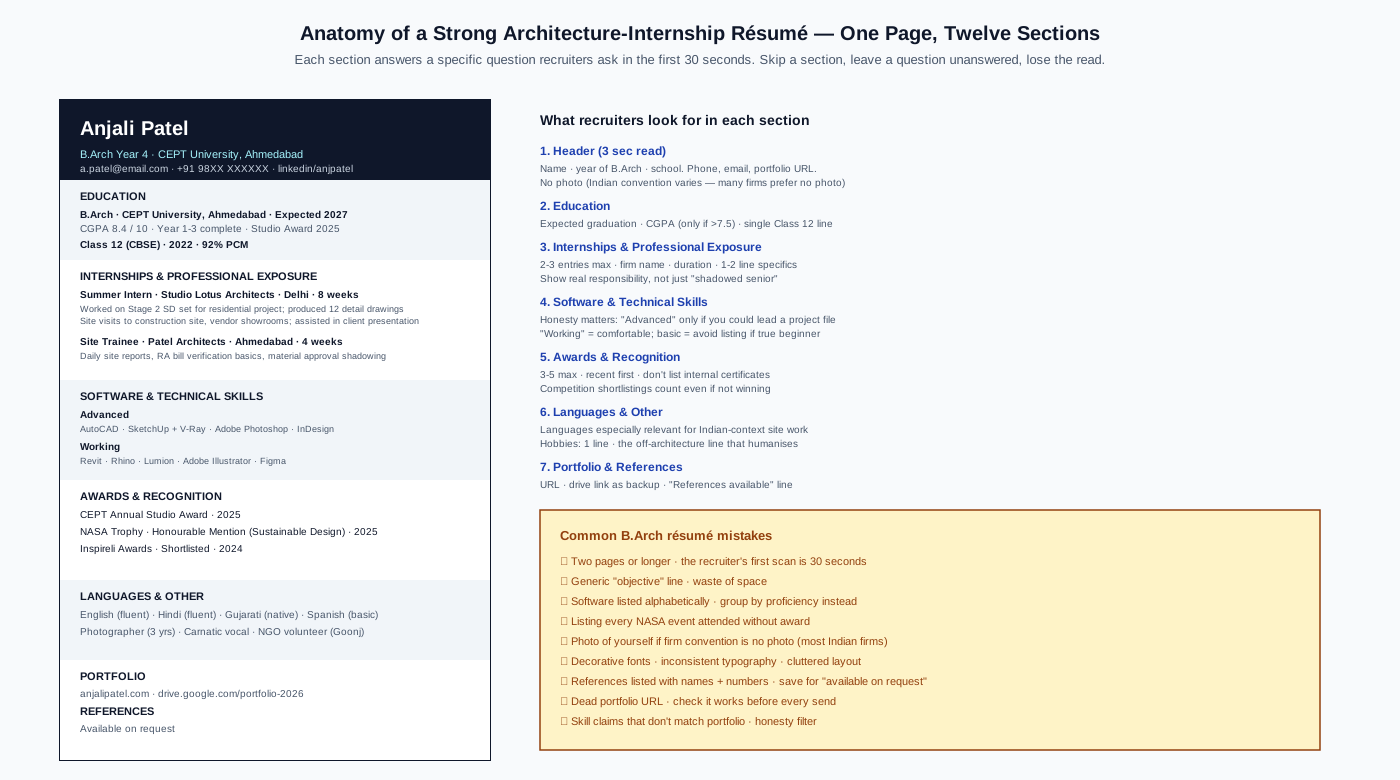
A strong architecture-internship résumé has twelve elements, distributed across three columns or stacked sections.
2.1 Header (3 seconds)
| Element | Content |
|---|---|
| Name | Largest text on the page; clear typography |
| Year + School | "B.Arch Year 4 · CEPT University, Ahmedabad" |
| Professional address (firstname.lastname@gmail.com works) | |
| Phone | India format: +91 98XX XXXXXX |
| Portfolio URL | Personal website or drive link |
| Professional profile URL | |
| Photo | Indian convention varies — most boutique studios prefer no photo; corporate firms sometimes ask for one. Default: omit unless explicitly requested. |
Avoid:
- "Objective" or "Career Objective" lines — wasted space
- Personal address (street level) — only city is needed if at all
- Multiple email addresses
- Date of birth (rarely necessary)
2.2 Education
Second section, since you are a current student:
``
B.Arch · CEPT University, Ahmedabad · Expected 2027
CGPA 8.4/10 · Year 1-3 complete · Studio Award 2025
Class 12 (CBSE) · 2022 · 92% PCM
`
Discipline:
- CGPA only if >7.5/10 (otherwise omit; firms will not penalise omission)
- Single line for Class 12 — full board exam details belong in the past
- Studio awards or distinctions — listed once here, fully on the awards section
- No need to list 10th board marks unless asked
2.3 Internships & Professional Exposure
The most-read section after education. Each entry:
`
Summer Intern · Studio Lotus Architects · Delhi · 8 weeks
Worked on Stage 2 SD set for residential project; produced 12 detail
drawings. Site visits to construction site, vendor showrooms; assisted
in client presentation.
`
Discipline:
- Firm name + duration prominently — recruiters scan firm names
- Specifics, not generics — "produced 12 detail drawings" beats "assisted with drawings"
- Show real responsibility — what you actually did, not just observed
- Avoid pure shadowing — "shadowed senior architect" is weak; "shadowed and produced [X]" is better
- 2-3 entries max; if you have only one, that's fine — quality over quantity
If you have no internships yet (Year 2 / early Year 3), this section can include:
- Studio assistant roles (working under faculty on real projects)
- Site visits (significant ones, listed briefly)
- Workshop participation (NID summer school, Charles Correa Foundation programmes, ICOMOS workshops)
- Volunteer work in architecturally-relevant contexts (heritage documentation drives, NGO design work)
2.4 Software & Technical Skills
Group by proficiency, not alphabetically:
`
Advanced
AutoCAD · SketchUp + V-Ray · Adobe Photoshop · InDesign
Working
Revit · Rhino · Lumion · Adobe Illustrator · Figma
`
Discipline:
- "Advanced" only if you could lead a project file in that tool — the firm will test
- "Working" = comfortable, not expert — honest signal
- Omit "Beginner" — list only Advanced and Working; if you have only beginner-level fluency, do not list
- Match to portfolio — if you list Revit "Advanced" but no portfolio piece shows BIM coordination, the claim collapses
2.5 Awards & Recognition
3-5 entries maximum, recent first:
`
CEPT Annual Studio Award · 2025
NASA Trophy · Honourable Mention (Sustainable Design) · 2025
Inspireli Awards · Shortlisted · 2024
`
What to include:
- Competition shortlistings (count even without winning)
- Studio-level awards
- Scholarships, fellowships
- Published work (blog mentions, magazine features)
- Major exhibitions
What not to include:
- Internal college certificates
- Participation-only entries
- Sports or non-architecture awards (unless distinguishing)
2.6 Languages & Other
| Element | Content example |
|---|---|
| Languages | English (fluent) · Hindi (fluent) · Gujarati (native) · Spanish (basic) |
| Other | Photographer (3 yrs) · Carnatic vocal · NGO volunteer (Goonj) |
Discipline:
- Language fluency matters for Indian-context site work — list honestly
- One line for hobbies, the off-architecture line that humanises
- Avoid overlong hobby lists
2.7 Portfolio & References
Final section, brief:
`
PORTFOLIO
anjalipatel.com · drive.google.com/portfolio-2026
REFERENCES
Available on request.
`
Discipline:
- Portfolio URL primary, drive link backup
- Test both links before every send
- "References available on request" — do not list names + numbers (save for when asked)
2.8 What NOT to Include
| Item | Why omit |
|---|---|
| "Career objective" line | Cliché; wasted space |
| Long personal statement | Saved for cover letter |
| Class 10 marks | Only Class 12 unless asked |
| Religion / caste / family info | Not relevant; sometimes inappropriate |
| Photo (default) | Indian convention varies; default omit |
| Two pages | One-page discipline is industry standard |
3. Layout, Typography, and File Format
3.1 Layout Principles
- Single column or two-column — both work; two-column saves space
- Clear hierarchy — name > section headers > content
- White space — readable, not cramped
- Consistent spacing — 6mm between sections, 3mm within
- Margins — 15-20mm minimum on all sides
3.2 Typography
- One typeface family — Helvetica, Inter, Roboto, Avenir, Garamond
- Maximum 3 weights — regular, bold, sometimes italic
- Body text 9-10pt — readable at A4
- Section headers 11-12pt bold
- Name 18-22pt bold
Avoid: decorative fonts, multiple typefaces, all-caps body text, light grey body text on white.
3.3 File Format
- PDF only — never Word; PDF preserves layout across devices
- File size <500KB — large files signal poor production discipline
- File name discipline — Patel_Anjali_CV_2026.pdf
is professional;final cv v3 (1).pdfis not - Embed fonts — to ensure consistent rendering
4. The Cover Letter
The cover letter is the motivated selection layer. The CV shows what you have done; the cover letter shows why this firm, and why you in particular for this firm.
4.1 The Four-Paragraph Framework
Paragraph 1 — The hook (3-4 sentences)
Open with what specifically attracted you to this firm. Reference a specific project, a specific approach, a specific architect. Generic openings ("I am writing to apply for an internship at your esteemed firm...") are filtered out within 5 seconds.
Strong:
"Studio Lotus's Hathigaon Jaipur (2010-15) is the project that made me understand how Indian residential architecture can be both vernacular-rooted and contemporary. The way the courtyard typology was reinterpreted at scale, with shared services consolidated below the elevated dwelling units, is the thinking I would like to learn directly. I am writing to apply for the summer internship."
Paragraph 2 — Your relevant background (4-5 sentences)
Brief — your year, your school, the studios that have most shaped your design thinking. Reference 1-2 portfolio pieces by name. The reader should be able to quickly understand what level you are at and what your design orientation is.
Paragraph 3 — What you bring (3-4 sentences)
Honest about your strengths. Software fluency, drawing strength, on-site exposure (if any), thesis or studio interests. Avoid grand claims; specific evidence beats general assertion.
Paragraph 4 — Practical close (2-3 sentences)
Availability dates, duration, and how to reach you. Mention attached CV and portfolio. Express genuine appreciation for their consideration.
`
I am available for an 8-week internship between [Date] and [Date]. My CV
is attached, and the portfolio is at [URL]. I would be honoured to discuss
how I might contribute to your studio. Thank you for your consideration.
Sincerely,
Anjali Patel
``
4.2 Customisation Discipline
The single most consequential rule of the cover letter: one cover letter per firm. The candidate who sends the same cover letter to ten firms — varying only the firm name — is filtered out by every firm that reads carefully.
The customisation requires:
- 30-45 minutes of research on the firm — recent projects, design ethos, principal architects' published views
- A specific reference in Paragraph 1 — a project, a quote, an approach
- Alignment of your stated interests with their declared work
The economics: 3 firms × 45 minutes of customisation = 2.25 hours, with high response rates. 30 firms × 5 minutes of generic copy-paste = 2.5 hours, with very low response rates. The customised approach wins by an order of magnitude.
4.3 Common Cover Letter Mistakes
- Generic opening — "I am writing to apply for..." filters out
- Padding the paragraph 1 — "I have always been passionate about architecture..." — assumed; not informative
- Listing CV content again — the cover letter complements the CV, doesn't duplicate
- Tone-deaf flattery — "Your firm is the most prestigious in India..." — recognised as filler
- Asking for the firm's time before earning it — "Could we set up a call so I can learn more about your firm?" — too presumptuous in first contact
- Typos and grammatical errors — disqualifying; proofread, get a peer to read, and read aloud
- Wrong firm name in Paragraph 1 — has happened; immediate disqualifier
5. The Five-Stage Interview Process
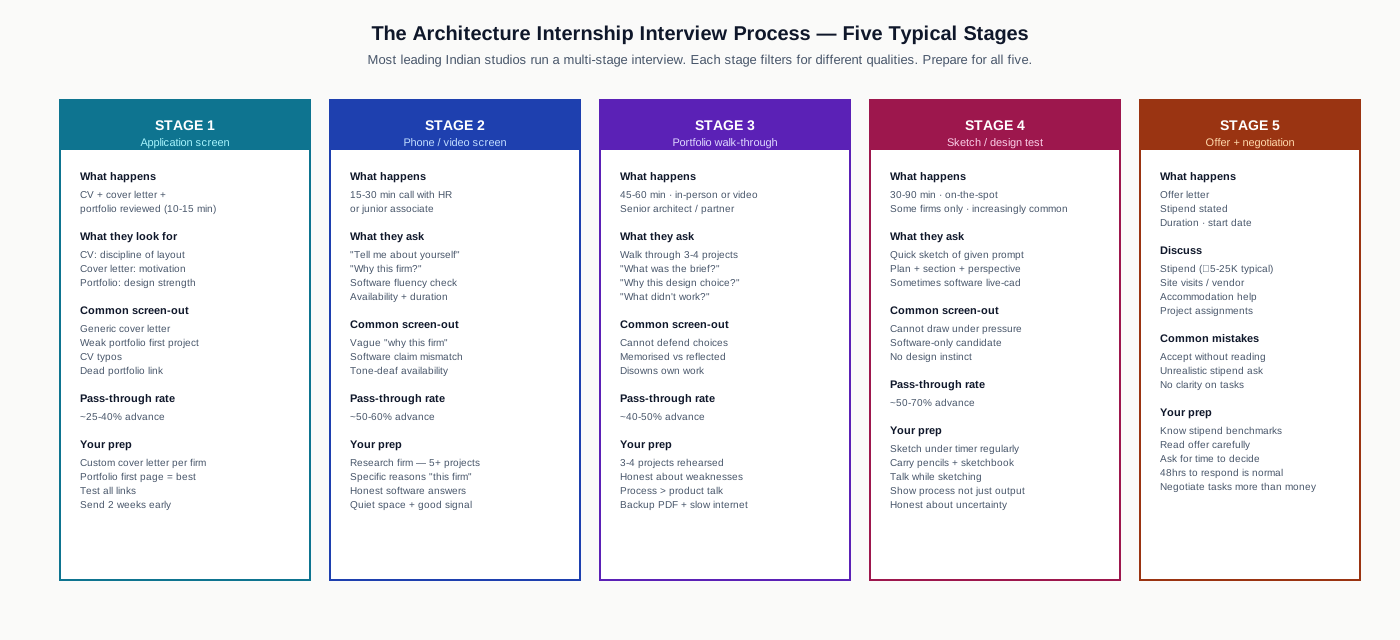
Most leading Indian studios run a multi-stage interview. Each stage filters for different qualities. Preparing for all five increases the conversion rate meaningfully.
5.1 Stage 1 — Application Screen
What happens: CV + cover letter + portfolio reviewed. 10-15 minutes per applicant. Senior architect or HR conducts.
What they look for:
- CV: discipline of layout, hierarchy, content depth
- Cover letter: motivation, specificity, written discipline
- Portfolio: design strength on first 3-4 pages
Common screen-out:
- Generic cover letter
- Weak portfolio first project (the strongest project must lead)
- CV typos or layout errors
- Dead portfolio link
Pass-through rate: ~25-40% of applications advance.
Your prep:
- Custom cover letter per firm
- Portfolio first page = strongest project
- Test all links before send
- Send 2 weeks before stated start date
5.2 Stage 2 — Phone / Video Screen
What happens: 15-30 minute call with HR or junior associate.
What they ask:
- "Tell me about yourself" — 60-90 second introduction
- "Why this firm?" — your customisation answer
- Software fluency check — technical questions
- Availability + duration confirmation
Common screen-out:
- Vague "why this firm" answer
- Software claim mismatch (you said Advanced Revit, can't answer basic Revit question)
- Tone-deaf availability (asking for 6 weeks when firm needs 8)
Pass-through rate: ~50-60% advance.
Your prep:
- Research firm — at least 5 projects
- Specific reasons "this firm" — at least 2 named
- Honest software answers (better to say Working than oversell as Advanced)
- Quiet space + good signal during the call
- Sit upright, dress reasonably (even on phone — affects voice)
5.3 Stage 3 — Portfolio Walk-Through
What happens: 45-60 minute conversation, in-person or video. Senior architect or partner.
What they ask:
- Walk me through 3-4 projects
- "What was the brief?"
- "Why this design choice?"
- "What didn't work?"
- "What would you do differently now?"
Common screen-out:
- Cannot defend design choices
- Sounds memorised rather than reflected
- Disowns own work ("It wasn't really mine, my partner did most of it")
- Cannot distinguish your contribution from the team's
Pass-through rate: ~40-50% advance.
Your prep:
- 3-4 projects rehearsed — the project narrative practiced
- Honest about weaknesses — "I would change X about this project, here's why"
- Process > product talk — describe the design journey, not just the final image
- Backup PDF — for slow internet on video calls
- Anticipate hard questions — "What's your weakest project?" "Where did this concept come from?"
5.4 Stage 4 — Sketch / Design Test (Some Firms)
What happens: 30-90 minutes of on-the-spot design work. Increasingly common at top studios.
What they ask:
- "Quick sketch a 50sqm cafe in this neighbourhood"
- "Plan + section + perspective of [given prompt]"
- Sometimes live AutoCAD or SketchUp work
Common screen-out:
- Cannot draw under pressure
- Software-only candidate (cannot sketch by hand)
- No design instinct evident in the rapid output
Pass-through rate: ~50-70% advance (firms that run this stage tend to be selective from prior stages).
Your prep:
- Sketch under timer regularly (20-30 minute prompts)
- Carry pencils + sketchbook to interview (always)
- Talk while sketching — narrate your thinking
- Show process, not just output — diagram, alternatives, decision
- Honest about uncertainty — "I'm thinking about this differently now" is fine
5.5 Stage 5 — Offer & Negotiation
What happens: Offer letter issued. Stipend stated. Duration and start date confirmed.
What to discuss:
- Stipend (₹5-25K typical for B.Arch internships, varies dramatically)
- Site visits and vendor exposure expectations
- Accommodation help (some firms provide; many don't)
- Project assignments
Common mistakes:
- Accepting without reading the full letter
- Unrealistic stipend ask (asking ₹40K from a firm whose typical is ₹10K)
- No clarity on tasks (accepting an offer that turns out to be 12 weeks of rendering)
Your prep:
- Know stipend benchmarks for the firm tier
- Read offer letter carefully (terms, IP clauses, NDAs)
- Ask for 48 hours to decide (always reasonable)
- Negotiate tasks more than money (most firms have stipend bands)
6. The Portfolio Walk-Through — The Decisive Stage
The portfolio walk-through is the most decisive single stage of the interview. It is where the firm understands how you think, not just what you have produced.
6.1 The Three-Project Selection
Choose 3-4 projects to walk through, in this order:
1. Strongest project first — your best work, most resolved
2. Most-relevant project second — aligned with the firm's typology focus
3. Process-rich project third — a project where you can talk about iteration and learning
4. Optional fourth — a stretch project — work that shows ambition beyond your year level
6.2 The Project Narrative
For each project, prepare to discuss:
- The brief — what was asked? What was the constraint?
- The site / context — what was the location? What did it require?
- The concept — your design parti, in plain language
- The development — how the design evolved, what alternatives you considered
- The resolution — final design, key drawings, how it works
- The reflection — what worked, what didn't, what you would do differently
A working project narrative is 3-5 minutes. Practise out loud — narrate to a peer or family member. The narrative becomes natural with practice.
6.3 Questions You Will Be Asked
Expect:
- "Why this concept and not [obvious alternative]?"
- "How did you handle [specific design challenge]?"
- "What would you change about this project now?"
- "Tell me about a project that didn't work"
- "Walk me through your process for one of the studio projects"
- "What were you trying to do here?"
- "Was this individual work or team work? What was your contribution?"
6.4 Disowning Versus Owning
A frequent mistake: disowning weak work. "Yes, this rendering came out badly because..." or "This wasn't really my part of the project."
The discipline is to own, not disown. If a project has weaknesses, the response is:
- Acknowledge the weakness honestly
- Explain what you understand now that you didn't understand then
- Identify what you would do differently
This signals reflective practice — the most-valued quality after raw design ability.
7. The Sketch Test
Some Indian studios run an on-the-spot sketch test. The candidate is given a brief — typically 1-2 sentences — and 30-60 minutes to produce sketches in plan, section, and perspective.
7.1 What They're Testing
- Hand-drawing fluency — can you sketch coherently under pressure?
- Design instinct — does the first parti make spatial sense?
- Process visibility — do you show alternatives, not just one resolved option?
- Time management — do you finish, even if rough?
7.2 Working Method
- First 5 minutes — read the brief twice; sketch 3-5 thumbnail alternatives
- Next 5 minutes — choose one direction; thumbnail it more carefully
- Next 30 minutes — develop plan, section, perspective at A3 scale
- Last 10 minutes — annotation, key sectional cuts, a perspective vignette
- Last 5 minutes — sign, scale, north arrow, brief reflective sentence
Talk while sketching. Narrate your thinking. The interviewer is watching the process, not just the product.
7.3 What Not to Do
- Stay silent while sketching — appears as memorised regurgitation rather than design thinking
- Erase repeatedly — show the alternatives in faint pencil rather than erasing
- Run out of time — better a complete rough sketch than an incomplete polished one
- Over-detail — the sketch test is not about beauty; it's about clarity of thinking
8. Behavioural and General Questions
Beyond design and software, expect questions about your character, work ethic, and professional fit.
8.1 Common Questions
| Question | What they're testing |
|---|---|
| "Tell me about yourself." | 60-90 sec narrative; structure + concision |
| "Why architecture?" | Authentic motivation |
| "Why this firm?" | Customisation depth |
| "Where do you see yourself in 5 years?" | Long-horizon thinking; humility |
| "What's your biggest strength / weakness?" | Self-awareness |
| "Tell me about a time you faced a deadline crisis." | Stress handling |
| "Tell me about a team conflict and how you handled it." | Collaboration discipline |
| "What questions do you have for us?" | Genuine interest |
8.2 Working Frameworks
For "Tell me about yourself":
- 60-90 seconds, four parts: where you are now, what shaped your design interests, what you have done recently, what you are looking for next
- Avoid: full life story; family details; school-by-school résumé
For "Greatest weakness":
- Honest weakness with action being taken
- Avoid: false-positive ("I work too hard"); claimed-fixed ("I used to be impatient but now am calm")
- Strong: "My software fluency in Revit is still developing — I've been completing tutorials this term and applying it in my latest studio project"
For "Where in 5 years":
- Three-step answer: short-horizon (next 1-2 years — internship + senior years), medium-horizon (3-5 years — first job and building practice instinct), long-horizon (5+ years — possible directions, with humility about uncertainty)
8.3 What You Should Ask Them
When asked "Do you have questions for us?", always have 2-3 prepared. Strong questions:
- "What does a typical week look like for an intern at this stage of a project?"
- "Can you tell me about the most interesting project the studio is currently working on?"
- "How does the studio approach concept development — sketches first, models, software?"
- "What did you find yourself learning most in your first year here?"
Avoid:
- Salary questions before offer stage
- Vacation policy questions
- Anything obviously answered on the firm's website
9. Stipend Benchmarks for B.Arch Internships in India (2026)
Stipends vary dramatically. The student should know the benchmarks before negotiating.
| Firm tier | Typical stipend / month | Notes |
|---|---|---|
| Boutique studios (Studio Lotus, Khosla, sP+a, Anagram, Studio Mumbai) | ₹8,000 - ₹15,000 | Includes mentoring; project exposure premium |
| Mid-size practices (Morphogenesis, Hafeez Contractor, HCP, Arun Rewal) | ₹10,000 - ₹20,000 | More structured stipend bands |
| Large architecture firms (multinational subsidiaries, large corporate) | ₹15,000 - ₹25,000 | Higher stipend, less mentoring sometimes |
| Real-estate developer in-house teams | ₹12,000 - ₹20,000 | Project-throughput-heavy |
| Conservation / heritage organisations (INTACH, AKTC India) | ₹0 - ₹10,000 | Lower stipend or stipend-free; strong mentorship |
| Smaller studios / regional firms | ₹5,000 - ₹10,000 | Variable; quality of mentoring is the differentiator |
9.1 What Drives Stipend Variation
- Firm size and corporate vs boutique — corporate firms typically pay higher; boutiques offer mentoring premium
- City — Mumbai / Bengaluru / Delhi pay 20-30% above tier-2 cities
- Internship quality — internships with site visits and vendor exposure typically pay less than pure-rendering roles (counter-intuitive but real)
- Duration — 8-12 week internships often have month-1 lower stipend than month-3
- Year of B.Arch — Year-3 stipends typically 20-30% below Year-4 stipends at the same firm
9.2 Negotiating Discipline
Stipend negotiation as an intern has limited room — most firms have stipend bands that the partner/HR cannot easily exceed. The stronger negotiation is on:
- Project assignment — push for at least 30% project-design exposure, not 100% rendering
- Site visits — explicit commitment to site exposure
- Mentor pairing — clear understanding of who the supervising senior architect is
- Software access — the firm should provide all needed software licences
- Accommodation help — if relocating, even informal guidance reduces friction
- Reference letter — at the end of internship, a strong written reference
These non-stipend negotiations often produce more value than a ₹2-3K stipend bump.
10. Evaluating an Offer
When the offer arrives, take 24-48 hours to evaluate. This is reasonable and expected.
10.1 The Offer-Letter Checklist
Read the offer letter carefully. Check:
- Stipend stated clearly — amount, frequency, payment method
- Duration — start date, end date, total weeks
- Probation period — typical 1-2 weeks; check what happens if not retained
- Working hours — typical 9-9 or 10-7; 6-day vs 5-day week
- IP clauses — who owns the work product? Some firms require all-rights assignment
- NDA — non-disclosure obligations during and after
- Reference letter commitment — should be standard
- Termination clauses — notice period for both sides
10.2 The Offer-Quality Rubric
Score each offer across these dimensions:
| Dimension | Weight |
|---|---|
| Project quality and exposure | High |
| Mentor quality (specific senior architect named) | High |
| Stipend | Medium |
| Site visits and vendor exposure commitment | High |
| Software / infrastructure | Medium |
| Geographic fit | Medium |
| Reference letter commitment | Medium |
| Reputation of the firm in target career trajectory | Medium-High |
| Cultural fit (interview impressions) | Medium-High |
The highest-scoring offer is usually the right answer. Stipend is one dimension of many — chasing the highest stipend at the cost of other dimensions is a common Year-3 mistake.
10.3 Politely Declining Lower-Quality Offers
The candidate with multiple offers must decline some. The discipline:
- Reply within 48 hours of decision
- Email is standard; phone is gracious for senior contacts
- Express genuine appreciation for the offer and the firm's time
- Brief reason if comfortable ("I have decided to focus on conservation-tier work this term...")
- Leave the door open for future engagement
A strong decline letter often results in the firm tracking you for future offers. The architecture community is small; how you decline matters.
11. The Post-Offer Discipline
11.1 Pre-Start Preparation
Before the internship starts (typically 2-4 weeks):
- Read the firm's published projects in depth (5-10 projects minimum)
- Refresh software you'll be using (especially the firm's primary CAD/BIM tool)
- Buy any equipment expected (some firms expect interns to bring laptop)
- Sort out accommodation if relocating
- Prepare a self-introduction for the team
11.2 First-Week Discipline
- Show up early; leave when the senior architects leave (or after)
- Take notes constantly; ask before assuming
- Identify 2-3 tasks where you can demonstrate the skills you claimed
- Don't wait for tasks; ask for them
11.3 The First-Job Conversion
The internship is, for many B.Arch students, the path to first-job offer. The conversion typically happens at week 6-8 of an 8-12 week internship. Indicators that the firm is considering you for first-job:
- Increased responsibility in the second half of the internship
- Inclusion in client meetings
- Conversations about "after graduation"
- Reference to specific project starting after your B.Arch
If no first-job conversation has happened by the last 2 weeks, you can ask gracefully:
- "I've enjoyed this internship enormously and would love to discuss possibilities for after graduation, when the time is right."
This signals interest without pressure.
11.4 The Reference Letter
At the end of the internship, request a written reference letter from the supervising senior architect. The letter is most valuable when:
- Specific to projects you worked on
- Names the responsibilities you held
- Quantifies your contribution where possible ("produced 12 detail drawings", "led the client presentation")
- Is on the firm's letterhead and signed by a senior partner
This reference letter is a portfolio asset that compounds across first-job applications and M.Arch admissions.
12. Common Mistakes Across Application and Interview
- Mass-applying with generic CV/cover letter — low response rate; signals weak research
- Applying late in the cycle — top firms fill internships 6+ months before start date
- Portfolio not tested across devices — looks fine on your laptop, breaks on recruiter's phone
- Software claims that don't match portfolio — the honesty filter
- No customisation of cover letter — auto-disqualifying at top firms
- Lying about availability — saying 12 weeks when you have 8 is destructive
- Disowning weak portfolio pieces in walk-through — disowning < reflecting
- Asking about salary too early — Stage 1 or 2 conversations should not be salary-led
- No questions for the interviewer — signals lack of genuine interest
- Late or no follow-up after interview — a 24-48 hour thank-you note is standard
- Accepting the first offer without comparing — when you have multiple, compare; when you have one, evaluate against your "no offer" baseline
13. Twelve-Test Self-Diagnostic Before Sending Applications
1. One-page CV discipline maintained?
2. All twelve sections appropriately covered?
3. Software claims match portfolio evidence?
4. Cover letter customised per firm with specific reference?
5. Portfolio first project is the strongest?
6. All links tested and working?
7. PDF file size under 500KB?
8. File name professional?
9. No typos (proofread by 2 people minimum)?
10. Application timed 6+ weeks before desired start?
11. Interview-stage prep completed (project narratives rehearsed)?
12. Stipend benchmarks known for the firm tier?
A "no" on any of these is a signal to fix before sending. The first impression in an internship application is durable; better to delay 2 days and send a clean application than to rush and send a flawed one.
14. References and Further Reading
Indian Architecture Internship Resources
- NASA India Internship Portal — nasaindia.co — student-firm matching platform.
- IIA chapter newsletters — internship listings by region.
- LinkedIn — most leading Indian studios post internship openings on company pages.
- Studio websites — direct application is often preferred over aggregators.
Job & Career References
- Greusel, D. (2020). How to Get a Job in an Architecture Firm. Wiley.
- Cuff, D. (1991). Architecture: The Story of Practice. MIT Press. — On the architectural-firm hiring culture.
- Roithmayr, R. (Various). Indian architecture-practice career writings.
Practice Management References
- Stamps, A. (2010). Architectural Practice in India. — On the architectural-firm context.
- Larson, M. S. (1993). Behind the Postmodern Facade. — Sociology of architectural careers.
Companion Studio Matrx Guides
- Architecture Internship Readiness — strategic-layer companion (when to intern, where to apply).
- Building Your Architecture Portfolio — the portfolio that the CV refers to.
- Career Pathways After B.Arch — long-horizon framework.
- Architectural Drawing & Representation Fundamentals — sketch-test foundation.
- The Software Stack — A Working Learning Path — software fluency for honest CV claims.
- Studio Burnout & Mental Health — maintaining wellbeing through application stress.
- Student Resources Hub — CV template SVG and broader student resources.
Author's Note: The internship application process is one of the highest-leverage learning experiences of B.Arch. The discipline of producing a one-page CV, writing a customised cover letter, walking through your portfolio, and engaging in a real professional interview is rehearsal for the first-job application six to eighteen months later — and the ten-fifteen first-jobs that follow over the architectural career. The student who runs this process well in Year 3 / Year 4 enters first-job applications with operational fluency that the student who has only studio experience cannot match. Apply early, customise relentlessly, prepare for all five interview stages, and treat every internship as a portfolio-building exercise. The compounding is real.
Disclaimer: Stipend benchmarks, firm hiring practices, and offer-letter conventions vary by firm, city, and year. The figures and rubrics in this guide are indicative as of 2026; verify current information directly with the firm at the time of application. This guide is for informational and educational purposes only; Studio Matrx, its authors, and contributors accept no liability for outcomes based on it.
Export this guide
Related Guides — Deep-dive reading
Internship Readiness — How to Find, Choose, and Excel
Module 5 of the Student Foundations Track — Identifying the Right Firms for Your Interests, the Internship Application Package, the First-Week Protocol, Performance Expectations, How to Convert an Internship into a Long-Term Opportunity, and the Twelve-Test Internship-Readiness Diagnostic for Indian B.Arch Students
Student FoundationsSecurity for People Living Alone in India (2026): Calm, Practical Habits When There Is No Second Person to Notice
Living alone is an ordinary and growing part of Indian life - the student in a new city, the working single, the elder whose children are abroad, the person after a separation. It does not call for fear. It calls for a few deliberate habits, because there is no second person in the home to notice trouble, raise the alarm, or catch an accident. This is calm self-reliance, layer by layer.
SecurityBuilding Your Architecture Portfolio
Module 3 of the Student Foundations Track — Project Selection, Narrative Structure, Layout Discipline, Print vs Digital, the Five Portfolio Stages, and What Indian Architecture Firms Actually Look For When Hiring B.Arch Graduates
Student FoundationsRelated Tools — Try Free
Cross-Ventilation Analyzer
Estimate airflow and air changes per hour (ACH) from room size, window areas, layout, and local wind — with NBC 2016 Part 8 compliance check.
Ventilation CalculatorBrise-Soleil Visualizer
Interactive horizontal-louvre cut-off angle calculator — sun altitude, louvre depth, and spacing inputs with a live shadow preview. Computes θ = arctan(spacing/depth) for façade shading, ECBC envelope compliance, hospital daylight design, and tropical sun-control detailing.
Sun Shading ToolContractor Checklist Generator
Generate a customised 60-question checklist to ask your contractor across 8 work categories.
Checklist Generator