
Prefab, Modular & DfMAVolume 1 · Issue 4 · September 2026
Prefab, Modular & DfMA
Making buildings in a factory and designing for it — why build off-site (the building made before it arrives), prefab's history and landscape, the spectrum of off-site (components, panels, volumetric modules, pods and hybrids), Design for Manufacture and Assembly (DfMA), materials and structural systems (light-gauge steel, timber/CLT, precast), the disciplines of grids, tolerance and connections, inside the factory, logistics and assembly (transport, craneage, the programme), services/MEP/finishes, performance, risk and economics (fire, acoustics, the honest cost-and-time case), and practice and the future. Rigorous and honest (prefab is a means, not a silver bullet), for architects, interior designers and students — deferring binding structural, fire, acoustic, transport and connection engineering to qualified specialists, the manufacturer's system and the governing codes (NBC India), and treating costs, savings and spans as illustrative.
Course byAmogh N P· Architect & interior designer11 modules · 44 lessons · ~15 hrs · 44 of 44 lessons live

 Module 0 · Why Build in a Factory
0.1 · The Building Made Before It Arrives
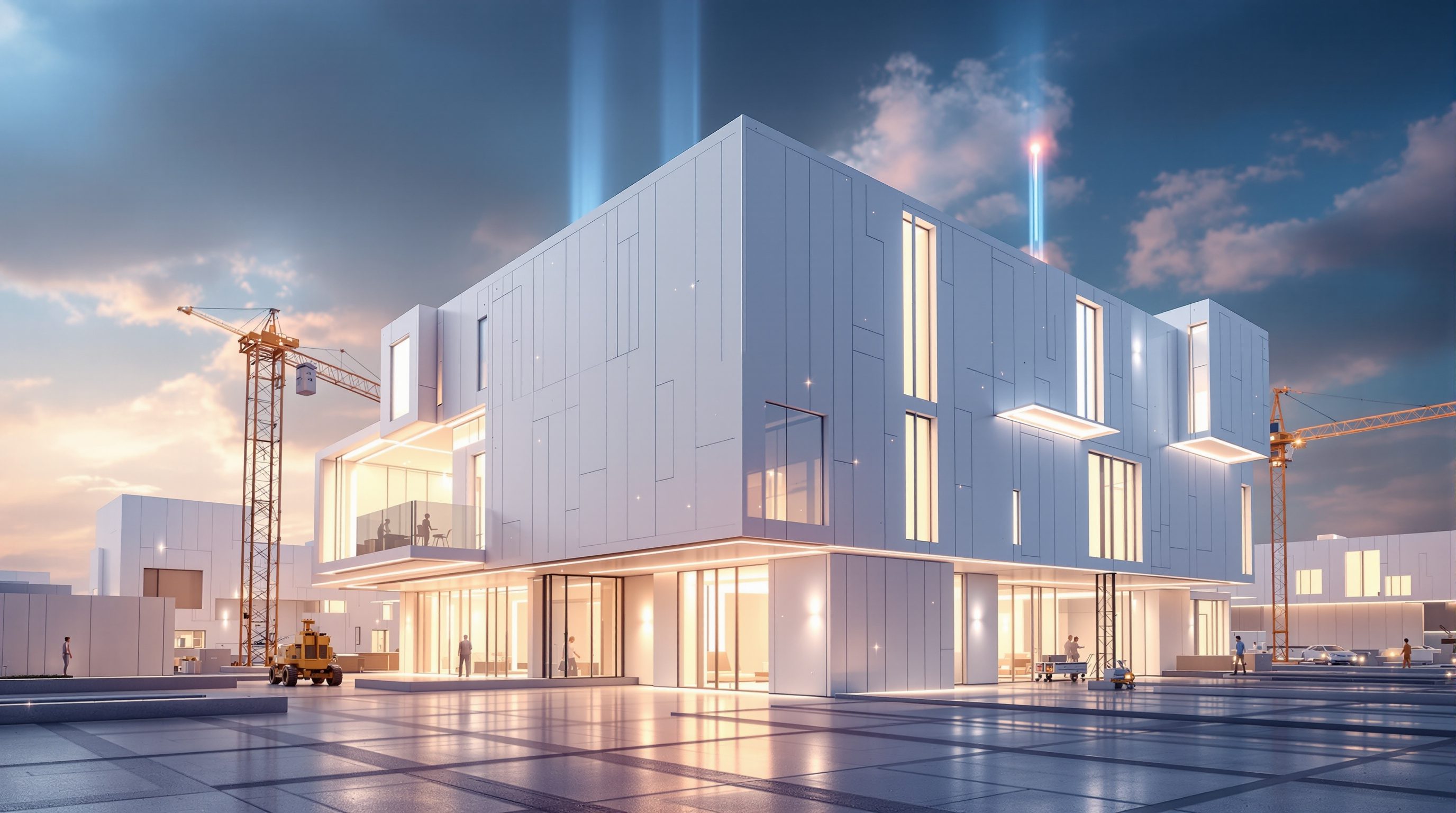
Prefabrication moves the making of a building off the site and into a factory, so it arrives part- or near-finished. That one shift reorganises cost, time, quality, risk and — above all — how we must design. This lesson frames the idea and sets up the course.
Read itStart with Module 0 — Why Build in a Factory
Free · open0.1 · The Building Made Before It Arrives
Open0.2 · Site-Built vs Manufactured
Open0.3 · The Spectrum of Prefabrication
Open0.4 · The Promise & the Pitfalls
Open0.✓ · Mastery check: Why Build in a Factory
OpenWhat this course covers
The through-line- 1Prefab: History & Landscape. Grounding the field: what prefab and modular really mean, a short history from the Crystal Palace to today, the modern revival and its drivers, and where prefab fits — and where it does not.
- 2The Spectrum of Off-Site. From the smallest part to the whole room: components and sub-assemblies, 2D panelised systems, 3D volumetric modular, and pods, hybrids and the kit-of-parts.
- 3Design for Manufacture & Assembly. The core discipline: what DfMA is, designing for manufacture (making parts well), designing for assembly (putting them together fast), and standardisation and platforms.
- 4Materials & Structural Systems. What modules are made of: light-gauge steel framing, timber and CLT modules, precast and modular concrete, and how to choose a structural system for off-site.
The full course ahead
11 modules · 44 lessons11 modules and 44 lessons, from the foundations through to practice — each lesson with a three-tier read, a hands-on workshop, hand-drawn figures and a scored mastery check.
0Module 0 · Why Build in a Factory
LiveBefore any system: the building made before it arrives; site-built versus manufactured construction; the spectrum of prefabrication from components to whole modules; and the promise, the hype and the pitfalls.
Module 0 · Why Build in a Factory
LiveBefore any system: the building made before it arrives; site-built versus manufactured construction; the spectrum of prefabrication from components to whole modules; and the promise, the hype and the pitfalls.
1Module 1 · Prefab: History & Landscape
LiveGrounding the field: what prefab and modular really mean, a short history from the Crystal Palace to today, the modern revival and its drivers, and where prefab fits — and where it does not.
Module 1 · Prefab: History & Landscape
LiveGrounding the field: what prefab and modular really mean, a short history from the Crystal Palace to today, the modern revival and its drivers, and where prefab fits — and where it does not.
2Module 2 · The Spectrum of Off-Site
LiveFrom the smallest part to the whole room: components and sub-assemblies, 2D panelised systems, 3D volumetric modular, and pods, hybrids and the kit-of-parts.
Module 2 · The Spectrum of Off-Site
LiveFrom the smallest part to the whole room: components and sub-assemblies, 2D panelised systems, 3D volumetric modular, and pods, hybrids and the kit-of-parts.
3Module 3 · Design for Manufacture & Assembly
LiveThe core discipline: what DfMA is, designing for manufacture (making parts well), designing for assembly (putting them together fast), and standardisation and platforms.
Module 3 · Design for Manufacture & Assembly
LiveThe core discipline: what DfMA is, designing for manufacture (making parts well), designing for assembly (putting them together fast), and standardisation and platforms.
4Module 4 · Materials & Structural Systems
LiveWhat modules are made of: light-gauge steel framing, timber and CLT modules, precast and modular concrete, and how to choose a structural system for off-site.
Module 4 · Materials & Structural Systems
LiveWhat modules are made of: light-gauge steel framing, timber and CLT modules, precast and modular concrete, and how to choose a structural system for off-site.
5Module 5 · Grids, Tolerance & Connections
LiveThe discipline of dimensions: dimensional coordination and grids, tolerance and fit, joints, interfaces and connections, and designing for repetition.
Module 5 · Grids, Tolerance & Connections
LiveThe discipline of dimensions: dimensional coordination and grids, tolerance and fit, joints, interfaces and connections, and designing for repetition.
6Module 6 · Inside the Factory
LiveWhere the building is made: how a building gets made off-site, lean manufacturing and flow, quality control in the factory, and digital fabrication and automation.
Module 6 · Inside the Factory
LiveWhere the building is made: how a building gets made off-site, lean manufacturing and flow, quality control in the factory, and digital fabrication and automation.
7Module 7 · Logistics & Assembly
LiveFrom factory to finished building: transport and the module envelope, craneage and site logistics, the assembly sequence and the programme, and site prep, foundations and tolerance.
Module 7 · Logistics & Assembly
LiveFrom factory to finished building: transport and the module envelope, craneage and site logistics, the assembly sequence and the programme, and site prep, foundations and tolerance.
8Module 8 · Services, MEP & Finishes
LiveMaking a module a place to live and work: integrating services in modules, MEP coordination and interfaces, finishes and fit-out, and weathertightness at the module joints.
Module 8 · Services, MEP & Finishes
LiveMaking a module a place to live and work: integrating services in modules, MEP coordination and interfaces, finishes and fit-out, and weathertightness at the module joints.
9Module 9 · Performance, Risk & Economics
LiveThe hard questions: fire and compartmentation in modular, acoustics and inter-module separation, the cost and time case honestly examined, and risk, procurement and the supply chain.
Module 9 · Performance, Risk & Economics
LiveThe hard questions: fire and compartmentation in modular, acoustics and inter-module separation, the cost and time case honestly examined, and risk, procurement and the supply chain.
10Module 10 · Practice & the Future
LiveTurning off-site literacy into practice: BIM and the digital thread, the team and new workflows, prefab and modular in India, and becoming a DfMA-literate designer.
Module 10 · Practice & the Future
LiveTurning off-site literacy into practice: BIM and the digital thread, the team and new workflows, prefab and modular in India, and becoming a DfMA-literate designer.
The author
Amogh N P
Architect, interior designer, and creative polymath. Studio Matrx began in his notebooks — his vision of design made honest, useful, and open to everyone. Its Academy is written and taught in his memory, and free, forever.
More about Amogh →