
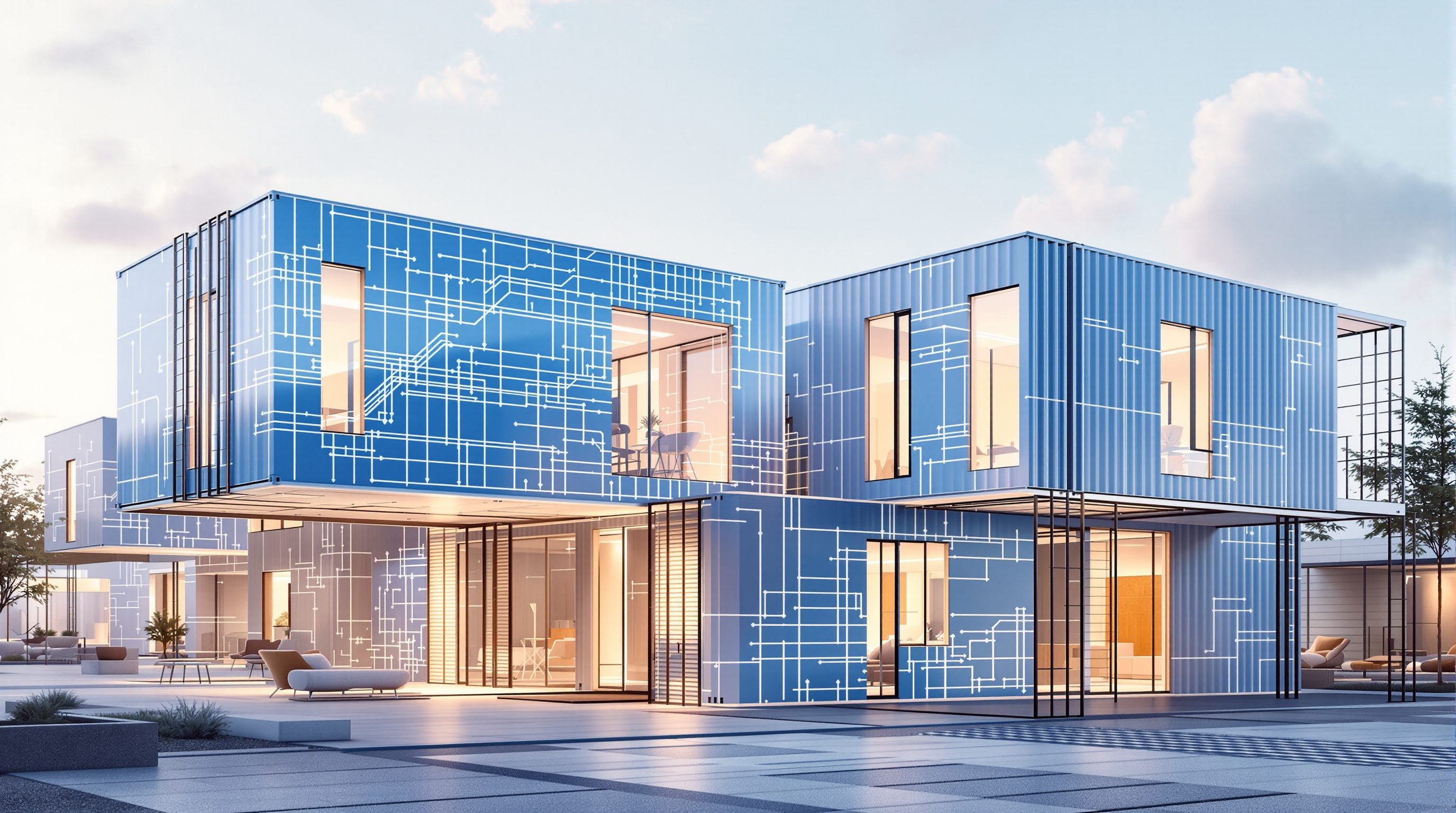
 Lesson 1.1
Lesson 1.1 · Prefab: History & Landscape
What Prefab & Modular Mean
The field is drowning in loose talk — this lesson pins down prefabrication, off-site, modular and MMC so that when you say a word, you and the factory mean the same thing
Two people say 'modular' across a meeting table and mean two different buildings. One pictures factory-finished rooms stacked by crane; the other just means 'made of standard parts'. Neither is wrong — and that is exactly the problem.
Walk into any off-site conversation — a client briefing, a trade show, a manufacturer's pitch — and you will hear 'prefab', 'off-site', 'modular' and 'MMC' used as though they were synonyms. They are not. They are nested and overlapping terms that name different things, and when a design team, a client and a factory each hear a different meaning behind the same word, the result is wasted work, mispriced bids and designs that assume one system while the budget assumes another.
This lesson does the unglamorous but essential job of pinning the vocabulary down. We will separate prefabrication (the broad umbrella) from off-site manufacturing (the modern neutral name for it), from modular (which strictly means three-dimensional volumetric boxes but is used loosely for all of it), from Modern Methods of Construction (a still broader policy umbrella). We will draw the line between a 2D panel and a 3D volumetric module, and name the rungs of the spectrum — component, sub-assembly, panel, module. None of this is pedantry. In a field where the off-site decision must be made early and shapes the whole design, getting the words right is the first act of getting the design right.
Say what you mean: volumetric (3D box), panelised (2D flat), component, MMC. Each word is a commitment, not a slogan.
Prefabrication and off-site: the umbrella and its modern name
Start at the top. Prefabrication is the umbrella term, and its literal meaning is simply *fabricated before* — any part of a building made before it reaches its final position in the finished structure. By that definition prefabrication is not new or exotic; it is everywhere. A roof truss assembled in a yard, a pre-hung door, a window unit glazed in a workshop, a precast lintel, cut-to-length plumbing, ready-made kitchen carcasses — all are prefabricated. Almost every modern building already contains a great deal of prefab. So the useful question is never 'is this building prefabricated?' (nearly all are, a little) but 'how much of it, and which parts, are made off-site?'
Because the old word 'prefab' carries baggage — post-war emergency bungalows, temporary site cabins, cheapness — the industry increasingly uses a neutral modern name: off-site construction, or off-site manufacturing (OSM). The two phrases mean essentially the same thing as prefabrication but without the dated connotations, and 'manufacturing' deliberately borrows the language of the factory to signal a shift in mindset: a building, or large parts of it, treated as a manufactured product rather than a one-off site assembly. You will meet OSM, off-site, and MMC (below) used almost interchangeably with prefabrication in professional and policy documents; treat them as near-synonyms for the same core idea — moving the making off the open site and into a controlled facility.
The important corollary is that off-site is a matter of degree, not a yes/no switch. It runs along a spectrum: from the smallest prefabricated component, through sub-assemblies (a plant skid, a pre-glazed curtain-wall unit), to 2D panels (flat walls, floors and roofs), to 3D volumetric modules (whole finished rooms), and at the far end a near-complete building delivered in a few pieces. Naming where a project sits on that spectrum — rather than labelling it simply 'prefab' or 'not prefab' — is the beginning of thinking clearly. A building can be '30 percent off-site by value' or 'volumetric above a site-built podium'; such precise descriptions are far more useful than the bare word 'prefab', which tells you almost nothing about what was actually decided.
Prefab = made before it arrives. Off-site / OSM = the modern neutral name. Neither is yes/no — it's a spectrum of degree.
Modular: the word that causes the most confusion
Modular is the single most misused word in the field, and it is worth slowing down on. It has a *strict* meaning and a *loose* meaning, and people slide between them without noticing.
In its strict, technical sense, 'modular construction' means volumetric: three-dimensional boxes — modules — built in a factory, each a complete chunk of building with floor, walls, ceiling, services and often finishes, transported whole and stacked or arranged on site. A modular hotel is built from room-sized boxes; a modular apartment block from flat-sized or room-sized boxes. The defining feature is the enclosed volume made off-site. This is the meaning engineers, manufacturers and most technical standards use, and it is the sense this course defaults to unless it says otherwise.
In its loose, everyday sense, people say 'modular' to mean anything built from standardised, repeating, interchangeable parts — which would include panelised systems, kit-of-parts components, even site-built systems using a strict grid. This loose usage is not wrong as ordinary English (it borrows from 'module' meaning a standard unit, as in modular furniture or modular software), but it is dangerous in a building conversation, because a client who says 'we want it modular' meaning 'rational and repeating' may be heard by a manufacturer as 'volumetric boxes' — an entirely different, far more committing decision about structure, transport, craneage and design freeze.
The discipline, then, is this: when precision matters, say what you mean. Say 'volumetric modular' when you mean 3D boxes; say 'panelised' when you mean flat 2D elements; say 'a standardised, repetitive design' when you mean the design philosophy rather than a specific off-site method. Reserve the bare word 'modular' for casual use, and pin it down the moment a real decision hangs on it. One more related term to file away: modular coordination — designing to a dimensional grid so parts are standard and interchangeable — is about *dimensions and the grid*, a topic in Module 5, and is distinct from modular *construction* (volumetric boxes), though the shared word invites confusion. Hearing which sense someone intends, and naming your own clearly, prevents expensive misunderstanding before it starts.
2D panels versus 3D volumetric: the line that matters most
Of all the distinctions in this lesson, the one that most changes a building is the line between 2D (panelised) and 3D (volumetric) off-site construction. Get this clear and much of the rest falls into place.
A 2D panel is a flat element — a whole wall, floor or roof — manufactured lying down or standing in the factory and delivered flat, to be raised and connected into three-dimensional space *on site*. Panels can be 'open' (a frame, to be insulated and clad later) or 'closed' (pre-insulated, pre-clad, sometimes pre-glazed, with services built in). The key point is that a panel encloses no volume until it reaches the site: it stacks flat on a truck, which makes transport efficient, and it is assembled into rooms by site labour, which keeps some site flexibility but pushes finishing and services work back onto the site.
A 3D volumetric module encloses its volume in the factory. It arrives as a box — six faces — often with internal walls, plumbing, wiring, fixtures, even furniture already installed, and is craned into final position. Because so much more is finished off-site, volumetric captures more of the factory's quality and speed advantage and leaves far less to do on site; but the module is heavy, occupies full volume on the truck (you are, in effect, 'shipping air'), is more fragile to transport, and locks in internal dimensions and layout very early.
The trade-off is therefore clean and worth memorising: the more finished off-site, the more quality control and on-site speed you gain — and the more transport cost, weight, fragility and early design commitment you take on. Panels and volumetric are not rivals so much as different points on the same spectrum, and real projects frequently combine them — volumetric for the highly repetitive cellular parts (bathrooms, bedrooms, hotel rooms) and panels or site construction for the larger, more variable spaces. A fluent designer can look at a project and say not just 'prefab' but 'panelised walls here, volumetric pods there, site-built frame around them' — and that sentence already contains most of the strategy. We build the full spectrum out, rung by rung, in Module 2.
2D panel = flat, encloses volume on site, ships flat. 3D volumetric = box, encloses volume in the factory, ships air. More finished off-site = more speed, more transport + early lock-in.
MMC and why precise language is a design skill
One more term sits above all the others in policy and procurement: Modern Methods of Construction (MMC). MMC is a deliberately broad umbrella — used heavily in UK and increasingly in other government and housing-sector language — that covers off-site manufacture *plus* some on-site innovations (for example, improved site-based systems, pre-assembly near the site, and non-traditional techniques that are not strictly factory-made). Off-site construction is a large subset of MMC, but MMC is wider: all off-site is MMC, but not all MMC is off-site. Various classification systems break MMC into categories — 3D volumetric, 2D panelised, sub-assemblies and components, and several site-based and process innovations. You do not need the category numbers, but you should recognise MMC as the policy-level umbrella and know that it is broader than prefab alone.
Why does all this vocabulary matter enough to spend a lesson on it? Because in off-site construction, unlike traditional building, the words carry commitments. Saying 'volumetric' commits you to transport envelopes, craneage, a frozen layout and a particular kind of connection design; saying 'panelised' commits you to on-site assembly and a different services strategy; saying 'MMC' in a funding bid may commit you to meeting a specific policy definition. When a client, a cost consultant, an engineer and a manufacturer each attach a different building to the same loose word, the project designs, prices and programmes three different things at once — and the gap surfaces late, expensively, often after the design is supposedly fixed.
Precise language is therefore not pedantry; it is a design and coordination skill, the first one this module teaches. The habit to build is simple: when a word could mean more than one thing, define it in the moment — 'by modular I mean volumetric 3D modules', 'by off-site I mean roughly this share of value made in a factory'. And as always in this course, hold the boundary: naming a system is not the same as specifying it. Whether a given volumetric or panel system actually performs — structurally, for fire, for acoustics — is a matter for the qualified engineers, the manufacturer's tested and approved system, and the governing codes (the National Building Code of India and local regulations), not for the label alone.
MMC classification (policy)
How off-site and related methods are categorised
Classification systems (e.g. UK MMC categories) split MMC into 3D volumetric, 2D panelised, sub-assemblies/components and site-process innovations. Useful as a shared vocabulary; the category label is not a performance certificate.
Volumetric vs panelised (definitions)
The 3D-vs-2D distinction that drives the design
Whether a system is truly volumetric or panelised changes transport, craneage, layout freeze and interfaces. Confirm which the manufacturer's tested system actually is — Module 2 builds out the spectrum.
Manufacturer's tested system
What a given 'modular' product can actually do
The word 'modular' guarantees nothing about structure, fire or acoustics; only the manufacturer's tested, approved proprietary system and its warranties do. Module 9.
NBC India & local codes
Regulatory meaning and approval of the method
The National Building Code of India and local regulations govern how any off-site method is approved and what it must achieve, regardless of the marketing label. Module 10.3.
Workshop — translate the loose words into a precise description
The skill this lesson builds is translating vague off-site talk into a precise, decision-useful description. In this workshop you take a real (or proposed) project and re-describe it in exact terms — where on the spectrum, which parts 2D, which 3D, which site-built — so the description alone begins to reveal the strategy.
A project you know and a notebook. No calculation — this is about using the vocabulary precisely and seeing the commitments each word carries.
Goal: convert a loose 'it's modular' into a precise spectrum description
Inputs: a building or project you know or can imagine + this lesson + a notebook
Time: ~35 minutes
- 1Pick a project and write down, first, however someone has loosely described its construction ('it's prefab', 'we're going modular'). Note exactly which words were used.
- 2Now re-describe it precisely: list which elements are (or could be) prefabricated COMPONENTS, which could be 2D PANELS, and which could be 3D VOLUMETRIC modules. Be specific — 'bathroom pods volumetric, external walls panelised, frame site-built'.
- 3For each volumetric element you named, write the commitments it implies in plain language: its dimensions and layout must be frozen early, it must fit a truck and a crane, its connections and interfaces must be designed. Do the same, more lightly, for the panels.
- 4Decide where on the spectrum the project as a whole sits, and write a one-sentence precise description a manufacturer and a cost consultant could both read the same way — avoiding the bare word 'modular'.
- 5Reflect: how different is your precise description from the loose one you started with? Note one place where the vague word could have led two people to picture different buildings.
You’ll walk away with
A one-paragraph precise description of a project's off-site strategy — naming components, panels and volumetric elements and their commitments — that replaces the loose word 'modular'. Flag every dimension or capability as illustrative, to be confirmed by the manufacturer and engineers.
Three altitudes on the same idea
Read the band that fits you — or all three.
You set the vocabulary for the whole team, so you must own it precisely. When you write a brief, a design statement or a planning submission, choose the exact term — 'volumetric modular', '2D panelised', 'off-site sub-assemblies', 'MMC' — and define it, because every downstream decision (grid, module size, craneage, connection design, the design freeze) follows from which you mean. Loose talk about 'going modular' at concept stage is where misaligned expectations and mispriced bids begin. Name where on the spectrum the project sits, say which parts are volumetric and which panelised or site-built, and make the manufacturer confirm that their tested system matches the word. The label is yours to set; the engineering behind it belongs to the specialists and the manufacturer's approved system.
The vocabulary reaches straight into your work, because 'volumetric' means your interior is built in a factory. If a project is volumetric, the room you are designing — its dimensions, finishes, joinery, fittings and services routes — is fixed inside a module on a production line, and locked early; if it is panelised or site-built, you keep more of the familiar on-site sequence and flexibility. Knowing whether you are fitting out a 3D module or a site-assembled space tells you when your decisions must be final, how repetition (the same room many times) rewards perfecting one design, and where the module-to-module and module-to-site interfaces fall. Insist the team say which method applies to your areas; coordinate the real fire, acoustic and warranty requirements with the manufacturer rather than assuming the label covers them.
This is the lesson that lets you speak about off-site without embarrassing yourself — and lets you hear what others actually mean. Learn the ladder: prefabrication (the umbrella) and off-site / OSM (its modern name); the spectrum from component to sub-assembly to 2D panel to 3D volumetric module to whole building; modular in its strict (volumetric) and loose (standardised) senses; and MMC as the broader policy umbrella. Practise the 2D-versus-3D distinction until it is automatic — it is the one examiners and employers probe. You are not expected to specify a system; you are expected to use the words correctly, say precisely where a project sits on the spectrum, and ask the clarifying question when someone uses 'modular' loosely. That precision alone will mark you out.
“'Prefab', 'off-site' and 'modular' all mean the same thing — buildings made in a factory instead of on site — so it does not really matter which word you use.”
Do it yourself
No tools needed — reason it through in words.
- 1Define prefabrication, off-site / OSM, and MMC, and explain how they nest — which is broadest, which narrowest.
- 2Give the strict and the loose meanings of 'modular', and explain why confusing them is expensive.
- 3Explain the difference between a 2D panel and a 3D volumetric module, and the trade-off between them.
- 4Why is 'all off-site is MMC, but not all MMC is off-site' a true statement?
- 5Why is using the words precisely a design skill rather than mere pedantry in off-site construction?
The one line to carry out
Peer-reviewed journals & authoritative standards
- 01Prefabrication — Wikipedia — Prefabrication, 2026.
- 02Modular building — Wikipedia — Modular building, 2026.
- 03Volumetric (construction) — Wikipedia — Volumetric (construction), 2026.
- 04Modern methods of construction — Wikipedia — Modern methods of construction, 2026.
- 05Panelling — Wikipedia — Panelling, 2026.
With the words straight, the field makes more sense historically — and prefab has a long, instructive past of bold promises and hard lessons. Next we trace that history from the Crystal Palace to today.
The author
Amogh N P
Architect, interior designer, and creative polymath. Studio Matrx began in his notebooks — his vision of design made honest, useful, and open to everyone. Its Academy is written and taught in his memory, and free, forever.
More about Amogh →