

Mohammad Shaheer
The quiet poet of Indian landscape — restraint, water and the living charbagh
Movements
Signature works
- Garden of Five Senses, Delhi
- Sanskriti Kendra (Anandgram), Delhi
- Historic-monument landscape settings, Delhi
- Mughal-garden scholarship & Landscape journal editorship
- Institutional & campus landscapes, Delhi region
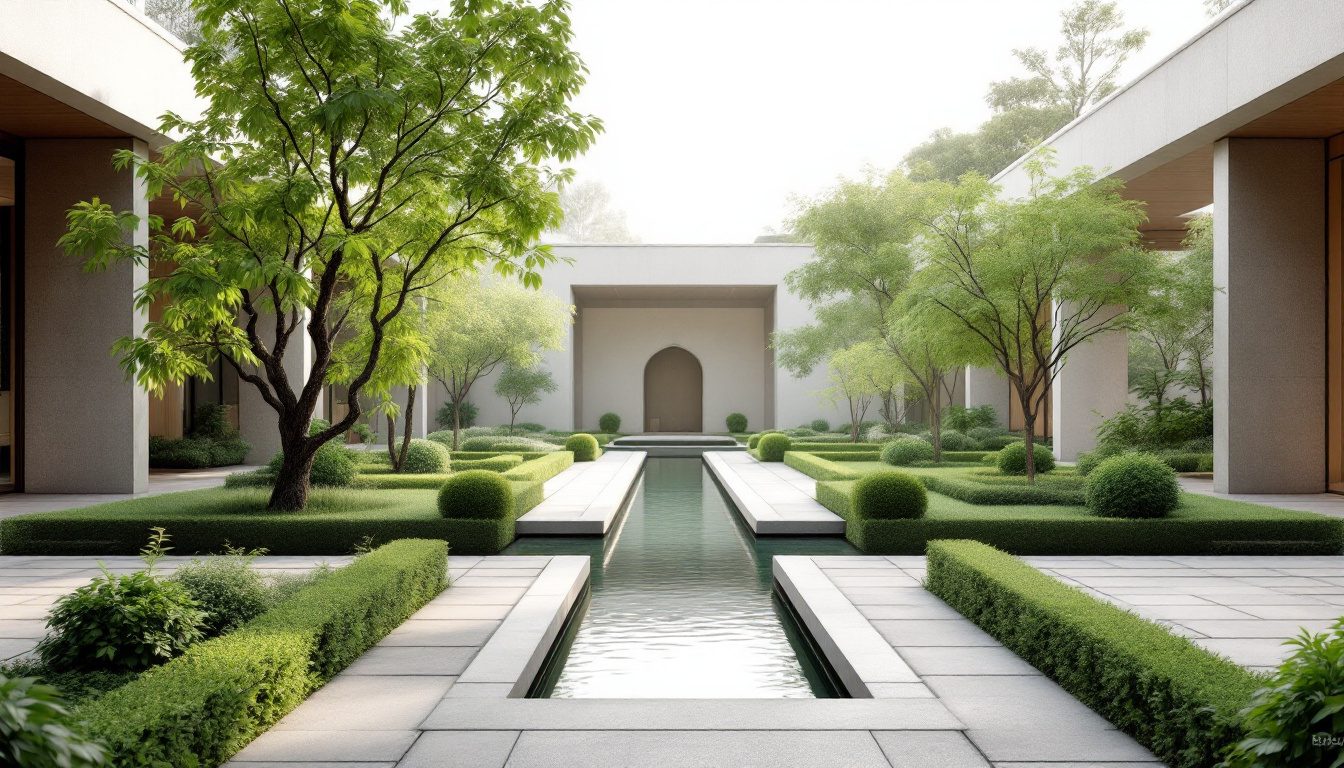
Walk into the Garden of Five Senses at Said-ul-Ajaib, on Delhi's southern edge, late on a winter afternoon, and the city seems to fall away behind you. The land here was never flat or easy — a rocky, broken stretch of the Delhi ridge, strewn with boulders, the kind of site a developer would have bulldozed. Instead the boulders were left where they lay, and a garden was threaded through and around them: stone-paved courts that climb the slope, a long axial water channel that catches the low sun, terraces of bamboo and flowering trees, quiet corners that reveal themselves only as you arrive. Nothing shouts. The garden does not impose a single grand vista; it unfolds, slowly, the way a good poem does.
The landscape architect who shaped it was Mohammad Shaheer, born in 1956 and, by the time of his death in 2015, among the most quietly revered figures in Indian landscape architecture. He was never the loudest voice in the room. He built no signature style you could photograph and copy. What he left instead was a sensibility — restrained, contextual, deeply learned in the Mughal garden tradition yet entirely modern — and two generations of students at the School of Planning and Architecture in Delhi who carried it forward.
Shaheer's central conviction was that a landscape should belong to its place and its climate before it belongs to any designer — that the best gardens are the ones that feel as though they were always there, ordered by water and shade and native planting rather than by a designer's ego. Around that quiet idea he built a body of work that married the geometry and serenity of the charbagh to a modern ecological care, and a contemplative restraint that has become his most enduring lesson.
The idea: restraint, water, and a garden that feels inevitable
Shaheer worked against the grain of his profession's louder instincts. Much landscape design, especially the commercial kind, reaches for spectacle — sweeping lawns that drink water a dry city cannot spare, imported palms lined up like soldiers, fountains that perform. Shaheer distrusted all of it. His gardens are notable for what they refuse: the showpiece, the thirsty turf, the forced symmetry imposed on a site that does not want it.
In place of spectacle he offered three quiet things. The first is water as structure — not decoration but the organising spine of a garden, exactly as it had been in the Mughal charbagh, where a still channel divides the four quarters and gives the whole composition its calm. Shaheer understood the channel and the still tank not as ornaments but as the elements that order space and cool the air, and he carried that understanding into contemporary work.
The second is native and climate-fit planting. He had little patience for the colonial inheritance of lawn-and-bedding, the English garden transplanted into a semi-arid Delhi that could not sustain it. He favoured indigenous trees, hardy shrubs, grasses and groundcovers suited to the heat and the long dry months — a planting palette that asked less of the soil and the water table and gave more back to the birds and the shade.
The third, hardest to name, is restraint itself. Shaheer's gardens are edited. He removed before he added. A path bends because the land bends; a tree is placed where a tree should be, not where a plan demands one. The result is a landscape that feels discovered rather than designed — which, he understood, is the highest compliment a garden can earn.

This is why his work rewards a return visit. A spectacle exhausts itself in one glance; a Shaheer garden keeps a little in reserve, a turn you did not take, a court you reach only the second time. He designed for the slow walker, not the camera.
Life and path
Mohammad Shaheer was born in 1956 and trained in architecture and landscape architecture in India, going on to advanced study abroad before returning to make his life's work at home. The decisive institution in his career was the School of Planning and Architecture (SPA) in New Delhi, where he taught landscape architecture for decades and shaped the discipline at the moment it was finding its feet in India.
This matters, because landscape architecture in India was young. For much of the twentieth century the country had architects and it had horticulturists, but the idea of the landscape architect — someone who thinks about land, water, planting and people together, at the scale of a site or a city — was barely established. Shaheer belonged to the small founding generation, alongside figures such as Prabhakar Bhagwat in the west of the country, who gave the profession its intellectual seriousness. Where Bhagwat built a practice and a school in Pune and Ahmedabad, Shaheer became Delhi's quiet conscience, working through teaching, writing and a carefully chosen handful of projects.
He was also a scholar of the Mughal garden, and an editor. He gave years to the study of the charbagh and the historic gardens of Delhi, Kashmir and beyond, and he served the field through editorial work — most notably his long association with the journal Landscape, the publication of the Indian Society of Landscape Architects, which under his hand became the record of a maturing profession. His writing and editing did as much to define Indian landscape thinking as any single garden could.
His practice was deliberately modest in volume. Shaheer did not chase the large commission. He took the projects where his sensibility could do real work — a public garden on broken ground, a cultural campus, the delicate setting of a historic monument — and he gave each one the patience it needed.

The signature works
Shaheer's portfolio is small by the standards of a commercial practice, and that is the point. A few works carry the whole argument.
| Work | Place & period | Why it matters |
|---|---|---|
| Garden of Five Senses | Said-ul-Ajaib, Delhi, opened 2003 | A public garden built across a rocky ridge site — boulders kept, paths threaded along the contours, water and native planting ordering a landscape designed to be experienced slowly, with all the senses. |
| Sanskriti Kendra (Anandgram) | Anandgram, Mehrauli–Gurgaon road, Delhi | The landscape of a cultural and museum campus, where built courts, terracotta-roofed pavilions, water and indigenous planting are woven into a calm, contemplative whole. |
| Historic-monument landscape settings | Delhi and beyond | Sensitive conservation-landscape work in the setting of historic Mughal-era gardens and monuments — restoring the logic of water, axis and planting around heritage rather than imposing a modern scheme on it. |
| Institutional and campus landscapes | Delhi region | Quiet, climate-fit grounds for institutions, where native trees, shade and restraint do the work instead of decorative display. |
| Mughal-garden scholarship & editorship | India | Years of study of the charbagh tradition and long editorial service to Indian landscape publishing — the intellectual scaffolding of a young profession. |
The Garden of Five Senses is the work most people can visit and the one that best explains him. Faced with a difficult, rock-strewn site that a lesser hand would have levelled, Shaheer made the difficulty the design. The boulders stay; the routes climb and turn with the land; a long water channel gives the garden its calm axis; courts and terraces open into bamboo, flowering trees and stone. The brief — a garden for the senses — could have produced kitsch. Instead it produced one of Delhi's most loved public spaces precisely because of its restraint.
Sanskriti Kendra at Anandgram shows the same mind at the scale of a campus. Here the landscape is not a frame around buildings but a continuous experience that binds courts, museum pavilions, sculpture and water into a single contemplative ground. It feels, like all his best work, as though the place came first and the design only revealed what was already there.
The most delicate strand of his career lay in conservation landscape — the work of restoring and setting the historic gardens and monuments of Delhi's Mughal heritage. Here Shaheer's twin gifts came together: his scholarship in the charbagh tradition and his instinct for restraint. The task in such places is not to design a new garden but to recover the old garden's logic — its axes, its channels, its planting — and to let the monument breathe within a landscape true to its origins. It is the rarest kind of landscape skill, and the one in which his learning and his temperament were perfectly matched. (Where exact authorship of any single historic-garden restoration is shared among teams and institutions, his contribution is best understood as part of this larger conservation-landscape sensibility rather than a solo signature.)
The philosophy
Shaheer is one of the designers most worth invoking when people ask why certain gardens are calming and others, for all their colour, are not. His answer was always the same: a peaceful garden is an ordered one, cooled by shade and water, planted with things that belong, and edited until nothing fights anything else. That conviction sits at the heart of Studio Matrx's guide to why some gardens feel peaceful — the still channel, the enclosing trees, the absence of noise, all of which Shaheer practised long before they were fashionable.
His instinct for the restorative also makes him a natural forebear of the healing garden. The slow-unfolding path, the shaded court, the sound of moving water, the refuge of a quiet corner — these are exactly the ingredients that contemporary research credits with lowering stress, and they were Shaheer's working vocabulary. He designed, instinctively, for the nervous system as much as the eye.
And his lifelong devotion to the charbagh connects him to the living tradition of the Indian courtyard landscape. The Mughal garden was, at heart, an enclosed quadrant ordered by water — the courtyard idea raised to an art. Shaheer studied it, taught it and carried its lessons into modern work: the cooling power of a still tank, the calm of a clear geometry, the way an enclosed green space can become the most generous room a home or a city has.
A garden, Shaheer taught, should feel as though it was always there. The designer's job is mostly to listen — to the land, the water and the sun — and then to take away everything that does not belong.
India
For Shaheer, India was not a backdrop but the entire subject. He spent his career insisting that a landscape made for Delhi could not be a landscape made for England — that the lawn, the bedding plant and the thirsty fountain were a colonial inheritance the country could not afford and did not need. The garden India already possessed, in the charbagh and the courtyard and the temple tank, was richer, cooler and far more sustainable than anything imported.
This gave his work a quiet political edge. In a city running short of water, he argued through his gardens for planting that survives the dry months, for shade over spectacle, for the boulder left in place over the slope bulldozed flat. His public gardens, like the Garden of Five Senses, made the case to ordinary Delhiites that a beautiful landscape need not be an expensive or wasteful one.
His influence, though, was largest as a teacher and editor. Through decades at the School of Planning and Architecture he shaped the people who now lead Indian landscape practice, and through his scholarship and his editorial work he gave the young profession a literature and a memory. Much of the sensibility behind Studio Matrx's own landscape guides — the preference for native trees, the respect for water, the patience with a site — runs back to the standards he and his generation set. He worked in the company of a small founding cohort, and his lessons stand alongside those of global masters such as Roberto Burle Marx, who in Brazil made the same essential argument from the other side of the world: that a country should garden with its own plants, its own water and its own way of seeing.
Legacy and what we can learn
Shaheer's legacy is unusual because so much of it is invisible. There is no flamboyant building to point to, no instantly recognisable trademark. What he left is a standard — of restraint, of contextual honesty, of scholarship married to practice — and the students and writings that keep it alive. The Garden of Five Senses endures as his most public monument, but his deeper monument is the maturity of Indian landscape architecture itself, a discipline he helped raise from horticulture into an art of land and water and people.
The first lesson for any homeowner is the one his gardens teach with their whole being: start by removing, not adding. Look at the site you actually have — its slope, its rock, its existing trees, its sun and its dry season — and design with it rather than against it. The most peaceful outdoor space is rarely the most decorated one; it is the one that feels inevitable, ordered by shade and water and plants that want to grow there.
The second lesson is about water and roots. In a country where water is precious and growing scarcer, Shaheer's preference for the still channel over the spraying fountain, and for native planting over the imported lawn, is not nostalgia — it is good sense, more urgent now than in his own lifetime. A garden tuned to its climate is cheaper to keep, kinder to the water table and far more alive with birds and shade.
These are exactly the principles we encode in DesignAI — letting climate, site and the right planting shape a landscape before decoration ever enters the conversation, the way Shaheer always insisted it should.
References
- Indian Society of Landscape Architects — Landscape journal archives and editorial record.
- Aga Khan Trust for Culture — publications on the conservation of historic gardens and monuments in Delhi.
- Geeti Singh and others, writings on Indian landscape architecture and the work of the founding generation.
- Published profiles and obituaries of Mohammad Shaheer, 1956–2015, in the Indian architecture and landscape press.
- Studies of the Mughal charbagh tradition and the historic gardens of Delhi and Kashmir.
Explore the ideas Shaheer championed — why some gardens feel peaceful, healing gardens and courtyard landscape design — alongside fellow masters Prabhakar Bhagwat and Roberto Burle Marx.
Philosophies they championed