
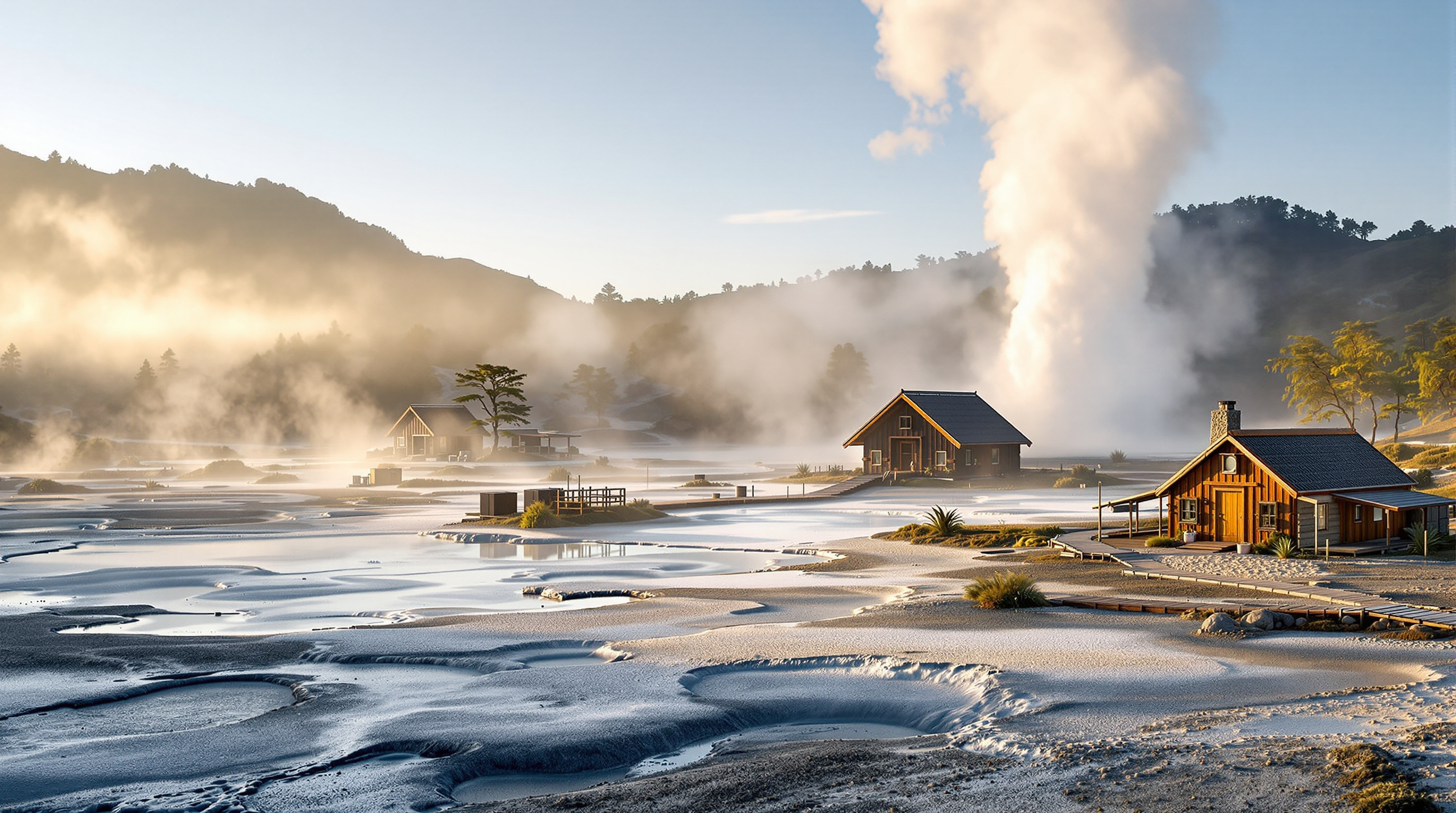
Whakarewarewa Geothermal Lodge Concepts: The Boiling Ground as a Building System
In a Rotorua valley where the earth cooks, heats and heals, Tūhourangi Ngāti Wāhiao have dwelt on active geothermal ground for some seven centuries. Read as a living precedent — and as the speculative 'lodge' briefs it now inspires — Whakarewarewa is the clearest argument in the canon that the most radical future energy source may be the oldest one, drawn straight from the ground.
Most buildings treat the ground as something to be resisted. You waterproof against it, insulate from it, drain it away, and spend a large share of a building's lifetime energy fighting the temperature it wants to impose. At Whakarewarewa, in the New Zealand city of Rotorua, a community has spent roughly seven hundred years doing the opposite: choosing to build directly on top of one of the most hostile pieces of terrain imaginable — a valley of boiling pools, superheated steam vents and erupting geysers — precisely because of the heat, and turning the hazard into the heating, the cooking and the bathing system for daily life.
This entry is unusual in our canon, and we want to be honest about that from the first paragraph. There is no single celebrated "Whakarewarewa Geothermal Lodge" by a named architect; the reference index lists the architect as "Various" and the date as unresolved, and it should. What Whakarewarewa offers is something rarer than a signature building: a living, continuously inhabited demonstration of geothermal architecture, and a body of design research and emerging "lodge" briefs that ask what a contemporary building might learn from it. Read that way — precedent plus provocation — it belongs squarely in Kushner's project of asking where architecture is going next.
Māori in the geothermal areas of the central North Island used the heated water and steam for warmth; the hot springs and geysers became places to bathe, to cook, and to heal. To design here is not to design a spa in a blue space, but to enter a socio-cultural landscape that already has an architecture.
The question it poses
Chapter 1 of this canon — Extreme Locations — collects buildings that work with hostile terrain, climate or resource constraints rather than pretending to be somewhere gentler. Whakarewarewa is the chapter's most literal case. Its terrain is genuinely dangerous: the wider geothermal field holds some 500 pools, most of them alkaline chloride hot springs, and at least 65 named geyser vents, of which around seven remain active; the celebrated Pōhutu geyser erupts roughly hourly to heights of up to 30 metres. Ground temperatures at the surface can reach boiling and, in pools such as Korotiotio, are reported to run superheated toward 120 °C. Hydrogen sulphide hangs in the air. The ground itself shifts, crusts over and gives way.
The question Whakarewarewa poses to a designer is therefore blunt: if the most dangerous thing on your site is also the most valuable resource on your site, what kind of building do you make? The village's answer, refined over centuries and long before any language of "sustainability," is that you make a building that is deliberately, intimately coupled to the ground — sited to catch its heat, planned around its safe zones, and humble enough to accept the terms the land sets. That is a very different design instinct from the sealed, mechanically conditioned box that dominates twentieth-century architecture, and it is exactly the instinct a decarbonising century is trying to recover.
Seven hundred years of geothermal dwelling
People of Tūhourangi Ngāti Wāhiao trace occupation of this landscape back to a fortified pā first settled around 1325. The valley's role sharpened tragically in 1886, when the eruption of Mount Tarawera destroyed the celebrated Pink and White Terraces and buried the village of Te Wairoa; survivors of Tūhourangi resettled at Whakarewarewa, and the community there became — and remains — one of the world's oldest continuously operating sites of Indigenous cultural tourism, welcoming visitors since the late nineteenth century.
The domestic architecture that grew on this ground was tuned to geothermal heat. Traditional wharepuni (sleeping houses) were built from natural materials — notably kaponga / ponga, the trunks and fronds of native tree ferns — and sited deliberately close to steam vents and warm ground so that heat conducted up through the floor and the earth kept them warm through cold Rotorua nights. The house did not make its own heat; the site made it. A restored wharepuni in the village still stands beside a crevice with a boiling spring at its base — a reminder that comfort and danger here share a single source.
The kitchen with no fire
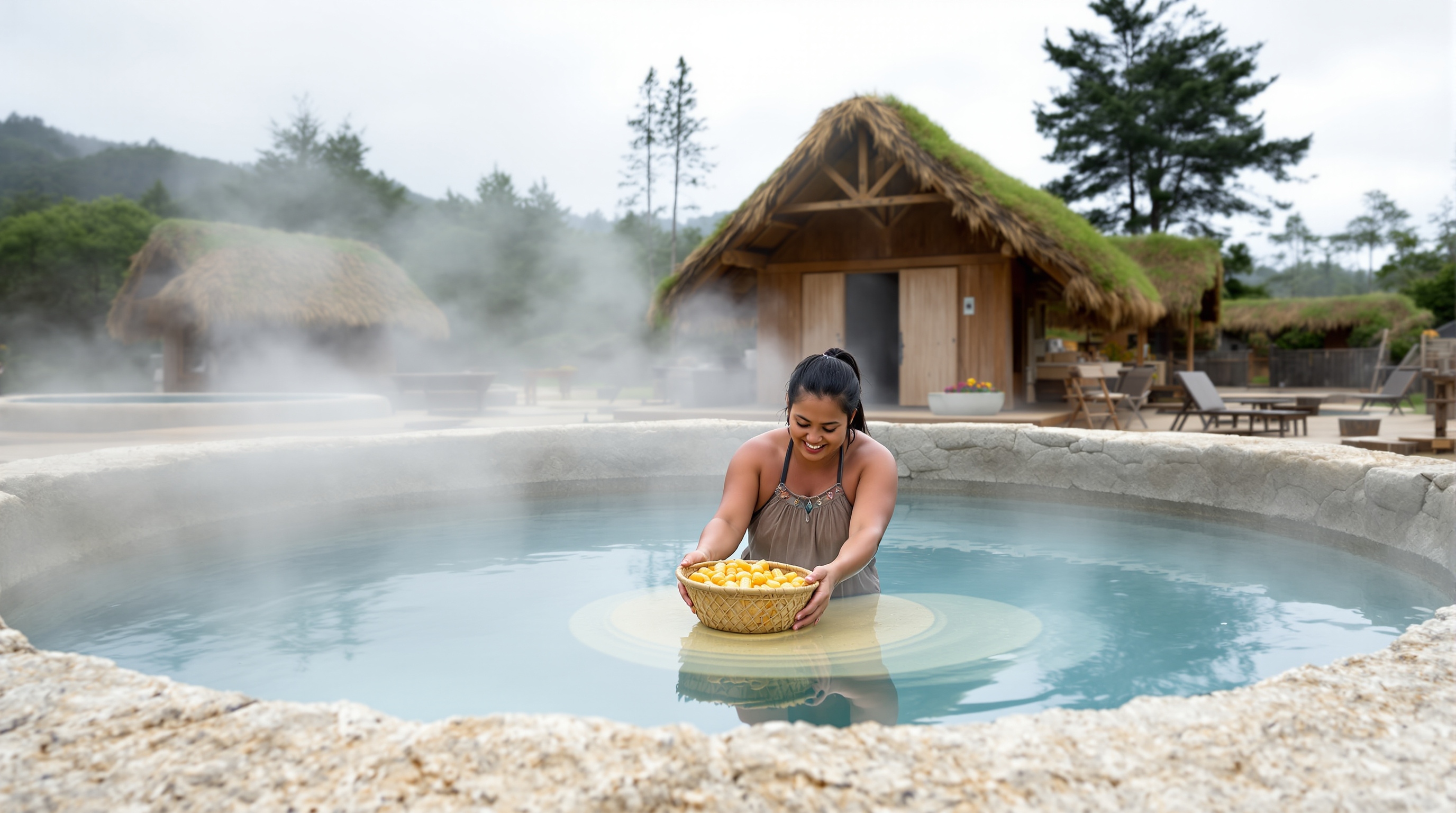
The most vivid lesson at Whakarewarewa is domestic. The village runs a kitchen with almost no combustion. Food is cooked in the ground and by the ground: chicken, potato, kūmara, corn and vegetables are steamed in covered steam boxes set over natural fumaroles, or lowered — wrapped in muslin or a woven flax basket — straight into a boiling pool. Parekohuru, whose name is often translated as "murderous rippling waters," is the deep blue cooking pool where sweetcorn is boiled on the cob in roughly eight minutes. Bathing happens in tempered geothermal water; heating is simply the warmth of the earth beneath the floor.
This is worth dwelling on as an energy fact. A modern lodge of comparable function — kitchen, hot water, space heating, bathing — would ordinarily burn gas or draw grid electricity for all four. Whakarewarewa supplies all four from a single renewable source that is, in effect, always on and free at the point of use. The table below reads the village not as folklore but as a functional brief.
| Geothermal resource | Village practice | Building function replaced | Lesson for a lodge concept |
|---|---|---|---|
| Warm ground / conducted heat | Wharepuni sited on hot ground | Space heating | Couple floor and plan to the thermal ground |
| Fumarole / steam vent | Covered steam boxes | Cooktop, oven | Capture steam directly; no combustion |
| Boiling pool (Parekohuru) | Basket-cooked corn, meat, vegetables | Stove, boiler | Zone hot pools as active kitchen infrastructure |
| Tempered hot spring | Communal bathing | Water heating, wellness | Design bathing as therapeutic landscape, not amenity |
That last row carries the deepest idea. In mātauranga Māori the pools are not plumbing; they are places of healing and gathering, understood through frameworks such as Te Whare Tapa Whā, Mason Durie's four-cornered model of health in which physical, mental, spiritual and family wellbeing are load-bearing "walls" of the same house. A geothermal lodge that treats the water as a luxury spa amenity misreads the site; one that treats bathing as care, ritual and communal encounter is reading it correctly.
From living village to "lodge concept"
Why call this a "lodge concept" at all, if the buildings already exist? Because a distinct strand of contemporary design research and hospitality development is now trying to translate this seven-century practice into new architecture — and doing so is genuinely hard. The most rigorous work in this space is academic. The architect and researcher Kezia Fairbrother, writing in the peer-reviewed Journal of Cultural Geography (2021), reframes geothermal places not as generic "blue spaces" to be commodified but as socially and culturally responsive therapeutic landscapes, using a Rotorua case study to argue that the material and physical conditions of such architecture must follow from Kaupapa Māori design principles rather than a resort template. Parallel scholarship on Māori values in geothermal management (Taute and colleagues, 2022) stresses that the resource is bound to kaitiakitanga — guardianship — and cannot be treated as an input to be maximised.
The technical translation is not trivial either. Building on active geothermal ground means designing for ground subsidence and crusting, for corrosive and toxic hydrogen sulphide that must be continuously vented and never allowed to pool in an enclosed room, for silica scaling that clogs any pipe carrying geothermal fluid, and for temperatures that can change without warning. The contemporary answer tends to be a hybrid: a downhole or shallow ground loop and heat exchanger to draw thermal energy safely into a sealed circuit, keeping corrosive fluids out of the living spaces, while the plan and the bathing sequence still take their cues from the old, direct-contact wisdom. That combination — indirect for safety, direct for meaning — is the emerging concept's real design signature.
What the concept must not do — the third position
Studio Matrx's editorial stance is to hold two things at once. Whakarewarewa is a magnificent, working proof that architecture can be heated, fed and healed by the ground with almost no carbon; it deserves to influence how the world builds in geothermal regions from Iceland to the Rift Valley to India's own geothermal provinces. And it is not raw material for the design industry to mine.
The village is a living community, its pools carry tapu — Korotiotio was permanently closed to cooking after a woman named Iriaka died in it in the 1870s — and its knowledge belongs to Tūhourangi Ngāti Wāhiao, not to a hospitality brand or a visiting architect. A "geothermal lodge" that lifts the steam-box aesthetic while severing it from the people, the language and the obligations of guardianship would be exactly the extractive move the scholarship warns against. The honest version of this concept is not a resort inspired by Whakarewarewa; it is architecture designed with and for the communities whose seven centuries of practice make it possible — with benefit, authorship and control flowing back to them. Where that partnership is absent, the right answer is to build nothing and simply learn.
Why it belongs in the canon
Kushner's original question is always about direction: where is architecture going? Whakarewarewa's answer is deceptively simple and quietly radical. It says the future of low-carbon dwelling may look less like a new gadget bolted to a sealed box and more like an old idea recovered — a building sited, planned and inhabited so that the ground does the work. It says that "extreme location" and "abundant resource" can be the same fact. And it says, pointedly, that some of the most advanced sustainable architecture on Earth was worked out centuries ago by people who never called it that, and whose authorship the discipline is only now learning to credit.
The lesson is portable well beyond Rotorua — ground-source heat is available almost everywhere, if far gentler elsewhere — but the ethic travels with it. Build with the ground; build with the people who know the ground. That is the concept worth carrying forward.
References
- Whakarewarewa: The Living Māori Village, official website and visitor/education material — geothermal cooking (Parekohuru), bathing pools, wharepuni, and the living community of Tūhourangi Ngāti Wāhiao. whakarewarewa.com (primary source)
- Fairbrother, K. (2021). "Architecture of geothermal places: socially and culturally responsive therapeutic landscapes." Journal of Cultural Geography, 38(1), 1–24. DOI: 10.1080/08873631.2020.1820682. (peer-reviewed; includes a Rotorua case study and Kaupapa Māori design framing)
- Taute, N., Morgan, T. K. K. B., Ingham, J., Archer, R. & Fa'aui, T. (2022). "Māori values in geothermal management and development." AlterNative: An International Journal of Indigenous Peoples, 18(3). DOI: 10.1177/11771801221118629. (peer-reviewed; guardianship / kaitiakitanga framing of the geothermal resource)
- Durie, M. (1998). Whaiora: Māori Health Development (Te Whare Tapa Whā model). Auckland: Oxford University Press. (scholarly book; the four-cornered wellbeing model referenced here)
- "The night Tarawera awoke." New Zealand Geographic. Account of the 1886 Mount Tarawera eruption and the resettlement of Tūhourangi survivors. nzgeo.com (press / reputable long-form)
- "Whakarewarewa." Wikipedia — field figures (approximately 500 pools, 65 named geyser vents, Pōhutu geyser, marae and hapū). en.wikipedia.org (tertiary reference; cross-checked against primary sources)
- Studio Pacific Architecture, "Waiwera Thermal Springs" (2025) — a contemporary New Zealand geothermal-hospitality project illustrating the emerging design direction. studiopacific.co.nz (architectural press / practice source)
Part of The Future of Architecture in 300 Buildings — Studio Matrx's canon of the buildings asking where architecture goes next. Chapter 1: Extreme Locations.
Export this guide
Related Guides — Deep-dive reading
Concordia Station: Architecture as a Survival Machine on the White Plateau
At Dome C, 3,233 m up on the Antarctic ice and colder than almost anywhere humans overwinter, the Franco-Italian Concordia base answers the oldest architectural question by refusing the usual terms — two eighteen-sided towers on jackable legs, a closed-loop life-support building that Europe's space agencies study as a stand-in for Mars.
The Future of ArchitectureMaggie's Centres: The Kitchen Table That Rewrote What a Cancer Building Is For
Since 1996 a small British charity has commissioned Gehry, Hadid, Foster, Rogers, Holl and Heatherwick to build the same tiny brief — a home, not a hospital, for people living with cancer. This is how a one-page programme by a dying woman became architecture's most rigorous experiment in care.
The Future of ArchitectureThe Center for Discovery: How Turner Brooks Designed a Campus Without Right Angles
In the Catskill foothills, Turner Brooks built a living-and-learning campus for children with autism around a single radical premise — that the corner, the corridor and the sudden spatial change are forms of violence to a sensitive nervous system. This deep study reads its meandering plans, its low timber residences, its clustered woodland siting, and what a building shaped around neurodiversity tells us about where care architecture is going.
The Future of ArchitectureRelated Tools — Try Free
Cross-Ventilation Analyzer
Estimate airflow and air changes per hour (ACH) from room size, window areas, layout, and local wind — with NBC 2016 Part 8 compliance check.
Ventilation CalculatorHealing View Impact Calculator
Evidence-Based Design dashboard quantifying the recovery impact of nature view + daylight factor on analgesic use, length of stay, and HCAHPS patient-experience uplift. Calibrated against Ulrich 1984 (Science), Park & Mattson 2008, and the CHD EBD evidence base.
EBD CalculatorRainwater Tank Sizer
How big should your rainwater tank be? Computes annual harvest, recommended tank capacity in litres, water-bill savings, and payback — for 10 Indian cities.
RWH Calculator