
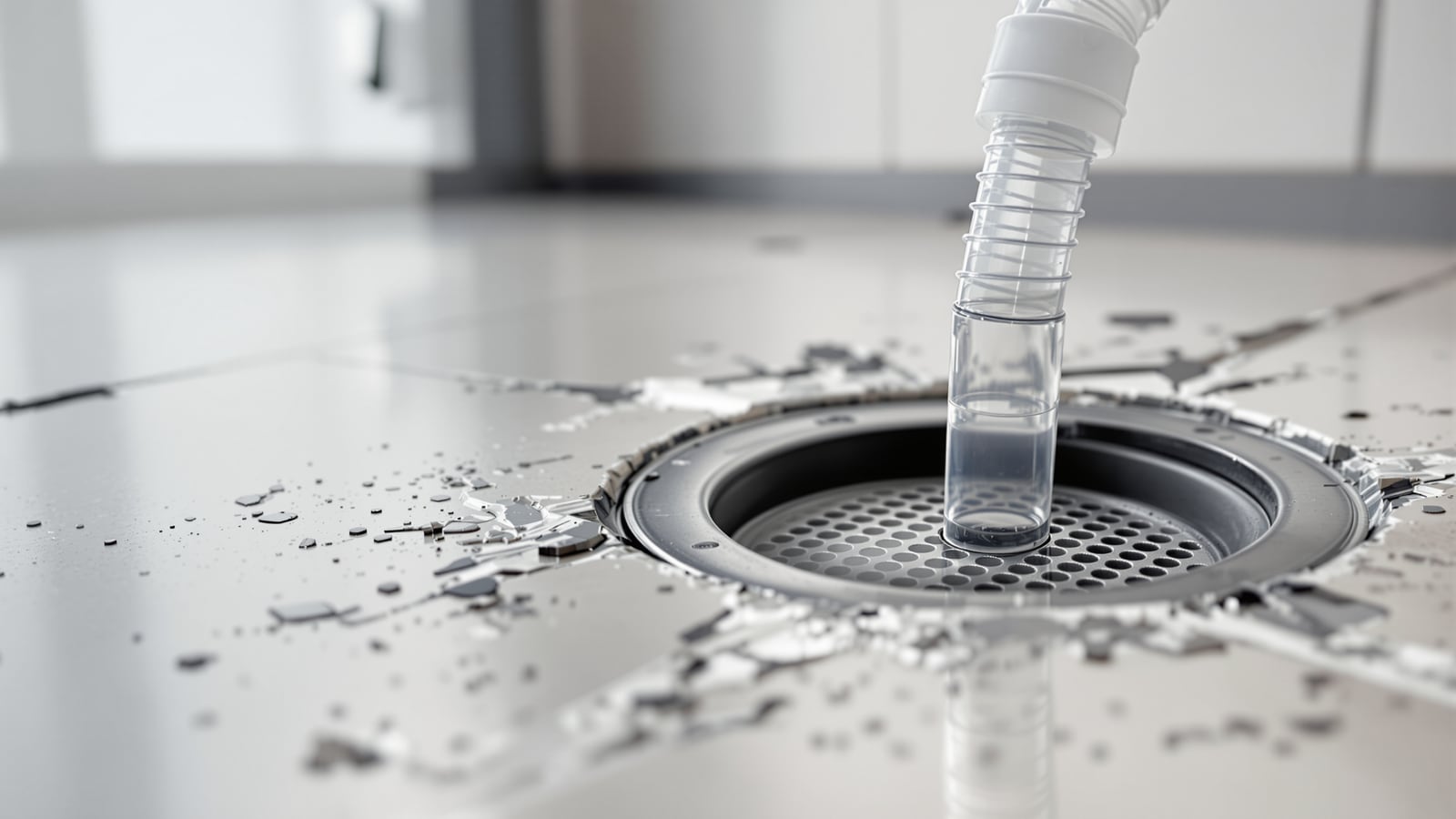
Trap Primers in India: Keep Floor-Drain Seals Wet and Sewer Gas Out
The dry-trap smell from a little-used floor drain, guest bathroom or terrace gully is a lost water seal, not a plumbing failure. This professional guide covers why traps evaporate, what a trap primer does, the device types, where they are required, and the low-tech alternatives.
A guest bathroom that no one has used for three weeks starts to smell of drains. A terrace gully stinks in the dry months and clears the day it rains. A basement floor drain breathes sewer gas every time the building settles. In almost every case the cause is the same, and it is not a leak, a blockage or a broken pipe — it is a trap seal that has quietly evaporated away, leaving an open pipe straight down into the drainage system. A trap primer is the small device whose only job is to stop that from ever happening.
This is a detail guide within the Studio Matrx drainage systems hub. It builds on the plumbing traps guide, which explains how a water seal works in the first place, and the ventilation guide, which covers the other way a trap seal is lost — siphonage and back-pressure. Here we stay on one narrow problem: the floor drain whose trap simply dries out, and the devices and habits that keep it wet.
A trap holds its seal by holding water. The day the water is gone, the trap is just a hole. Nothing about the smell is mysterious — you are looking down an open sewer.
Why floor traps dry out
Every trap — under a WC, a basin, a floor drain — relies on a plug of standing water, roughly 50 mm deep, sitting in a U or P bend to block sewer gas. Fixtures in daily use refill that seal every time they are used, so they never dry. The trap that fails is the one nobody feeds:
- Little-used floor drains — guest bathrooms, second toilets, servant baths, pooja-room and utility drains used once a month.
- Terrace, balcony and chajja gullies — dry for the whole non-monsoon season, then flooded.
- Basement, parking and plant-room drains — provided for washdown that rarely happens.
- Shower or floor drains in holiday homes and unsold flats — sealed and shut for months at a stretch.
The water leaves by evaporation. In the dry, warm interior air of an Indian summer — low humidity, 35 to 42 degrees Celsius, often with fan or AC draught across the grating — a 50 mm floor-trap seal can evaporate in two to four weeks. Warm air rising up the drain (the "stack effect" in tall buildings) accelerates it, and a slightly leaking trap body or a hairline crack speeds it further. Once the seal drops below the trap weir, the barrier is gone and sewer gas — hydrogen sulphide, methane, ammonia, plus whatever bacteria ride with it — flows freely into the room.
Seal loss is not only evaporation
Evaporation is the failure a trap primer is built to solve, but it is worth separating from the others, because they need different fixes:
| Mechanism | Cause | The right fix |
|---|---|---|
| Evaporation | Trap unused; water simply dries out | Trap primer, or top-up habit |
| Self-siphonage | Fixture's own discharge pulls its seal out | Correct trap arm slope and venting |
| Induced siphonage | Other fixtures on the stack suck the seal | Proper stack venting |
| Back-pressure | Positive pressure blows the seal | Venting / air admittance |
| Capillary / wicking | Rag or lint bridges the weir | Clean the trap |
Siphonage and back-pressure are venting problems — the ventilation guide is the reference. A trap primer does nothing for those; it only replaces water lost to evaporation. Diagnose which one you have before you reach for a device.
What a trap primer does
A trap primer is a small automatic valve that delivers a metered squirt of clean water to a floor-drain trap on a schedule or a trigger, so the seal is topped up faster than it can evaporate. A thin primer line — typically 15 mm (½ inch) copper, CPVC or PEX — runs from the primer to a tapping on the trap body or the drain's side inlet. Every time the primer fires, a few hundred millilitres of water refresh the seal.
The device is plumbed to a potable-water source, so protecting that source matters: a code-compliant primer either has an integral air gap / vacuum breaker or is fed through one, so a drop in supply pressure can never siphon dirty trap water back into the drinking-water line. Never hard-connect a raw tapping off a pressurised main to a drain without that protection.
The device types
Trap primers fall into four families, distinguished by what triggers the top-up.
1. Pressure-drop primers
The workhorse. The primer taps into a nearby cold-water supply line. When a fixture on that line is used, the pressure drop across the primer's spring-loaded valve opens it briefly and releases a metered charge of water to the trap. No power, no timer, purely hydraulic. The catch: it only fires when someone actually draws water on that branch, so it suits floor drains near fixtures that see occasional use — not a drain on a dead branch that is never touched.
2. Electronic / timed primers
A small solenoid valve on a mains-powered timer opens on a set schedule — say, thirty seconds once every 24 hours — regardless of whether anyone used the plumbing. This is the reliable choice for truly abandoned drains: basements, plant rooms, unsold flats. It needs a power point and periodic checking that the timer and solenoid still work, but it does not depend on human use at all. One timed primer can feed several traps through a distribution unit.
3. Flow-through / tailpiece primers
Fitted into the tailpiece of a lavatory or basin (or teed off its waste), a small share of every discharge from that fixture is diverted through a line to a nearby floor trap. Elegant where a floor drain sits beside a basin that gets used now and then — the basin waters the floor trap as a by-product of normal use. Useless if the host fixture is itself idle.
4. Trap-guard membranes (a different approach)
Not a primer at all, but the main alternative: a one-way elastomeric membrane or "duckbill" insert dropped into the floor-drain body. It opens under downward flow and springs shut afterward, blocking sewer gas mechanically without any water seal. No primer line, no power, no evaporation to worry about — ideal where running a water line is impractical (retrofits, terraces, remote drains). The trade-off is that the rubber can stiffen, foul with grease or lint, or perish over years, so it is a maintenance item, not a fit-and-forget one. Waterless inserts are covered again under alternatives below.
| Primer type | Trigger | Power | Best for | Watch out for |
|---|---|---|---|---|
| Pressure-drop | Nearby tap used | None | Floor drains near a used fixture | Dead branches never fire |
| Electronic / timed | Timer schedule | Mains | Abandoned basement / plant drains | Needs power + valve checks |
| Flow-through / tailpiece | Host fixture discharge | None | Drain beside an occasional basin | Idle host = dry trap |
| Trap-guard membrane | Downward flow (no water) | None | Retrofits, terraces, no water line | Rubber fouls / perishes |
Where a primer is required
The judgement is simple: a floor drain that is far from any daily-use water draw needs an assured top-up. In practice, specify a primer (or a waterless insert) for:
- Floor drains in guest, spare or servant bathrooms used less than weekly.
- Basement, parking, plant-room, generator and pump-room washdown drains.
- Terrace, balcony and podium gullies dry through the non-monsoon months.
- Floor drains in commercial kitchens, cold rooms and toilets on night-idle floors.
- Any drain in a holiday home, second home or unsold unit left shut for weeks.
A floor drain inside a shower that is used every day usually needs nothing — daily use is its own primer. The deep-seal (75 mm) trap sold for exactly these positions also buys weeks of extra evaporation margin and is worth specifying wherever a primer is not run. For the fixture-level sizing behind all of this, see the bathroom drainage pipe calculator and the floor slope calculator.
Installation notes
- Feed from potable water with backflow protection. The primer must have an integral vacuum breaker / air gap, or be fed through one. This is not optional — it stops trap water siphoning back into the drinking line.
- Run the primer line to fall slightly toward the trap so it drains and does not freeze or stagnate, and keep it as short and accessible as the layout allows.
- Tap the trap body or the drain's dedicated primer port, not the grating. Many floor-drain bodies sold in India now include a side ½-inch primer connection — specify that variant up front.
- Keep the primer accessible. A primer buried in a screed with no access hatch is a future leak you cannot reach. Locate it behind an access panel or in a serviceable duct.
- Insulate distribution runs in hill regions so the thin primer line does not freeze — see the pipe insulation guide.
- Label and commission. Test that every trap actually receives water, note the primer positions on the drainage drawing, and hand the timer schedule to the facility team.
The low-tech alternatives
Not every dry-trap problem needs a device. On a modest job, or where no water line can reach, the cheapest fixes are often the right ones:
- Pour water down it. A mugful of water into each idle floor drain every two to three weeks refills the seal completely. For a home with one guest bathroom this is genuinely the correct answer — put it on the housekeeping checklist and forget the hardware.
- Add a film of mineral oil or cooking oil. A tablespoon of oil floats on the seal and slows evaporation dramatically, buying a dry trap months instead of weeks. Cheap, effective, and standard practice for drains left before a long absence.
- Fit a waterless trap-seal insert. The elastomeric duckbill or silicone-flap insert described above drops straight into the drain body and needs no water at all — the go-to retrofit where a primer line is impractical. Check it yearly for grease and perishing.
- Specify a deep-seal (75 mm) trap at design stage wherever a drain will be idle. It does not stop evaporation but roughly doubles the time before the seal fails.
For anything unattended for months — basements, plant rooms, holiday homes — pair a habit with hardware: an automatic primer or a waterless insert as the primary defence, and a periodic pour as the backstop.
The best system is the one that survives being forgotten. A guest-bath trap you must remember to fill will be dry when the guest arrives; a primer or a waterless insert holds the seal whether anyone remembers or not.
References
- National Building Code of India (NBC) 2016, Part 9 — Plumbing Services (Section on drainage, traps and floor gullies).
- IS 1742 — Code of Practice for Building Drainage (trap seal and floor-trap provisions).
- IS 2470 — Code of Practice for Installation of Septic Tanks / building sanitary drainage (referenced for gully and trap detailing).
- Manufacturer installation data for the specific primer, distribution unit or waterless insert used — figures above are indicative; confirm seal depths, primer flow and backflow protection against current code and the local authority.
Export this guide
Related Guides — Deep-dive reading
Plumbing Ventilation Guide (India): Vent Systems, Stack, Loop & Wet Vents
A professional, India-first reference to drainage venting — why traps lose their seal, how vents equalise pressure, and how to size and route main, branch, loop and wet vents to code.
PlumbingBathroom Drainage India: Waste vs Soil Pipes, Slope, Sizes, Traps & Venting (2026)
How a bathroom's waste and soil pipes actually work — the difference between waste lines (basin, shower) and the soil line (WC), the fall you need, pipe sizes in mm, floor slope to the floor trap, how it all joins the stack, and how traps and venting stop blockages and smells.
BathroomsPlumbing Traps in India: The Water Seal That Blocks Sewer Gas
A homeowner's India-first guide to plumbing traps — how the ~50 mm water seal at every fixture and floor drain stops sewer gas, the trap types (P, S, bottle, gully, floor/nahani, running), how seals fail (siphonage, evaporation, back-pressure, capillary) and how to fix them.
PlumbingRelated Tools — Try Free
Monsoon-Readiness Checklist
Pre-rain home audit across 9 categories — terrace, drains, waterproofing, electrical, HVAC, pest, vehicles, documents.
Seasonal AuditBathroom Drainage Pipe Calculator
Recommended drain and waste pipe sizes, slopes and stack size for a bathroom's fixtures — indicative IS 1172 / NBC plumbing practice.
Bathroom CalculatorPlumbing Pressure-Test & Leak Checklist
Pre-closure pressure and leak test — 9 categories, 60+ checkpoints across water supply, drainage, fixtures, waterproofing, hot water, tanks.
Pre-Closure Test