
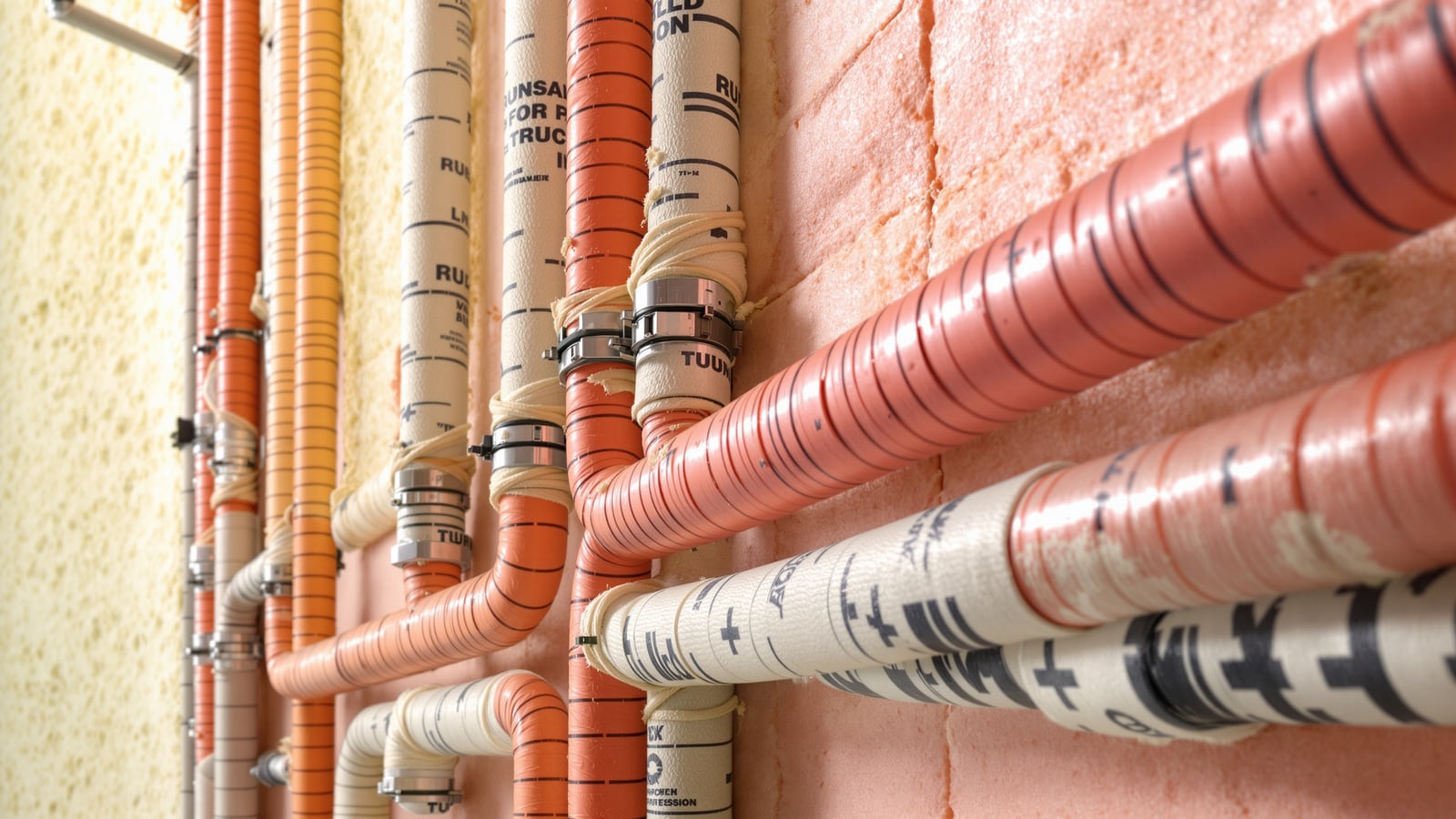
Pipe Insulation & Lagging in India: Stop Heat Loss, Sweating and Freezing
Why and how to lag your pipes — cut heat loss on hot lines for faster hot water, stop condensation dripping off cold lines in humid weather, and protect hill-station pipes from freezing. Materials, thickness, fixing and vapour barriers explained.
Most Indian homes leave their pipes completely bare, and mostly get away with it. But three quiet problems trace straight back to un-lagged pipe: hot water that arrives lukewarm and slow, cold pipes that drip and rot the ceiling in the monsoon, and — up in the hills — pipes that split open on a January night. Pipe insulation, also called lagging, is the cheap sleeve of foam or rubber that fixes all three.
This is a how-to guide within the Studio Matrx Plumbing Pipes hub. It sits alongside the hot water distribution guide, which covers the layout of hot lines, and the exposed plumbing guide, which covers surface-run pipe on walls and terraces. Here we stay on one narrow, practical question: which pipes to wrap, in what, how thick, and how to fix it so it lasts.
Insulation does nothing you can see the day it goes on. You notice it a year later — in the hot water that comes fast, the ceiling that never stained, the pipe that never burst.
The three reasons to insulate
Insulation is not one job. It solves three different problems, and which one you have decides the material, the thickness and whether you even need a vapour barrier at all.
1. Hot-water lines — cut heat loss, get hot water faster
A bare hot pipe bleeds its heat into the wall and the air the moment the tap closes. By the time you next open it, that water has cooled and must be flushed away before hot water arrives — the "dead leg" wait covered in the hot water distribution guide. Lagging the hot run slows that cooling dramatically: water that would have dropped to room temperature in fifteen minutes stays warm for an hour or more, so you wait less and waste less. On a central geyser feeding distant bathrooms, insulating the hot main and its risers is the single cheapest comfort upgrade you can make.
2. Cold lines — stop condensation and sweating
This is the reason most homeowners have never heard of, and the one that quietly does the most damage. In a humid Indian summer or monsoon — coastal Kerala, Mumbai, Chennai, Kolkata — a cold-water pipe carrying tank or borewell water sits well below the dew point of the muggy air around it. Moisture condenses on the cold metal or plastic exactly as it beads on a cold soft-drink bottle. That water drips onto false ceilings, stains gypsum board, rusts clamps, feeds mould and, on chilled or AC pipes, rots insulation from within. Wrapping the cold pipe keeps its surface above the dew point so no moisture can form. For condensation control the insulation MUST have an unbroken vapour barrier — more on that below.
3. Hill and cold regions — prevent freezing
In Shimla, Manali, Srinagar, Gangtok, Leh and the high hill stations, water left standing in an exposed pipe on a sub-zero night can freeze. Ice expands about nine percent, and the pressure it generates splits pipe walls and cracks fittings — the leak only shows the next morning when it thaws. Insulation does not make heat, so it cannot stop a truly long freeze on its own; what it does is slow the loss enough that normal use, or a low-wattage trace-heating cable underneath it, keeps the water moving and above zero. Exposed outdoor and terrace runs, and any pipe on an unheated exterior wall, are the ones at risk.
Choosing the material
Four materials cover almost every Indian home. The right one depends on the duty (hot, cold or chilled), whether it is indoors or exposed to sun and rain, and your budget.
| Material | Best for | Vapour barrier | Temp range (indicative) | Notes |
|---|---|---|---|---|
| Nitrile rubber / elastomeric (NBR) | Cold + chilled lines, AC, condensation control | Built-in (closed cell) | -40 to +105 C | Flexible black foam, self-seal slit tube; best anti-sweat choice |
| EPDM elastomeric | Hot + cold, better UV/ozone resistance | Built-in (closed cell) | -50 to +150 C | Pricier; good for exposed runs and hot mains |
| PE (polyethylene) foam | Hot-water lines, general lagging | Partial (closed cell) | -40 to +90 C | Cheapest tube form; common grey/white sleeve, less flexible |
| Glass wool / mineral wool | Hot mains, risers, high-temp | None — needs a jacket | Up to +230 C+ | For high temperature; must be clad and kept dry, fibres irritate skin |
- For condensation on cold pipes, closed-cell nitrile rubber is the default — the closed cells are themselves the vapour barrier, so moisture cannot travel through to the cold surface.
- For hot-water lines indoors, PE foam tube is cheap and adequate; EPDM is worth it on long exposed hot mains.
- Glass wool belongs on high-temperature or larger commercial mains; in a home it is overkill and must be jacketed to stay dry, because wet glass wool loses almost all its value.
- Match the tube bore to your pipe's outside diameter — buy insulation by the pipe size (15/20/25 mm etc.), not by guess.
Choosing the thickness
Thicker insulation loses less heat and resists condensation better, but costs more and gets bulky in a wall chase. For homes, these indicative sleeve thicknesses are a sensible starting point — confirm against the manufacturer's condensation tables for your local humidity.
| Pipe size (nominal) | Hot line (comfort) | Cold line, humid area (anti-sweat) | Freeze protection (hills) |
|---|---|---|---|
| 15 mm | 9 mm | 13 mm | 19-25 mm |
| 20 mm | 9-13 mm | 13-19 mm | 25 mm |
| 25 mm | 13 mm | 19 mm | 25-32 mm |
| 32-50 mm main | 13-19 mm | 19-25 mm | 32 mm |
| Roof tank / large exposed | 25-50 mm board or blanket | 25 mm+ with sealed jacket | 50 mm+ |
For anti-condensation duty, thickness is not about comfort — it is calculated so the outer surface stays above the dew point. In very humid coastal air you go thicker than the hot-line figure, not thinner. When in doubt, go up one step.
Fixing it right — the vapour barrier is everything
Getting insulation onto the pipe is easy; getting it to actually work is about the seams. For cold and chilled lines especially, one unsealed gap and humid air reaches the cold pipe, condenses inside the insulation, and you get hidden dripping and corrosion that is worse than a bare pipe.
- Slide, don't slit, where you can. Push the tube on before the pipe run is closed up. Slitting a tube to wrap an existing pipe leaves a seam you must glue shut.
- Glue every seam and butt joint with the manufacturer's contact adhesive, not tape alone. Tape peels; the adhesive weld is the vapour barrier.
- Seal at fittings, valves and tees — these are the spots people skip and exactly where condensation forms. Use moulded elbows or mitre-cut and glue.
- Do not compress it. Squashing foam under a tight clamp destroys the air pockets that do the insulating. Use saddle clamps sized for the insulated diameter.
- Keep glass wool bone dry and always clad it; wet mineral wool is near-useless and stays wet.
UV jacket for outdoor and exposed runs
Bare foam or rubber left in the Indian sun turns brittle, chalky and crumbles within a season or two — UV is its enemy. Any insulation on a terrace, external wall, roof or open shaft needs protection over it:
- A UV-stable outer jacket — aluminium foil-faced cladding, factory UV-grade EPDM, or a PVC/metal cover — over the foam.
- A weatherproof paint made for elastomeric insulation, as a lighter-duty option, re-coated periodically.
- Overlap and seal the jacket shingle-fashion, top over bottom, so rain runs off and cannot get behind it.
This ties directly into the exposed plumbing guide — any pipe you can see outdoors is a pipe the sun and rain are working on.
Roof tanks and exposed lines — the biggest wins
The overhead storage tank and the pipes on your terrace are where insulation pays back fastest, because they take the full beating of the Indian climate.
- Roof tank: a black or exposed tank on a Chennai or Nagpur terrace can push stored water past 40 C by afternoon — you open the "cold" tap and get warm water for hours. A tank insulation blanket, a double-walled tank, or even a shade cover keeps it usable. In the hills the same blanket keeps the tank from freezing at night.
- Exposed hot main from the geyser: insulating just the visible hot run on the terrace or shaft stops most of the heat loss between heater and house.
- The tank-to-house down-comer in humid regions sweats along its whole length — lag it to stop the drip trail down the wall.
Insulating the tank and the exposed lines together often makes a bigger difference than anything you do to the buried indoor pipe.
Common mistakes and how they fail
- Insulating only the straight lengths, skipping the fittings. Elbows, tees and valves are up to a third of the surface area and the first place condensation appears. Seal them.
- Taping instead of gluing seams on cold lines. The tape lifts in a monsoon, humid air gets in, and the pipe sweats under the intact-looking insulation. You never see it until the ceiling stains.
- Using open-cell or unsealed foam for anti-sweat duty. It soaks up the very moisture it was meant to keep out and stays permanently damp.
- Leaving foam bare outdoors. No UV jacket means crumbled, useless insulation within a year or two.
- Under-sizing thickness in humid coastal air. A 9 mm hot-line sleeve will still sweat on a cold pipe in Mumbai — anti-condensation thickness is larger.
- Compressing insulation behind clamps or in a tight chase, which flattens the air cells and the insulating value with them.
A quick decision guide
- Long or exposed hot run and slow hot water? Lag it with PE foam or EPDM, 9-13 mm.
- Cold pipe in a humid city, dripping or near a false ceiling? Nitrile rubber, sealed, 13-19 mm — vapour barrier is non-negotiable.
- Pipe on a terrace or outer wall? Whatever the foam, add a UV jacket.
- Home in the hills with freeze risk? Thick sleeve (19-32 mm) on exposed runs, plus trace heating for the worst spots.
- Warm water from a roof tank? Insulate or shade the tank, not just the pipe.
Whether your pipes run concealed in chases or exposed on the surface changes how easy this is to do and re-do; the trade-off between the two is covered in the Studio Matrx concealed vs exposed plumbing comparison.
References
- National Building Code of India (NBC) 2016, Part 9 — Plumbing Services — the governing framework for water supply, hot-water and drainage services in Indian buildings.
- Bureau of Indian Standards — the IS codes covering elastomeric (nitrile/EPDM) and polyethylene foam thermal insulation, mineral/glass wool insulation, and thermal insulation practice for pipework; confirm the current code, edition and grade with a licensed professional before specifying.
- Manufacturer condensation-control and thickness selection tables for the specific insulation product, matched to your local design humidity and pipe duty. Treat all thickness figures here as indicative and verify locally.
- For local freeze-protection practice in hill regions, consult a licensed plumber familiar with the area's minimum temperatures and trace-heating options.
Export this guide
Related Guides — Deep-dive reading
Bathroom Fire Safety India: NBC 2016 Part 4, Fire-Rated Materials & Electrical Ignition
The bathroom is rarely thought of as a fire risk, yet it hides several: a leaky geyser element, an over-run exhaust-fan motor, cheap flammable PVC panels overhead, and aerosol cans stored beside a heat source. This is an honest, practical reference to fire and life safety in the Indian bathroom — the NBC 2016 Part 4 context that actually applies to homes, the real ignition sources, self-extinguishing false-ceiling and PVC materials, earth-leakage protection as fire prevention, escape considerations, and the carbon-monoxide danger of gas geysers.
BathroomsBathroom Plumbing Code India: NBC 2016 Part 9, UPC-I & the IS Standards That Govern Pipework
A professional reference to the codes and standards that govern bathroom plumbing in India — the National Building Code (NBC 2016) Part 9 on Plumbing Services, the Uniform Plumbing Code India (UPC-I), the CPHEEO Manual, and the IS standards for water supply, drainage, trap seals, pipe sizing, slopes and venting — with a caveat to always verify the current code and your local authority.
BathroomsBathroom Plumbing India: The Complete Guide to Water Supply, Drainage, Traps & Pipes
The whole plumbing picture for an Indian bathroom in one place — the two systems (cold and hot water supply, and waste/soil drainage with its vented SWV stack), traps and the floor trap, slopes and gradients, concealed vs exposed pipework, pipe materials (CPVC/UPVC/PEX/GI) and the overhead-tank pressure reality — with the coordination that must happen before any civil work starts.
BathroomsRelated Tools — Try Free
False Ceiling Cost Estimator
Live ₹/sqft across 8 ceiling types — POP, gypsum, designer, metal, PVC, wooden — with cove and spot lighting for 20 Indian cities.
Cost CalculatorMonsoon-Readiness Checklist
Pre-rain home audit across 9 categories — terrace, drains, waterproofing, electrical, HVAC, pest, vehicles, documents.
Seasonal AuditPlumbing Pressure-Test & Leak Checklist
Pre-closure pressure and leak test — 9 categories, 60+ checkpoints across water supply, drainage, fixtures, waterproofing, hot water, tanks.
Pre-Closure Test