
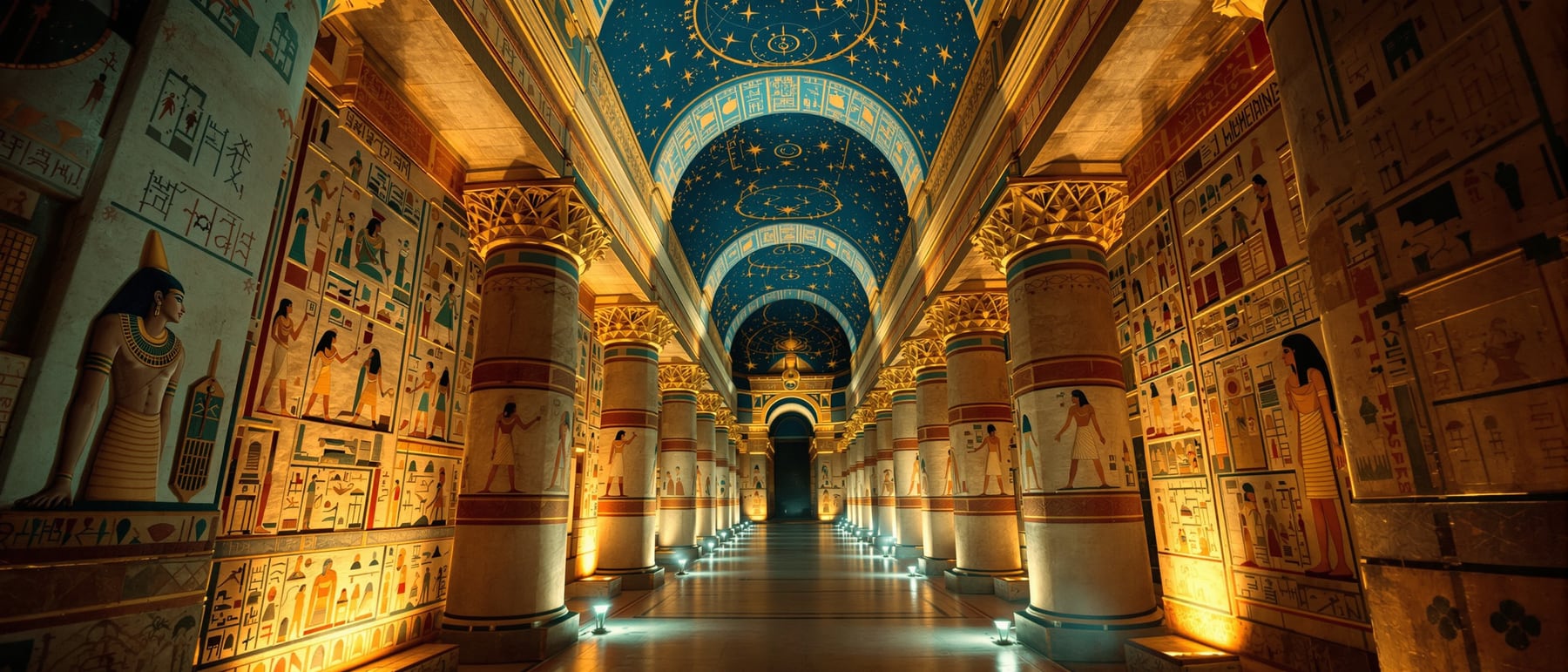
The Tomb of Seti I: The Painted Underworld Beneath the Peak
How Egypt gave up the pyramid for the hidden tomb — and then cut the longest, deepest and most exquisitely painted of them all, a 137-metre stairway into the underworld roofed by the first ceiling of stars, whose translucent alabaster coffin now glows in a London museum while its king sleeps in Cairo and its tomb stands empty in Luxor.
We come to Egypt — but not to a pyramid. By the time of our next tomb, the pharaohs had stopped building pyramids altogether, and for a very good reason: every last one had been robbed. A pyramid is a giant arrow pointing at a king's treasure. So the great pharaohs of the New Kingdom did the opposite of their ancestors at Giza: instead of the most conspicuous tomb imaginable, they cut the most hidden one — deep into the desert cliffs of a remote valley across the Nile from Thebes, the Valley of the Kings.
And the greatest of all those hidden tombs was cut for Seti I — father of Ramesses the Great — who died around 1279 BCE. Known as KV17, or "Belzoni's Tomb," it is the longest, deepest and most beautifully painted tomb in the entire Valley: a 137-metre stairway into a painted underworld, roofed by the first ceiling of stars, its king carved among the gods. It is the artistic summit of ancient Egyptian tomb-building.
This is the fortieth article in our Architectural Wonders series.
1. When the pharaohs hid their tombs
To understand this tomb, you have to understand the great reversal that produced it.
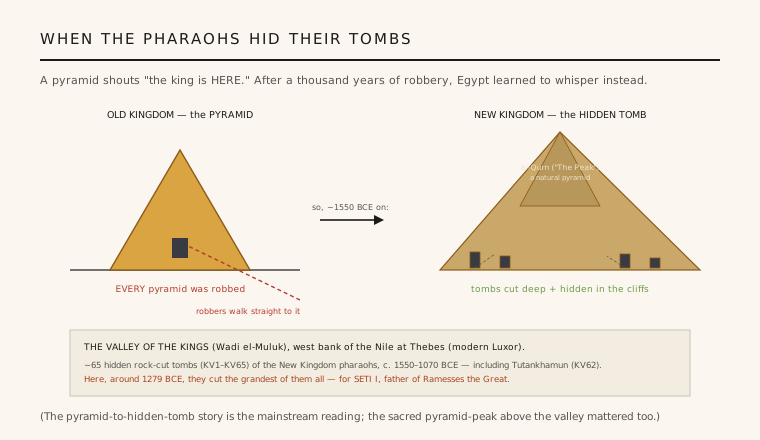
For a thousand years, Egyptian kings had been buried under pyramids — and for a thousand years, robbers had emptied them, because a pyramid tells you exactly where to dig. So from around 1550 BCE, the New Kingdom pharaohs made a radical choice: they abandoned the pyramid entirely and cut their tombs hidden and deep into a barren valley on the Nile's west bank at Thebes — the Valley of the Kings. There they carved some sixty-five concealed rock-cut tombs (including the one that would make Tutankhamun famous), all clustered beneath a striking natural peak, al-Qurn — a mountain shaped, as it happens, like a pyramid. So the pyramid did not vanish; it was handed back to nature, standing guard over the hidden kings below. (The security motive is the mainstream reading; the sacred peak surely mattered too.) It is one of history's great lessons in humility: the most powerful men on earth concluded that the way to be remembered forever was not to be seen.
2. The longest, deepest tomb of all
Within that valley of hidden tombs, Seti I's is the masterpiece of scale — a descent that seems to have no bottom.
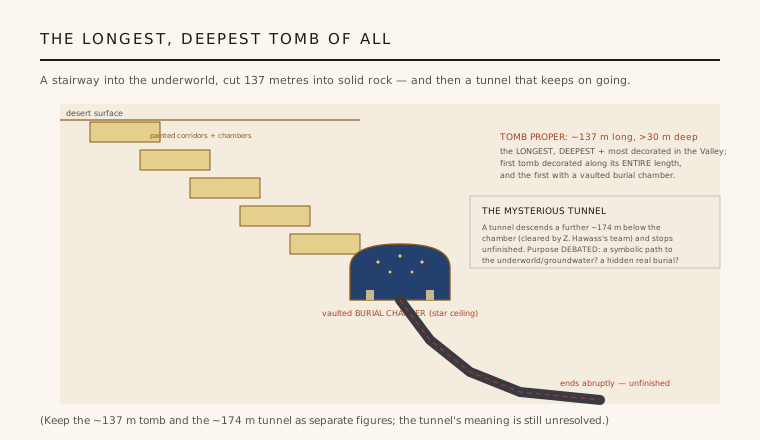
KV17 drives about 137 metres into the mountain and more than thirty metres down, through a long sequence of stepped corridors and pillared halls to a vaulted burial chamber — the longest and deepest tomb in the Valley, and the first to be decorated along its entire length. To walk it is to descend, stage by stage, into the world of the dead. And then there is the mystery: below the burial chamber, a tunnel plunges a further 174 metres into the rock — cleared in modern times by Zahi Hawass's team — before it simply stops, unfinished. No one is sure why it is there. Was it a symbolic passage reaching down toward the underworld and the primeval waters? An attempt to touch the groundwater? A secret, never-finished chamber to hide the real burial? The tunnel keeps its secret. What is certain is the ambition: this is a tomb conceived not as a room but as a journey, cut on a scale no one had attempted before.
3. A sky of stars, a book of the dead
But the true wonder of Seti's tomb is not its length. It is its skin — the most exquisite painted decoration in all of ancient Egypt.
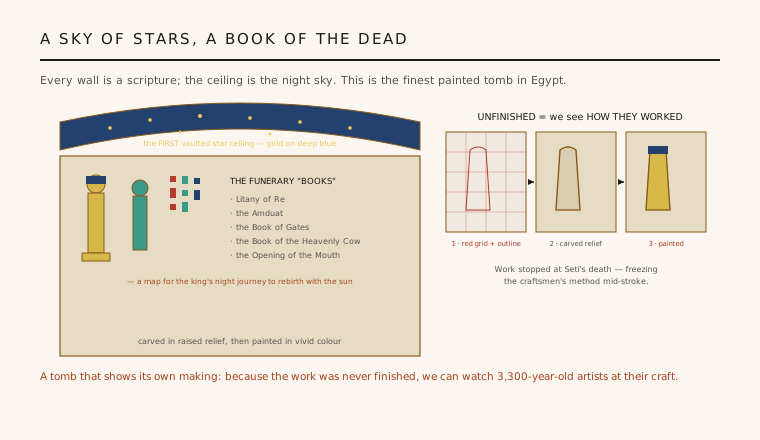
Virtually every surface is carved in delicate raised relief and then painted in colours still vivid after three thousand three hundred years. And the walls are not decoration — they are scripture. They carry the great funerary "books" — the Litany of Re, the Amduat, the Book of Gates, the Book of the Heavenly Cow, the Opening of the Mouth — a complete illustrated guide to the king's perilous night journey through the underworld to be reborn each dawn with the sun. Over the burial chamber arches the crowning glory: the first vaulted astronomical ceiling in Egypt, a deep-blue night sky sprinkled with golden stars and constellations. It is the same cosmic ambition we met at Newgrange — a tomb that maps the heavens — but here rendered in dazzling colour. And there is a rare bonus: because the work stopped, unfinished, at Seti's death, some chambers freeze the craftsmen's method mid-stroke — the draughtsman's red grid and outline, then the sculptor's relief, then the painter's colour — so we can watch, stage by stage, how the ancient Egyptians actually made their art. A tomb that shows its own making.
4. Belzoni's tomb — found, and plundered
The tomb slept, sealed and flooded, for three thousand years — until a former circus strongman found it, and both saved and scarred it.
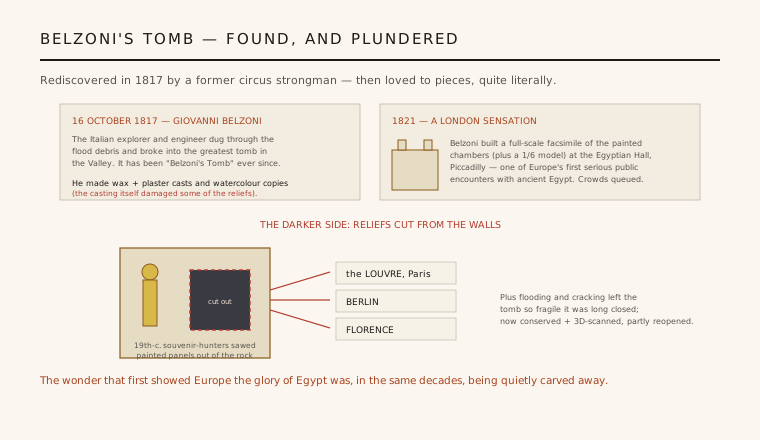
On 16 October 1817, the Italian explorer and engineer Giovanni Belzoni dug through the flood debris and broke into KV17 — and it has been "Belzoni's Tomb" ever since. He copied its walls in wax and plaster casts and watercolours (though the casting itself damaged some reliefs), and in 1821 he built a full-scale facsimile of its painted chambers at the Egyptian Hall in Piccadilly, London — a public sensation that gave Europe one of its first real glimpses of pharaonic Egypt. But the same century that discovered the tomb also dismembered it: souvenir-hunters and collectors sawed whole painted panels out of the walls, and today pieces of Seti's tomb hang in the Louvre, Berlin and Florence — the very fate we watched scatter the Treasury of Atreus across Europe. Between the sawing, the flooding and the cracking, the finest tomb in Egypt was left so fragile it had to be closed for years; only now, with painstaking conservation and 3-D scanning, is it carefully coming back.
5. The glowing coffin, and the missing king
And so to the strangest fate of all — because the "house of eternity," built to keep a king and his coffin together forever, ended up scattering all three across the world.
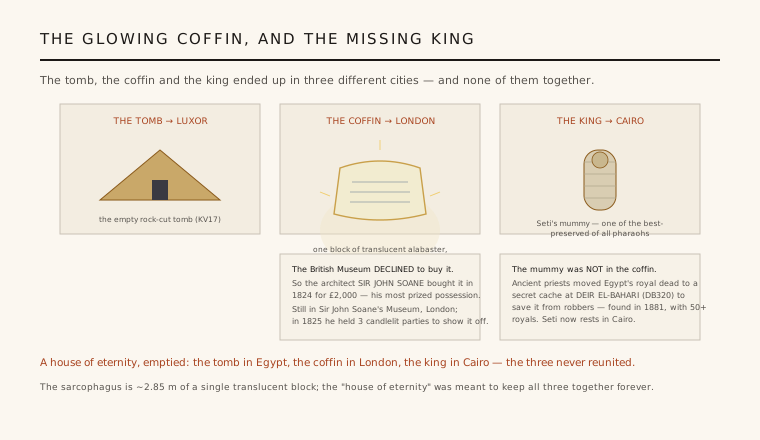
At the tomb's heart Belzoni found Seti's sarcophagus — and it is a marvel in its own right: carved from a single block of translucent Egyptian alabaster, incised inside and out with the Book of Gates and inlaid with blue, and cut so thin that it glows when a light is placed within it. The British Museum declined to buy it, so in 1824 the architect and collector Sir John Soane bought it for £2,000 — his most treasured possession — and it still stands, glowing, in the crypt of Sir John Soane's Museum in London, where in 1825 he threw three candlelit parties to show it off. But the coffin was empty. Seti's mummy had been spirited away in antiquity by priests who, to save Egypt's kings from robbers, gathered the royal dead into a secret cache at Deir el-Bahari — discovered in 1881, packed with more than fifty pharaohs — and Seti's remarkably well-preserved body now rests in Cairo. So the great house of eternity lies broken into three: the tomb empty in Luxor, the coffin glowing in London, the king himself in Cairo — the very togetherness it was built to guarantee, undone. And yet the tomb is still, unquestionably, one of the most beautiful things human beings have ever made underground.
6. What a modern architect can learn from the Tomb of Seti I
- Sometimes the answer is to hide, not to display. After a thousand years of robbed pyramids, Egypt's kings chose concealment over conspicuousness. The boldest design move can be restraint — reading what actually protects what you value, and doing the counter-intuitive thing.
- Make the path the architecture. Seti's tomb is a descent, staged corridor by corridor into the underworld. Sequence, depth and procession — the experience of moving through — can be the real design, not just the destination room.
- Let the surface carry the meaning. Here the walls are literally the sacred text; the building is its message. Ornament, when it is integral and meaningful rather than applied, turns a structure into a story.
- Unfinished work teaches. Because it was never completed, the tomb reveals its own method — grid, relief, paint. There is honesty and value in letting the making show; a process left visible can instruct for millennia.
- The most durable thing is fragile. A tomb built for eternity was undone by flood, saw and sale within a century of rediscovery. Preservation is never finished; what we inherit, we must actively protect, or lose.
- Beauty survives even a broken promise. The tomb failed at its one job — keeping the king safe and whole. Yet its artistry still moves everyone who enters. Do the work beautifully; the beauty may outlast even the purpose.
References & further reading
1. Theban Mapping Project — Sety I (KV17). https://thebanmappingproject.com/tombs/kv-17-sety-i
2. Encyclopaedia Britannica — Seti I. https://www.britannica.com/biography/Seti-I
3. Sir John Soane's Museum — The Sarcophagus of Seti I. https://www.soane.org/sarcophagus-seti-i
4. UNESCO World Heritage Centre — Ancient Thebes with its Necropolis (inscribed 1979). https://whc.unesco.org/en/list/87/
5. Wikipedia — Tomb of Seti I (discovery, dimensions, dispersed reliefs). https://en.wikipedia.org/wiki/Tomb_of_Seti_I
6. Factum Foundation — The Tomb of Seti I (Belzoni's record and modern conservation). https://factumfoundation.org/our-projects/digitisation/the-theban-necropolis-preservation-initiative/the-tomb-of-seti-i/
Last verified 2026-07-04. Figures follow the Theban Mapping Project and standard Egyptological sources and are given as widely cited approximations. Seti I (19th Dynasty, father of Ramesses II) reigned c. 1290/1294–1279 BCE (the ~1279 BCE end date is firm; the start varies by chronology); KV17 dates to his death, c. 1279 BCE. The tomb proper is ~137.19 m long and >30 m deep — the longest, deepest and most completely decorated in the Valley of the Kings, and the first decorated along its entire length and with a vaulted burial chamber; the mysterious tunnel below descends a further ~174 m (a separate figure) and ends unfinished, its purpose genuinely debated (symbolic underworld passage vs. an unfinished hidden chamber). The decoration (Litany of Re, Amduat, Book of Gates, Book of the Heavenly Cow, Opening of the Mouth, and the vaulted astronomical ceiling) is documented; some chambers are unfinished, exposing the craftsmen's grid-outline-relief-paint method. Discovered by Giovanni Belzoni on 16 October 1817 (one source gives 18 Oct); his 1821 Egyptian Hall exhibition, and the 19th-century removal of reliefs now in the Louvre, Berlin and Florence, follow the record. The translucent alabaster sarcophagus was bought by Sir John Soane in 1824 for £2,000 and is in Sir John Soane's Museum, London; Seti's mummy, moved to the Deir el-Bahari royal cache (DB320, found 1881), is in Cairo. The Valley of the Kings is part of the UNESCO World Heritage Site "Ancient Thebes with its Necropolis" (1979).
Export this guide
Related Guides — Deep-dive reading
The Temples of Karnak: A Sacred City Built by Thirty Kings
How thirty pharaohs across two thousand years — from the Middle Kingdom to the age of Ramesses — kept adding to a single sacred precinct at Thebes until it became the largest religious complex of the ancient world, crowned by a hall of 134 colossal stone columns raised as a petrified papyrus marsh, a forest of stone built to be the very morning of creation for the King of the Gods, Amun-Ra.
Architectural WondersAbu Simbel: The Temple a Pharaoh Cut Into a Mountain — and the World Moved to Save It
How Ramesses the Great hollowed two temples out of a Nubian cliff, guarded them with four twenty-metre giants of himself, and aimed the whole mountain so precisely that twice a year the rising sun still races sixty metres into the dark to touch the gods at the very back — and how, three thousand years later, more than fifty nations sawed the temples into a thousand pieces and lifted them bodily up the cliff to escape a rising lake.
Architectural WondersThe Lighthouse of Alexandria: The Wonder That Became a Word
How Ptolemy's Egypt raised a 100-metre tower of light on the island of Pharos — the tallest building on earth after the Great Pyramid, the model for every lighthouse since, and so famous its island's name became the word for 'lighthouse' itself — which stood 1,600 years, fell to earthquakes, and was reborn as a fort and a field of ruins on the sea floor.
Architectural WondersRelated Tools — Try Free
Before & After Studio
Generate AI before-and-after renders to preview how your redesign could look.
DesignAICircadian Light Meter
Patient-centric circadian lighting visualizer for Indian healthcare design — time-of-day × intensity → CCT, melanopic lux (EML / mEDI), melatonin suppression, and an alertness curve. Calibrated against WELL v2 L03 Circadian Lighting Design, CIE S 026:2018, Brainard 2001, and Lucas et al. 2014.
Circadian ToolHome Colour Studio
Colour every room — living, bedroom, dining, kitchen, bathroom — surface by surface in any HEX/RGB/CMYK colour, or from 80+ curated Indian shades.
Colour Studio