
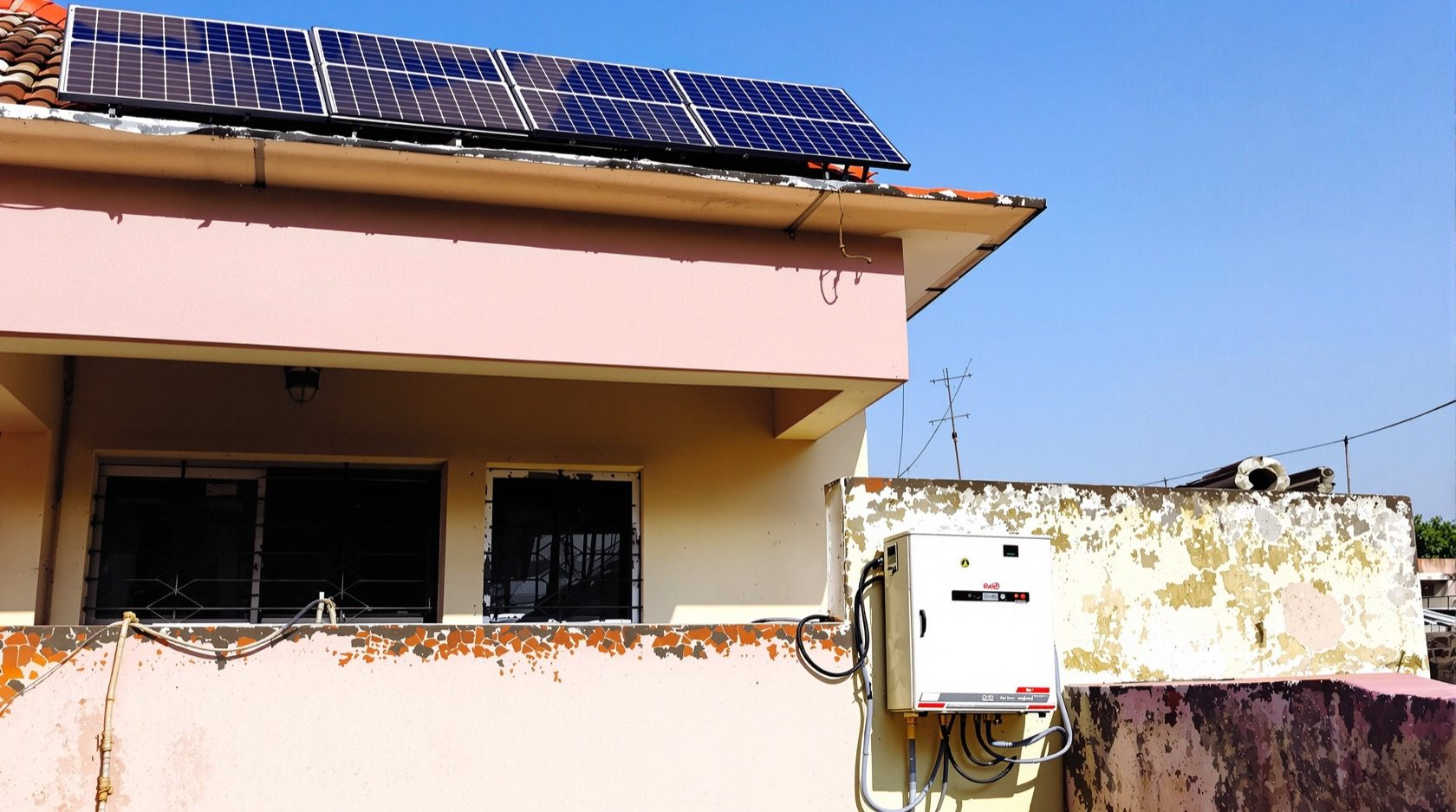
String vs Microinverter vs Power Optimiser: Solar Inverter Choices
The inverter decision that shapes a rooftop system's output and cost — how string inverters, microinverters and power optimisers differ, why shading and roof complexity tilt the choice, and which makes sense for a typical Indian rooftop.
Once you've decided on rooftop solar, one technical choice quietly shapes how much energy the system actually makes and what it costs: the inverter architecture. A string inverter, microinverters, or a string inverter with power optimisers each convert your panels' DC to usable AC differently — and the right choice depends heavily on shading and roof complexity. This guide compares the three for a typical Indian rooftop, without the sales spin.
It is the solar-inverter comparison in the Electrical Knowledge Hub, building on the rooftop solar and grid-tied vs off-grid guides.
The safety line. Solar inverter selection and installation are done by a qualified solar installer and licensed electrician to the relevant standards and your DISCOM's net-metering rules. This guide helps you understand the choice and question a quote.
The core difference: where conversion happens
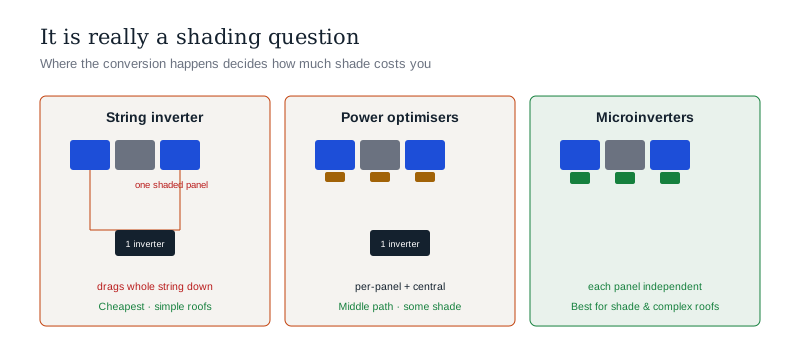
Panels produce DC; it must be converted to AC for your home and the grid. The three approaches differ in where that conversion (and optimisation) happens:
- String inverter — panels wired in a series "string" to one central inverter; conversion happens centrally.
- Microinverter — a small inverter on each panel; conversion happens at every panel.
- Power optimiser — a small optimiser on each panel that conditions its DC, feeding one central (string) inverter; a middle path.
Microinverters and optimisers are together called module-level power electronics (MLPE) — electronics at each panel.
At a glance
| String inverter | Power optimisers | Microinverters | |
|---|---|---|---|
| Electronics | One central unit | Per-panel + central inverter | Per-panel |
| Shading tolerance | Weakest (string dragged down) | Good | Best (panels independent) |
| Complex/multi-facing roofs | Less ideal | Good | Best |
| Upfront cost | Lowest | Middle | Highest |
| Per-panel monitoring | No | Yes | Yes |
| Best for | Simple, unshaded roofs | Some shade/complexity | Shaded/complex roofs |
String inverter — the simple, economical default
The string inverter is the most common, most economical choice:
- One central inverter for a string of panels — simplest and cheapest.
- Best on simple, unshaded, single-orientation roofs where all panels perform alike.
- The weakness — shading: because panels are in series, a shaded or underperforming panel drags down the whole string (like a kink in a hose).
- Ideal for a clean, open Indian terrace with no shadows.
Microinverters — best for shade and complex roofs
Microinverters put a small inverter on every panel:
- Each panel works independently — a shaded or dirty panel doesn't drag the others down, maximising output on shaded or complex roofs.
- Per-panel monitoring — you see each panel's performance.
- Multi-orientation roofs handled naturally (panels facing different ways all perform their best).
- Highest upfront cost, but recovers energy that a string would lose to shade.
- Ideal where trees, water tanks, parapets or neighbouring buildings cast shadows, or the roof faces several directions.
Power optimisers — the middle path
Power optimisers sit on each panel but feed one string inverter:
- Per-panel optimisation and monitoring like microinverters, but with a central inverter (often lower cost than full microinverters).
- Good shade tolerance — a middle ground between string and micro.
- A sensible compromise for roofs with some shading or complexity.
How to choose
The deciding factor is nearly always shading and roof complexity:
- Simple, open, unshaded, single-orientation roof → string inverter (cheapest, works great).
- Significant shading (trees, tanks, parapets) or a multi-facing/complex roof → microinverters (best recovery).
- Some shade or moderate complexity, cost-conscious → power optimisers (the middle path).
- Also weigh — budget, whether you want per-panel monitoring, and future expansion.
- Get a shading assessment from your installer — it drives the answer more than any brochure.
The one-line answer
The solar inverter choice is really a shading question: a string inverter (one central unit) is the cheapest and works excellently on a simple, open, unshaded roof, but its series wiring means one shaded panel drags down the whole string; microinverters (one per panel) let every panel work independently, making them best for shaded or complex, multi-facing roofs at a higher cost; and power optimisers (per-panel electronics feeding a central inverter) are the middle path for some shade or complexity. Match the architecture to your roof's shading and layout — get an installer's shading assessment — rather than to a brochure, and have a qualified solar installer and licensed electrician size and fit it.
Where to go next
- The system overview: Rooftop Solar Guide.
- Grid vs off-grid: Grid-Tied vs Off-Grid Solar Guide.
- Storing the energy: Solar Battery Storage Guide.
- Size a system: Solar Sizing Calculator.
References
- IS/IEC 62109 (Parts 1 & 2), Safety of Power Converters for Use in Photovoltaic Power Systems, Bureau of Indian Standards.
- IS 16221 / IEC 61730, Photovoltaic Module Safety Qualification; grid-connection & net-metering — your State Electricity Regulatory Commission / DISCOM.
- Ministry of New and Renewable Energy (MNRE) / PM Surya Ghar — rooftop solar (verify current terms): https://mnre.gov.in/
Inverter suitability depends on your roof's shading and layout; selection and installation must be done by a qualified solar installer and licensed electrician to the current standards and DISCOM rules. Verify any standard's status via the BIS catalogue before relying on it.
Export this guide
Related Guides — Deep-dive reading
Rooftop Solar for Indian Homes: The Complete Guide
How rooftop solar actually works and pays back — the panels, inverter and net meter, the on-grid, off-grid and hybrid choice, how much roof and money a system needs, the PM Surya Ghar subsidy and net metering, and how to judge a good installation.
Electrical & WiringHot Water Systems Guide (India): How to Choose the Right Water Heater
Electric, gas, solar or heat-pump? Central or point-of-use? A homeowner's how-to-choose overview that compares every water-heating option on upfront cost, running cost and where each one actually suits an Indian home.
PlumbingRooftop Solar Approvals & Net Metering in India: The Permissions You Actually Need
The approvals side of putting solar on an Indian roof — not how solar works, but the permissions: the DISCOM net-metering application and feasibility, an empanelled installer, the structural load check, the electrical safety inspection, the PM Surya Ghar subsidy, and metering and commissioning. These are DISCOM, state and MNRE rules — not one national IS code — so amounts and caps change; always confirm the current rule locally.
RoofingRelated Tools — Try Free
Solar CCTV Sizing Calculator
Enter cameras, sun-hours and backup days to get the solar panel wattage, battery Ah and an indicative kit cost for an off-grid camera.
Solar SizingSolar Sizing Calculator
Size a rooftop solar system from your monthly electricity use — the kW system, number of panels, roof area and yearly generation.
SolarInverter & Battery Calculator
Size a home inverter (VA) and battery (Ah) for the load you want to back up and the hours of backup you need.
Backup Power