
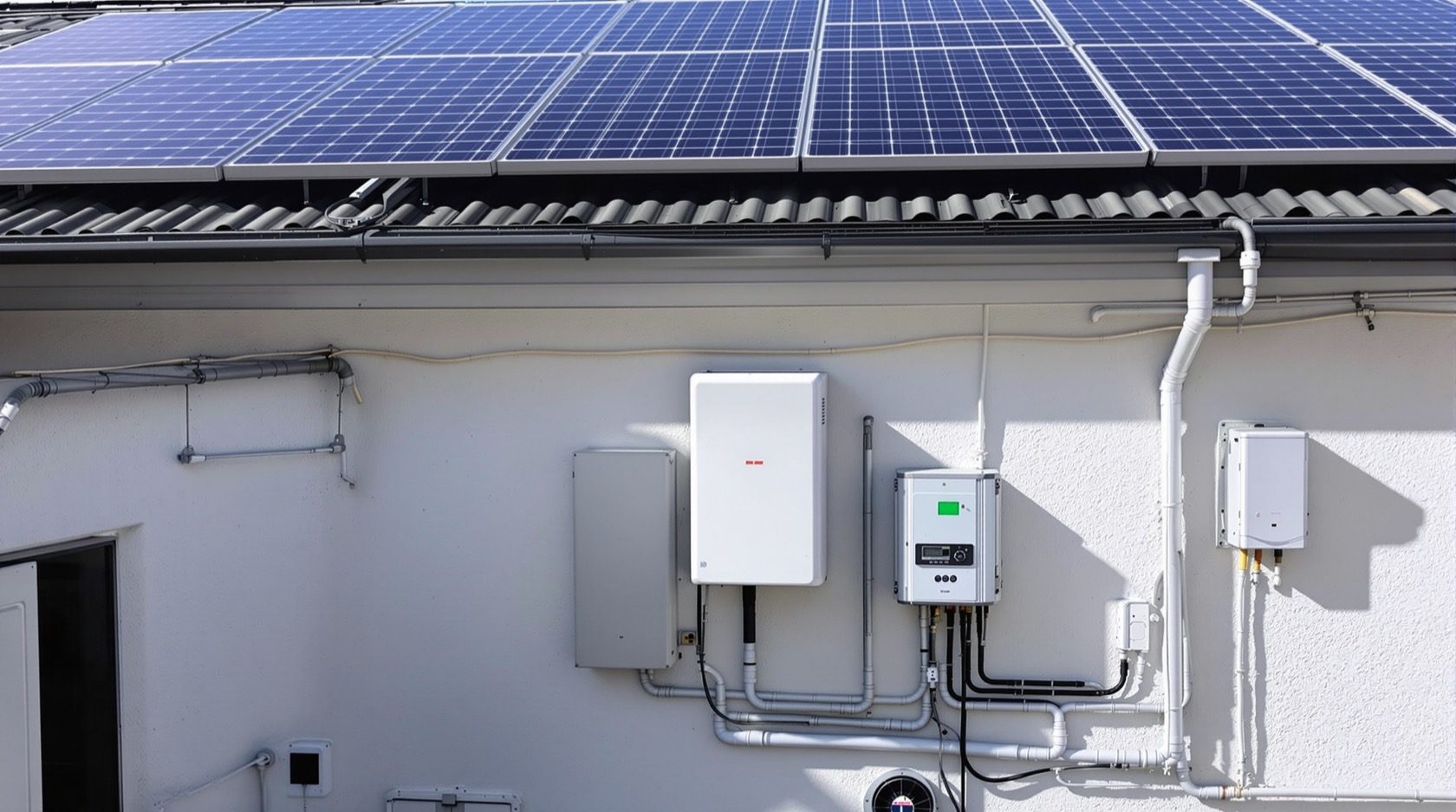
Grid-Tied vs Off-Grid vs Hybrid Solar: Which to Choose
The decision that shapes your whole solar system — grid-tied for best payback, off-grid for independence, or hybrid for both plus outage backup. How each works, the inverter each needs, why grid-tied solar shuts off in a power cut, and how to choose for an Indian home.
Before you size panels or count savings, one decision shapes your entire solar system: is it grid-tied, off-grid, or hybrid? It determines the inverter you need, whether you have batteries, what happens during a power cut, and your payback. Many buyers are surprised to learn that a standard grid-tied system — the cheapest and best-returning — switches off during a blackout. This guide explains the three types, the inverter each needs, and how to choose for an Indian home.
It sits under the rooftop solar guide and connects to solar battery storage.
The safety line. The system type, inverter and grid interconnection are designed and installed by a qualified solar installer and licensed electrician to the inverter safety standard IS 16221 and (for grid-tied) the anti-islanding standard IS 16169, plus your DISCOM's rules. This guide helps you choose the type; the engineering is professional work.
Grid-tied (on-grid)
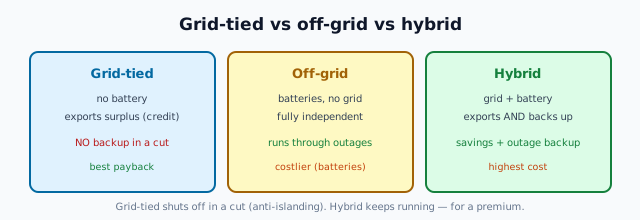
A grid-tied system has no battery. It uses solar power directly, exports surplus to the grid via net metering, and imports from the grid at night.
- Pros: cheapest (no battery), most efficient, best payback, simplest.
- The catch: during a power cut it shuts down. This is a deliberate safety feature — a grid-tied inverter must stop feeding the line (called anti-islanding, to IS 16169) so it can't electrocute a lineman working on the "dead" grid. So grid-tied solar gives you savings, not backup.
- Inverter: a grid-tied (string) inverter.
- Best for: homes with a reliable grid and available net metering who want maximum savings.
Off-grid
An off-grid system runs independently of the grid, with batteries storing solar energy for night and cloudy days.
- Pros: full independence; works where there is no grid or a very unreliable one; runs through any outage.
- Cons: costlier (batteries are the expense), needs careful sizing (run out of stored energy and you're dark), and no net-metering income.
- Inverter: an off-grid inverter with a charge controller.
- Best for: remote sites, farms, or places with no dependable grid connection.
Hybrid
A hybrid system is grid-connected and battery-backed — the best of both.
- Pros: exports surplus for net-metering credit and keeps running during outages from its battery; can prioritise solar, battery or grid intelligently.
- Cons: the most expensive (grid features + battery), more complex.
- Inverter: a hybrid inverter managing panels, battery and grid together.
- Best for: homes that want both savings and outage backup — increasingly the choice where power cuts are common (much of India).
Head to head
| Feature | Grid-tied | Off-grid | Hybrid |
|---|---|---|---|
| Battery | No | Yes | Yes |
| Works in a power cut | No | Yes | Yes |
| Net metering / export | Yes | No | Yes |
| Cost | Lowest | High (batteries) | Highest |
| Payback | Best | Slower | Good |
| Inverter | Grid-tied (string) | Off-grid | Hybrid |
| Best for | Reliable grid, max savings | No/poor grid, independence | Savings + outage backup |
The solar inverter, briefly
The inverter is the brain of the system, and its type follows the system type (grid-tied, off-grid or hybrid above). A couple of extra points:
- String inverters (one inverter for a string of panels) are the common, cost-effective choice for homes.
- Microinverters / power optimisers (one per panel) help where shading or complex roofs make a single string inefficient — costlier, but they stop one shaded panel dragging down the rest.
- All inverters must meet safety (IS 16221), and grid-tied ones the anti-islanding (IS 16169) requirement.
How to choose
- Reliable grid + net metering + want best savings: grid-tied — accept that it won't run during a cut.
- No or very poor grid, or you want independence: off-grid — budget for the batteries.
- Want savings and to keep running through outages (common in India): hybrid — pay the premium for both.
- Frequent power cuts are your main pain: hybrid (or grid-tied solar + a separate inverter-battery) — because plain grid-tied solar gives you no blackout cover.
The one-line answer
Grid-tied solar is the cheapest and best-paying — it exports surplus for net-metering credit — but it shuts off during a power cut for safety (anti-islanding), so it saves money without giving backup; off-grid runs independently on batteries for places with no reliable grid, at higher cost; and hybrid is grid-connected and battery-backed, giving both savings and outage backup for a premium. For most Indian homes with a decent grid, grid-tied gives the best return, while hybrid is worth it where power cuts are frequent and you want to keep running through them — the inverter (string, off-grid or hybrid) follows the choice.
Where to go next
- The full solar picture: Rooftop Solar Guide.
- The batteries hybrid/off-grid need: Solar Battery Storage.
- Backup without solar: Home Backup Power Guide.
- Size a system: Solar Sizing Calculator.
References
- IS 16221 (Parts 1–3, IEC 62109), Safety of Power Converters for Use in Photovoltaic Power Systems, Bureau of Indian Standards.
- IS 16169 : 2019 (IEC 62116), Utility-Interconnected Photovoltaic Inverters — Test Procedure of Islanding Prevention, BIS.
- IS 14286 : 2010, Crystalline Silicon Terrestrial PV Modules, BIS.
- Ministry of New and Renewable Energy (MNRE) and your State DISCOM net-metering regulations: https://mnre.gov.in/
System costs and payback are indicative and vary by state, tariff and site; net-metering rules are state-specific. Design and installation must be by a qualified installer and licensed electrician. Verify any standard's status via the BIS catalogue before relying on it.
Export this guide
Related Guides — Deep-dive reading
Hybrid Solar System Guide for Indian Homes: Solar Plus Battery Backup (2026)
A design and specification guide to the hybrid solar system -- grid-connected solar with a battery that keeps critical loads running through a cut. How it works, how it differs from pure on-grid and off-grid, the components, sizing the battery, the trade-offs, and when hybrid beats an on-grid system with a separate inverter.
Solar & EnergyRooftop Solar for Indian Homes: The Complete Guide
How rooftop solar actually works and pays back — the panels, inverter and net meter, the on-grid, off-grid and hybrid choice, how much roof and money a system needs, the PM Surya Ghar subsidy and net metering, and how to judge a good installation.
Electrical & WiringThe Solar Roof Guide
Putting rooftop solar on an Indian home, made clear — the system types (grid-connected, off-grid and hybrid, plus BIPV and solar tiles), how to judge whether your roof is ready (area, orientation, tilt, shading, structure and age), how panels are mounted and waterproofed, the electrical and fire-safety essentials, cleaning and access, indicative cost and payback, and the permissions, net-metering and subsidy path. Plain language, India-grounded.
RoofingRelated Tools — Try Free
Solar CCTV Sizing Calculator
Enter cameras, sun-hours and backup days to get the solar panel wattage, battery Ah and an indicative kit cost for an off-grid camera.
Solar SizingInverter & Battery Calculator
Size a home inverter (VA) and battery (Ah) for the load you want to back up and the hours of backup you need.
Backup PowerSolar Sizing Calculator
Size a rooftop solar system from your monthly electricity use — the kW system, number of panels, roof area and yearly generation.
Solar