
Shower Maintenance India: Descale a Shower Head, Fix Weak Spray, Clean Glass & Stop Mould
A practical upkeep guide for Indian showers — descaling clogged shower-head nozzles, restoring a weak or uneven spray from hard water, cleaning the diverter, fixing a dripping shower, keeping glass partitions spot-free and clearing mould from silicone joints.
A shower rarely fails all at once. It fades. The wide spray that once drummed on your shoulders narrows to a few crooked jets, the glass clouds over with white film, a slow drip starts long after you have turned the lever off, and a dark line creeps along the silicone in the corner. Almost every one of these is the same culprit wearing a different costume — hard water. Most Indian supplies, especially from borewells and municipal lines across Delhi, Bengaluru, Hyderabad, Chennai and much of the west, are rich in dissolved calcium and magnesium. When that water evaporates it leaves limescale behind, and limescale is what blocks nozzles, dulls glass and stiffens moving parts.
This is the maintenance companion in the Studio Matrx bathroom hub. Read it alongside the bathroom cleaning guide for India, which is the upkeep pillar for the whole room, and the shower systems guide if you want to understand the parts you are cleaning. For the white deposits specifically, the hard-water stain removal guide goes deeper, and for the partition and any shower mirror, pair this with bathroom mirror and glass care.
Ninety percent of shower complaints in Indian homes trace back to limescale. Fix the deposits and you fix the symptoms — no plumber, no new fittings.
Descaling a clogged shower head — the vinegar-bag trick
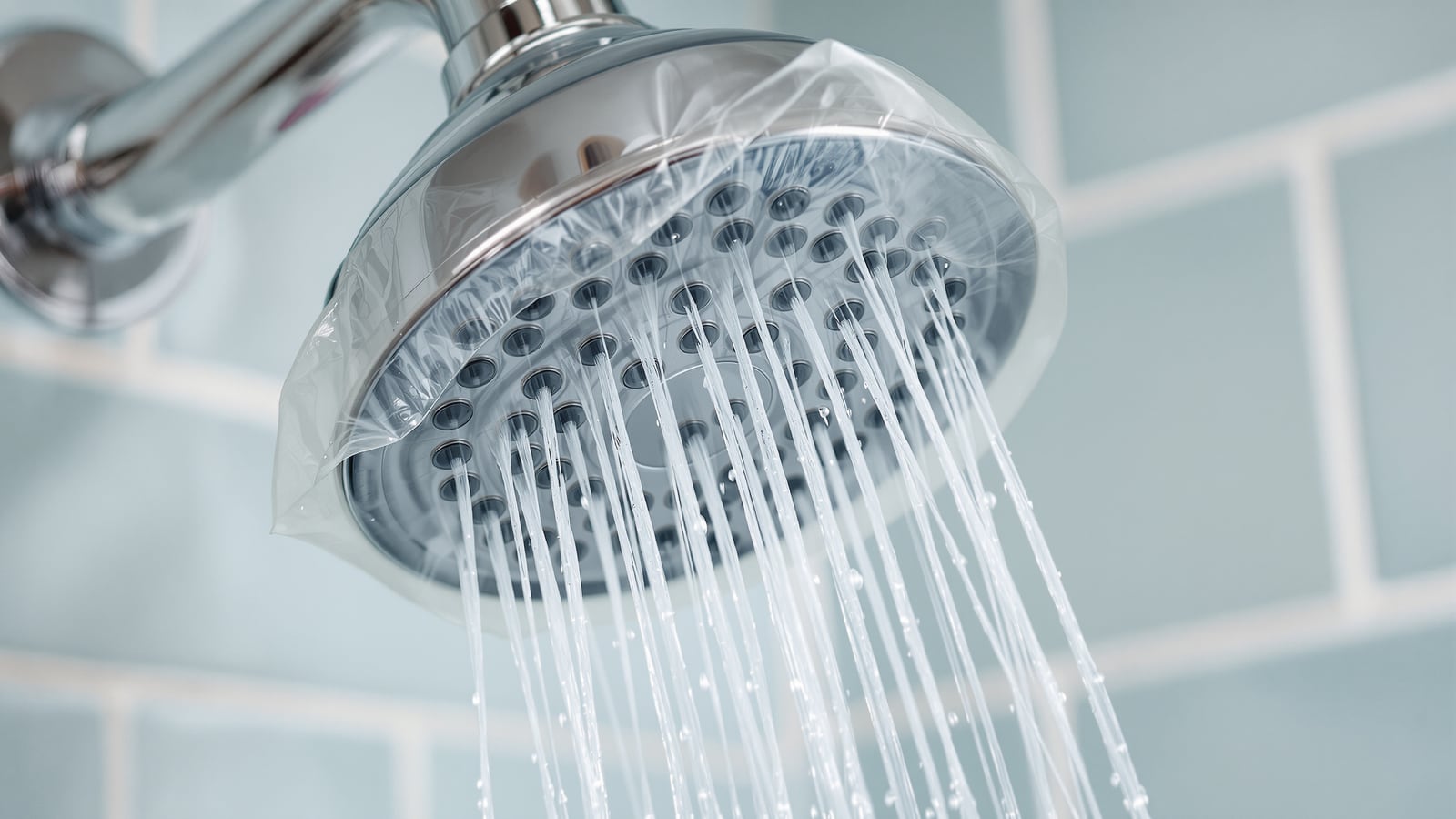
When individual nozzles spit sideways or stop entirely, the rubber or brass ports are crusted with scale. You do not need to remove the head. The classic, genuinely effective fix uses only white vinegar (the ordinary distilled kind from any kirana, around ₹60-120 a litre).
1. Fill a sturdy polythene bag with plain white vinegar — enough to submerge the face of the head. For heavy scale, warm the vinegar slightly first; it works faster.
2. Slip the bag over the shower head so the spray face is fully immersed. Tie it in place around the arm with a rubber band or a strip of cloth.
3. Leave it for 1-2 hours. For a badly blocked head, leave it overnight, but see the caution below.
4. Remove the bag, then rub each nozzle. On modern heads the ports are soft rubber "anti-lime" nozzles — press and rub them with your thumb or a soft toothbrush and the softened scale pops out.
5. Run the shower on full for a minute to flush loosened debris. The spray should return to a full, even fan.
For a removable head, unscrew it, take out the small filter washer at the inlet (it is often clogged with grit), and soak the whole head in a bowl of vinegar instead of a bag.
Cautions. Do not soak brushed nickel, matte black, gold or other coated/PVD finishes in vinegar for long — acid can dull the coating. Limit these to 30 minutes and rinse well, or use a proprietary limescale remover diluted per its label. Never use a metal pin or needle to ream rubber nozzles; it tears them and makes the spray worse. And never mix vinegar (an acid) with bleach or any harsh cleaner — the combination releases toxic chlorine gas.
Weak or uneven spray from hard water
If the whole spray is weak, work through causes from cheapest to hardest:
- Blocked nozzles — descale as above. This solves most cases.
- Clogged inlet filter/flow washer — unscrew the head and clean or replace the mesh washer at the connection.
- Partly closed angle valve — the small stop-valve feeding the mixer may be half shut. Open it fully.
- Genuinely low pressure — gravity from an overhead tank gives roughly 0.1 bar per metre of height. A single-floor drop simply cannot push a large rain head. If descaling does not help and pressure is the real limit, a pressure pump is the fix; see the shower systems guide.
Cleaning the diverter
The diverter is the knob or lever that switches flow between the overhead and the hand shower. When it gets stiff, leaks water from the "off" outlet, or refuses to switch cleanly, scale in the mechanism is usually to blame.
- For an exposed diverter, close the water supply, unscrew the diverter spindle or knob, and soak the removable brass parts in vinegar for 30-60 minutes. Brush off softened scale, smear a little silicone plumber's grease on the O-rings, and reassemble.
- For a concealed diverter behind the tiles, you can descale the visible spindle, but if it still weeps or jams, the internal cartridge needs replacing — a job for a plumber (₹400-1,200 in labour plus the cartridge).
- Never force a seized diverter. Snapping a spindle inside a concealed body turns a ₹300 fix into a wall-opening job.
A dripping shower — usually the cartridge
A shower that keeps dribbling after you shut it off is wasting water and staining the tray with scale. In a single-lever mixer the seal is the ceramic cartridge; in older two-handle taps it is a rubber washer.
1. Turn off the water at the angle valves or the main.
2. Prise off the lever cap, remove the retaining screw, and lift the handle.
3. Unscrew the retaining ring and pull out the cartridge. Take it to a plumbing shop to match the exact size — cartridges are not universal.
4. Fit the new cartridge (a genuine one costs ₹250-900 for most Indian brands), reassemble, and test.
If you are not confident opening a concealed body, call a plumber. Do not attack a stuck cartridge with strong acid — it damages the ceramic discs and chrome.
Problem to fix, at a glance
| Symptom | Likely cause | Your fix |
|---|---|---|
| Nozzles spray sideways or blocked | Limescale in rubber ports | Vinegar-bag soak, rub nozzles |
| Whole spray weak | Clogged inlet washer or low pressure | Clean washer; pump if pressure-limited |
| Diverter stiff or leaks when off | Scale or worn O-ring/cartridge | Soak parts; replace concealed cartridge |
| Constant drip after shut-off | Worn ceramic cartridge or washer | Replace matched cartridge |
| White film on glass | Dried hard-water spots | Squeegee daily; vinegar weekly |
| Dark line on silicone corner | Mould in the joint | Bleach-gel treat; reseal if it returns |
Cleaning glass partitions and preventing water spots
Those white spots on a glass partition are dried limescale, and left alone they etch into the glass permanently. Prevention beats scrubbing every time.
- Squeegee after every shower. A ₹150 rubber squeegee, three quick strokes, removes the water before it can dry and deposit scale. This single habit keeps glass clear.
- Weekly clean. Spray a 1:1 white-vinegar-and-water mix, leave two minutes, wipe with a microfibre cloth, rinse and squeegee dry. For stubborn film, a paste of baking soda lifts it without scratching.
- Avoid abrasive scourers and steel wool — they scratch glass and strip any protective coating.
- Consider a coating. A rain-repellent glass treatment (nano hydrophobic coating) makes water bead and run off, cutting spotting for several months.
Mould in the corner and resealing silicone
The dark line where the wall meets the tray is mould feeding on soap film in constantly damp silicone. First improve drying — run the exhaust fan and leave the partition open after showers.
To clean it: apply a mould-remover gel or a bleach-based cleaner (Domex, or a diluted bleach) along the joint, leave 15-30 minutes, scrub with an old toothbrush and rinse. Never mix bleach with vinegar or acid cleaners.
When mould has grown under the silicone and keeps returning, the seal is done — reseal it:
1. Slice out the old silicone with a blade or a silicone-removal tool and pull it away in a strip.
2. Clean the channel, treat any mould, and let it dry completely.
3. Run a bead of good anti-fungal (mould-resistant) sanitary silicone — a ₹250-400 tube.
4. Smooth the bead with a wetted finger and let it cure 24 hours before wetting.
A simple upkeep schedule
| Frequency | Task |
|---|---|
| Daily | Squeegee glass dry; wipe fittings; leave partition open |
| Weekly | Vinegar-clean glass; clean drain grate; scrub tray and corners |
| Monthly | Descale shower head and diverter; check for drips |
| Yearly | Inspect and reseal silicone; replace worn cartridges; service pump |
When to DIY and when to call a plumber
Do it yourself: descaling heads and diverters, cleaning glass, treating mould, resealing silicone, and swapping a cartridge in an accessible exposed mixer. These need only vinegar, a brush, a squeegee, a silicone tube and basic spanners.
Call a plumber when a concealed diverter or mixer keeps leaking behind the tiles, when a cartridge is seized in a concealed body, when low pressure needs a pump wired in, or whenever a repair means opening the wall. Paying ₹400-1,200 in labour is far cheaper than a cracked concealed body.
The big-picture tip for India: if your whole home runs on hard borewell water, a water softener or at least an inlet scale filter pays back across every tap, geyser and shower in the house. Combined with the daily squeegee habit, it turns shower maintenance from a monthly battle into a five-second wipe.
References
- Manufacturer care and cleaning guidance for taps and showers — Jaquar, Kohler India, Grohe India, Hindware and Cera (finish-specific cleaning cautions for chrome and PVD/coated finishes).
- Cartridge and O-ring replacement instructions in the fitting manufacturer's product manual (match cartridge size exactly).
- IS 1172 (Bureau of Indian Standards) — basic requirements for water supply, drainage and sanitation, for context on supply pressure.
- Sanitary silicone manufacturer datasheets (for example Dow, Wacker, Pidilite) for anti-fungal sealant selection and cure times.
Export this guide
Related Guides — Deep-dive reading
Tap Maintenance India: How to Descale, Clean & Fix Bathroom Faucets (2026)
A practical upkeep guide for CP fittings and faucets in Indian bathrooms — descaling the aerator and spout when hard water weakens the flow, cleaning chrome, PVD and matte-black finishes safely, fixing a dripping tap, sealing a leaky base, freeing a stiff lever, and knowing when to swap the cartridge.
BathroomsToilet Maintenance India: Clean the Bowl, Fix a Running or Weak-Flush WC (2026)
The WC is the hardest-working fitting in an Indian bathroom and the quietest money-waster when it fails. This is the practical, do-it-yourself guide to keeping a toilet clean and working: scrubbing the bowl and under the rim, killing the hard-water limescale ring, and fixing the four things that actually go wrong — a running cistern, a weak flush, a leak, and a blockage.
BathroomsBathroom Maintenance Checklist India: A Printable Daily, Weekly, Monthly & Yearly Schedule
The organising companion to bathroom cleaning — a printable maintenance schedule for Indian homes. What to do daily, weekly, monthly, quarterly and yearly, why each task matters, and what neglect actually costs you in mould, limescale, leaks and a burnt-out geyser.
BathroomsRelated Tools — Try Free
Shower Water Flow Calculator
Shower water use per shower, day and month by head type, plus a pressure-adequacy check for your tank height or pump and low-flow savings.
Bathroom CalculatorWindow Cleaning Cost Calculator
Estimate professional window cleaning cost per visit and per year by access and frequency.
Window CalculatorMonsoon-Readiness Checklist
Pre-rain home audit across 9 categories — terrace, drains, waterproofing, electrical, HVAC, pest, vehicles, documents.
Seasonal Audit