
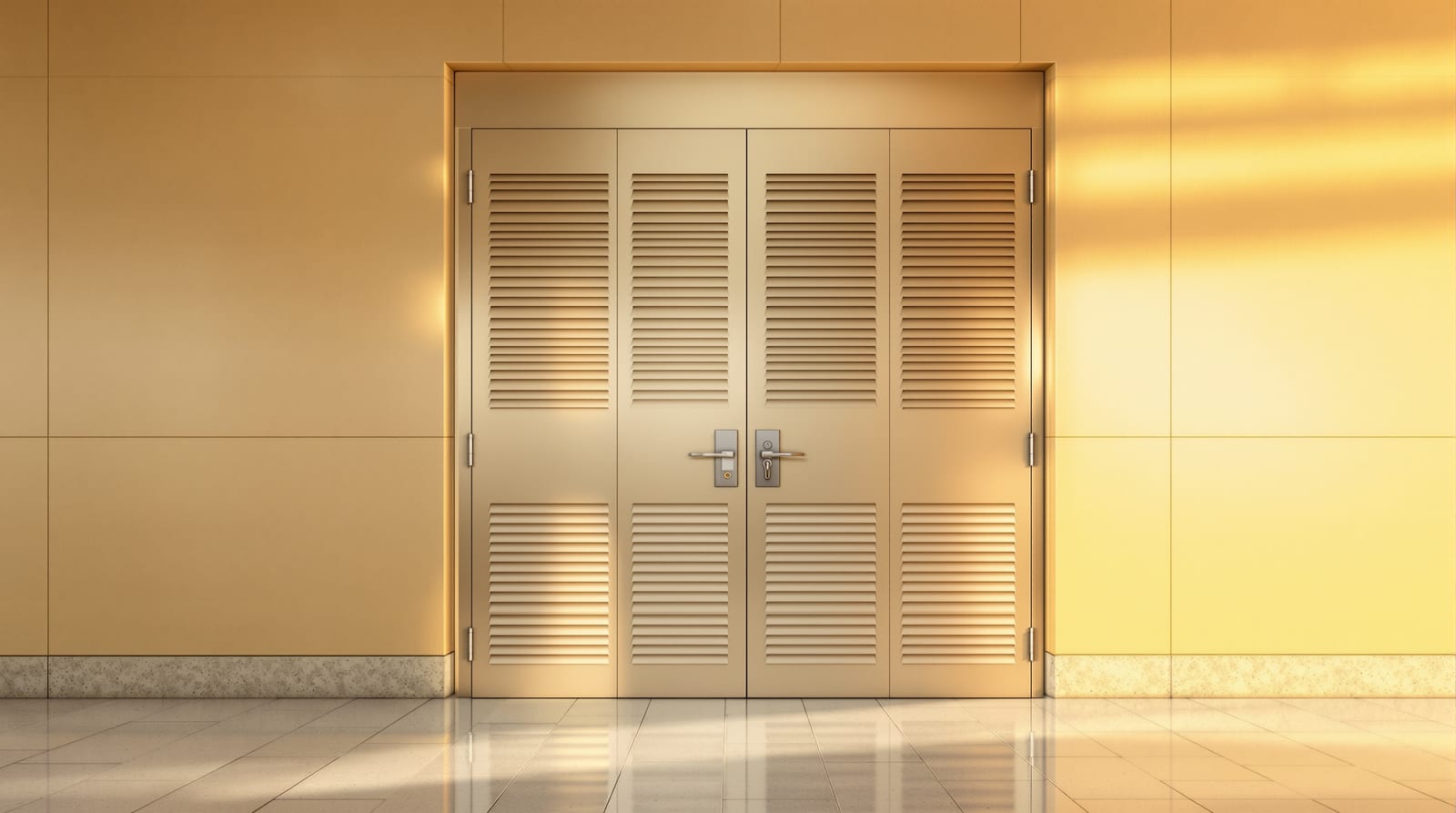
Service & Utility Door in India: Electrical, Plant, Riser and Back-of-House Doors (2026)
How to specify the unglamorous but essential service doors in Indian commercial buildings - electrical/DB and meter rooms, plant and AHU rooms, fire-rated riser shafts, housekeeping, refuse-chute and terrace mumty access - with fire ratings, louvers, access control and indicative rupee costs.
Nobody photographs the service door. It sits at the dark end of the corridor, painted the same grey as the wall, behind it a tangle of busbars, chilled-water pipes, garbage chutes or fire-fighting risers. Yet these back-of-house doors decide whether a fire stays in one room, whether a transformer cooks itself for lack of ventilation, whether a stranger can walk into the meter room, and whether your fire NOC clears at all. A commercial building has dozens of them - electrical and DB rooms, plant and AHU rooms, pump rooms, fire-fighting and electrical risers, housekeeping stores, refuse-chute rooms, staff corridors and the terrace mumty. Each has its own non-negotiable demand. This guide tells you which door belongs on which service space in India, and why - with indicative rupee costs and the codes to quote.
What a service door actually has to do
Service doors look plain, but they juggle a harder brief than a glossy office cabin. Rank the demands by what gets you a notice from the fire officer or the electrical inspector first:
1. Fire compartmentation. Electrical rooms, DB rooms, riser shafts and refuse-chute rooms are where fires start - or where they travel between floors. NBC 2016 treats these as fire-compartment boundaries; the door must be a tested fire-rated, self-closing assembly that holds its rating in both directions.
2. Ventilation (heat dump). Transformers, switchgear, DBs and pump motors throw off heat. A sealed electrical room cooks. The door often needs louvers to let cooling air in - but louvers and fire rating pull in opposite directions, so they must be reconciled (fire-rated louvers or fusible-link dampers).
3. Access control and security. Meter rooms, electrical rooms and plant rooms must be locked against tampering and theft (copper, equipment). Authorised staff only; ideally a key or card audit trail.
4. Acoustics. AHU, pump, DG and pressurisation-fan rooms are loud. The door is a major noise leak into adjacent occupied space and must attenuate it.
5. Durability. Trolleys, gas cylinders, ladders and pipe lengths bash these doors daily. Steel survives; flush timber does not.
Looks come dead last. There is no client-facing finish, no Vastu consideration, no vision panel for show - this is pure performance and pure code.
The big rule: louvers versus fire rating
The single most-botched detail in Indian back-of-house design is the electrical room that needs both a fire rating and ventilation. A plain cut-out louver in a fire door destroys its rating. The compliant ways to get both are:
- A fire-rated louver assembly with an intumescent insert that swells and closes the opening when heat hits it; or
- A louver fitted with a fusible-link fire damper that drops shut on temperature; or
- Mechanical ventilation (ducted supply/exhaust with fire dampers) so the door itself stays solid and rated, with louvers only on a non-rated nuisance door where allowed.
Decide ventilation strategy before you finalise the door rating - never afterwards. For the louver hardware logic and where louvered doors genuinely suit a space, see louvered doors in India; for the rating mechanics, fire-rated doors in India.
Which door for which service space
| Service space | Recommended door | Why |
|---|---|---|
| Electrical / DB room | Fire-rated steel door (60-120 min), fire-rated louver or duct vent, lockable | Compartment boundary + heat dump + theft/tamper security |
| Meter / metering room | Steel or MS door, louvered, padlock/access control, often 60 min | Inspector access, ventilation, anti-tamper, durability |
| Plant / pump / AHU room | Acoustic-rated steel door, fire rating if compartmented, ventilated | Plant noise control + heat + maintenance access |
| DG (generator) room | Fire-rated + acoustic steel door, sound-trapped vent | High noise + fuel fire risk + compartmentation |
| Fire / electrical riser shaft | Fire-rated steel door (60-120 min), self-closing, no louver | Stops a shaft acting as a chimney between floors |
| Refuse / garbage-chute room | Fire-rated steel door, self-closing, washable, often louvered | Fire path control + odour + hygiene + durability |
| Housekeeping / janitor store | Steel or flush laminate door, lockable, moisture-tolerant | Security of chemicals + wet-mop durability |
| Staff / service corridor | Steel or solid-core door, self-closing if fire-separated, kick plates | Heavy traffic, trolleys, occasional fire separation |
| Terrace / mumty access | Steel weatherproof door, lockable, fire-rated if on escape route | Weather, security, escape-route code |
The recommended default for the high-risk trio - electrical/DB rooms, risers and refuse rooms - is a fire-rated single-skin steel door, ventilated only by code-compliant means, self-closing, lockable. Steel is preferred because it adds no fuel load, accepts louvers and seals cleanly, and shrugs off years of trolley impact - the wider treatment is in steel doors in India.
Inline detail: the electrical room door
Cost: what service doors run in India
Indicative, per door, 2026, including frame and basic fitting; add about 18% GST. Fire-rated louvers, dampers and access electronics are usually separate line items. Costs vary by size, rating, louver and city.
| Service door / scope | Typical spec | Indicative cost (₹ per door) | Notes |
|---|---|---|---|
| Housekeeping / janitor store | Steel or laminate flush, lockable | 6,000 - 14,000 | Moisture-tolerant, simple latch |
| Staff service corridor | Solid-core / steel, kick plates | 8,000 - 20,000 | Add closer if fire-separated |
| Meter / metering room | MS / steel, louvered, padlockable | 9,000 - 22,000 | Ventilated, anti-tamper |
| Electrical / DB room, single steel fire door | 60 min IS 3614, self-closing | 14,000 - 30,000 | Before louver/damper add-on |
| Electrical / refuse room with fire-rated louver | 60-90 min + fire louver/damper | 22,000 - 42,000 | Louver assembly adds the premium |
| Riser / shaft door | 60-120 min steel, self-closing | 12,000 - 35,000 | No louver - shaft must stay sealed |
| Plant / AHU / pump room, acoustic | Steel acoustic, STC 35-45, ventilated | 25,000 - 60,000+ | Noise control + maintenance width |
| Terrace / mumty door | Weatherproof steel, lockable | 10,000 - 28,000 | Fire-rated if on an escape route |
| Fire-rated louver / damper (add-on) | Per leaf | 6,000 - 25,000+ | Intumescent or fusible-link type |
| Access-control package (add-on) | Reader, lock, sensor, wiring | 12,000 - 50,000+ | Security contractor scope |
For a like-for-like steel baseline see steel doors in India; for the fire-door premium logic, fire-rated doors in India; and to model a mixed schedule of service doors across a project, use the commercial door cost calculator at /utilities/commercial-door-cost-calculator.
Plant and pump rooms: the acoustic angle
AHU, chiller, pump, pressurisation-fan and DG rooms are the loud ones. Equipment runs at 80-95 dB; the door is the weakest link between that and the office or apartment next door. Specify an acoustic-rated steel door (a rated STC, typically 35-45 for plant separation), with perimeter gaskets and a drop-down threshold seal, and route ventilation through sound-attenuated ducts rather than a bare louver in the door - a plain louver leaks both noise and, in a fire, smoke. Where the room is also a fire compartment (DG, transformer), the door must be acoustic and fire-rated together. The attenuation principles, STC bands and seal detailing carry straight over from soundproof doors in India.
Access control and anti-tamper
Meter rooms get pilfered (copper, smart-meter modules); electrical rooms are a genuine electrocution hazard if anyone wanders in; plant rooms hold expensive controls. Lock them, and on larger or higher-risk projects log who enters. A simple high-quality mortise lock and a master-key system suffice for most stores and meter rooms; electrical rooms, main panels and BMS/UPS spaces benefit from card or PIN access with an audit trail. Always pair the lock with clear danger and authorised-personnel-only signage. Specify the electronics via door access control in India. Crucially, any door a person can be inside (plant, DG, large electrical rooms) must let them out freely in an emergency - the lock fails safe for egress even while resisting entry.
Standards to quote in your schedule
- IS 3614 - fire-resistant door assemblies; cite the rating (60/90/120 min) for the leaf-plus-frame assembly on electrical, riser and refuse-room doors.
- IS 4351 - steel door frames.
- NBC 2016 - fire compartmentation and means of egress; electrical rooms, riser shafts and refuse-chute rooms are compartment boundaries, and service corridors and mumty doors may sit on escape routes (open in the direction of escape, self-closing).
- Electrical safety / CEA regulations and local electrical-inspector requirements - ventilation, clearance in front of panels, lockable access and danger signage for electrical and DB rooms.
- RPwD 2021 - where staff regularly work inside a plant or electrical room, keep clear width >=900 mm, a lever-operable exit and threshold <=12 mm at the walking line.
Do and don't
Do decide the ventilation method before you fix the fire rating, so the louver and the rating are compatible from the start. Do make every electrical, riser and refuse-room door self-closing and positively latching. Do add kick plates and steel construction for trolley-heavy service routes. Do lock and sign electrical and meter rooms, and make plant-room locks fail-safe for the person inside.
Don't cut a plain louver into a fire door - it voids the rating; use a fire-rated louver or duct the air instead. Don't put any louver on a riser-shaft door, which must stay sealed so the shaft does not become a chimney. Don't re-purpose a hollow flush timber door as an electrical or refuse-room door - it has no rating and rots or burns. Don't wedge service doors open; that defeats fire and smoke containment building-wide.
For the building-wide which-door-where logic this fits into, see doors by space in India.
Frequently asked questions
Does an electrical or DB room door legally need a fire rating in India?
For rooms that are designated fire compartments - which main electrical, DB, transformer and large UPS rooms almost always are under NBC 2016 - yes, the boundary door must be a tested fire-rated assembly (IS 3614), commonly 60 minutes and 90-120 minutes on escape routes or for big loads. The electrical inspector and fire NOC will also require lockable, ventilated, well-signed access. Confirm with your fire and electrical consultants.
How do I get both ventilation and a fire rating on one door?
Use a fire-rated louver that has an intumescent insert (it swells shut on heat) or a fusible-link fire damper that drops closed at a set temperature - both let air through in normal use but seal the opening in a fire. Alternatively, keep the door solid and rated and bring cooling air through ducts with fire dampers. A plain cut louver in a fire door is non-compliant. See louvered doors in India.
What door goes on a riser or service shaft?
A fire-rated steel door, self-closing and positively latching, 60-120 minutes depending on the shaft and building height - and with no louver. The whole point of a riser-shaft door is to stop the shaft acting as a chimney that spreads fire and smoke between floors, so it must stay sealed. Rate it per your fire consultant and NBC 2016 compartmentation.
Do plant and pump room doors need to be soundproof?
If the plant room abuts occupied space - offices, apartments, classrooms - yes. AHU, chiller, pump, pressurisation-fan and DG rooms run loud, and the door is the main noise leak. Specify an acoustic-rated steel door (STC roughly 35-45), full perimeter and threshold seals, and ducted attenuated ventilation rather than a bare louver. DG and transformer rooms usually need the door to be acoustic and fire-rated at once. See soundproof doors in India.
Can I use a normal flush door for a housekeeping or janitor store?
For a dry, low-risk store, a lockable solid flush laminate door is acceptable - but choose a moisture-tolerant face and a good lock, because mops, chemicals and wet floors punish ordinary timber. Once a store doubles as a refuse-chute room or sits on a fire-separated corridor, step up to a self-closing fire-rated steel door instead. For broader material trade-offs see steel doors in India.
Export this guide
Related Guides — Deep-dive reading
Soundproof Doors in India: How Doors Leak Sound, STC Ratings, Seals & Real Costs
A door is the weakest acoustic link in any wall - and it usually leaks through the gaps, not the panel - so here is how to actually quieten a bedroom, home theatre or street-facing room, from a 1,500-rupee seal kit to a proper acoustic door.
Home Doors & EntrancesDoors by Space in India: The Complete Which-Door-Where Decision Guide (2026)
Pick the right door for every room and building type in India - residential, office, hotel, hospital, retail and industrial - with the driver that should decide it and indicative costs.
Home Doors & EntrancesEmergency Exit Planning in India (2026): Number of Exits, Travel Distance & Two-Way Escape
The building-scale means of egress that a home escape plan sits inside: why you need two independent, remote exits, how travel distance and exit width scale with occupant load, and why exits must open outward, discharge to safety, and never be locked.
SecurityRelated Tools — Try Free
Acoustic Privacy (STC) Visualizer
Indian healthcare acoustic visualizer — compare wall assemblies and noise sources, see received SPL after STC attenuation, and check FGI 2018 / IS 1950 / NABH speech-privacy compliance with live dual-canvas waveform.
Acoustic ToolElectrical Safety & Load Audit
Home electrical audit — 10 categories, 65+ checkpoints across earthing, RCCB, MCB, wiring, switchboards, appliance circuits, DG/inverter backup.
Safety AuditDoor Cost Calculator
Estimate the all-in cost of a door — leaf, frame, hardware, fitting and GST — by type, material and size.
Door Calculator