
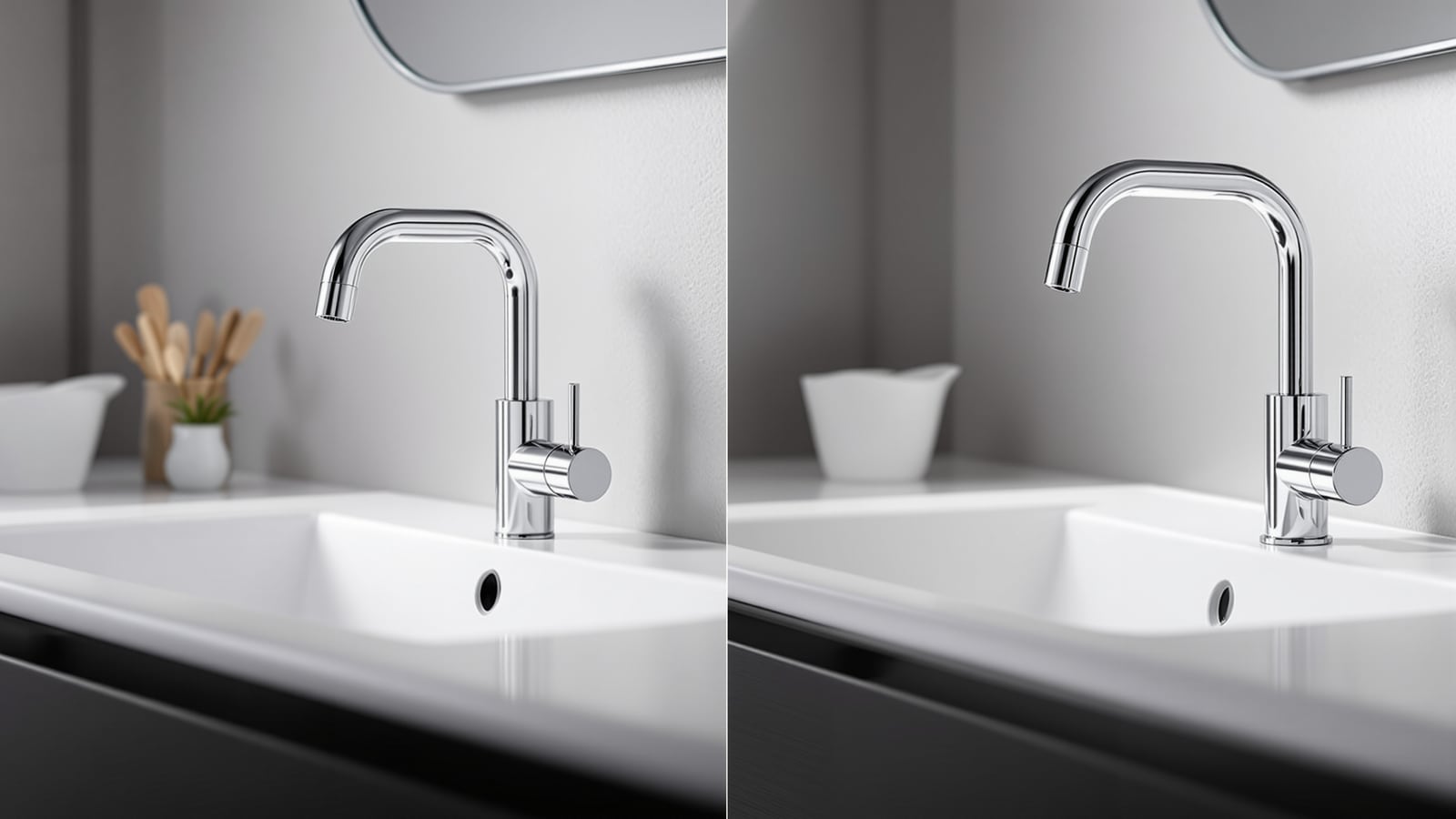
Sensor vs Manual Faucet: Which Is Better? (India)
Touchless taps save water and stay hygienic, but manual taps are cheaper and give you real hot-water control. A fair, India-first verdict for every room.
A sensor faucet turns on the moment your hands appear under the spout and shuts off when you pull them away — no touching, no forgetting to close it. A manual faucet needs a hand on the lever or knob. That single difference ripples into hygiene, water bills, hot-water control, running cost and how well the tap survives Indian hard water. This Studio Matrx comparison gives you an honest, room-by-room verdict instead of a sales pitch — because sensor taps genuinely win some rooms and lose others.
The two contenders in one line
- Sensor (touchless) faucet — an infrared eye and a solenoid valve open and close the flow automatically. Powered by batteries or a mains adapter. Great for hygiene and water saving, weaker on hot-water control and long-term simplicity.
- Manual faucet — a mechanical cartridge you turn or lift. A single-lever mixer blends hot and cold in one move; a pillar tap runs one temperature. No power, no electronics, decades of proven life.
Head-to-head verdict table
The table below scores the two on the attributes that actually decide an Indian bathroom. "Winner" is the better default choice for that row, not an absolute — the scenarios section explains the exceptions.
| Attribute | Sensor faucet | Manual faucet | Winner |
|---|---|---|---|
| Hygiene (touch points) | No touch — hands never spread germs to the tap | You touch it with dirty and clean hands both | Sensor |
| Water saving | Runs only while hands are present; auto-off | Easy to leave running or drip | Sensor |
| Temperature control | Usually fixed/pre-set; blending is limited | Full hot-cold blend on a mixer | Manual |
| Upfront price | Higher — electronics + solenoid | Lower — pure mechanical | Manual |
| Running cost | Batteries or standby power; sensor spares | Effectively nil | Manual |
| Power dependence | Needs battery or mains to work at all | Works with zero power | Manual |
| Hard-water reliability | Solenoid and aerator can clog; more failure points | Cartridge is easy to service | Manual |
| Ease of repair | Needs a plumber who knows electronics | Any local plumber can fix | Manual |
| Suits kids & elderly | No grip or twist needed | Needs hand strength and dexterity | Sensor |
| Commercial / high-traffic | Cuts water waste and germ spread hugely | Every user touches it | Sensor |
| Look & tech appeal | Sleek, modern, premium feel | Familiar, wide range of styles | Toss-up |
Score: manual takes the practical, cost and control rows; sensor takes hygiene, water and accessibility. Neither is a knockout — the right answer depends on the room.
Where the sensor faucet genuinely wins
- Hygiene. In a shared or guest bathroom, a manual tap is touched by dirty hands before washing and clean hands after — a classic re-contamination point. A sensor tap removes it entirely. This is why hospitals, airports and restaurants standardised on them.
- Water saving. The auto-off is the real saver. No tap left trickling while you brush or lather, no drips from a worn washer. In a busy household or office this quietly trims the monthly water bill — see our water-saving faucet guide for India for how aerators stack on top of this.
- Kids and elderly. Small children who can't reach or twist a stiff knob, and older users with arthritis or weak grip, get water with a simple wave. It is one of the most under-rated accessibility upgrades in an Indian home.
- High-traffic washrooms. In a clinic, café, school or office washroom, sensor taps pay back fast — less waste, less germ transfer, less "someone left the tap on."
Where the manual faucet genuinely wins
- Hot-water control. This is the big one for India. Most sensor taps run a fixed or pre-mixed temperature and blend poorly, so getting a comfortable warm stream from your geyser is fiddly. A manual single-lever mixer lets you dial the exact warmth instantly — much better for a family bathroom in winter.
- Price and running cost. A decent manual mixer costs a fraction of a sensor tap, and it never needs batteries or a sensor spare. Over ten years the manual tap is far cheaper to own.
- No power, no problem. A sensor tap with a dead battery or a tripped adapter simply stops working. A manual tap does not care about power cuts.
- Hard-water resilience. India's hard water scales up aerators and, worse, the sensor's fine solenoid valve — adding failure points a manual cartridge doesn't have. When something clogs, any neighbourhood plumber can service a manual tap; a sensor tap needs someone comfortable with its electronics.
Battery vs mains: the reliability question inside sensor taps
If you do choose a sensor faucet, how it is powered matters as much as the brand.
- Battery (usually 4x AA or a 6V lithium pack). Easy to install anywhere, no wiring. Downside: batteries last roughly 1–3 years depending on traffic, and the tap dies without warning when they run flat. Keep spares.
- Mains adapter (transformer to 6V/9V DC). No battery worries, but you need a switched, RCD-protected point safely away from water — read our bathroom electrical safety guide before wiring anything near a basin.
In hard-water areas, the weak spot for both is the solenoid valve and the aerator — mineral scale is the number-one cause of a sensor tap going weak or dead. Periodic descaling, a good inline filter and softer water all extend its life.
Cost difference at a glance (indicative, 2026 India)
| Manual mixer tap | Sensor (touchless) tap | |
|---|---|---|
| Entry / value | ₹1,500 – ₹4,000 | ₹4,500 – ₹9,000 |
| Mid-range branded | ₹4,000 – ₹9,000 | ₹9,000 – ₹18,000 |
| Premium | ₹9,000 – ₹25,000+ | ₹18,000 – ₹40,000+ |
| Ongoing cost | Negligible | Batteries / power + sensor spares |
A sensor tap typically costs roughly two to three times a comparable manual tap upfront, plus small running costs. Water saving offsets some of that in a busy setting, but rarely all of it in a low-traffic home bathroom.
Two ways to see the choice
The scorecard shows the split cleanly: sensor owns the top-left rows, manual owns the practical ones. The flow below turns that into a decision.
Which should you choose? By scenario
| Pick a SENSOR faucet if… | Pick a MANUAL faucet if… |
|---|---|
| It's a guest, powder or shared bathroom | It's your everyday family bathroom |
| Young kids or elderly users need easy access | You want precise hot-cold blending from a geyser |
| It's a commercial or high-footfall washroom | Budget is tight, upfront and long-term |
| Hygiene and water saving top your list | You dislike batteries and power dependence |
| You want a sleek, modern, hands-free look | You want the simplest thing any plumber can fix |
For most Indian family bathrooms, the manual single-lever mixer is still the smarter default: it costs less, gives real hot-water control for geyser-fed winters, survives hard water with easy servicing, and never dies on a dead battery. The sensor tap earns its place in guest bathrooms, kids' and elderly bathrooms, and any high-traffic or commercial washroom, where hygiene and water saving matter more than temperature blending.
The best answer in a larger home is often both — a manual mixer where you bathe and blend hot water, a sensor tap at the powder room and guest basin. If you're weighing sensor taps specifically, our complete sensor faucets guide for India covers models, installation and upkeep; for the full landscape of tap types, start with the bathroom faucets guide for India; and to shortlist a specific tap for one basin, use how to choose a faucet in India.
Bottom line: Sensor faucets win hygiene, water saving and accessibility; manual faucets win price, hot-water control and hard-water simplicity. For an everyday Indian family bathroom, buy a good manual mixer. Add sensor taps to guest, kids', elderly and commercial washrooms — and in hard-water areas, filter and descale whichever you choose.
References
- Bureau of Indian Standards (BIS) IS 8931 — specification for pillar taps and bib taps for water services.
- Bureau of Indian Standards (BIS) IS 15529 — specification for single-lever mixer valves for domestic use.
- National Building Code of India (NBC) 2016, Part 9 — Plumbing Services (water supply, drainage and sanitation).
- Central Public Health and Environmental Engineering Organisation (CPHEEO) Manual on Water Supply and Treatment — guidance on water hardness and fittings.
- Bureau of Energy Efficiency (BEE) — water-efficiency guidance for taps and fixtures.
Export this guide
Related Guides — Deep-dive reading
Sensor Tap India: Touchless & Automatic Faucets for Homes (2026 Guide)
How infrared sensor taps actually work, battery vs mains power, the hygiene and water-saving payoff, and why hard water is the real test — plus temperature limits, where a touchless faucet belongs, install, maintenance and honest rupee ranges.
BathroomsBathroom Faucets India: The Complete Guide to Taps, Cartridges, Finishes & Flow (2026)
Every faucet type explained for Indian bathrooms — pillar taps, basin mixers, single-lever vs two-handle, wall vs deck vs concealed, sensor and thermostatic — plus the ceramic-disc cartridge that survives hard water, CP-fitting quality to IS standards, finishes, aerators and honest rupee ranges.
BathroomsTap Maintenance India: How to Descale, Clean & Fix Bathroom Faucets (2026)
A practical upkeep guide for CP fittings and faucets in Indian bathrooms — descaling the aerator and spout when hard water weakens the flow, cleaning chrome, PVD and matte-black finishes safely, fixing a dripping tap, sealing a leaky base, freeing a stiff lever, and knowing when to swap the cartridge.
BathroomsRelated Tools — Try Free
Child & Elder Home-Safety Audit
Room-by-room safety audit for households with children or seniors — 10 categories, 70+ checkpoints tagged by audience.
Safety AuditBathroom Water Savings Calculator
See the water and money saved by switching to efficient bathroom fittings — dual-flush, low-flow shower and tap aerators — per year.
Bathroom CalculatorBefore vs After — Cost Reality Check
Compare what you expected to pay vs what you actually paid, category by category.
Reality Check