
Self-Cleaning Facades in India: Photocatalytic, Lotus-Effect and Easy-Clean Glass, Honestly Assessed
Photocatalytic concrete, lotus-effect coatings and self-cleaning glass promise facades that wash themselves — but in India's dust, monsoon and hard water, the science is more modest than the marketing, and good detailing still wins.
Somewhere in your city there is a white building that has gone grey. Not from age exactly — from traffic. A film of soot, diesel particulate and road dust has crept up its north face, settled into the rough patches, streaked below every window sill, and turned what the architect drew as a crisp white box into something that looks tired. The owner now faces the oldest facade problem there is: how do you clean a wall four storeys up without it costing a fortune every single year?
For the last two decades, the building industry has been selling an answer that sounds like science fiction. Surfaces that clean themselves. Concrete that stays white. Glass you never have to wipe. Panels that eat smog out of the air as a bonus. The pitch is irresistible, and the underlying science is genuinely real — Nobel-adjacent chemistry, a lotus leaf studied under an electron microscope, a Rome church that still looks white after twenty years. But there is a wide gap between what these technologies do in a German laboratory and what they do on a Delhi flyover or a Chennai seafront, and that gap is exactly what this guide is about.
This is part of our Building Facades series, where we look hard at the outer skin of Indian buildings and what actually survives our climate. If you have not yet read our piece on facade maintenance and durability in India, keep it open alongside this — because the honest truth, which we will come back to repeatedly, is that no coating on earth beats a well-designed drip groove. Let us look at what self-cleaning really means, what works, and what is hype.
1. The four families of "self-cleaning" (they are not the same thing)
The phrase "self-cleaning" is marketing shorthand for at least four completely different physical mechanisms. Lumping them together is the first mistake everyone makes. Understanding the differences is most of the battle.
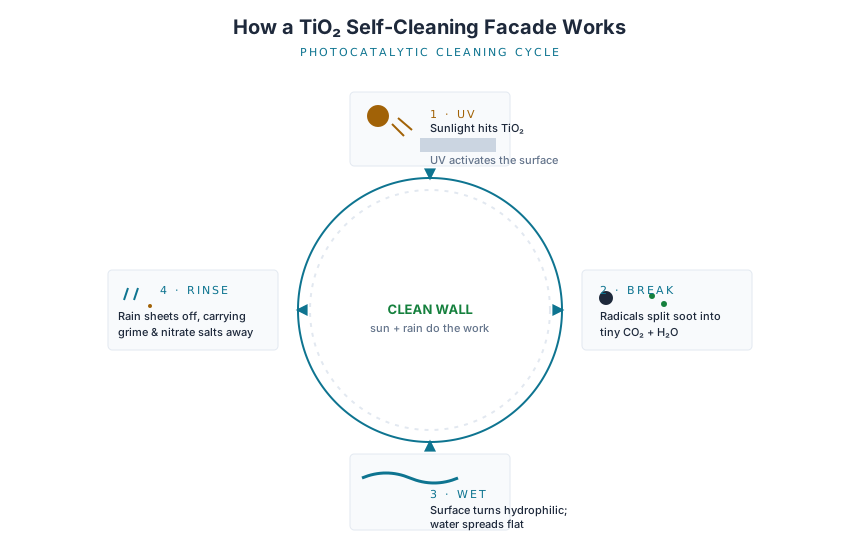
Photocatalytic surfaces use a coating of titanium dioxide (TiO₂) — the same harmless white pigment found in toothpaste, sunscreen and paint. When ultraviolet light from the sun hits it, the TiO₂ acts as a photocatalyst: it uses light energy to break apart organic dirt (soot, grime, biological films) into carbon dioxide and water at the molecular level. It does not consume itself doing this, which is why it keeps working for years. As a side effect, it also makes the surface superhydrophilic, meaning water spreads into a thin sheet rather than beading — and that sheet rinses the loosened dirt away when it rains.
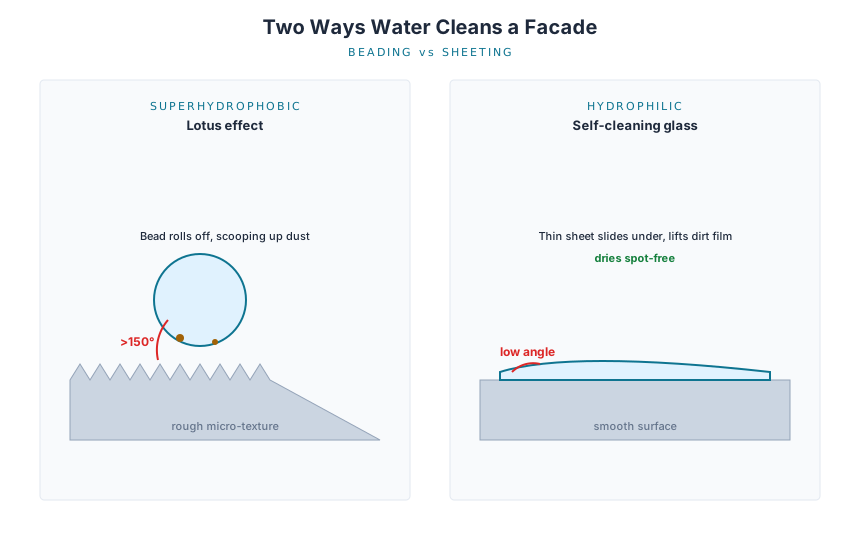
Superhydrophobic ("lotus-effect") surfaces do the opposite. Instead of loving water, they violently repel it. Inspired by the lotus leaf, the surface is given a microscopic rough texture coated with a water-hating chemistry, so water cannot wet it. Droplets bead up into near-spheres and roll off, and as they roll they pick up dust and carry it away — the leaf stays clean. The technical signature is a contact angle above 150 degrees (water on ordinary glass sits at around 30 to 40 degrees).
Hydrophilic / easy-clean coatings are the gentler, more practical cousins. They make a surface very wettable so water films out and dries without the spots and streaks ordinary glass leaves. Self-cleaning glass (more on this below) combines this with a mild photocatalytic action.
Smart detailing — the fourth family, and the one nobody sells you, because it cannot be bottled. Drip grooves under copings, generous overhangs, throated sills, sloped ledges: geometry that controls where water runs so dirt never streaks in the first place. It is free, it is permanent, and it works in every climate. Keep it in mind as the benchmark every coating is competing against.
2. Photocatalytic TiO₂: the closest thing to magic — with conditions
Photocatalysis is the headline act, so it deserves the most scrutiny. The chemistry goes back to 1972, when Akira Fujishima and Kenichi Honda in Japan discovered that titanium dioxide, under ultraviolet light, could split water and drive chemical reactions — the Fujishima-Honda effect. By the late 1980s, researchers realised that if TiO₂ could decompose bacteria and pollutants, it could decompose the organic grime that dirties a wall. Self-cleaning tiles, glass and cement followed.
In a TiO₂-cement facade, the photocatalyst is mixed into white Portland cement or sprayed on as a coating. In sunlight, three things happen: organic dirt on the surface is oxidised and loosened; the surface becomes superhydrophilic so rain sheets it off; and a fraction of airborne pollutants — notably nitrogen oxides (NOx) from traffic — that touch the wall get converted into harmless nitrate salts, which then wash away. The first two effects keep the wall white. The third is the "smog-eating" claim, which we will weigh honestly in Section 6.
The crucial condition, the one every brochure underplays, is in the word photo-catalytic. It needs light — specifically ultraviolet. No UV, no reaction. That means a deeply shaded north wall, a courtyard, an underpass, or any surface in monsoon gloom for weeks gets little to no self-cleaning benefit. It also means the technology was developed and proven against thin, organic, north-European pollution films. Which brings us to the part India needs to hear.
3. The lotus effect: beautiful science, fragile in practice
The superhydrophobic story is one of the great biomimicry tales. In the 1990s the botanist Wilhelm Barthlott put lotus leaves under an electron microscope and found their water-repellency and self-cleaning came not from a slippery wax alone but from a hierarchical micro-and-nano roughness. His 1997 paper with Christoph Neinhuis, "Purity of the sacred lotus," triggered a paradigm shift in surface science and launched a thousand superhydrophobic coatings. (There is a quiet poetry, for an Indian audience, in the lotus — our national flower and an emblem of purity rising clean out of muddy water — being the literal model for these surfaces.)
The problem is durability. That magic roughness is microscopically delicate. On a building facade exposed to wind-blown grit, UV, foot traffic at lower levels, and the abrasive scrub of monsoon rain, the texture wears down. As it does, the contact angle falls and the lotus effect quietly dies — often within a year or two — leaving you with an ordinary surface and a recoating bill. Independent reviews are blunt: many real-world superhydrophobic formulations degrade under environmental stress and need frequent reapplication. Laboratory samples that survive sandpaper for fifty cycles are genuine progress, but a lab coupon is not a fifteen-year facade in Jaipur.
This is why, for buildings, lotus-effect coatings are best treated as a consumable finish (like paint, recoated periodically) rather than a permanent property — and why they appear more on cars, textiles and small glass than on whole elevations.
4. Self-cleaning and easy-clean glass: the most practical option
If photocatalytic concrete is the showpiece and lotus coatings are the fragile darling, self-cleaning glass is the workhorse that actually ships at scale. Two products define the category: Pilkington Activ and Saint-Gobain SGG BIOCLEAN. Both bake a transparent dual-action coating onto the glass during float manufacture (by pyrolysis, so it is fused in, not a wipe-on film that rubs off).
The dual action is the clever bit. First, a photocatalytic TiO₂ layer uses daylight UV to break down organic dirt. Second, the coating is hydrophilic, so rain does not bead into spotty droplets — it spreads into a sheet that flows down the pane, washes the loosened dirt off, and dries fast and evenly without the drying marks ordinary glass leaves. The result is glass that stays markedly cleaner between cleans and needs far less frequent wiping.
Note the honest words there: cleaner, less frequent. Self-cleaning glass reduces cleaning; it never eliminates it. It needs daylight and it needs rain to do its job — an interior pane, or a shaded one, sees little benefit. And it has a specifically Indian Achilles heel covered in Section 7: hard water. A hydrophilic surface relies on water sheeting and evaporating cleanly; pour mineral-laden borewell water over it and you swap soot streaks for limescale spots.
Distinct from these factory products are aftermarket easy-clean coatings (brands like EnduroShield, StarShield and others sold in India). These are hydrophobic, applied on site, make glass easier to wipe and resist hard-water etching for a while — useful for shower screens and ground-floor shopfronts — but they are not photocatalytic, do not self-clean in the true sense, and wear off on a schedule.
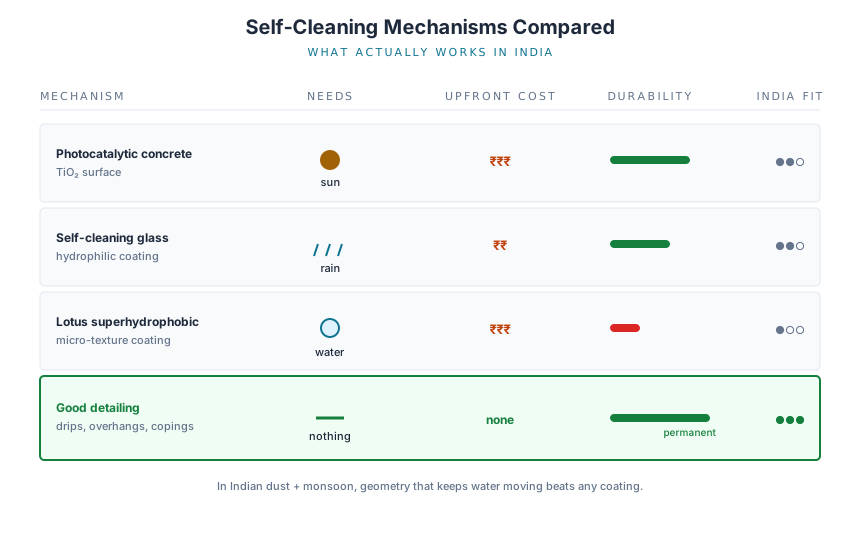
5. The mechanisms compared, with an honest India fit
| Mechanism | How it works | Needs to function | Maturity | Honest India fit |
|---|---|---|---|---|
| Photocatalytic TiO₂ concrete / coating | UV light breaks down organic dirt and some NOx; surface turns hydrophilic so rain rinses it | Direct sunlight (UV) + rain | Mature, 20+ yr track record | Mixed. Great UV abundance, but heavy dust loading can overwhelm it; only works on sunlit, rain-washed faces |
| Photocatalytic + hydrophilic self-cleaning glass (Pilkington Activ, SGG Bioclean) | Same TiO₂ action plus water-sheeting to wash dirt off and dry spot-free | Daylight + rain | Mature, mass-produced | Good for high, hard-to-reach glazing — but hard water causes spotting; reduces, never eliminates, cleaning |
| Superhydrophobic "lotus-effect" coating | Micro-rough water-hating texture; droplets bead and roll off carrying dust | Liquid water to roll; intact texture | Improving but fragile | Weak on facades. Abrasion from dust and monsoon wears the texture; needs recoating in 1–3 yrs |
| Hydrophobic easy-clean coating (aftermarket) | Repels water and grime so surfaces wipe clean faster; resists hard-water etch | Manual cleaning, just less of it | Mature, widely sold | Practical and cheap for shower glass, shopfronts; not true self-cleaning; reapply periodically |
| Good detailing (drip grooves, copings, overhangs) | Geometry routes water so dirt never streaks or settles | Nothing — it is built in | Ancient and proven | Best value of all. Free, permanent, climate-proof. The benchmark every coating competes with |
6. The "smog-eating" claim, weighed honestly
This is where scepticism earns its keep. Photocatalytic facades genuinely break down NOx — that is not in doubt, it happens in the lab every time and it happens on the wall. The question is how much it matters at the scale of a city you and I breathe in.
Field studies of photocatalytic surfaces in real street canyons measure local NOx reductions of roughly 14 to 21 percent right at the wall. Impressive. But air does not sit still against a wall — it disperses, mixes and moves. Once you account for that, the effect on the air a pedestrian actually breathes shrinks dramatically. Modelling studies that imagine coating an entire municipality, under ideal conditions, find the reduction in pollution-related mortality tops out around 3 percent — and several real-world studies found no statistically significant effect at all. The honest summary: there is a large gap between laboratory potential and street reality, and the marketing lives entirely in the gap.
So treat "smog-eating" as a real but modest co-benefit, never the reason to specify the material. In Indian cities with some of the world's worst PM2.5 — much of it dust and combustion particulate that is not the organic NOx these surfaces target — the air-cleaning contribution of a single building's facade is, frankly, a rounding error. Plant a tree. The self-cleaning benefit to the facade itself is the real, defensible reason to consider this technology.
7. The India verdict: dust, monsoon and hard water
Here is the part imported brochures never address, because they were written for Munich and Manchester.
Dust loading. Photocatalysis was tuned to oxidise thin, organic pollution films. Indian facades face something coarser and heavier — a thick mineral dust from construction, agriculture and arid winds that piles on far faster than UV can chemically nibble it away, and that is largely inorganic, so the photocatalyst cannot decompose it at all. The cleaning chemistry simply gets buried. On a dusty arterial road in Delhi or Ahmedabad, a TiO₂ wall can still go grey; it just goes grey a little slower.
Monsoon, both ways. Rain is the rinse cycle these technologies depend on, and India has plenty of it — a genuine plus, since hydrophilic surfaces need water to sheet off the loosened dirt. But monsoon also means weeks of overcast skies with little UV (so the photocatalytic step stalls), and driving rain that scrubs delicate superhydrophobic textures off. The same revealing study that tracked Rome's photocatalytic Jubilee Church over 16 years found that the abrasive action of rainwater roughened the surface over time and actually increased the bond between dust and the concrete — the self-cleaning effect degraded rather than lasting forever. Monsoon is a friend to glass and a slow enemy to delicate coatings.
Hard water. This is the quiet killer. Much of India runs on hard borewell and municipal water thick with calcium and magnesium. Hydrophilic self-cleaning glass works by water sheeting and drying without spots — but hard water leaves white limescale rings exactly where the sheet evaporates. You can win the soot battle and lose the limescale war. Where building washdowns use hard water rather than rain, the self-cleaning promise erodes fast.
The verdict is not "do not use it." It is: use it where its conditions are met — sunlit, rain-washed, hard-to-reach surfaces, away from the worst dust, cleaned with soft water — and never expect it to run maintenance-free.
8. Real buildings, not renders
Three verified, built projects tell the real story.
Dives in Misericordia (the Jubilee Church), Rome, 2003. Richard Meier's church of curving white concrete "sails" is the world's most studied photocatalytic building. It was built with Italcementi's TX Active photocatalytic white cement specifically to stay white in a polluted suburb. For years it was the poster child. Then a study tracking it over 16 years found the self-cleaning and colour-preserving performance had fallen short of design intent, with premature signs of decay — exactly the honesty the industry needed and rarely repeats. The technology is real; permanence is not.
Palazzo Italia, Milan Expo 2015. Designed by Nemesi & Partners, this six-storey "petrified forest" is wrapped in around 900 panels of Italcementi i.active BIODYNAMIC photocatalytic cement over roughly 9,000 square metres, about 80 percent of it made from recycled Carrara marble scrap. It is the most ambitious built demonstration of "air-purifying" facade cement to date, and it stayed strikingly white through the Expo — a genuine showcase, if also a heavily marketed one.
Self-cleaning glass, everywhere and quietly. Unlike the showpiece concrete, Pilkington Activ and Saint-Gobain SGG BIOCLEAN have shipped into thousands of ordinary roofs, atria, conservatories and high glazed facades worldwide since the early 2000s, including projects in India through both manufacturers' networks. This is the technology that actually earns its keep at scale — not because it is dramatic, but because reaching that glass to clean it is expensive, so even a partial reduction in cleaning frequency pays.
The honest case: cost, maintenance and payback
Self-cleaning is sold as a way to save money on cleaning. Sometimes it is. Often the sums are tighter than they look.
Self-cleaning glass typically carries a premium of roughly 20 to 40 percent over equivalent ordinary glazing — for a home, that might be a few thousand rupees extra per window; for a glazed facade, lakhs. The payback comes only where access for manual cleaning is genuinely costly: a tall atrium roof, a sloped skylight, a high curtain wall needing cradles or rope access. On a ground-floor window you can wipe with a cloth, the premium never pays back — buy ordinary glass.
Photocatalytic cement and coatings add cost to the concrete or finish, and as the Rome study warns, the benefit is not permanent — budget as if you may still need periodic cleaning and eventual recoating, not never. Aftermarket lotus and easy-clean coatings are cheap to apply (often a few tens of rupees per square foot) but must be reapplied every one to three years, so over a building's life they are a recurring cost, not a one-time saving.
And the benchmark, always: a drip groove costs nothing extra to detail and works for the life of the building. Before you spend on chemistry, spend on geometry. A facade designed so water runs off cleanly — overhangs, throated sills, copings with drips, the right materials in the right places — stays clean for free, and then any self-cleaning coating is a bonus rather than a crutch.
What this means for you
If you are a homeowner choosing windows: self-cleaning glass is worth the premium only for glazing you genuinely cannot reach easily — a high stairwell window, a skylight, a double-height atrium. For everything within arm or ladder reach, buy ordinary glass and a squeegee. If your water is hard, factor in limescale spotting and clean occasionally with soft or filtered water. Skip aftermarket lotus coatings for whole facades; they are fine for shower screens.
If you are a practitioner or developer: specify self-cleaning glass strategically on inaccessible glazing where the access cost of routine cleaning is high — that is where the maths works. Treat photocatalytic concrete as a premium aesthetic-and-marketing choice with a real but time-limited self-cleaning benefit, not a maintenance-free guarantee; cite the Jubilee Church honestly to your client. Do not specify any of it for its "air-purifying" claim — the city-scale benefit is too small to defend. And above all, design the facade to clean itself the old way first: overhangs that keep rain off, drip grooves that stop streaking, sills that throw water clear, materials chosen for how they weather. Get the geometry right and the building stays handsome for decades with no chemistry at all. Get it wrong, and no coating will save you.
Self-cleaning surfaces are a genuine, fascinating technology with a real and narrow place in the Indian building. The trick is to buy the science, not the science fiction.
Sources
- Fujishima, A. & Honda, K. (1972), discovery of TiO₂ photocatalysis (the Fujishima-Honda effect); University of Tokyo profiles of Akira Fujishima's photocatalysis work.
- Barthlott, W. & Neinhuis, C. (1997), "Purity of the sacred lotus, or escape from contamination in biological surfaces," Planta — origin of the Lotus Effect; reviews of the Barthlott effect in surface science.
- "Self-cleaning and colour-preserving efficiency of photocatalytic concrete: case study of the Jubilee Church in Rome," Building Research & Information (2020) — 16-year performance assessment of the Dives in Misericordia.
- Italcementi / Heidelberg TX Active and i.active BIODYNAMIC photocatalytic cement technical literature; Palazzo Italia, Milan Expo 2015 (Nemesi & Partners) project documentation.
- Pilkington Activ and Saint-Gobain SGG BIOCLEAN self-cleaning glass technical datasheets (dual-action photocatalytic + hydrophilic pyrolytic coating).
- Field and modelling studies on photocatalytic NOx abatement in street canyons (real-world local reductions of ~14–21% and modest, ~3% maximum, city-scale health effect).
- Reviews of superhydrophobic coating durability and abrasion resistance; EnduroShield / StarShield aftermarket easy-clean coating product literature.
- Studio Matrx Building Facades series: why facades matter, types of facades, glass curtain walls, and facade maintenance and durability.
Export this guide
Related Guides — Deep-dive reading
Jubilee Church: Richard Meier's Three White Sails and the Concrete That Was Meant to Clean the Air
In a public-housing suburb east of Rome, Richard Meier answered the Vatican's Jubilee 2000 brief with three curving shells cut from spheres of a single radius — and clad them in a titanium-dioxide 'smog-eating' cement that promised to stay white forever. Two decades on, the building is a case study in both what advanced materials can do and how honestly we must test their claims.
The Future of ArchitecturePalazzo Italia: The Building Whose Skin Eats Smog
Nemesi's Italian Pavilion for Expo Milano 2015 wraps six storeys in some 700 branch-like panels of photocatalytic 'biodynamic' cement — a facade that is meant to do chemical work on the air around it. A deep study of its urban-forest concept, its TX Active white concrete, and the honest gap between the smog-eating headline and what the science can actually measure.
The Future of ArchitecturePlaster, Render and Texture-Paint Facades in India: The Honest Guide to the Country's Default Wall Finish
A building-physics guide to cement and lime render, exterior emulsion and weatherproof paints, and textured coatings — how these everyday facades are built, why they crack, streak and grow algae, and what actually keeps them looking good in the Indian monsoon.
Building FacadesRelated Tools — Try Free
Window Cleaning Cost Calculator
Estimate professional window cleaning cost per visit and per year by access and frequency.
Window CalculatorBefore vs After — Cost Reality Check
Compare what you expected to pay vs what you actually paid, category by category.
Reality CheckCross-Ventilation Analyzer
Estimate airflow and air changes per hour (ACH) from room size, window areas, layout, and local wind — with NBC 2016 Part 8 compliance check.
Ventilation Calculator