

Security Incident Report Template for India (2026): Recording What Happened, Fairly
A ready-to-adapt form to record a security incident factually and completely, so it can be acted on, learned from and lawfully escalated, while protecting personal data and the dignity of everyone named.
Every security operation needs one plain form that anyone on duty can fill in the moment something happens: an intrusion, a theft, a trespass, an alarm activation, a footage or data breach, or a safety event. That form is the security incident report template — the standard record of what happened, written factually enough that it can be acted on, learned from and, where the law requires, escalated. This page explains the fields, shows a worked example, and gives you a blank copy-ready version to adapt.
It sits in the operate phase of a security programme (brief -> design -> procurement -> install -> commission -> handover -> operate). A guard, control-room operator or facility manager completes it whenever an incident occurs; management, insurers, the police (where lawful) and any investigation read it later. Done well, it drives the right response, supports a fair claim, feeds honest learning, and never becomes a tool to shame or accuse.
Scope & how to read this. This is a ready-to-adapt professional template, not authoritative, legal or contractual wording. A security incident report can hold personal data and may support serious decisions, so get professional and legal review before you standardise it, and defer specifics to your site, your organisation and the authorities. It records facts; it does not decide guilt.
What it is, and when it is used
An incident report is the single source of truth for one event. It is written at the time, by the person who responded, while memory is fresh and evidence is intact. It answers who, what, when, where and what-was-done — and deliberately stops short of why-and-who-is-to-blame, because that is for a proper investigation or due process, not for a form filled in the dark by a guard.
Use it for the whole range of security events, not just crimes:
- Intrusion, theft, trespass, vandalism — someone or something crossed a line.
- Alarm activation — genuine or false; log both, because patterns of false alarms matter.
- A data or footage breach — CCTV clips shared wrongly, a lost drive, an unauthorised login. This also triggers your data-breach response process.
- A safety event or near miss — a fall, a blocked fire exit, a fault that could have hurt someone. Near misses are the cheapest lessons you will ever get; capture them.
The report is where your incident response plan turns from intention into evidence. One completed form should let a reader who was not there understand exactly what occurred and what still needs doing.
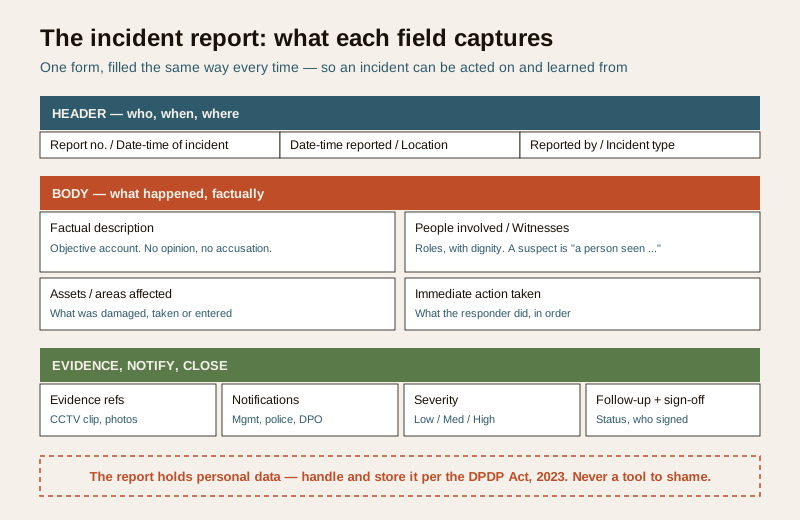
The fields the form should capture
Keep it to fields anyone can complete under pressure. Group them so the form reads top to bottom in the order an incident unfolds.
| Field | What goes in it | Note |
|---|---|---|
| Report no. | A unique reference | Sequential, e.g. IR-2026-014 |
| Date and time of incident | When it actually happened | Use the 24-hour clock |
| Date and time reported | When the report was written | Gap between the two is itself useful |
| Location | Where, in plain words | "Basement 2, near lift lobby" |
| Reported by | Name, role, contact | The person completing the form |
| Incident type | Category | Intrusion / theft / alarm / breach / safety / other |
| Description of what happened | Objective, factual account | No speculation, no accusation |
| People involved | Roles, described with dignity | A suspect is "a person seen ...", never "the thief" |
| Witnesses | Who else saw it | Name and how to reach them |
| Assets / areas affected | What was damaged, taken or entered | Be specific |
| Immediate action taken | What the responder did, in order | Made safe, secured, called for help |
| Evidence | CCTV clip reference, photos | Reference only; handle per DPDP |
| Notifications made | Who was told, when | Management, police, DPO |
| Severity | An honest rating | Low / Medium / High |
| Follow-up / status | What remains and who owns it | Open / In progress / Closed |
| Sign-off | Who completed and who reviewed | Names, date |
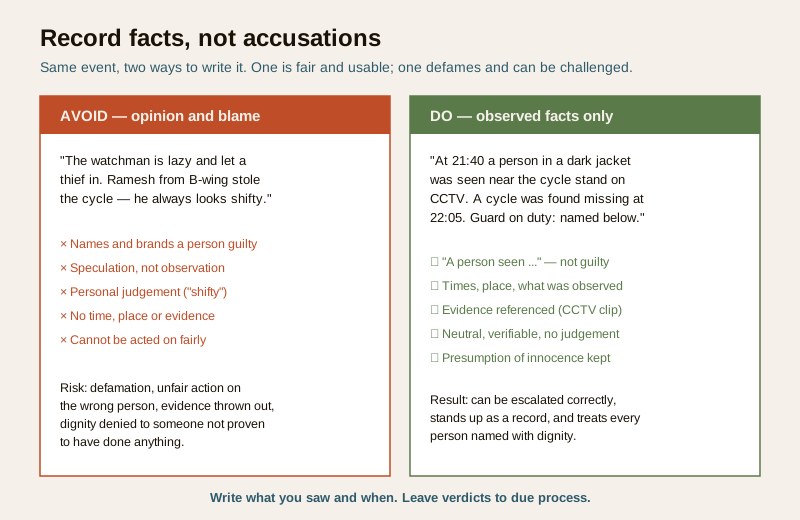
Facts, not verdicts. The description and the people fields are where reports go wrong. Write what was observed and when. A person captured on camera near a stolen item is "a person seen near the cycle stand at 21:40", not "the thief". Presumption of innocence is not a nicety; a report that brands someone guilty can defame them, be challenged, and see an unfair action taken against the wrong person.
A worked example
Illustrative only, to show the shape. The values below are a neutral, made-up example.
Example only — adapt to your project. Names, times and references here are placeholders, not real data.
| Field | Entry (example only) |
|---|---|
| Report no. | IR-2026-014 |
| Date and time of incident | 21 July 2026, 21:40 |
| Date and time reported | 21 July 2026, 22:15 |
| Location | Resident cycle stand, Tower B basement |
| Reported by | Duty guard on shift (name, role, phone) |
| Incident type | Theft (suspected) |
| Description | At about 21:40 a person in a dark jacket was seen on CCTV near the cycle stand. At 22:05 a resident reported a bicycle missing from that stand. No one was stopped; no confrontation occurred. |
| People involved | A person seen on camera (not identified). Resident who reported the loss (name recorded). |
| Witnesses | One resident present in the basement at about 22:00 (contact recorded). |
| Assets / areas affected | One bicycle reported missing from the cycle stand. |
| Immediate action taken | Secured the area, checked the exit, noted the CCTV time window, informed the duty manager. |
| Evidence | CCTV clip 21:35 to 22:10, camera near cycle stand (reference logged; access restricted). |
| Notifications made | Duty manager at 22:15. Police: to be decided by management. |
| Severity | Medium |
| Follow-up / status | Open — management to review footage and decide on a police report; add a light near the stand. |
| Sign-off | Completed by duty guard; reviewed by facility manager (names, date). |
Notice what the example does not do: it names no one as guilty, offers no theory of motive, and hands the escalation decision to management rather than the guard. The footage is referenced, not attached or forwarded.
The blank template
Copy this into your own sheet, print it as a pad for the gate, or paste it into your operations system. Keep the field order; add site-specific rows if you must.
| Field | Entry |
|---|---|
| Report no. | ... |
| Date and time of incident | ... |
| Date and time reported | ... |
| Location | ... |
| Reported by (name, role, contact) | ... |
| Incident type | Intrusion / theft / trespass / alarm / breach / safety / other |
| Description of what happened (facts only) | ... |
| People involved (roles, with dignity) | ... |
| Witnesses | ... |
| Assets / areas affected | ... |
| Immediate action taken | ... |
| Evidence (CCTV ref, photos) | ... |
| Notifications made (who, when) | ... |
| Severity | Low / Medium / High |
| Follow-up / status | Open / In progress / Closed — owner |
| Completed by / reviewed by / date | ... |
This report holds personal data. Descriptions, names and CCTV references identify people, so the form is personal data under the Digital Personal Data Protection (DPDP) Act, 2023. Store it securely, restrict who can read it, share it only on a lawful basis, and keep it only as long as you genuinely need it. For sharing footage referenced here, follow the CCTV footage sharing rules.
Field guide: how to complete it well
- Be factual and objective. Record what you saw, heard and did, with times. If you are inferring something, label it clearly as an inference, or leave it out.
- Never accuse or defame. No one is guilty until due process says so. "A person seen ..." is your default phrasing for anyone not clearly identified and confirmed.
- Protect personal data. Reference evidence rather than pasting faces and footage into a widely shared document. Access to the report itself should be limited to those who need it.
- Escalate correctly. Management owns the response and the decision to escalate. Reporting a crime to the police goes through due process, not through a guard branding a suspect — see responding to police requests. A data or footage breach goes to your Data Protection Officer and the data-breach response process.
- Keep it secure. A stack of incident reports on a shared desk is a privacy leak. Lock them, digital or physical.
- Close the loop. An open follow-up with no owner is how the same incident happens again. Use the report to learn and prevent recurrence, then log the fix.
Common mistakes to avoid
| Mistake | Why it hurts | Do instead |
|---|---|---|
| Opinion and accusation | Defames, can be challenged | Observed facts, with times |
| Missing key facts | Report cannot be acted on | Complete every field, or write "not known" |
| Mishandled footage | DPDP breach, evidence weakened | Reference the clip; restrict access |
| No follow-up owner | Recurrence, nothing learned | Assign an owner and a status |
| Naming and shaming | Injustice to the innocent, legal risk | "A person seen ..."; leave verdicts to process |
| Filled in late from memory | Errors, weaker as a record | Write at the time; note both timestamps |
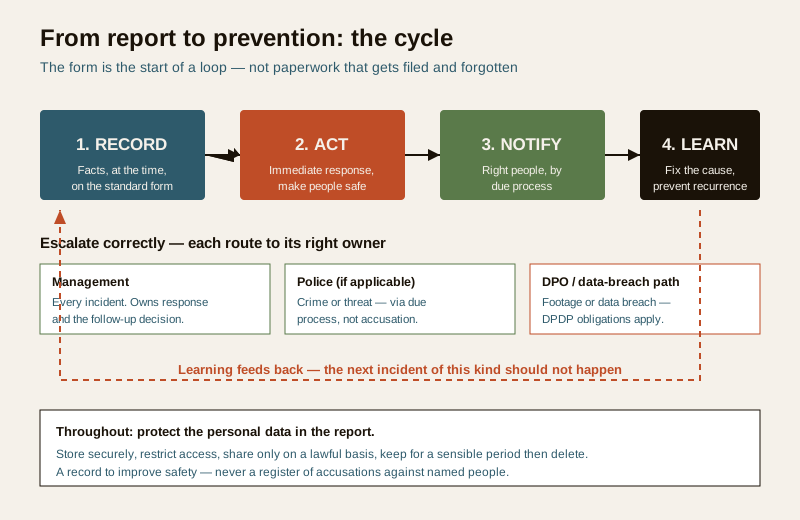
How it connects to the rest of your operation
The incident report is one document in a small family that a professional security operation keeps together:
- Your incident response plan defines who does what when something happens; the report is the evidence that they did it, and the raw material for the debrief.
- A data-breach response is triggered when the incident is a footage or data breach; the report starts that clock and hands it to the DPO.
- The CCTV footage sharing rules govern any clip you reference here — reference, do not forward.
- When an incident becomes a police matter, responding to police requests keeps escalation on a lawful footing.
- Routine faults and tests belong in the security maintenance log, not the incident report — keep the two distinct so real incidents stand out.
For the full toolkit and how these fit together, see the professional security resources guide in the security resources hub.
Completion checklist
- [ ] Every field completed, or marked "not known" — no blanks left ambiguous.
- [ ] Description is factual; no opinion, no accusation, no "the thief".
- [ ] People described with dignity; suspects written as "a person seen ...".
- [ ] Evidence referenced, not pasted or forwarded; access restricted per DPDP.
- [ ] Notifications logged with times; escalation routed to the right owner.
- [ ] Follow-up has an owner and a status; the lesson is captured.
- [ ] Report stored securely, retained only as long as needed.
- [ ] Completed and reviewed, both signed and dated.
Key takeaways
- One standard form, filled every time. Consistency is what makes a report usable months later.
- Facts, not verdicts. Record what was observed and done; leave guilt to due process and protect the presumption of innocence.
- The report is personal data. Handle, store, share and retain it under the DPDP Act, 2023 — never let it become a register of accusations.
- Escalate correctly. Management, police and the DPO each have their route; the form routes to the right one, it does not decide.
- Close the loop to learn. An owned follow-up is how one incident stops the next.
References
- Digital Personal Data Protection (DPDP) Act, 2023 — incident reports and referenced footage that identify people are personal data; keep access controlled, sharing lawful and retention limited.
- Your organisation's incident response and escalation procedures — the authoritative source for who is notified and when; this template records, it does not override them.
- Bureau of Indian Standards catalogue for any life-safety or system standard referenced in an incident; verify the current edition at https://www.services.bis.gov.in/
This is an educational, ready-to-adapt template, not legal advice. A security incident report can hold personal data and support serious decisions — get professional and legal review before you standardise it, and defer specifics to your site, your organisation and the authorities.
Export this guide
Related Guides — Deep-dive reading
Access Control Testing Checklist for India (2026): Every Door Opens and Locks as Designed
A ready-to-adapt per-door and system checklist to verify an access-control installation at commissioning and as a periodic check, with the egress and fire-to-release life-safety tests that must always pass before sign-off.
SecurityResponding to Police Requests in India (2026): Handing Over CCTV Footage the Right Way
A police officer asks for your camera footage. You want to help a genuine investigation — and you also owe a duty to everyone caught in that clip. This guide shows how to cooperate properly: verify the request, share proportionately, keep the original, and record what you did.
SecurityProfessional Security Resources for India (2026): The Documents Behind a Secure Project
The overview and map of the whole professional-deliverable toolkit — the brief, schedules, BOQ, checklists, handover pack and logs a consultant, designer, PMC or facility manager produces across a security project, and how each document connects to the next.
SecurityRelated Tools — Try Free
Home Security Risk Scorecard
Score your home across six security layers — perimeter, entry points, lighting, detection, alarm and habits — and get a prioritised action plan.
Security ScorecardInterior Contract Clause Checklist
16 sections and 98 checkboxes covering scope, BOQ, milestones, penalties, warranty, and disputes.
Contract ChecklistLift Safety Audit Checklist
Interactive checklist that scores your home lift on safety devices, compliance and upkeep.
Checklist