
Screed Flooring in India: Exposed Screed as a Raw Minimalist Finish, Types, Cost & How It's Sealed
Screed is usually the hidden levelling base under your floor — but left exposed, power-floated, densified and sealed, a sand-cement or polymer-modified screed becomes a muted, industrial-Japandi finished floor in its own right, at ₹60–200 per sq ft.
Screed is the layer almost nobody is meant to see — the levelling bed of sand and cement spread over a slab to take tiles, stone or wood on top. But strip away the covering, finish that screed carefully and seal it, and the humble base becomes the floor itself: a seamless, muted, slightly imperfect grey surface that has become the signature of minimalist and Japandi interiors. At ₹60–200 per sq ft, exposed screed is one of the cheapest ways in India to get a calm, raw, industrial-soft floor.
This guide is about screed used as a finished floor, not as a hidden base. If you want the base version — depths, mixes, bonding and how screed prepares a substrate for other finishes — see the dedicated guide on floor screed and mortar beds. Here we cover the types, the look, how it is power-floated and sealed, the real durability and dusting caveats, and exactly where it sits between polished concrete and microcement.
What "screed flooring" means as a finish
A screed is a relatively thin layer of sand-cement (or a flowing modified compound) laid over a structural slab to create a flat, true surface. Traditionally it is sacrificial — a bed for the real floor. "Screed flooring" flips that intent: instead of tiling over it, the screed is finished to a deliberate quality and left exposed, sealed and lived on.
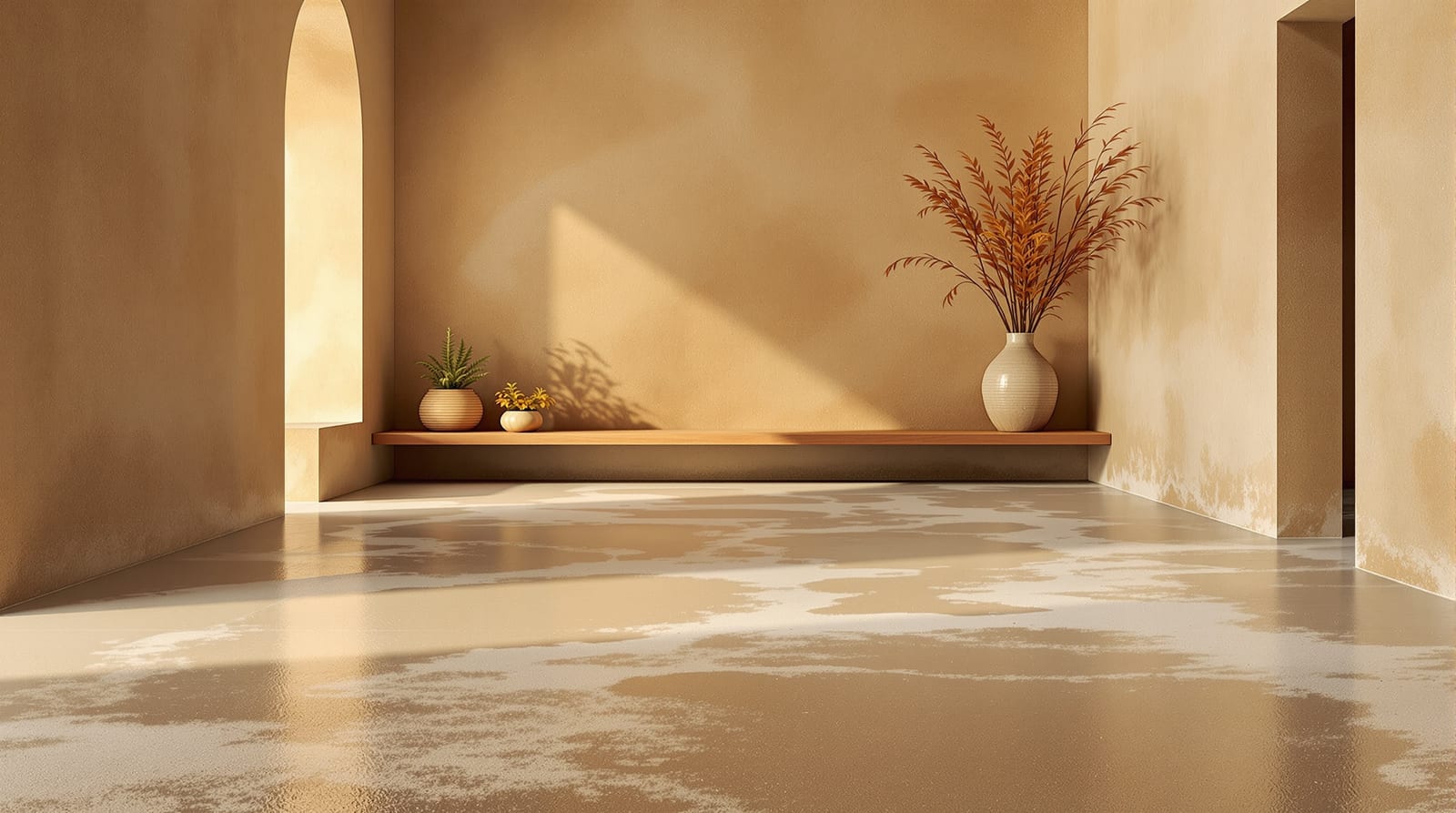
The appeal is the look. A well-finished screed reads as a soft, monolithic grey plane with subtle trowel marks, faint colour variation and the occasional hairline — honest, quiet, and a little industrial. It carries the same family DNA as IPS (Indian Patent Stone), polished concrete and microcement: all seamless cementitious floors, differing in thickness, hardness and how they are finished. Screed sits at the raw, affordable, low-build end of that family.
It is important to be honest from the start: a screed is softer and more porous than a polished concrete slab and far less robust than a purpose-made resin or microcement topping. It can dust and craze if it is just left as-is. The entire art of exposed screed is in the finishing — power-floating it dense, densifying the surface chemically, and sealing or waxing it. Done right it is a beautiful, serviceable floor for the right rooms. Skipped, it disappoints.
Types of screed used as a finished floor
Not every screed makes a good finished floor. Three broad types are used in India for an exposed result.
Bonded sand-cement screed
The classic: a 1:3 to 1:4 cement-and-sharp-sand mix, typically 25–50 mm thick, bonded directly to the slab with a slurry coat so it does not move independently. Laid and ruled flat, then power-floated. It is the cheapest route and uses materials and masons available everywhere. The trade-off is that an ordinary site screed is only as good as the mason — gradient, flatness and a dense closed surface all depend on skill, and a weak or over-sanded mix will dust.
Polymer-modified / proprietary screed
Here a polymer (SBR, acrylic or a proprietary additive) is gauged into the mix, or a bagged modified screed is used. The polymer raises tensile strength, reduces shrinkage cracking and dusting, improves bond and gives a harder, less porous surface that takes a seal better. Free-flowing self-levelling screeds (cement or calcium-sulphate based) also fall here — they are pumped, spread and trowelled to a very flat plane, ideal where you want a smooth modern finish with minimal labour. Modified and flowing screeds cost more but are far more reliable as a wearing surface, and are the sensible choice if the screed is the final floor.
Decorative / microtopping-adjacent screed
The upper end: a fine, often pigmented, modified screed or topping laid thin and finished to a tighter, more controlled surface — edging towards what microcement does, but thicker and more "screed-like" in texture. You can integrally colour it (greys, taupes, warm sands, charcoals using the same oxide pigments as red-oxide and concrete finishes), seed in fine aggregate, or burnish it. This is where screed blurs into decorative concrete and microtopping, and where a specialist applicator rather than a general mason earns their fee.
How exposed screed is finished: float, densify, seal
Three steps separate a base screed from a floor you can live on. This sequence is the whole guide in miniature — skip a step and the floor dusts or stains.
The diagram below shows the build-up and the float-finished surface.
1. Power-float to a dense, closed surface
After the screed is laid, ruled to level and has begun to set, it is worked with a power float (a "helicopter" trowel) or, on small areas, hand-trowelled hard. Floating drives the fines and cement paste to the top and compacts the surface, closing the pores. A tightly floated screed is denser, harder-wearing and far less prone to dusting than a roughly wood-floated base screed. This single step is the biggest determinant of how the finished floor behaves. Curing matters just as much — slow, damp curing for several days develops strength and reduces crazing; a screed dried out fast in hot Indian sun will be weak and dusty at the surface.
2. Densify the surface
Bare cement is the weak link: it abrades and powders. A chemical hardener or densifier (typically a lithium, sodium or potassium silicate) is applied to the cured surface, where it reacts with free lime to form additional hard silicates inside the pores. This makes the top few millimetres denser, harder and much more resistant to dusting and abrasion — the same chemistry used on polished concrete. For an exposed screed that will see daily foot traffic, densifying is strongly recommended, not optional.
3. Seal or wax
Finally the floor is sealed. A penetrating sealer (silane/siloxane or lithium-silicate type) soaks in and repels water and oil while keeping the surface matte and natural — the preferred look for that raw, muted aesthetic. A film-forming sealer (acrylic or PU) sits on top, gives stronger stain protection and a slight sheen, but can scuff and needs re-coating. A wax or oil over a penetrating sealer adds a soft hand-finished glow. Whichever you choose, sealing is what makes a screed practical: it resists the spills, the mopping water and the staining that would otherwise ruin a bare cement floor. Plan to refresh a topical seal or wax periodically (see the floor resealing guide).
Cost in India: type, look and ₹ per sq ft
Exposed screed is cheap relative to most finished floors because it can double as the levelling layer you were going to pay for anyway. The table gives indicative all-in ranges (material plus labour, varies by city, mason and finish quality; add 18% GST; pigment, densifier and specialist applicators push the upper end).
| Screed type | Look | Indicative ₹/sq ft | Best use |
|---|---|---|---|
| Bonded sand-cement, float-finished, sealed | Soft matte grey, honest trowel marks, some variation | ₹60–110 | Budget minimalist homes, studios, utility-chic |
| Polymer-modified screed, floated, densified, sealed | Tighter, harder, more uniform grey | ₹100–160 | Living areas, cafes, retail, durable raw look |
| Self-levelling flowing screed, sealed | Very flat, smooth, modern | ₹120–180 | Open-plan modern interiors, showrooms |
| Decorative / pigmented microtopping-adjacent screed | Controlled colour, fine texture, near-microcement | ₹140–200 | Feature floors, designer minimalist spaces |
| (Reference) polished concrete slab | Ground, glossy or honed, very hard | ₹100–400 | High-traffic, industrial-chic, seamless |
| (Reference) microcement topping | Ultra-thin, smooth, designer, over existing floors | ₹250–700 | Walls + floors, renovations, premium seamless |
Use the Studio Matrx flooring cost calculator and the IPS flooring cost calculator (the closest cementitious comparison) to sanity-check a quote, and the floor sealer calculator to budget the densifier and sealer that this floor genuinely needs.
Durability, dusting and cracking: the honest caveats
A screed floor lives or dies on its finishing, so the caveats deserve their own section.
- Dusting. Bare or weakly finished cement surfaces powder underfoot — the classic complaint about exposed screed. The cure is the float-densify-seal sequence above. A floated, silicate-densified, sealed screed will not dust; a roughly finished, unsealed one will.
- Cracking and crazing. Cement screeds shrink as they cure and will craze (fine surface map-cracking) and sometimes crack along stress lines. This is partly aesthetic — many people embrace the patina — but to control it you bond the screed well, cure it slowly and damp, keep the mix from being over-wet or over-sanded, and use saw-cut or strip control joints in larger areas (just as IPS floors are grooved into panels). Polymer-modified and fibre-reinforced screeds crack noticeably less.
- Staining. Until sealed, cement is porous and grabs oil, turmeric, wine and hard-water marks. Sealing is non-negotiable for kitchens and dining zones; even then, wipe spills promptly.
- Wear and impact. Screed is softer than a polished concrete slab; it can scuff and chip at edges and under dragged furniture. Felt pads, area rugs in heavy-use spots and a tougher film sealer in commercial settings all help.
- Wet areas and slip. Sealed screed can be slippery when wet. For bathrooms or wet thresholds, choose a matte anti-slip sealer or add a fine grip additive, and read the anti-slip flooring for wet areas guide before using it where water pools.
Finished properly, an exposed screed is a perfectly serviceable everyday floor for living rooms, bedrooms, studios and cafes. It is not, by itself, an industrial or wet-room floor — that is what PU and epoxy toppings or polished concrete are for.
Where screed flooring suits in India
Exposed screed belongs in spaces that want calm, raw and minimal over polished and perfect. It shines in modern minimalist and Japandi homes, where its muted grey grounds light timber, linen and greenery. It suits studios, artist lofts and open-plan apartments where a seamless neutral floor lets the architecture and objects speak. In cafes, boutiques, galleries and co-working spaces it delivers the on-trend industrial-soft look at a fraction of the cost of designer microcement, and its imperfections read as character rather than defects.
It is a strong fit on a budget renovation where you are levelling a slab anyway — finishing that screed instead of tiling over it saves the entire cost of a separate floor covering. It is a weaker fit for ultra-high-traffic commercial floors (go polished concrete), wet rooms (go tiles or a wet-area system), and anyone who wants a flawless, variation-free surface (screed celebrates its imperfections; if that worries you, microcement or vitrified tiles are calmer choices).
Screed vs polished concrete vs microcement
These three seamless cement looks are constantly confused. The simplest way to place them: screed is the cheapest and rawest, polished concrete is the hardest and most industrial, and microcement is the thinnest and most refined.
- Polished concrete mechanically grinds and progressively polishes a hardened concrete slab (often the structural slab itself) to expose fine aggregate and bring it to a honed or glossy sheen. It is the hardest and most durable of the three, ideal for high-traffic and commercial floors, but needs a sound thick slab and heavy machinery. Screed is softer, thinner, applied as a fresh layer, and float-finished rather than ground — so it is cheaper and lighter-build but less robust and more matte.
- Microcement is an ultra-thin (2–3 mm) polymer-rich cementitious coating troweled in layers over almost any existing surface — floors, walls, even countertops — to give a smooth, controlled, designer finish with very fine texture. It is the most refined and versatile but also the most expensive and the most dependent on specialist application. Screed is thicker, coarser, more honest in texture and far cheaper; it reads as raw cement, where microcement reads as a deliberate designer surface.
- Screed sits between them: more affordable and rawer than either, a genuine structural layer rather than a thin coating or a ground slab, finished by floating, densifying and sealing. Choose screed when you want the muted seamless look on a budget and you are comfortable with honest imperfection; step up to polished concrete for hard-wearing industrial floors, or to microcement for a refined designer finish over existing surfaces.
For the full map of how all these cementitious and seamless floors relate, see the Studio Matrx specialty flooring guide.
Cross-links and where this fits
This guide is part of the Studio Matrx flooring cluster. For the overview of all alternative and seamless floors, start with the specialty flooring guide. For screed used as a hidden levelling base — depths, mixes and bonding — see floor screed and mortar beds. To compare the seamless cement family, read polished concrete flooring, microcement flooring and IPS flooring.
Frequently asked questions
Can a screed really be left as the finished floor?
Yes — but only if it is finished for the job. A screed laid purely as a base will dust and stain if walked on bare. To use it as a finished floor it must be power-floated to a dense closed surface, cured slowly, densified with a silicate hardener and then sealed or waxed. Done that way it is a perfectly serviceable everyday floor for living rooms, studios and cafes.
Will an exposed screed floor crack?
Some hairline crazing is normal and, for many people, part of the charm — it gives the muted, lived-in patina that makes screed appealing. Structural cracks are controlled by bonding the screed well, curing it slowly and damp, avoiding an over-wet or over-sanded mix, using a polymer-modified or fibre-reinforced screed, and cutting control joints in larger areas, much as IPS floors are grooved into panels.
Is screed flooring cheaper than polished concrete or microcement?
Generally yes. At roughly ₹60–200 per sq ft, exposed screed is the most affordable of the seamless cement looks. Polished concrete runs higher because it grinds and polishes a hard slab with heavy machinery, and microcement is the most expensive because it is a specialist-applied designer coating. Screed also doubles as the levelling layer, saving the cost of a separate floor covering.
How do I stop my screed floor from dusting?
Dusting comes from a weak, open cement surface. Prevent it by power-floating the screed dense, curing it slowly and damp for several days, then applying a chemical densifier (a lithium or sodium silicate hardener) that reacts inside the pores to harden the surface, and finally sealing it. A floated, densified, sealed screed will not dust; a roughly finished, unsealed one will.
Is exposed screed suitable for bathrooms and wet areas?
Cautiously. Sealed screed can become slippery when wet and the surface must be fully sealed against water, so it is not a default wet-room floor. If you do use it near water, choose a matte anti-slip sealer or a grip additive, ensure proper falls and waterproofing below, and read the anti-slip flooring for wet areas guidance first. For showers and pooling water, tiles or a dedicated wet-area system are safer choices.
Export this guide
Related Guides — Deep-dive reading
Epoxy Grout vs Cement Grout for Tiles in India: Which to Specify (2026)
A plain-English guide to tile grouts for Indian homes: what grout does, how cementitious grout compares with epoxy grout on cost, stain and water resistance, hygiene and durability, and exactly where each one belongs - kitchens, bathrooms, pools, dry rooms and more.
Building MaterialsMicrocement Flooring in India: The Seamless 2-3 mm Concrete Look
A thin, hand-applied cement-polymer coating that gives a jointless concrete or stone surface over your existing floors, tiles and walls — no demolition.
Flooring & SurfacesGranolithic Flooring in India: Cement-and-Granite Wearing Topping for Industrial Floors, Method, Cost & IS 5491
Granolithic is the heavy-duty cement-and-crushed-granite wearing topping trowelled over a concrete base for factories, warehouses, garages, godowns, staircases and high-traffic floors — abrasion-resistant, dust-free and cheap at ₹50–150 per sq ft. Here is what it is, how it is laid to IS 5491, its finishes, where it suits and its trade-offs.
Flooring & SurfacesRelated Tools — Try Free
Bathroom Waterproofing Calculator
Work out waterproofing material (kg/L) and cost for a bathroom by area, wall band, system type and coats — cementitious, acrylic, PU or SBR.
Bathroom CalculatorFlooring Cost Calculator
Estimate the all-in cost of a floor — material, laying, wastage, skirting and GST — by area and material.
Flooring CalculatorBathroom Renovation Cost Calculator
Cost to renovate an existing bathroom with a replace-vs-keep model — demolition, re-waterproofing, tiles, fittings and the money saved by keeping items.
Bathroom Calculator