
Roman Blinds: The Complete Guide for Indian Homes (2026)
The soft fabric blind that folds up in neat stacks — flat vs hobbled folds, lining and blackout, fabrics, cord vs chain vs motor, costs and cleaning, decoded for Indian rooms.
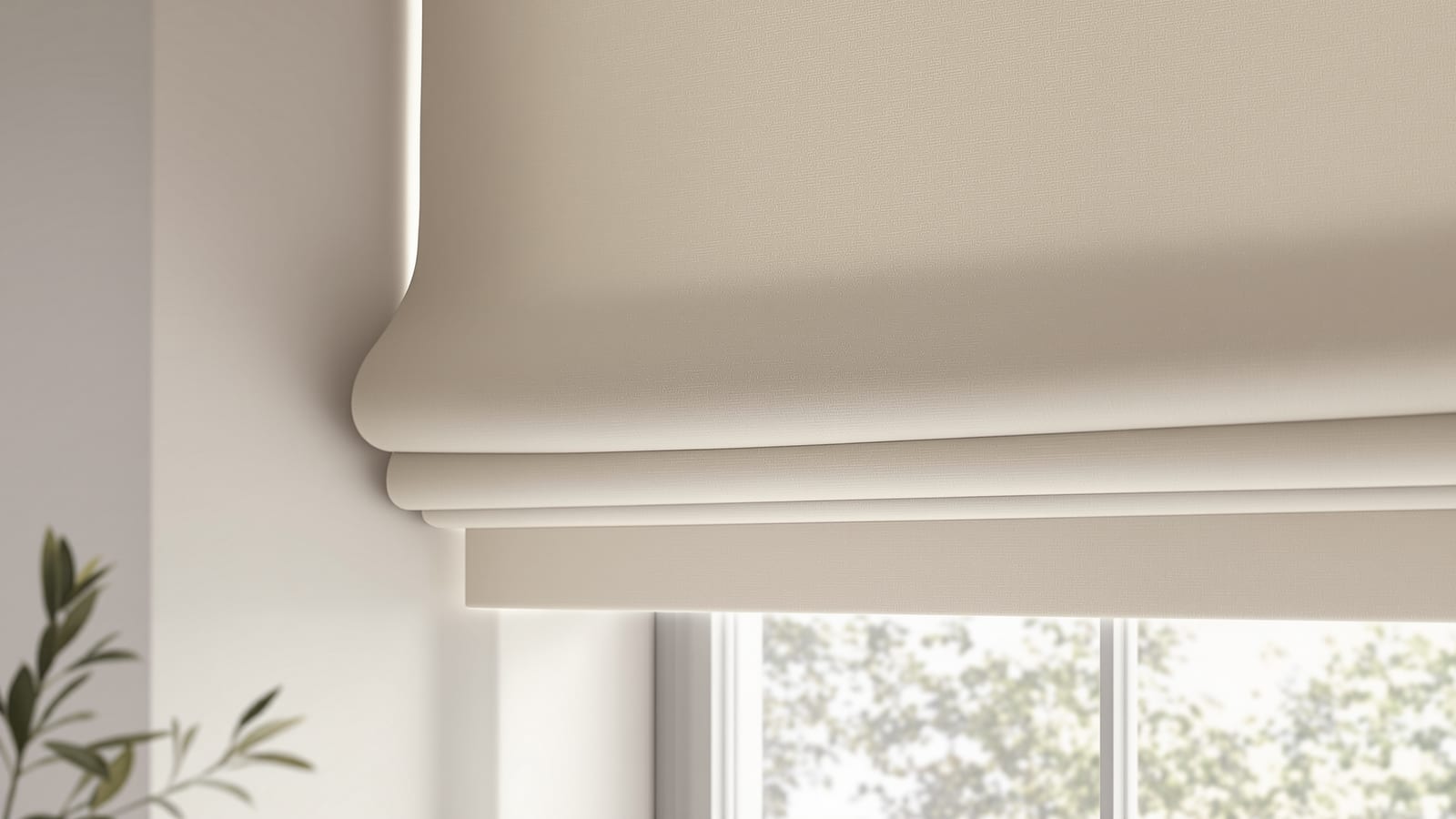
A Roman blind is the quiet over-achiever of window treatments. It is made of soft fabric like a curtain, so it brings warmth, colour and texture to a window — but instead of bunching sideways, it draws up into clean horizontal folds that stack neatly at the top. The result is the tailored, architectural look of a blind with the softness of a drape. For Indian homes, where windows are often smaller, recessed, and competing for wall space with furniture, that combination is genuinely useful.
A Roman blind is the curtain-and-blind hybrid: the cloth and softness of a curtain, the crisp flat stack and minimal sideways footprint of a blind. When a window is too small for full curtains but too important for a cheap roller, this is usually the answer.
This guide walks every decision that decides whether a Roman blind looks expensive and lasts, or sags and frustrates — the fold style, the lining, the operating mechanism (and a serious child-safety note), the right rooms, and what it actually costs in India.
What a Roman blind is — and is not
Picture a single flat panel of fabric the width of your window. Horizontal rods or dowels are sewn into pockets across the back at regular intervals. Cords run up through rings, and when you pull, the fabric gathers into those crisp horizontal pleats and rises. Lower it and the panel falls flat and smooth, covering the glass like a framed piece of cloth.
That is the key difference from a roller blind, which rolls onto a tube and shows no folds, and from a curtain, which gathers sideways and needs width to stack into. A Roman blind stacks upward, so it clears almost no wall on either side — perfect for windows flanked by a wardrobe, a kitchen counter, or a study desk. For the wider comparison of soft cloth versus hard slats, see curtains vs blinds for Indian homes and the broader types of window blinds.
Flat vs hobbled: the fold style that sets the whole look
There are two families of Roman blind, and choosing between them is the first real decision.
- Flat (classic / plain) Roman — when lowered, the fabric is completely smooth and flat, like a taut painting. When raised, it folds into crisp, clean horizontal pleats. This is the modern, tailored, minimalist look and it shows off patterned or textured fabric beautifully. It needs less cloth and reads as more contemporary.
- Hobbled (looped / soft-fold) Roman — the fabric is sewn so that even when fully lowered, it keeps a series of soft, cascading horizontal loops or waterfalls down the whole panel. This is the softer, more traditional, more luxurious look. It uses more fabric (the loops are permanent), so it costs more and reads richer.
A simple rule: choose flat for clean contemporary, urban-apartment and minimalist rooms where you want the fabric pattern to sing; choose hobbled for formal living rooms, classic interiors and anywhere you want extra softness and a sense of luxury. Flat suits most Indian homes and most budgets.
Lining: the difference between cheap and considered
A Roman blind is only as good as its lining, and this is where most regrets happen. The same face fabric behaves completely differently depending on what is behind it.
| Lining | What it does | Best for |
|---|---|---|
| Unlined | Light, casual, lets daylight glow through; cheapest | Kitchens, casual rooms, sheer effect |
| Standard lined | Cleaner drape, protects face fabric from sun, mild light control | Living rooms, studies, most windows |
| Blackout lined | Near-total darkness, blocks heat, hides the window at night | Bedrooms, nurseries, home theatres |
| Interlined | A soft layer between face and lining for body, insulation and a plush hand | Premium living rooms, cold hill-station homes |
For an Indian bedroom, blackout lining is close to non-negotiable — early summer sunrises and bright street lighting both wreck sleep, and a blackout Roman blind tucked into the window reveal kills most of it. Note the honest caveat: a Roman blind mounted inside the recess will always leak a thin halo of light around the edges, so for true total darkness, mount it outside the reveal (overlapping the wall) or pair it with side curtains. The same lining logic governs curtains too, covered in the curtain fabric guide.
Fabrics that work in Indian conditions
Because a Roman blind is one flat, visible panel, the fabric carries the whole effect — and Indian sun, dust and humidity are unforgiving.
- Cotton and cotton blends — breathable, easy to print, the everyday workhorse; choose tighter weaves that resist sagging.
- Linen and linen-look — beautiful natural texture and the most popular "designer" choice, but pure linen creases and can sag in humidity; linen blends behave better.
- Polyester blends — the most practical for India: fade-resistant, dimensionally stable, easy to clean, and cheaper. The honest workhorse for bright, dusty windows.
- Textured weaves and faux silk — add richness for formal rooms, but keep them off the hottest west and south windows where UV will dull them.
Avoid heavy, stiff fabrics that fight the folds, and be wary of very loose weaves that stretch and droop after a season. A medium-weight, tightly woven fabric folds crisply and holds its shape for years. On a bright, heat-loaded window, fade resistance matters more than the print — the same lesson as in the full curtain fabric guide.
How it operates: cord vs chain vs motor (and a child-safety warning)
The mechanism is the part you touch every day, and it is also the part with the most important safety implication.
- Corded (traditional cord lock) — a looped cord you pull and cleat off. Cheapest and most common, but the loose looped cord is a strangulation hazard for young children and pets — this is a documented, serious risk, not a theoretical one.
- Continuous chain / cord drive — a beaded chain on a clutch mechanism; smoother, more durable, and the chain can (and should) be anchored taut to the wall with a tension device so there is no loose loop. The sensible default for most homes.
- Cordless / spring-operated — you simply push the bottom rail up or pull it down; no cords at all. The safest choice and increasingly available in India, though the size range is more limited.
- Motorised — a battery, rechargeable or wired motor raises and lowers the blind by remote, app, voice (Alexa / Google Home) or schedule. Premium, completely cordless, and brilliant for tall or hard-to-reach windows.
If there are children or pets in the home, do not buy a loose-corded Roman blind. Choose cordless, motorised, or a chain that is anchored taut to the wall. Indian and global safety guidance is unanimous on this — it is the one rule in this guide you should not bend.
Motorisation is worth it on the windows you operate daily and on anything above reach — a stairwell window, a tall living-room blind. For battery models, you recharge or swap cells every few months; wired models need cabling planned during construction. The same automation logic and ecosystem advice in the pillar window-treatment guide applies here.
Best rooms for Roman blinds in an Indian home
Roman blinds shine in specific rooms and struggle in others — match the blind to the job.
- Bedroom — arguably their best room. A blackout-lined Roman blind gives clean sleep-darkness, takes no side wall, and looks far more refined than a roller. Pair with a sheer curtain for daytime softness.
- Living room — excellent on medium windows; use lined or interlined fabric, or layer a flat Roman blind behind decorative curtains for a rich, finished look. See living-room curtain ideas for the layering.
- Study / home office — superb glare control on the screen wall; lower the blind to a precise height to kill screen reflection without going fully dark.
- Kitchen — only with an easy-clean polyester fabric and well away from the flame; cooking grease and steam are hard on cloth, so many kitchens are better served by a wipeable roller.
- Bathroom and balcony — generally avoid; the humidity sags and spots fabric. Choose a moisture-tolerant roller or a faux-wood blind instead.
A reliable pattern in Indian homes is the layered window: a sheer curtain for daytime privacy and softness, with a blackout Roman blind behind it for night and sleep — the same two-layer idea that runs through the whole window-treatments cluster.
Pros and cons, honestly
The case for Roman blinds:
- The softness and warmth of fabric with the tailored, space-saving stack of a blind.
- Minimal sideways footprint — ideal for small, recessed, or furniture-flanked Indian windows.
- Hundreds of fabrics, full lining and blackout options, and a genuinely premium, custom look.
- Cordless and motorised options make them safe and effortless.
The honest drawbacks:
- Cleaning is the real weakness — the rigid rods and folds mean you cannot just toss most Roman blinds in the machine; they collect dust along the fold lines and usually need vacuuming, spot-cleaning, or professional dry cleaning.
- They are pricier than a basic roller for the same window.
- Fabric can sag or fade on hot, bright windows if you skimp on weave and lining.
- Inside-mount blinds leak edge light — a problem for true blackout.
Compared with a roller blind, the Roman trades easy cleaning and lower cost for softness and a more designed look. Compared with full curtains, it trades acoustic mass and drama for a smaller footprint and crisper lines.
What Roman blinds cost in India
Prices swing with fabric, lining, fold style, mechanism and city, so treat these as honest ranges, not quotes — and measure and price locally before you commit.
| Factor | Cheaper | Pricier |
|---|---|---|
| Fabric | Polyester blend | Linen, faux silk, designer prints |
| Fold style | Flat | Hobbled (more cloth) |
| Lining | Unlined / standard | Blackout / interlined |
| Mechanism | Corded / chain | Cordless / motorised |
As a working sense of scale, a custom flat, lined Roman blind for an average Indian window commonly lands in the low-to-mid thousands of rupees per window, with blackout, hobbled, premium fabric or motorisation pushing a single window higher from there. Ready-made standard-size Roman blinds are cheaper but limited in size and fabric. The cost drivers people underestimate are lining and fold style, not the print. Use the Curtain Cost Calculator to size fabric and price a window in seconds, and the curtain cost guide for the full ready-made-vs-custom breakdown.
Cleaning and care — the part nobody mentions in the showroom
This is the caveat that decides long-term happiness, so be clear-eyed about it.
- Routine — vacuum gently with a brush attachment every couple of weeks; dust settles along the fold lines and in the rod pockets, and Indian dust is relentless.
- Spot stains — blot with a mild cleaner; never soak, which warps the rods and shrinks the fabric unevenly.
- Deep clean — most lined or blackout Roman blinds should be professionally dry cleaned, not machine washed. Some unlined cotton blinds can be hand-washed flat after removing the rods, but check before you buy.
- Mechanism — keep the chain or cord clean and the cords even so the blind rises level; an uneven rise usually means a snagged or stretched cord.
If low-maintenance is your top priority, a wipeable roller blind may suit you better. Roman blinds reward homes willing to dust and occasionally dry-clean them in exchange for the softer, richer look.
How to choose, in five moves
1. Pick the fold style — flat for modern and most budgets, hobbled for formal luxury.
2. Choose the lining for the job — blackout for bedrooms, standard for living and study, unlined only for casual rooms.
3. Pick an India-friendly fabric — a tight polyester blend or linen blend for bright, dusty windows.
4. Choose a safe mechanism — cordless or motorised if there are children or pets; otherwise an anchored chain.
5. Decide inside-mount (neat, but edge-light) or outside-mount (true darkness, bigger look).
Do those five in order and the fabric — the fun part everyone starts with — becomes the easy, last decision.
Find your right window treatment with Studio Matrx. Not sure if a Roman blind, roller or curtain suits your room? Run the Window Treatment Selector for a matched recommendation, then size and price the fabric with the Curtain Cost Calculator. For the full picture across every option, start at the complete window treatments guide and the complete curtain guide for Indian homes.
Export this guide
Related Guides — Deep-dive reading
Curtains vs Blinds: The Complete Comparison for Indian Homes (2026)
Light, privacy, heat, noise, cleaning, cost and looks — a head-to-head verdict on curtains and blinds, plus the under-rated answer most good designers actually use: both.
Window TreatmentsWooden Blinds Guide: Real Wood vs Faux-Wood for Indian Homes (2026)
The warmth of timber slats versus the humidity-proof sense of faux-wood — how to choose horizontal wooden blinds that survive Indian monsoons, coastal damp and west-sun heat.
Window TreatmentsCurtains vs Roller Blinds: Which for Your Window? (India 2026)
A head-to-head on light, privacy, heat, acoustics, cost and cleaning — when a roller blind wins, when curtains win, and the quiet trick of using both on the same window.
Window TreatmentsRelated Tools — Try Free
Window Treatment Selector
Curtains, blinds or a layered system? Answer five questions about your room and get a specific recommendation.
SelectorCurtain Cost Calculator
Get the fabric metres you need plus the total curtain cost by window size, fabric, pleat, lining and hardware.
Curtain CalculatorCross-Ventilation Analyzer
Estimate airflow and air changes per hour (ACH) from room size, window areas, layout, and local wind — with NBC 2016 Part 8 compliance check.
Ventilation Calculator