
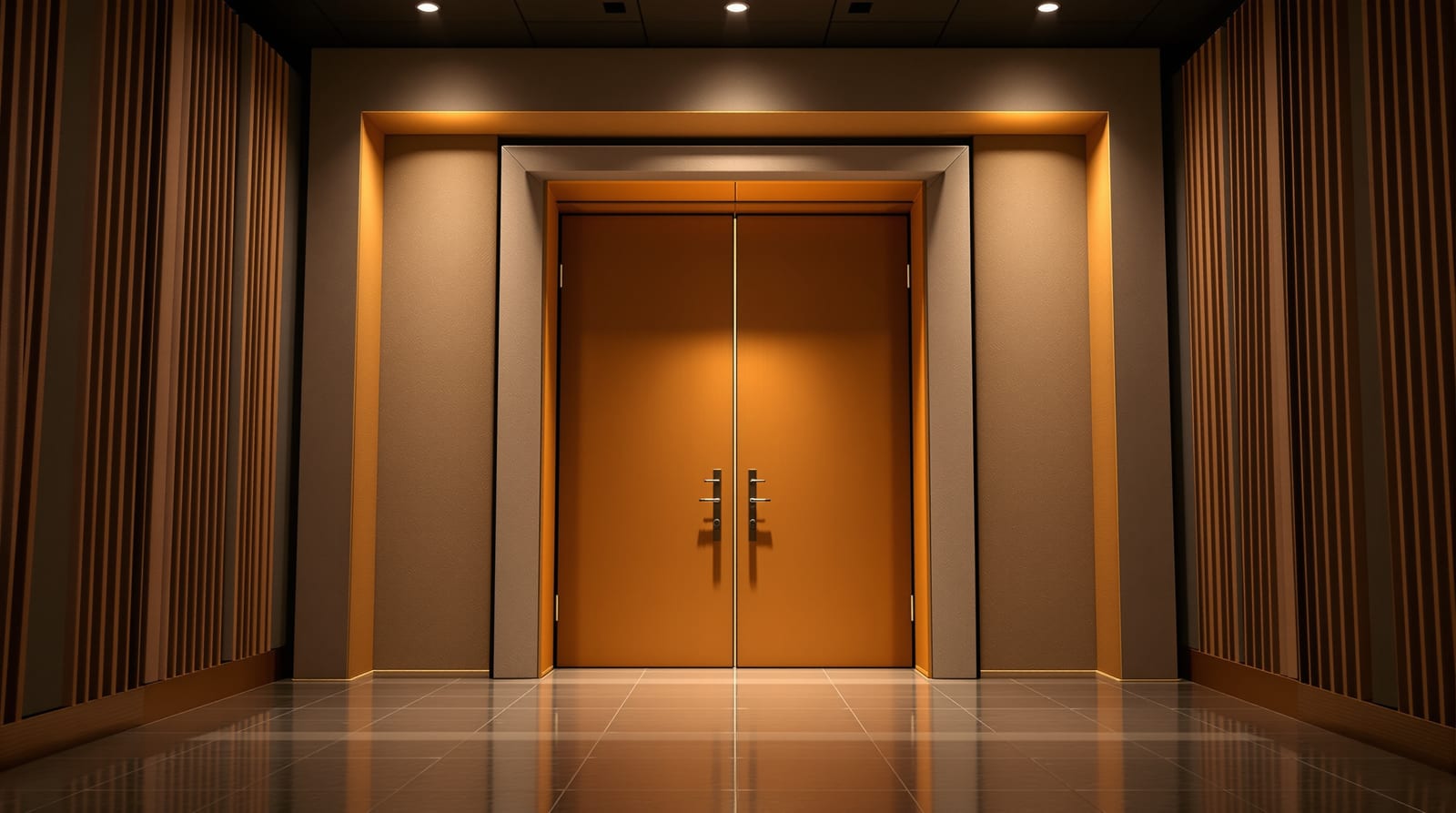
High-STC acoustic doors: STC 45-60 specified, India 2026
How an acoustic door reaches STC 45-60 — dense core, full perimeter compression gaskets, automatic drop seal and the sound-lock vestibule.
A standard timber flush door stops perhaps 25-30 decibels of airborne noise; the moment you ask for a recording booth, an auditorium or a generator room you are in a completely different engineering class. High-STC acoustic doors — rated STC 45 through 60 — are not ordinary doors with foam glued on. They are mass-loaded, multi-seal assemblies where the leaf, the frame, every gasket and the threshold are engineered together. This guide explains, at specifier level, exactly how a door reaches a high Sound Transmission Class, what each element contributes, how the rating is tested, and what it costs in India in 2026. It is the high-performance deep-dive that complements the broader soundproof doors overview.
What STC actually measures
Sound Transmission Class (STC) is a single-number rating derived from laboratory measurement of how much airborne sound a partition or door reduces across the 125 Hz-4000 Hz speech band. Higher is better, and the scale is roughly logarithmic: every 10 points is perceived as roughly halving the loudness on the other side. STC is measured to ASTM E90 (lab) and reported per ASTM E413; the field-measured cousin is FSTC/ASTC. Indian practice references IS 9901 for the acoustic-measurement methodology, but most rated door leaves on the market quote ASTM E90 lab data from an accredited acoustic lab.
A critical honesty point: STC was developed for speech frequencies. It under-weights low bass. A door rated STC 55 will block office chatter beautifully but will leak the kick-drum and the sub from a home theatre or a band room. For low-frequency-heavy uses, ask the vendor for the full third-octave Transmission Loss (TL) curve, not just the headline STC.
| STC | Subjective result | Typical application |
|---|---|---|
| 25-30 | Normal speech clearly audible | Ordinary internal flush door |
| 35-40 | Loud speech faint/unintelligible | Good office, basic soundproof door |
| 45-50 | Loud speech barely heard | Conference rooms, gen-set rooms, hotel suites |
| 50-55 | Most amplified sound blocked | Auditoria, home theatres, music practice |
| 55-60 | Near-silence; only heavy bass leaks | Recording studios, broadcast, isolation booths |
How High-STC acoustic doors reach STC 45-60
There are four levers, and a high-performing door pulls all of them at once. Miss any one and the assembly fails to its weakest path — typically a perimeter gap.
1. Mass and a dense, decoupled core
The mass law is unforgiving: doubling the mass per unit area of a single leaf adds only about 5-6 dB. So acoustic leaves run heavy — 45-100 kg/m² and more — using dense particleboard, high-density MDF, mineral or composite cores, or steel skins over a damped honeycomb/mineral fill. To push past the limits of a single mass, premium leaves are double-wall: two independent skins separated by an air or fibre cavity so the panels are decoupled, plus a constrained-layer damping membrane to kill the coincidence dip. This decoupling is how an STC 55-60 leaf out-performs what its raw weight alone would predict.
2. Full perimeter compression gaskets
Acoustically, a door is only as good as its seals. A 1 mm continuous gap around the perimeter can drop a lab STC 50 leaf to an installed STC 35 or worse. High-STC doors use compression (not brush/blade) gaskets — silicone or neoprene bulb seals housed in adjustable aluminium carriers on the head and both jambs — and the leaf compresses against them via heavy magnetic or cam-action hardware. Many studio doors deliberately add a second, inner gasket line so there are two sealing planes in series.
3. Automatic drop seal at the threshold
The sill is the hardest gap to close because you cannot put a permanent obstruction there. The answer is a mortised automatic drop seal (also called an acoustic threshold drop seal): a spring-loaded bar inside the bottom rail that, when the door closes, is pushed by an end-plunger to drop a gasket firmly onto a matching threshold plate, then retracts clear when the door opens. A good drop seal can be worth 6-10 STC points on its own; a brush sweep at the bottom is not equivalent and should never be specified for a high-STC door.
4. The sound-lock vestibule (double-door)
Beyond roughly STC 50-52 a single door becomes impractical and very expensive. The professional answer for studios and broadcast is the sound-lock vestibule: two acoustic doors a short distance apart, opening into a small lined airlock so the two leaves work in series. Two STC 45 doors with an absorptive vestibule between them deliver a composite isolation far higher than either alone, and the vestibule also buys you a place to put diffusion and a cable pass-through. This is why control-room and live-room doors almost always come in pairs.
Where high-STC doors are specified
- Recording & broadcast studios — control rooms, live rooms and vocal booths, almost always as sound-lock pairs targeting STC 55-60. See the recording studio door guide.
- Auditoria, cinemas and music halls — projection rooms, side-stage and lobby doors at STC 50-55; the auditorium door guide covers the wider envelope.
- Home theatres — STC 50-55, but specify for bass; a sound-lock or a second door pays off here.
- Conference and board rooms — speech-privacy STC 45-50, frequently double-glazed vision panels.
- Generator (gen-set) and plant rooms — STC 45-55 to contain mechanical roar; pair with an absorptive plenum.
- Hotel suites, hospitals and courts — speech privacy and confidentiality at STC 45-50.
For the broader family of engineered specialty doors, see the phase pillar specialty doors, and for the full cluster the complete door guide.
Specification and cost in India (2026)
High-STC doors are project-engineered: the leaf is rated only as a tested assembly (leaf + frame + gaskets + drop seal + hardware) and the rating is void if you mix components. Treat the bands below as planning guidance and get a written vendor spec quoting the specific lab-tested STC and the TL curve. GST on doors is 18%.
| Rating tier | Construction | Typical use | Cost band (supply only) |
|---|---|---|---|
| STC 40-45 | Single dense-core leaf, perimeter gasket + drop seal | Conference, gen-set, hotel | ₹35,000-75,000/door |
| STC 45-50 | Heavy mass leaf, twin gasket line, drop seal | Auditorium lobby, home theatre | ₹70,000-1,50,000/door |
| STC 50-55 | Double-wall decoupled leaf, full seals | Studio control room, theatre | ₹1,30,000-2,75,000/door |
| STC 55-60 | Sound-lock pair (two leaves + vestibule) | Recording booth, broadcast | ₹2,50,000-6,00,000+/set |
Add-ons that move the price: double-laminated-glass acoustic vision panels (each can cost ₹20,000-60,000 and may pull the assembly down a tier), automatic operators, magnetic seal upgrades, and stainless or veneer finishes. Always clarify supply-only vs installed — fitting an acoustic frame plumb and square, and tuning the drop-seal plunger, is skilled work, and a poor install will throw away 10-15 STC points. Lead times are typically 4-8 weeks because leaves and frames are custom-fabricated. Indian and global suppliers active in this segment include Avians, Envirotech, GMP Technical, ASSA ABLOY and Hörmann; frame any one against your own tested data rather than a brochure number.
Before you finalise size and target rating, model the trade-offs with the acoustic door STC calculator and shortlist a product with the acoustic door selector. Engage an acoustic consultant for any studio or auditorium — the flanking path through the wall, slab and ducts often governs, and a great door in a leaky wall is wasted money.
Common ways high-STC doors fail
1. Brush sweep instead of a drop seal — the single biggest field error; it cannot seal an air gap.
2. Undersized gasket carriers or worn bulbs — compression gaskets need periodic adjustment and replacement; budget AMC.
3. Glazed panel mismatch — a single-pane vision lite in an STC 55 leaf becomes the weak path.
4. Frame not isolated from the structure — rigid grouting transmits flanking noise around the door.
5. Specifying STC for a bass-heavy room — use the TL curve, not the headline number.
Frequently asked questions
What STC do I need for a recording studio?
For a serious control room or live room, target a composite STC 55-60, which in practice means a sound-lock vestibule with two acoustic doors rather than a single leaf. Vocal booths can sometimes manage with one very high-mass STC 50-52 door, but two-in-series is the safe specification. Always ask for the third-octave TL curve because studios are bass-critical.
Is STC the same as a soundproof door?
No. "Soundproof door" is a loose marketing term; STC is the measured, single-number lab rating to ASTM E90/E413 (IS 9901 covers the test method in India). A door without a quoted, lab-tested STC and a TL curve should be treated as unrated. See the general soundproof doors guide for the basics.
Why does my STC 50 door let sound through after installation?
Almost always a perimeter problem: an unadjusted drop seal, a worn or missing compression gasket, a frame that is not square, or flanking noise around the door through the wall and slab. Lab STC assumes a perfect seal; a 1 mm continuous gap can cost 10-15 points. Re-tune the seals and check the wall before blaming the leaf.
Can a single door reach STC 60?
It is theoretically possible with an extremely heavy double-wall leaf, but it is rarely practical or economic in India — the leaf becomes very heavy, needs industrial hardware, and is hard to seal reliably. Beyond roughly STC 52-55, the cost-effective route is a sound-lock pair of two acoustic doors.
Do high-STC doors also help with low-frequency bass?
Not in proportion to their STC. STC under-weights frequencies below about 125 Hz, so a high-STC door can still leak kick-drum, sub and gen-set rumble. For low-frequency-heavy rooms, specify by the full Transmission Loss curve and add mass plus a decoupled wall and a sound-lock vestibule.
How much maintenance do acoustic doors need?
The seals are consumables. Plan an annual check of the compression gaskets and the automatic drop-seal plunger, and replace bulb gaskets every few years or when they take a set. A neglected door drifts down by several STC points; a simple AMC keeps the rating you paid for.
Export this guide
Related Guides — Deep-dive reading
Recording Studio Door in India: Sound-Lock Airlock, STC/Rw Ratings and Costs (2026)
The highest acoustic-isolation door in any building - a very heavy lead-loaded or solid acoustic leaf with full perimeter gaskets, an automatic drop seal, a multi-pane vision window and, for true isolation, the double-door sound-lock with a dead-air vestibule.
Home Doors & EntrancesSoundproof Doors in India: How Doors Leak Sound, STC Ratings, Seals & Real Costs
A door is the weakest acoustic link in any wall - and it usually leaks through the gaps, not the panel - so here is how to actually quieten a bedroom, home theatre or street-facing room, from a 1,500-rupee seal kit to a proper acoustic door.
Home Doors & EntrancesDoor Acoustic Performance: STC & Sound Control (India 2026)
How sound travels through and around a door, what STC ratings really mean, and what makes a door genuinely quiet in an Indian home.
Home Doors & EntrancesRelated Tools — Try Free
Acoustic Privacy (STC) Visualizer
Indian healthcare acoustic visualizer — compare wall assemblies and noise sources, see received SPL after STC attenuation, and check FGI 2018 / IS 1950 / NABH speech-privacy compliance with live dual-canvas waveform.
Acoustic ToolAcoustic Door Selector
Get the STC rating and door build you need for a quiet space — home theatre, studio, boardroom or hotel room.
Door ToolWindow Cleaning Cost Calculator
Estimate professional window cleaning cost per visit and per year by access and frequency.
Window Calculator