
The Royal Tombs of Petra: Palaces for the Dead, Carved From a Cliff
How the Nabataeans — Arab traders grown rich on frankincense and myrrh — carved a whole city of tombs into the multicoloured sandstone of Jordan, cutting monumental facades from the top down out of the living rock, crowning the desert with the Treasury and the Monastery, and keeping it all alive with a water genius that made a great city bloom where there was no river.
The tombs we have visited were built, or dug, or piled up. Our next were carved — sculpted straight out of the face of a mountain, like statues the size of buildings. In a hidden valley among the desert cliffs of southern Jordan, an Arab people called the Nabataeans grew fabulously rich, and spent their fortune doing something no one had done at this scale before: they turned the living rock itself into a city of monumental tombs, each one a great classical facade cut from the solid sandstone.
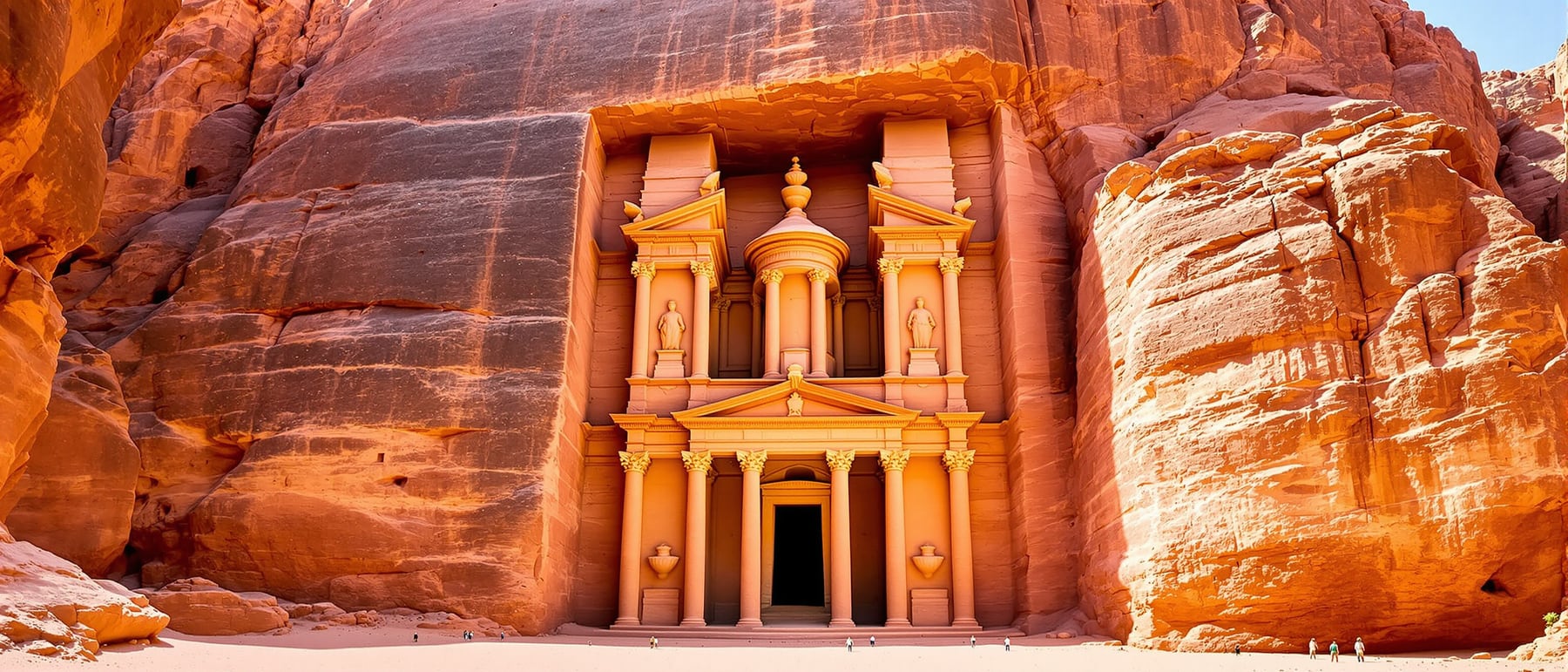
This is Petra — the Nabataeans called it Raqmu — and its hundreds of rock-cut tombs are among the most beautiful and mysterious funerary monuments on earth. The most famous, Al-Khazneh, appears with a shock of theatre at the end of a dark gorge, a forty-metre temple-front glowing in the cliff. It is not, as its nickname claims, a treasury; it is a king's tomb. And behind the beauty lies an even greater marvel: the desert genius that let a whole city live, and feast, where there was no river at all.
This is the forty-third article in our Architectural Wonders series.
1. A city carved from the rock
To understand Petra's tombs, you have to understand the people who paid for them — and how they got so extraordinarily rich.
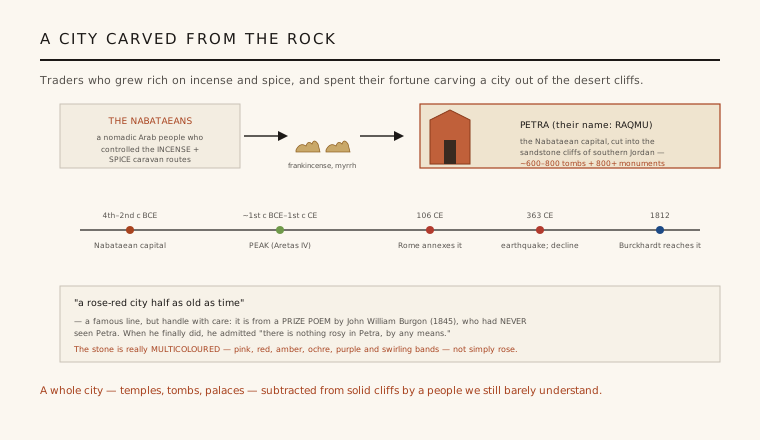
The Nabataeans began as nomads, and became the great middlemen of the ancient world, controlling the caravan routes that carried frankincense, myrrh and spices across Arabia to the Mediterranean. That trade made them immensely wealthy, and at the crossroads they built their capital, Petra, carving it into the multicoloured sandstone. It flourished from about the 1st century BCE, reaching its dazzling peak under King Aretas IV around the turn of the era; then Rome annexed the kingdom in 106 CE, an earthquake shattered it in 363 CE, the trade routes shifted, and Petra slowly emptied and was forgotten by the outside world — until the Swiss explorer Johann Burckhardt talked his way in, in 1812. One caution before we go further: the beloved phrase "a rose-red city half as old as time" is poetry, from a prize poem by John William Burgon — who had never seen Petra, and who, when he finally did, admitted "there is nothing rosy in Petra, by any means." The stone is gloriously multicoloured — pink, red, amber, ochre, purple — not simply rose. The real Petra is stranger and more beautiful than the postcard.
2. Carved from the top down
Now the method — because the way these tombs were made is as astonishing as how they look.
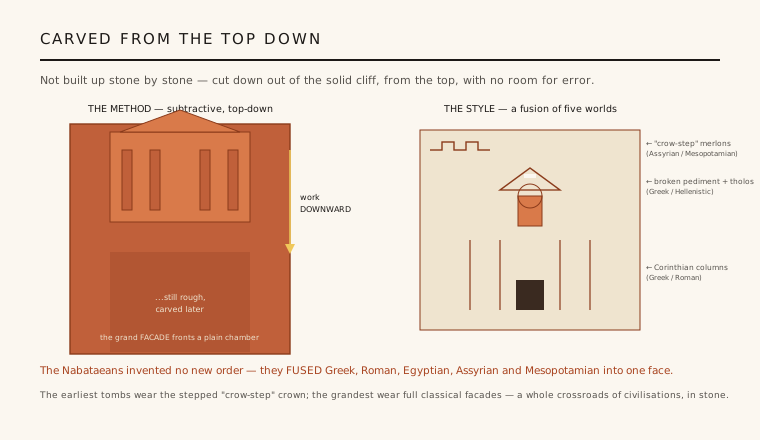
Petra's tombs are subtractive sculpture on an architectural scale: rather than building a facade up from the ground, the carvers cut it down out of the cliff, starting at the top and working downward on ledges — which means there was no scaffolding to build and no way to fix a mistake; every line had to be right the first time. Behind each magnificent facade lies a comparatively plain rock-cut chamber for the dead. It is the same top-down, no-undo discipline we marvelled at in the monolithic Kailasa temple and the Ajanta caves of India — carving as an act of total, irreversible commitment. And the style is a wonder of its own: the Nabataeans invented no new order but fused five civilisations into one face — Greek and Roman columns, broken pediments and round kiosks, Egyptian motifs, and, on the earliest tombs, the stepped "crow-step" crenellations they inherited from Assyria and Mesopotamia. Their architecture is, quite literally, a crossroads of the ancient world rendered in cliff-stone — exactly what you would expect from a people who lived by connecting everyone to everyone else.
3. The "Treasury" that was really a tomb
And so to the icon — the facade that has stopped travellers in their tracks for two thousand years, and whose famous name is a beautiful mistake.
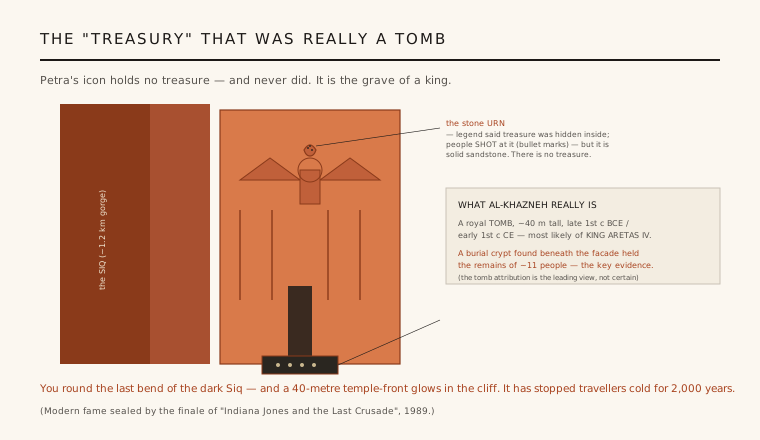
You reach it by walking the Siq, a narrow gorge over a kilometre long, the cliffs closing to a few metres overhead — and then, at the final bend, the darkness opens onto a forty-metre classical facade blazing in the sun: Al-Khazneh, "the Treasury." Its name comes from a Bedouin legend that a pharaoh hid his treasure in the great stone urn crowning its upper storey — which is why the urn is pocked with bullet marks, from people over the centuries firing at it to break the gold loose. But the urn is solid sandstone; there is no treasure, and there never was. What Al-Khazneh actually is, on the best evidence, is a royal tomb — most likely the mausoleum of King Aretas IV himself — a reading strongly supported by the discovery of a burial crypt beneath the facade holding the remains of about eleven people (the attribution is the leading view, not a certainty). It fronts, as ever, a plain chamber. The most photographed facade in the Middle East, the star of the finale of Indiana Jones and the Last Crusade, is not a bank vault of legend but something quieter and greater: a grave, carved to make death itself look magnificent.
4. The wall of kings, and the Monastery
Al-Khazneh is only the beginning. Petra's kings and nobles competed, across the centuries, to out-carve one another — and the result is a whole skyline of the dead.
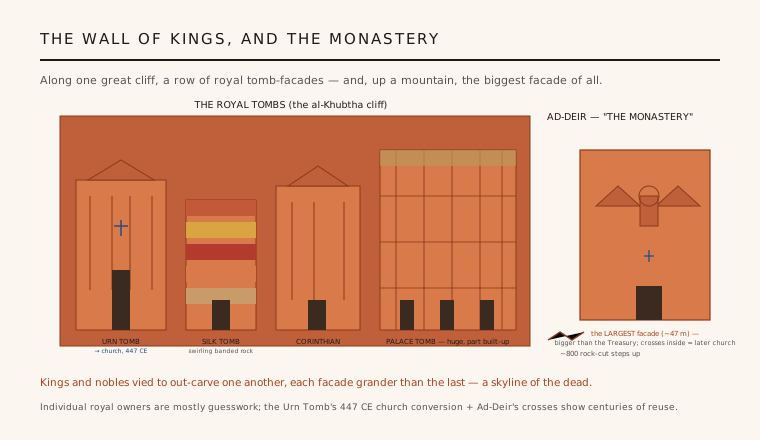
Along one great cliff, the al-Khubtha, runs a row of the grandest tombs, generally taken to be those of Nabataean kings and nobles (individual owners are mostly guesswork). There is the Urn Tomb, fronted by a broad colonnaded courtyard, so grand that it was later converted into a Byzantine church in 447 CE; the Silk Tomb, whose facade ripples with the most gorgeous swirling bands of coloured sandstone in all of Petra; the Corinthian Tomb; and the vast, multi-storey Palace Tomb, which imitates a Roman palace facade and is so large that the carvers ran out of cliff and had to build the top up in masonry. And then, high on the far side of the valley, up a climb of some eight hundred rock-cut steps, stands the greatest facade of all — Ad-Deir, "the Monastery," even larger than the Treasury at some forty-seven metres, austere and colossal, its interior later marked with the crosses of Christian monks that gave it its name. Tomb after tomb, each grander than the last: an entire aristocracy that chose to spend its wealth making its graves immortal.
5. The desert genius: water, and the banquet
But here is the deepest wonder of Petra, the one the postcards miss entirely. None of it — not the city, not the tombs, not the crowds — could have existed at all, because Petra sits in a desert with no river. That it lived is down to Nabataean genius.
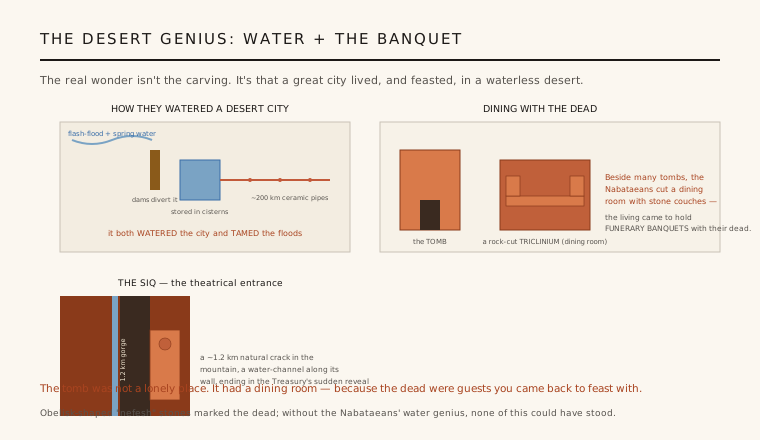
The Nabataeans were, above all, hydraulic engineers of genius. They laced their city and its mountains with dams, hundreds of rock-cut cisterns, and some two hundred kilometres of ceramic pipes and channels that captured every drop of flash-flood and spring water, stored it against the dry season, and — just as cleverly — controlled the floods that would otherwise have scoured the city away. A water channel even ran along the wall of the Siq as you walked in. This invisible engineering, not the carving, is what truly made Petra possible: a great city, blooming in a place that should have been empty sand. And it shaped how they lived with their dead, too. Beside many of the tombs, the Nabataeans cut a triclinium — a dining room, with stone couches carved from the rock — where the living came to hold funerary banquets with the departed. The tomb, here, was not a lonely, dreaded place. It had a room for dinner. As at Cerveteri and the great Mausoleum, the grandest tombs are really about the living — a stage where a community goes on gathering, and remembering, long after the burial is done.
6. What a modern architect can learn from Petra
- You can build by taking away. Petra's tombs are carved, not constructed — sculpture at the scale of architecture. Sometimes the most powerful way to make a form is to remove everything that is not it. Subtraction is a design method, not just a demolition.
- Get it right the first time. Top-down rock-carving allows no scaffolding and no correction. Working within irreversible constraints forces a rigour — total planning, total commitment — that produces some of the most disciplined work humans have ever made.
- Great style is often synthesis. The Nabataeans invented no new order; they fused Greek, Roman, Egyptian and Assyrian into something unmistakably their own. Originality frequently comes not from inventing from nothing but from combining traditions with confidence and taste.
- The infrastructure is the real wonder. Petra dazzles with facades, but it exists because of dams, cisterns and pipes. The unseen systems — water, drainage, servicing — are what make the beautiful visible parts possible. Never let the facade distract you from the plumbing.
- Design the arrival. The Siq's long, dark, narrowing walk before the Treasury's sudden reveal is a masterclass in staged experience. How a person approaches and first sees a building can be as designed — and as moving — as the building itself.
- A tomb can be a table. The triclinium beside the grave turned mourning into gathering. The most humane architecture for the dead makes room for the living — a place to return to, to share a meal, to keep the departed in the company of the community.
References & further reading
1. UNESCO World Heritage Centre — Petra (inscribed 1985). https://whc.unesco.org/en/list/326/
2. Encyclopaedia Britannica — Petra (ancient city, Jordan). https://www.britannica.com/place/Petra-ancient-city-Jordan
3. World History Encyclopedia — Kingdom of Nabatea. https://www.worldhistory.org/Kingdom_of_Nabatea/
4. Smarthistory (Khan Academy) — Petra: rock-cut facades. https://smarthistory.org/petra-rock-cut-facades/
5. Charles R. Ortloff — The Water Supply and Distribution System of the Nabataean City of Petra (Cambridge Archaeological Journal, 2005) / MDPI Water (2020). https://www.mdpi.com/2073-4441/12/12/3498
6. American Society of Civil Engineers — Petra (Historic Civil Engineering Landmark). https://www.asce.org/about-civil-engineering/history-and-heritage/historic-landmarks/petra
Last verified 2026-07-04. Figures follow UNESCO and standard archaeological sources and are given as widely cited approximations that vary by source. Petra (Nabataean Raqmu), capital of the Nabataean Kingdom in southern Jordan, flourished from the 1st century BCE, peaked under Aretas IV (r. c. 9 BCE–40 CE), was annexed by Rome in 106 CE, damaged by earthquakes (notably 363 CE) and reached by Burckhardt for the West in 1812; the founding of Petra as capital is a range (4th–2nd c. BCE). The tombs were carved subtractively, top-down, into multicoloured sandstone; counts vary (commonly ~600–800+ tombs / 800+ monuments). "Rose-red city half as old as time" is a phrase from John William Burgon's Newdigate Prize poem (1845), written before he had seen Petra. Al-Khazneh ("the Treasury," ~39–43 m / ~40 m tall, late 1st c. BCE–early 1st c. CE) is most likely a royal tomb (leading candidate Aretas IV), supported by a burial crypt beneath it with ~11 individuals — the "urn holds treasure" story is a Bedouin legend and the urn is solid stone. The Royal Tombs (Urn, Silk, Corinthian, Palace) are attributed to Nabataean royalty (individual owners largely conjectural); the Urn Tomb became a Byzantine church in 447 CE. Ad-Deir ("the Monastery," ~47 m high × ~48 m wide, some sources ~45/50 m, mid-1st c. CE) is the largest facade and larger than the Treasury; its function is debated (likely temple/cult monument, later Christian use). The Nabataean water system (dams, cisterns, ~200 km of piping) and funerary triclinia are documented. Petra is a UNESCO World Heritage Site (1985); its "New7Wonders" listing (2007) is a modern popular poll, not a scholarly or UNESCO designation.
Export this guide
Related Guides — Deep-dive reading
Petra: The Architecture of the Rose-Red City
How a desert people carved a city from living rock — the Treasury, the royal tombs, and the hidden water engineering that made it all possible — and what a modern architect can still learn from it.
Architectural WondersKailasa at Ellora: A Mountain Carved into a Temple
How 8th-century carvers made the largest monolith on earth — a complete multi-storey Dravidian temple, gateway to spire, released top-down from a single basalt hill with no scaffolding and no chance to correct a mistake. The supreme act of subtraction, and the climax of India's rock-cut story.
Architectural WondersPersepolis: The Palace Where Every Nation Came Bearing Gifts
On a vast stone terrace in southern Iran, the kings of Persia built the grandest ceremonial capital of the ancient world — a forest of impossibly tall columns whose walls, unlike those of any conqueror before them, carved not war and captives but a peaceful procession of twenty-three nations bringing gifts. It is the gentlest image of empire the ancient world produced — until Alexander burned it to the ground. The third article in our chapter on the palaces of worldly power.
Architectural WondersRelated Tools — Try Free
Before & After Studio
Generate AI before-and-after renders to preview how your redesign could look.
DesignAIApartment Furniture Size Chart
Standard furniture dimensions for Indian apartments — sofas, beds, tables, dining, storage.
Reference ChartConcept Generator
Get 3 AI-generated design concepts for any room with style, materials, and cost estimate.
DesignAI