
Cerveteri: The City of the Dead With Streets of Its Own
How the Etruscans built their dead a whole town — with avenues, squares and blocks of round mound-tombs and terraced 'houses' carved to imitate the homes of the living — and why this vast city of the dead is the only surviving picture we have of a vanished civilisation's architecture, daily life and belief in an afterlife of feasting.
The tombs we have visited so far were each built for one person — a pharaoh, a Mycenaean king, a Neolithic community's dead. Our next wonder is different in kind: it is not a tomb but a whole city — a city with streets and squares and neighbourhoods, laid out with the same care as a living town. Except that no one living ever dwelt in it. It was built, entirely, for the dead.
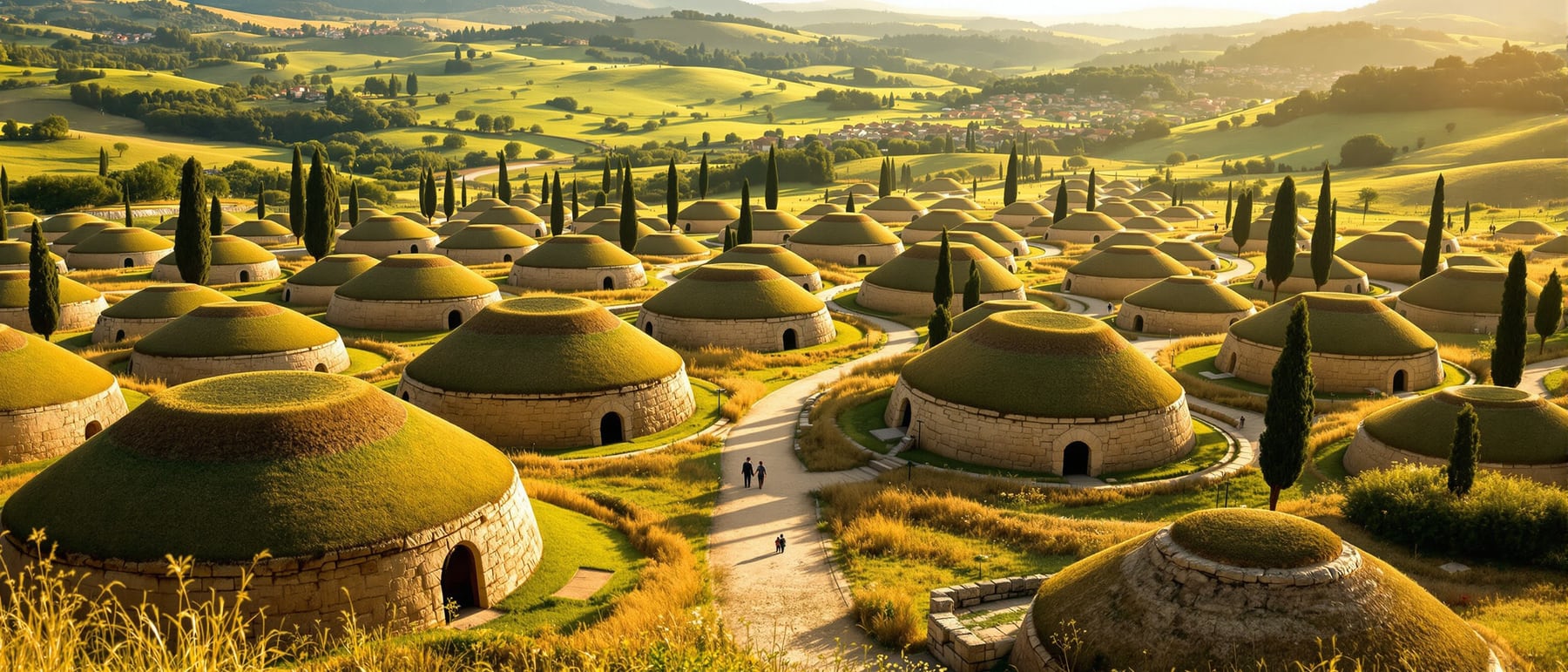
This is the Banditaccia necropolis at Cerveteri — the great cemetery of Caere, one of the wealthiest cities of the Etruscans, the brilliant civilisation that ruled central Italy before Rome and taught Rome much of what it knew. Just north-west of Rome, across a green landscape, thousands of Etruscan tombs stand ranged along ancient avenues: round grassy mounds and neat rows of stone "houses," a city of the dead so complete that walking through it is the closest anyone can come to walking through a living Etruscan town. And that is exactly why it matters more than almost any tomb on earth.
This is the forty-first article in our Architectural Wonders series.
1. A city built for the dead
The first shock of Cerveteri is not any single tomb. It is the town plan.
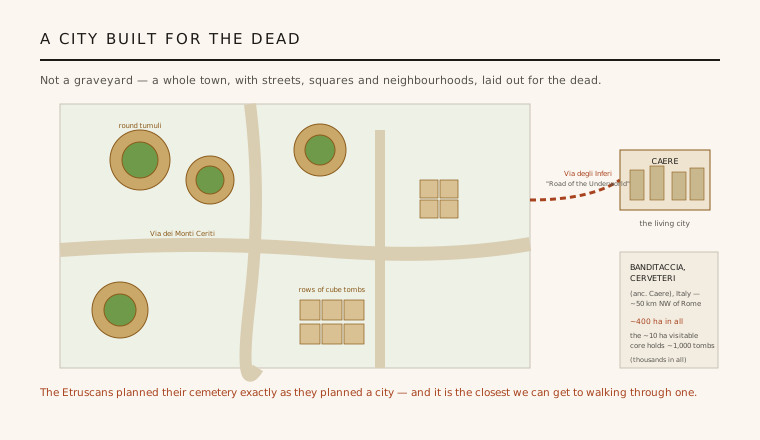
The Banditaccia is laid out exactly like a real city — with streets and avenues, small squares, and "blocks" of tombs grouped into neighbourhoods. Two of its ancient streets still bear names; a great sunken road cut deep into the rock, the Via degli Inferi — the "Road of the Underworld" — once linked the living city of Caere to this city of its dead. The scale is staggering: the whole necropolis spreads across roughly four hundred hectares (the largest ancient cemetery in the Mediterranean), and even the fenced, visitable core of about ten hectares holds some thousand tombs. The Etruscans, in other words, did not simply bury their dead — they urban-planned for them, giving the departed the same avenues and quarters as the living. To grasp why they did this, and why it is so precious to us, you have to understand what has been lost.
2. A stone photograph of a lost world
Here is the extraordinary thing about the Etruscans: for all their wealth and sophistication, almost none of their actual cities and houses survive. And this necropolis is the reason we can picture them at all.
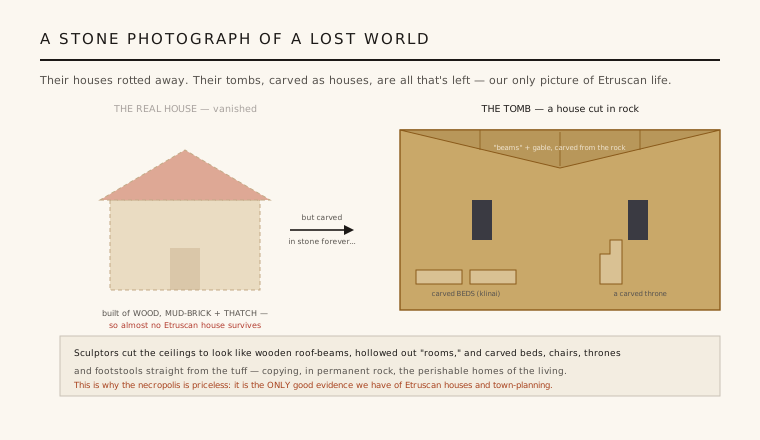
The Etruscans built their homes and temples largely of wood, mud-brick and thatch — materials that have almost entirely rotted away. So we have scarcely any Etruscan houses left to study. But their tombs were cut into solid volcanic tufa, and — this is the key — they were carved to imitate real houses. Inside a Cerveteri tomb you find ceilings cut to look like wooden roof-beams and gables, doorways between several "rooms," and even furniture carved from the living rock — beds and banqueting couches, chairs, thrones, footstools. The sculptors copied, in permanent stone, the perishable homes of the living. And so the necropolis became, by accident of survival, a stone photograph of a vanished world: our only good evidence of what Etruscan domestic architecture and town planning actually looked like. It is the same instinct we saw in the Egyptian "house of eternity" at the Tomb of Seti I — the tomb as a home for the afterlife — but here it accidentally preserved an entire civilisation's idea of home.
3. From round mounds to city blocks
Walk the streets in order of age and you witness something remarkable: an idea being invented — the planned town itself.
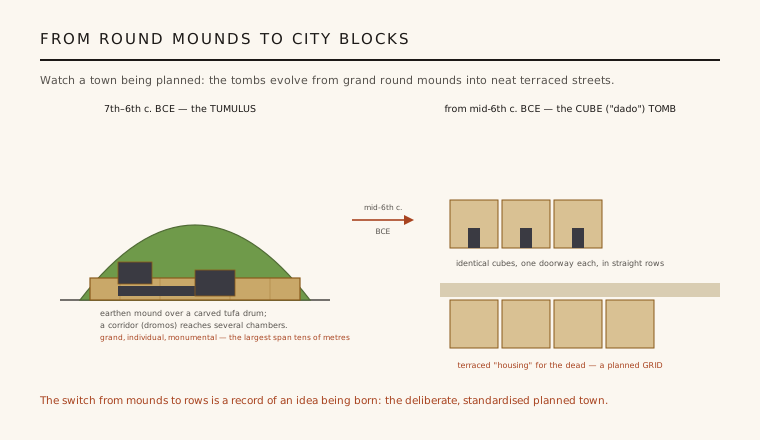
The oldest and grandest tombs, from the 7th and 6th centuries BCE, are tumuli — great circular earthen mounds raised over a drum of carved tufa, each covering a corridor and several rock-cut chambers, the largest spanning tens of metres. They are individual, monumental, each family's own hill. But from the mid-6th century BCE something changes: the tombs become standardised cubes — the "dado" tomb, each a neat stone box with a single doorway — and they are lined up in straight rows along regular streets, like terraced houses. In that shift from grand private mounds to orderly identical rows, you are watching the birth of formal town-planning — the same disciplined grid the Etruscans would pass to Rome, and Rome to the world. The city of the dead was, quite literally, a laboratory for how to lay out a city.
4. The house that shows everything they owned
Among the thousand tombs, one is unlike any other on earth — and it is the reason we know the Etruscans not as an abstraction, but as people who owned things and loved their pets.
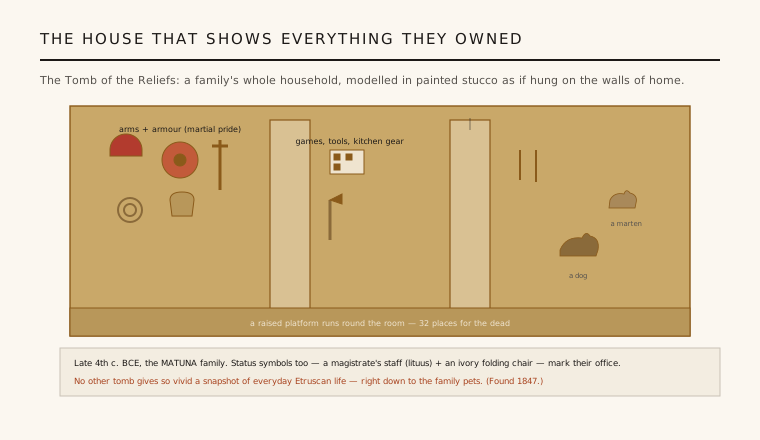
The Tomb of the Reliefs, cut for the Matuna family in the late 4th century BCE, is decorated not with paintings but with painted stucco relief covering its walls and pillars — and what it models is a family's entire household. Sculpted as if hung from nails on the walls of a real home are tools, helmets, shields and swords, kitchen pots and utensils, coils of rope, a board game — and, delightfully, the family pets, a dog and a marten. There are status symbols too: a magistrate's staff and an ivory folding chair that proclaim the family's rank. A raised platform runs around the room with thirty-two places for the dead. No other tomb anywhere gives so intimate, so domestic a snapshot of ancient daily life — the Etruscans reduced to the wonderfully human sum of their possessions and their pets. It is the same impulse we felt at the Tomb of Seti I — to carry the whole of life into the tomb — but where the pharaoh took the gods, the Matuna took their kitchenware and the dog.
5. An afterlife of feasting
Why furnish a tomb like a home, with beds and kitchenware and gold? Because of what the Etruscans believed death was — and it is one of the most life-affirming visions of the afterlife any culture has produced.
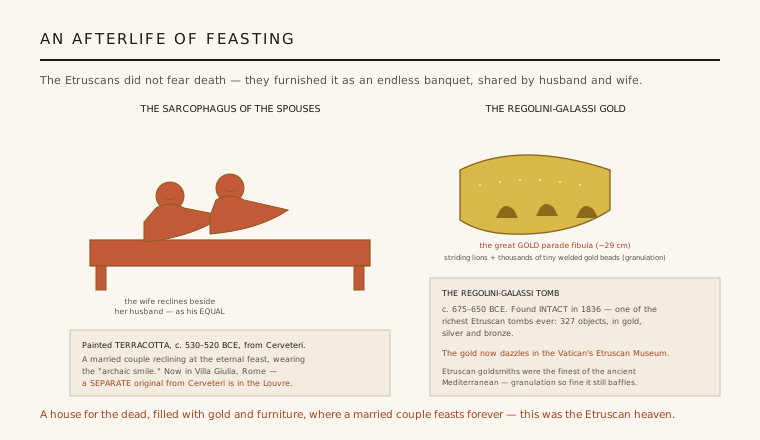
To the Etruscans, the afterlife was an eternal banquet — and the couple went to it together. Nothing captures this like the famous Sarcophagus of the Spouses, made of terracotta at Cerveteri around 530–520 BCE: a husband and wife reclining side by side on a banqueting couch, wearing the serene "archaic smile," the wife beside her husband as an equal (Etruscan women enjoyed a status that startled the Greeks and Romans). It now reclines in the Villa Giulia museum in Rome, with a separate, near-identical original from Cerveteri in the Louvre. And these tombs were filled with treasure for that eternal feast: the Regolini-Galassi tomb, found intact in 1836, held 327 objects — among them a breathtaking gold parade fibula, some twenty-nine centimetres long, worked with striding lions and thousands of tiny welded gold beads so fine the technique still amazes goldsmiths, now glowing in the Vatican's Etruscan Museum. A house for the dead, furnished with beds and gold, where a married couple feasts forever: that was the Etruscan heaven. Unlike the anxious, hidden tombs of Egypt, Cerveteri feels less like a place of dread than a place of welcome — which may be its most human lesson of all.
6. What a modern architect can learn from Cerveteri
- To design for the dead is to record the living. Because they built the necropolis as a town of houses, the Etruscans unwittingly preserved their entire domestic world. What we build for one purpose can become priceless evidence for another; build honestly, and you archive your age.
- Plan the whole, not just the object. Cerveteri's wonder is its urbanism — streets, squares, blocks — not any single tomb. The relationships between buildings, the spaces you move through, are as much "architecture" as the buildings themselves.
- Standardisation is a design achievement. The shift to identical cube tombs in orderly rows was the birth of town-planning. Repeatable, rational units — terraced housing, the grid — are not a lesser architecture; they are a civilisation learning to organise space.
- Let the ordinary in. The Tomb of the Reliefs is immortal precisely because it shows pots, games and pets. Buildings that honour everyday life — not only the heroic and the sacred — speak most warmly across the centuries.
- Architecture expresses what a culture believes. Cerveteri's welcoming houses-for-the-dead flow directly from a belief in a joyful afterlife. Your buildings inevitably declare your values; make sure they declare the ones you mean.
- Perishable is human; permanent is memory. The Etruscans lived in wood and mud-brick and built their tombs in stone. There is wisdom in knowing which things should last forever — and a poignancy in the fact that we remember a people best by where they buried their dead.
References & further reading
1. UNESCO World Heritage Centre — Etruscan Necropolises of Cerveteri and Tarquinia (inscribed 2004). https://whc.unesco.org/en/list/1158/
2. World History Encyclopedia — Cerveteri. https://www.worldhistory.org/Cerveteri/
3. Smarthistory (Khan Academy) — The Regolini-Galassi tomb and the Parade Fibula. https://smarthistory.org/regolini-galassi-tomb-and-parade-fibula/
4. Smarthistory (Khan Academy) — Sarcophagus of the Spouses. https://smarthistory.org/sarcophagus-of-the-spouses-rome/
5. Vatican Museums — Gregorian Etruscan Museum: the Regolini-Galassi Tomb. https://www.museivaticani.va/content/museivaticani/en/collezioni/musei/museo-gregoriano-etrusco.html
6. Encyclopaedia Britannica — Caere. https://www.britannica.com/place/Caere
Last verified 2026-07-04. Figures follow UNESCO and standard archaeological sources and are given as widely cited approximations. The Banditaccia is the principal necropolis of ancient Caere (modern Cerveteri, ~50 km NW of Rome); its tombs span the 9th–3rd centuries BCE, with the monumental tumuli mainly 7th–6th c. BCE and the shift to grid-planned cube ("dado") tombs from the mid-6th c. BCE. Area figures should be kept distinct: the whole necropolis is ~400 ha, the visitable core ~10 ha with ~1,000 tombs (the UNESCO-inscribed property is a separate ~197 ha measure); "thousands of tombs" refers to the whole necropolis. Maximum tumulus diameters are given loosely ("tens of metres") as a single authoritative figure was not confirmed. The Tomb of the Reliefs (Matuna family, discovered 1847) dates to the late 4th c. BCE; the Regolini-Galassi tomb (found intact 1836, c. 675–650 BCE) yielded 327 objects including the ~29.2 cm gold parade fibula now in the Vatican's Gregorian Etruscan Museum. The terracotta Sarcophagus of the Spouses (c. 530–520 BCE, from Cerveteri) is in the Museo Nazionale Etrusco di Villa Giulia, Rome; a separate original from Cerveteri is in the Louvre (not a copy). The town-planning-as-only-evidence and afterlife-banquet framings follow UNESCO's Outstanding Universal Value and mainstream scholarship. The Etruscan Necropolises of Cerveteri and Tarquinia are a UNESCO World Heritage Site (2004).
Export this guide
Related Guides — Deep-dive reading
Cahokia and Monks Mound: The Great City America Forgot
A thousand years ago, across the river from where St Louis now stands, Native Americans built a city of perhaps twenty thousand people — larger than London at the time — with a hundred and twenty earthen mounds, a plaza the size of dozens of football fields, and a solar calendar of cedar posts. At its heart rose Monks Mound, the largest earthwork in the Americas, with a footprint to rival the Great Pyramid. Then, before Europeans ever arrived, it vanished — and almost no one remembers it.
Architectural WondersSomapura Mahavihara: The Buddhist University Hidden Inside a Hill
Twelve hundred years ago in Bengal, a Pala emperor built one of the largest monasteries the Buddhist world had ever seen — a walled quadrangle a fifth of a mile across, ringed by 177 monks' cells, with a great cross-shaped, terraced temple rising from its courtyard. For four centuries scholars came from as far as Tibet to study here; then it was abandoned, and slowly buried, until villagers knew it only as Paharpur — 'the hill-town.'
Architectural WondersThe Pantheon: The Dome That Has Never Been Beaten
Nearly nineteen centuries ago the Romans poured a hemisphere of concrete 43 metres across, left a single round hole open to the sky at its summit, and walked away — and it is still, today, the largest unreinforced concrete dome on Earth. A temple to all the gods that became a church, the best-preserved building of ancient Rome, and the ancestor of every great dome from Florence to the United States Capitol.
Architectural WondersRelated Tools — Try Free
Interior Layout Planner — Printable Graph Grid
Printable graph grid to sketch room layouts to scale before committing to furniture placement.
Layout ToolCircadian Light Meter
Patient-centric circadian lighting visualizer for Indian healthcare design — time-of-day × intensity → CCT, melanopic lux (EML / mEDI), melatonin suppression, and an alertness curve. Calibrated against WELL v2 L03 Circadian Lighting Design, CIE S 026:2018, Brainard 2001, and Lucas et al. 2014.
Circadian ToolFalse Ceiling Cost Estimator
Live ₹/sqft across 8 ceiling types — POP, gypsum, designer, metal, PVC, wooden — with cove and spot lighting for 20 Indian cities.
Cost Calculator