
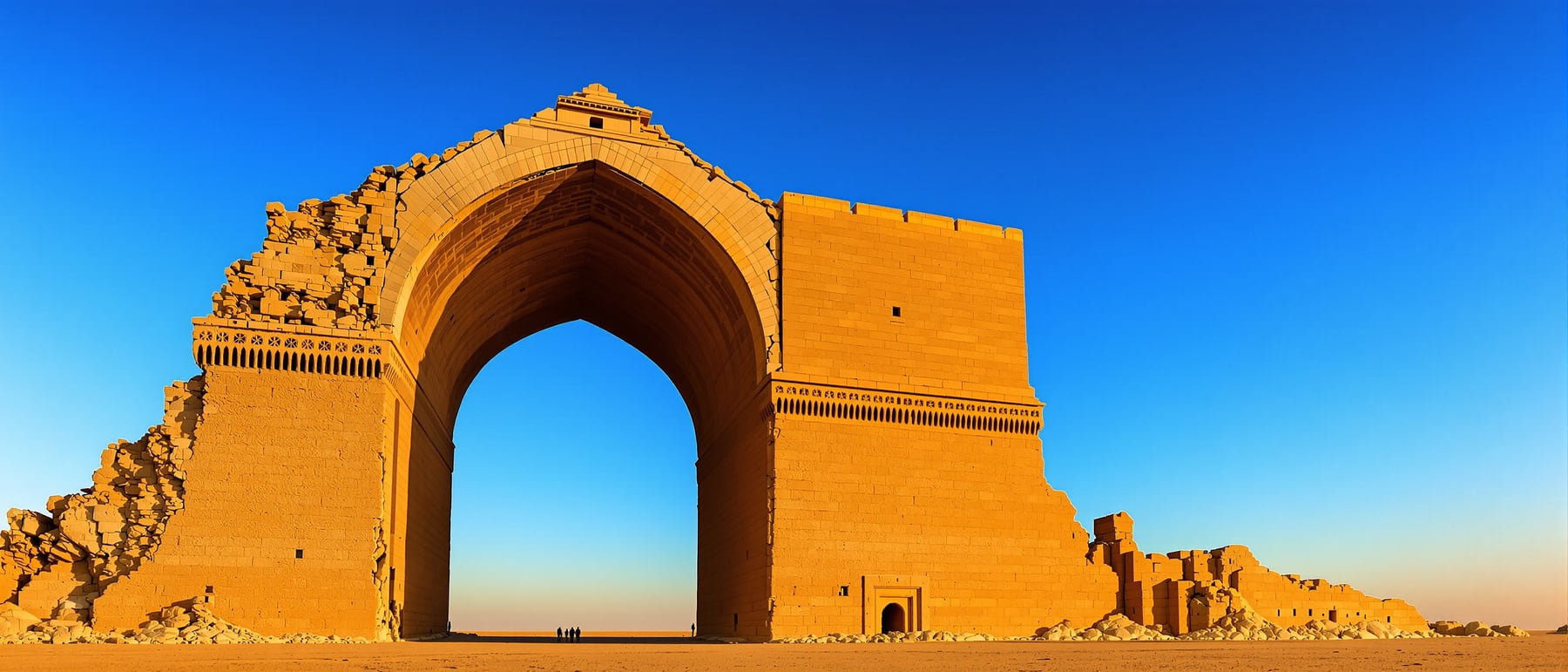
The Arch of Ctesiphon: The Largest Brick Vault the World Has Ever Built
On the Tigris near Baghdad stands a single, staggering arch of bare brick — nearly 37 metres high and the widest unreinforced brick vault ever raised, built without a scrap of wooden scaffolding. It is the ghost throne-hall of the Sasanian Persian kings, the empire that revived the glory of Persepolis; its court was a legend of jewelled carpets and suspended crowns; and it outlived the empire that built it by fourteen centuries. The eighth article in our chapter on the palaces and pleasures of worldly power.
We stay in the world of Persia, but leap forward a thousand years from Persepolis — and to a wonder of a completely different kind. Persepolis was all slender columns and open colonnades, holding up light timber roofs. This is its opposite: a single, overwhelming arch of solid brick, a vault so vast and so daring that no one has ever built a larger one of its kind. It is the last great monument of ancient Persia, and one of the most haunting ruins on Earth: the Arch of Ctesiphon.
This is the seventy-first article in our Architectural Wonders series, and the eighth in our chapter on the great palaces and pleasures of worldly power.
The Taq Kasra — the "Arch of Khosrow" — stands on the bank of the Tigris, about 35 kilometres south-east of Baghdad, in modern Iraq. It is the surviving throne-hall of the royal palace of Ctesiphon, the great capital of the Sasanian empire — the second Persian empire (224–651 CE), which consciously revived the glory of the Achaemenid Persia of Persepolis some nine centuries after Alexander burned it. Beneath this single brick vault, the Sasanian King of Kings ruled as the equal and rival of Rome. And the vault has now outlived him, and his whole empire, by fourteen hundred years.
1. The throne-arch of the King of Kings
To stand before the Taq Kasra is to stand at the gate of a vanished superpower.
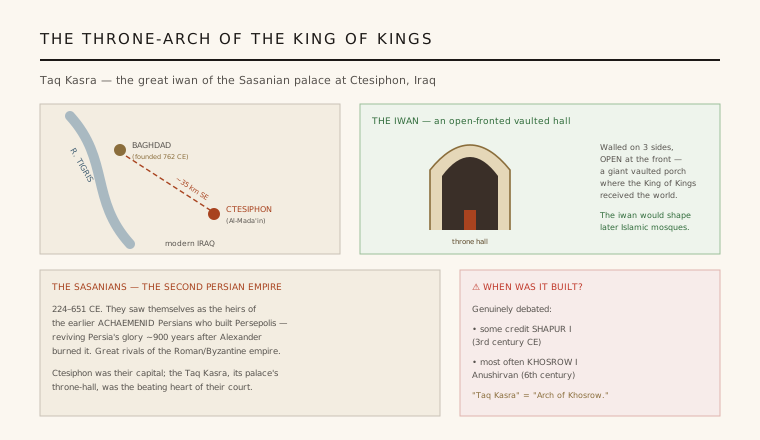
The Sasanians ruled one of the two great superpowers of late antiquity — a Persian empire that stood toe to toe with Rome and Byzantium for four centuries. Their capital was Ctesiphon, a huge cosmopolitan city on the Tigris, and the beating heart of their court was this: an enormous vaulted audience hall called an iwan — a hall walled on three sides and thrown wide open at the front, like a colossal vaulted porch facing the world. Under its vault, on a golden throne, the King of Kings (Shahanshah) received ambassadors, dispensed justice, and displayed a majesty designed to overwhelm. Exactly when it was built is a genuine scholarly puzzle: some attribute it to the 3rd-century king Shapur I, but it is most often credited to the great 6th-century reformer-king Khosrow I Anushirvan — from whom it takes its name, Taq Kasra, "the Arch of Khosrow." Either way, it was the throne-room of an empire that saw itself as the true, ancient Persia reborn.
2. The largest brick arch on Earth
Now the wonder itself — and it is, purely as a feat of building, one of the most staggering in this entire series.
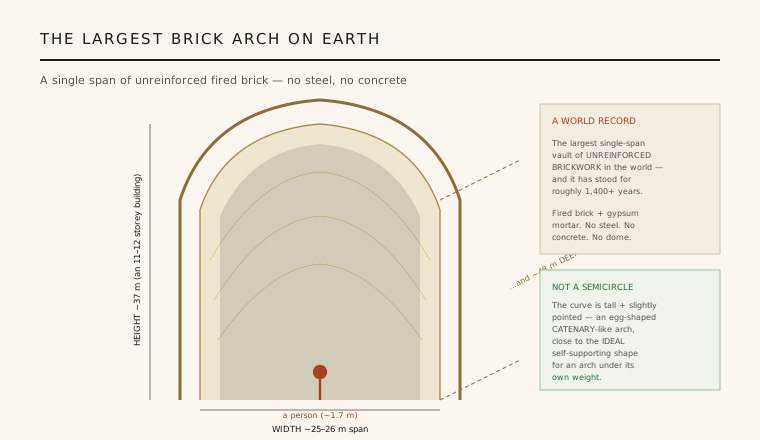
The vaulted hall is about 25 to 26 metres wide, rises roughly 37 metres — the height of an eleven- or twelve-storey building — and runs some 48 metres deep. And here is the astonishing fact: it is, to this day, the largest single-span vault of unreinforced brickwork in the world. Not the largest ancient one — the largest ever, of its kind. It is built entirely of fired brick set in gypsum mortar: no steel, no concrete, no dome to spread the loads in every direction — just a single, unimaginably heavy brick arch, holding itself up across a span of twenty-five metres for the better part of fifteen hundred years. (Where Rome's Pantheon holds the record for the largest unreinforced concrete dome, Ctesiphon holds it for the largest unreinforced brick vault — two rival empires, two different masteries of the very same problem: how to roof a vast space with no steel to help you.) And look closely at its shape: it is not the simple half-circle most people picture when they think "arch." It is a tall, subtly pointed, egg-shaped curve — a catenary-like profile, wide at the base and narrowing as it climbs. That is not decoration. It is close to the ideal shape for an arch to carry only its own weight in pure compression, with no sideways thrust to burst it open — the same deep structural wisdom that engineers would rediscover and formalise more than a thousand years later. The builders of Ctesiphon found it by instinct and experience, and it is why the arch still stands.
3. Built without a frame
The deeper marvel is not that they built so vast an arch, but how — because they built it with no wooden scaffold at all.
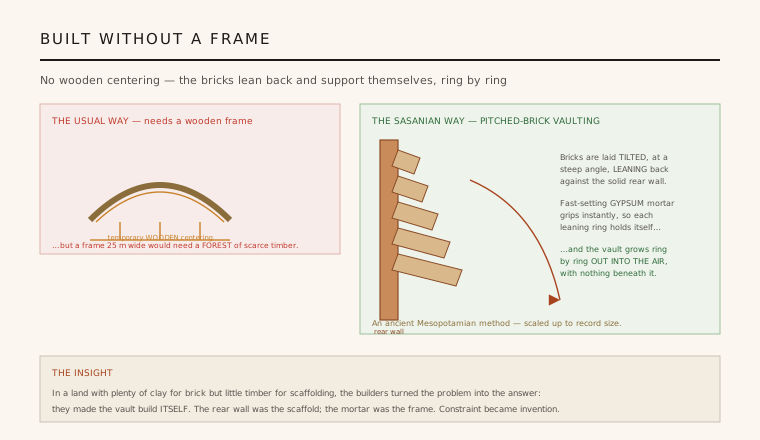
Normally, to build any large arch, masons must first erect a temporary wooden framework — called centering — in the exact shape of the arch, lay the bricks or stones over it while the mortar sets, and strike the timber away once the arch can stand on its own. But a wooden centering twenty-five metres wide and thirty-seven metres tall would have swallowed a forest of timber — and timber was scarce in the treeless plains of Mesopotamia, where the abundant material was river clay for brick. So the Sasanian builders reached for an ancient local trick, pitched-brick vaulting — a brick-building tradition stretching back thousands of years in this same land, to the mud-brick mountains of Sumer like the Ziggurat of Ur — and pushed it to a colossal scale. Instead of laying the bricks flat and horizontal, they set them tilted at a steep angle, leaning back against the solid rear wall of the hall. Each sloping ring of brick leaned on the one behind it and, gripped instantly by fast-setting gypsum mortar, could support itself the moment it was laid — so the vault grew ring by ring, out into empty air, with nothing at all beneath it. It is one of the most elegant solutions in the history of construction: rather than fight the shortage of timber, they turned the wall itself into the scaffold, and the mortar into the frame. Constraint became invention — a lesson the whole of architecture keeps re-learning.
4. A court of legend
Under that vault unfolded a court whose splendour became the stuff of legend across the medieval world.
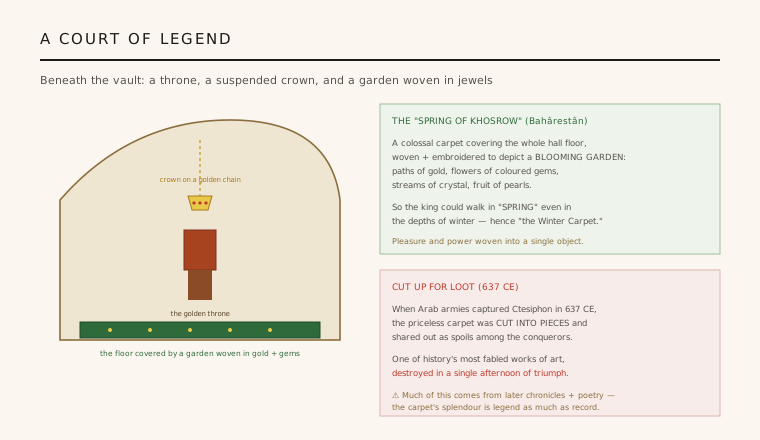
Beneath the great vault, the King of Kings staged majesty on an overwhelming scale. Later histories and legends describe a golden throne, and a crown so massive with jewels that it was said to be suspended on a golden chain from the vault above the king's head, lest its weight crush him. But the most fabled treasure of all lay on the floor: the "Spring of Khosrow" (the Bahârestân, or "Winter Carpet") — a stupendous carpet, said to cover the entire hall, woven and embroidered to depict a blooming garden, with pathways of gold, flowers and fruit of coloured gems and pearls, and streams of glittering crystal, so that the king could walk in eternal spring even in the depths of winter. It is, in a single object, this whole chapter's marriage of pleasure and power — a garden of jewels beneath a throne. And its end is this chapter's other great theme. When Arab armies captured Ctesiphon in 637 CE, they seized the carpet as spoil and cut it into pieces, sharing the fragments out among the conquerors. One of the most extravagant works of art ever made was destroyed in a single afternoon of triumph. (We should be honest that much of this splendour reaches us through later chronicles and poetry — the carpet is as much legend as record — but the awe it inspired was real, and lasting.)
5. The arch that outlived its empire
And so to the ending — which is, for this series, almost unbearably fitting.
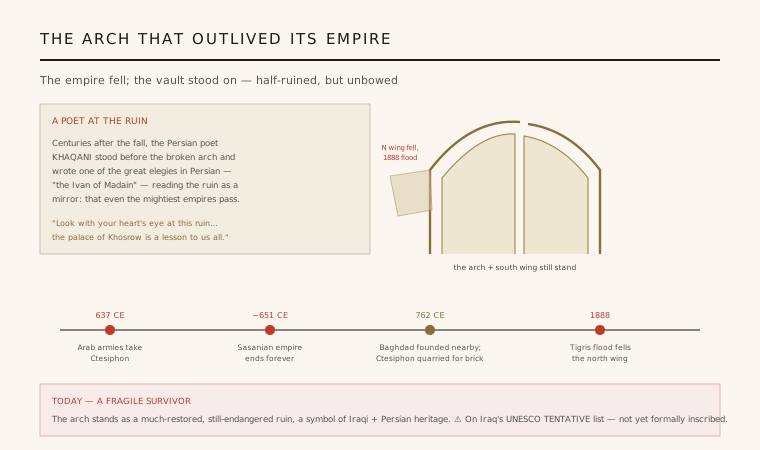
Within a few years of that looted carpet, the Sasanian empire was gone. Arab Muslim armies shattered the Persian army, took Ctesiphon in 637 CE, and by around 651 CE the four-hundred-year empire had ended forever. In 762 CE the new Abbasid capital of Baghdad rose just up the river, and over the centuries Ctesiphon was abandoned and slowly quarried for its bricks. And yet — the great arch would not fall. It stood on, half-ruined but unbowed, through the entire span of Islamic history. In 1888, a great flood of the Tigris finally brought down the northern wing of its decorated facade; but the southern wing, and the mighty arch itself, still survived. Centuries before that, a Persian poet named Khaqani had journeyed to the ruin and written one of the most famous elegies in the Persian language — the Ivan of Madain — standing before the broken vault and reading it as a mirror held up to all human pride: that even the palace of the King of Kings becomes a lesson, and every empire, however mighty, passes away. It is the exact meditation this series keeps circling back to, written on the very stone. Today the Taq Kasra survives as a fragile, much-restored ruin, a beloved symbol of both Iraqi and Persian heritage — and, honestly noted, it sits on Iraq's tentative list for UNESCO World Heritage status, but is not yet formally inscribed. It remains what Khaqani saw: the largest brick arch on Earth, standing alone on an empty plain, outliving everyone who ever knelt beneath it.
6. What a modern architect can learn from the Arch of Ctesiphon
- Let constraint drive invention. No timber for scaffolding became the reason for one of history's most ingenious techniques — the self-supporting pitched-brick vault. The tightest limitation, faced honestly, is often the doorway to originality. Ask not "how do I get around this constraint?" but "what does this constraint make possible?"
- Find the form that carries itself. The catenary-like arch stands because its shape channels its whole weight into pure compression. The most enduring structures obey the natural logic of forces rather than fighting it. Learn how loads actually want to travel, and give them a path — the result is both stronger and, usually, more beautiful.
- Use the material of the place. Ctesiphon is a triumph of humble river brick, in a land that had brick and little else. Great architecture rarely comes from importing the perfect material; it comes from mastering the local one so completely that its limits vanish. Know what your ground gives you.
- One great space can be a whole building. The Taq Kasra is essentially a single, overwhelming room — and that was enough to awe an empire and outlast it. Sometimes the most powerful architecture is not complexity but one idea, executed at a scale and quality no one can forget.
- The threshold is the throne. The open iwan made the act of approaching the king a piece of theatre — you walked, small, into a vault the size of the sky. What a building does at its great opening can carry the entire message of the power within. Design the moment of entry as the climax, not the preamble.
- Build to outlive your own certainties. The empire that raised this arch believed itself eternal, and it was gone in a lifetime; the arch it left behind has lasted fourteen centuries and become a poem about impermanence. We cannot know which of our works will endure — so build each one honestly and well, because the thing that survives may carry a meaning we never intended, to people we will never meet.
References & further reading
1. World History Encyclopedia — Ctesiphon and Taq Kasra. https://www.worldhistory.org/ctesiphon/
2. Encyclopaedia Britannica — Ctesiphon and Sasanian dynasty. https://www.britannica.com/place/Ctesiphon
3. Encyclopædia Iranica — Ayvān-e Kesrā (Taq-e Kasra). https://iranicaonline.org/articles/ayvan-e-kesra-palace
4. UNESCO World Heritage Centre — Ctesiphon (Iraq Tentative List). https://whc.unesco.org/en/tentativelists/
5. Lionel Bier — "The Taq-i Kisra at Ctesiphon" (architectural study; on the vault and pitched-brick construction). https://www.jstor.org/
6. The Metropolitan Museum of Art — Sasanian Empire (224–651). https://www.metmuseum.org/toah/hd/sasa/hd_sasa.htm
*Last verified 2026-07-05. Figures follow the World History Encyclopedia, Britannica, Encyclopædia Iranica, the Metropolitan Museum of Art and standard scholarship, and are given as widely cited approximations that vary by source. The Arch of Ctesiphon (Taq Kasra / Ṭāq Kisrā; Ayvān-e Kesrā / "Iwan of Madain") is the vaulted throne-hall (iwan) of the Sasanian royal palace at Ctesiphon (Al-Madāʾin), on the Tigris ~35 km south-east of Baghdad, Iraq. Ctesiphon was the capital of the Parthian and then Sasanian Persian empires; the Sasanians (224–651 CE) were the second Persian empire and heirs to the Achaemenids of Persepolis. Dating is debated: attributed by some to Shapur I (3rd c. CE), but most often to Khosrow I Anushirvan (r. 531–579 CE). The single-span brick vault is ~25–26 m wide, ~37 m high and ~48 m deep — the LARGEST single-span vault of unreinforced brickwork in the world; built of fired brick and gypsum mortar in a tall, pointed/elliptical (catenary-like) profile that approximates the ideal compression shape. It was built WITHOUT wooden centering, using pitched-brick (leaning-course) vaulting — bricks set at a slant against the rear wall, self-supporting via fast-setting gypsum mortar — an ancient Mesopotamian technique scaled up. The Sasanian court beneath it was legendary (golden throne; a jewelled crown reputedly suspended on a chain; the "Spring of Khosrow"/Winter Carpet, the Bahârestān, a colossal garden-carpet of gold, gems and pearls), though much of this derives from later chronicles/poetry. Arab Muslim forces captured Ctesiphon in 637 CE (after the battle of al-Qādisiyyah); the carpet was reportedly cut up as loot; the Sasanian empire fell c. 651 CE. Baghdad was founded nearby in 762 CE and Ctesiphon was later quarried for brick. The northern facade wing collapsed in a Tigris flood in 1888; the arch and southern wing survive as a fragile, repeatedly restored ruin (recent conservation campaigns). The 12th-century Persian poet Khaqani's ode "Aivan-e Madain" ("the Iwan of Madain") elegises the ruin as a meditation on the impermanence of empires. Ctesiphon is on Iraq's UNESCO World Heritage TENTATIVE list but is NOT formally inscribed. This is the eighth article in the "palaces and pleasures of worldly power" chapter of the Architectural Wonders series.
Export this guide
Related Guides — Deep-dive reading
Persepolis: The Palace Where Every Nation Came Bearing Gifts
On a vast stone terrace in southern Iran, the kings of Persia built the grandest ceremonial capital of the ancient world — a forest of impossibly tall columns whose walls, unlike those of any conqueror before them, carved not war and captives but a peaceful procession of twenty-three nations bringing gifts. It is the gentlest image of empire the ancient world produced — until Alexander burned it to the ground. The third article in our chapter on the palaces of worldly power.
Architectural WondersChan Chan: The Vast City of Mud Where Every King Built His Own Palace
On the desert coast of Peru sprawl the ruins of the largest city ever built of mud — a thousand-year-old capital of adobe walls three storeys high, carved with fish and seabirds, that survived only because it almost never rains. It was a city of ten royal palaces, one for each king, driven by a strange rule of inheritance; and today, an earthen city in a warming world, it is racing the rain to survive. The ninth article in our chapter on the palaces and pleasures of worldly power.
Architectural WondersGreat Zimbabwe: The Stone City Europe Refused to Believe Africans Built
In the hills of southern Africa stand the largest ancient stone ruins south of the Sahara — a whole city of massive granite walls built without a drop of mortar, the wealthy capital of a gold-trading kingdom. For a century, colonists refused to accept that Africans had raised it, and invented every other builder they could. This is the story of that architecture, and of the lie it outlived. The article that closes our chapter on the palaces and pleasures of worldly power.
Architectural WondersRelated Tools — Try Free
Acoustic Privacy (STC) Visualizer
Indian healthcare acoustic visualizer — compare wall assemblies and noise sources, see received SPL after STC attenuation, and check FGI 2018 / IS 1950 / NABH speech-privacy compliance with live dual-canvas waveform.
Acoustic ToolBefore & After Studio
Generate AI before-and-after renders to preview how your redesign could look.
DesignAIFalse Ceiling Cost Estimator
Live ₹/sqft across 8 ceiling types — POP, gypsum, designer, metal, PVC, wooden — with cove and spot lighting for 20 Indian cities.
Cost Calculator