
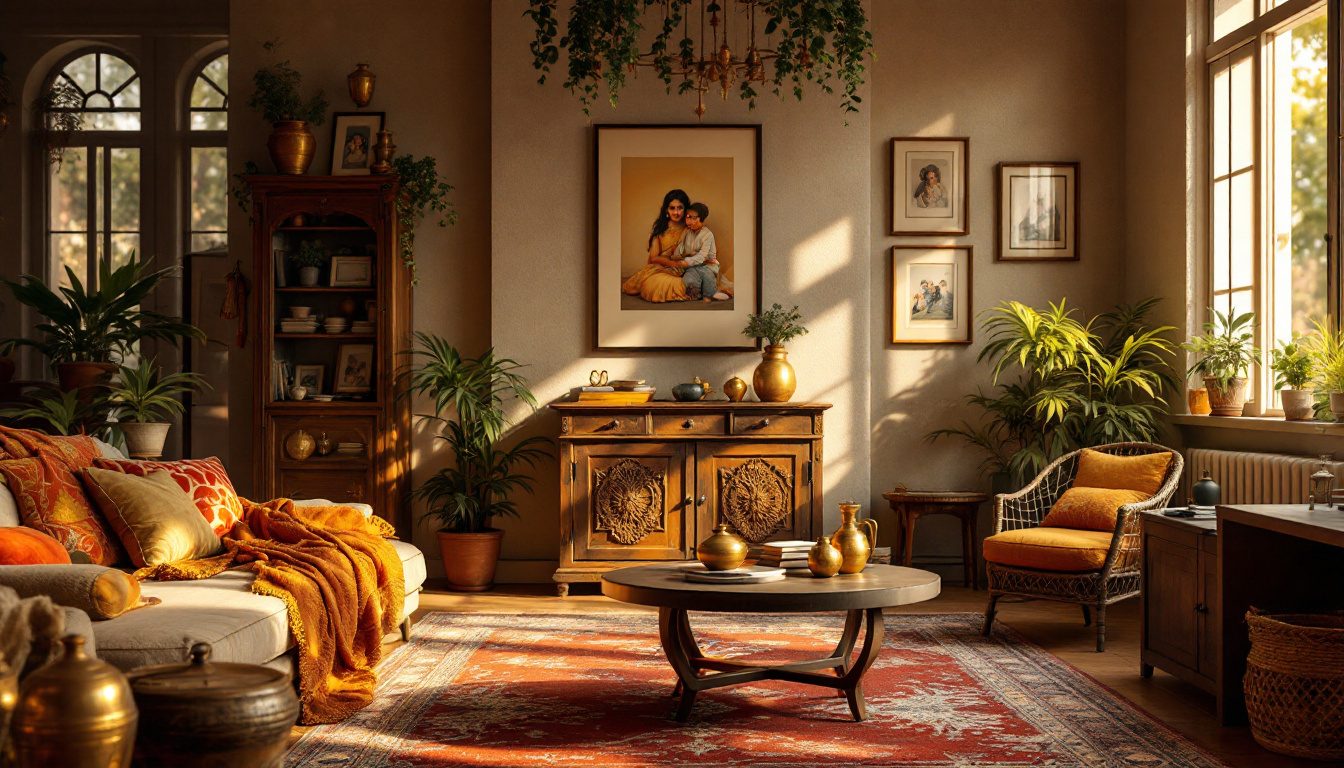
The Importance of Nostalgia in Making a House Feel Like Home
Why a perfectly styled room can feel like a hotel while a home full of inherited objects, ageing materials and ritual feels alive — the psychology of place attachment, and how to design for memory in the Indian home.
Walk into a freshly handed-over flat — every surface clean, the sofa straight from the showroom, the cushions karate-chopped into perfect peaks — and a strange thing happens. It looks wonderful and feels like nothing. You could be in a hotel, a furniture catalogue, anybody's home. Now walk into your grandmother's house: the brass urli by the door gone soft and dark with decades of polishing, the almirah that smells faintly of camphor and old cotton, the worn patch on the floor where the jhula has swung for forty years. Nothing in that house would survive a styling shoot. Everything in it says you are home.
This guide is about the gap between those two rooms — the difference between a house that is designed and a house that is loved. It is the gap most people cannot name: the reason a beautifully renovated home can leave its owners faintly disappointed, and the reason a slightly imperfect, memory-soaked house feels alive. We will look at the psychology of why this happens, the design moves that build belonging, and the very Indian materials, objects and rituals that turn four walls into the place your heart settles.
A house becomes a home not when it is well designed but when it holds memory and meaning — when the objects, materials, light and rituals inside it are bound to a life that has been lived there. Style makes a room photogenic; memory makes it yours.
The hotel-room feeling, and why it haunts us
Almost everyone has felt it. The renovation is finished, the budget is spent, the photos look like the magazine you tore the page from — and yet, sitting in the room a week later, something is missing. Designers have a name for it: the space feels "decorated" rather than "inhabited." Environmental psychologists have a deeper name for what is absent — place attachment, the emotional bond between a person and a particular setting, built up slowly through experience, repetition and memory.
A new room, however beautiful, has no biography. It carries no trace of who you are, where you came from, or what has happened in it. It is, quite literally, anonymous. This is exactly why a hotel suite — engineered to be pleasant for everyone and personal to no one — can be flawless and still leave you cold. It is designed for an average guest, and you are not average. You are a specific person with a specific history, and home is the one place that is supposed to know that.
The geographer Yi-Fu Tuan gave us the word topophilia — literally "love of place" — for the affective bond between people and their environment. In his 1977 book Space and Place, he drew a careful distinction: space is abstract, open, undifferentiated freedom; place is space that has acquired meaning through our experience of it. A new flat is space. The home you grew up in is place. The whole work of making a house feel like home is the work of turning space into place — and you cannot buy that finished. You can only grow it.
A house full of beautiful things you have just acquired is a stage set. A house full of ordinary things you cannot bear to part with is a home. The difference is not money — it is memory.
What the mind is actually doing: the poetics of inhabited space
The most influential meditation on this is Gaston Bachelard's The Poetics of Space (1958), a book read as often by psychologists as by architects. Bachelard argued that the house is not merely a shelter or an arrangement of rooms — it is "the topography of our intimate being," the structure through which we organise memory and imagination. The corners we hid in as children, the stairs we climbed half-asleep: the spaces of the childhood home become the permanent furniture of the psyche. We carry our first home inside us for life, and we measure every later home against it, mostly without knowing.
This is why nostalgia is not sentimental clutter — it is a genuine human need. The word comes from the Greek nostos (homecoming) and algos (pain), originally a diagnosis of acute homesickness, but modern research has reframed it as psychologically protective. Work by Constantine Sedikides, Tim Wildschut and colleagues at the University of Southampton has shown across many studies that nostalgia increases social connectedness, self-continuity (the sense that you are the same person across time) and meaning in life, and can even buffer loneliness. A home that triggers nostalgia is, quite literally, doing emotional work for you every day.
There is also a strong sensory layer. Smell in particular has a famously direct line to memory and emotion — the olfactory bulb wires almost straight into the limbic system, which is why a single scent can collapse decades in an instant. The smell of a wooden cupboard, of agarbatti in the morning, of rain on a hot courtyard floor, of your mother's cooking — these are not decoration. They are the strongest memory triggers a home owns, and almost no one designs for them.
| Sense | Anonymous home | Home that holds memory |
|---|---|---|
| Smell | Fresh paint, new MDF, room spray | Old wood, camphor, agarbatti, rain on stone |
| Sight | Matched showroom set, bare surfaces | Inherited objects, framed faces, layered things |
| Touch | Smooth new laminate, plastic | Worn wood, cool brass, a soft old chair |
| Sound | Hard, echoing, TV-loud | A swing's creak, a clock, courtyard birds |
| Light | Flat, even, switched on | Changing daylight, lamps, a diya's flicker |
Why patina beats polish
There is a deep reason heirlooms feel alive and new things feel inert, and it is partly material. Some materials improve with age; others merely decay. This single distinction quietly decides whether a home grows richer over decades or just gets shabby and gets replaced.
Solid wood develops a patina — the surface mellows, deepens and gains a soft glow from years of handling. Brass and copper acquire a living surface that shifts from bright gold to deep antique brown, which is why temple bells and old urlis are more beautiful at eighty than at one. Stone — Kota, granite, marble, terracotta — wears smooth and takes on the faint topography of feet. Leather creases into the shape of the people who used it. These materials carry time visibly and beautifully, which is exactly what makes them feel like memory made solid.
Plastics, laminates, MDF, vinyl wraps and most synthetics do the opposite. They are at their best on day one and decline from there: laminate chips and cannot be repaired, the printed wood-grain peels, the plastic yellows. They have no patina, only wear — a home built mostly of such materials can never earn the look of a loved house, because its surfaces are designed to be discarded, not aged. The Japanese aesthetic of wabi-sabi — finding beauty in the imperfect, impermanent and incomplete — names what we tend to fight: that the marks of time and use are not damage but character.

| Material | What time does to it | Memory value |
|---|---|---|
| Solid teak, rosewood, sheesham | Deepens, glows, can be re-oiled and repaired | Very high — improves for generations |
| Brass, copper, bronze | Develops antique patina; re-polishable | Very high — the more handled the better |
| Natural stone (Kota, granite, marble) | Wears smooth, gains soft sheen | High — ages with grace |
| Terracotta, lime plaster, kadappa | Mellows, breathes, takes on age | High — vernacular and forgiving |
| Genuine leather, handloom cotton, jute | Creases, softens, fades pleasingly | Medium–high — ages into comfort |
| Laminate, MDF, particle board | Chips, swells, peels; unrepairable | Low — designed to be replaced |
| Plastic, vinyl, acrylic | Yellows, cracks, scratches dully | Low — no patina, only decay |
When you choose where to spend on materials, this is the most underrated reasoning of all. The pieces you want around for life — the dining table, the bed, the puja items, the front door — are exactly the ones worth making in materials that age into beauty; the disposable, fashion-driven layers can be the cheaper synthetics. This is not about luxury; it is about buying things that become heirlooms instead of garbage. Our guide on the details that define a home goes deeper into where small, lasting choices carry the most weight.
The Indian home is built for this
If place attachment, sensory memory and patina are the universal ingredients, the traditional Indian home is almost a textbook of how to use them — which is why ancestral houses so often feel more "home" than the flats that replaced them.
The ancestral home and joint-family memory. A traditional house was rarely a single generation's project. It absorbed the lives of grandparents, parents and children at once, layer upon layer: the courtyard where three generations of weddings were blessed, the staircase worn by decades of feet. The very jointness of the joint family meant a house was thick with shared memory in a way a two-year-old nuclear flat cannot be. This is also why the spaces of retreat — a quiet corner, the threshold between public and private — carry such weight; our guide on zones of retreat, rest and privacy explores how a home holds both togetherness and solitude.
The objects with a story. The grandmother's almirah — that tall, dark Godrej or solid-wood cupboard — is the archetype, often the single most loaded object in an Indian home: it holds the silk saris kept for weddings, the documents, the smell of camphor and old cloth, and the memory of every festival it was opened for. The brass and copper vessels passed down, the family mandir inherited from a parent, the framed black-and-white photographs of ancestors, the jhula (swing) creaking on the verandah — each carries a life with it.
Ritual and the spaces that hold it. Indian domestic life is unusually rich in ritual, and rituals need places: the puja corner where the morning aarti happens, the threshold where the rangoli is drawn at Diwali, the kitchen where festival sweets are made to a recipe nobody wrote down, the entrance where the toran goes up. A ritual repeated in the same spot, year after year, charges that spot with memory. The space is not just used; it is consecrated by repetition.
Regional craft and material. The Chettinad tile floor, the Kerala wood and the nadumuttam courtyard, the Rajasthani jharokha and inlay, the Bengali red-oxide floor, the Channapatna toy on the shelf — regional craft ties a home to a place and a lineage of makers. A handmade object is never anonymous; it carries the hand that made it.
| Indian element | What it carries | How to honour it today |
|---|---|---|
| Grandmother's almirah | Saris, documents, the smell of camphor | Restore, re-oil, use it — do not replace with modular |
| Brass / copper vessels | Generations of festivals and meals | Display, keep polishing; let the patina show |
| Family mandir | Inherited devotion and daily ritual | Give it a real, lit, honoured corner |
| Ancestral photographs | Faces of the people you came from | A dedicated wall, not a stairwell afterthought |
| Jhula / swing | The sound and rhythm of the verandah | Keep or recreate it; rituals love motion |
| Regional craft (tiles, inlay, toys) | A place, a lineage of makers | Mix into modern rooms as anchors, not museum pieces |
Designing for memory without becoming a museum
The risk at the other extreme is real: a home so devoted to the past that it is frozen, dusty and unliveable — a shrine, not a house. Nostalgia becomes a trap when it stops a family from living. The art is to honour memory while keeping the home alive, breathing and current. A few principles keep the balance.
Give heirlooms pride of place, not a crowd. One brass lamp lit and beautifully placed says more than a shelf crammed with twenty. The power of a memory-object comes from being seen and used, not stored. Curate ruthlessly — editing is not betrayal of the past; it is respect for it.
Adapt, don't embalm. An old teak almirah can be re-oiled and used as it was, or repurposed as a bar or bookcase. A grandmother's sari can be framed or made into cushion covers. Adaptive reuse keeps an object in daily life rather than behind glass — the only way it goes on accumulating memory. A loved object earns new stories; a museum object is finished.
Mix old and new on purpose. A single heirloom in a clean contemporary room sings far louder than the same piece lost in a roomful of period furniture. Contrast creates focus: one patinated brass lamp on a minimalist sideboard, one ancestral painting on a plain wall, one old swing in a modern verandah — the new frames the old and the old gives soul to the new. This is also the surest way to keep a memory-rich home from tipping into clutter.
Design for the senses, not just the eye. Think about how a room smells (a wooden cupboard, sandalwood, the kitchen), how the light moves across a day (a courtyard, a deep verandah, a low evening lamp rather than a flat tube light), and what it sounds like (the creak of a swing, soft surfaces that don't echo). These are the channels memory runs on. A home that gets the senses right feels like home even before you have lived there long enough to make memories — because it is ready to hold them.
Make space for new memory. The deepest move of all is to design not only for the memories you have but for the ones you have not made yet — the corner where the next generation will be photographed, the table that will host the next thirty Diwalis. A home that feels right is built to gather memory over time, not merely to curate the past. Our pillar guide on why design principles beat magazine examples and the companion on a home that feels right both come back to this: a home is judged over decades, not in a photograph.
What this means for your home
The flat that disappoints its owners after the renovation is almost always one designed for the photograph and not for the life — style and no story. The cure is not more money; it is more meaning. A modest home full of honoured heirlooms, ageing materials and charged ritual spaces will feel more like home than the most expensive showroom interior, because it is doing the one thing a home is for: holding a life. A handful of moves builds it, and most cost little.
1. Inventory what you already have. Before buying anything, gather the family objects that carry real feeling — the almirah, the vessels, the photographs, the swing, a grandparent's chair. A home built outward from genuine heirlooms is half-made before you spend a rupee.
2. Choose three or four anchor objects per room and design the room around them rather than fitting them in as leftovers. The almirah can be the hero of a bedroom; the brass lamp the focal point of an entry. Give each one light and air — a memory-object in shadow does nothing.
3. Spend material money where it becomes an heirloom — solid wood, brass, stone, genuine handloom — and save on the fashionable, replaceable layers. Reread the patina table before signing off on a quote full of laminate.
4. Protect the rituals and their places. Design the puja corner, the festival threshold and the dining table with the most care, because repetition charges them with memory for decades. Use the home lifestyle quiz to surface how your household actually lives — the gathering, the retreating, the celebrating — before you fix the layout.
5. Engage every sense and leave room to grow. Plan for smell, changing light and sound, not just for how the room photographs, and resist finishing the home completely on day one. The deepest beauty of a home is not how it looks the day it is finished, but how it feels on the thousandth ordinary evening, full of the life it has gathered.
How Studio Matrx helps. Memory is personal, but the design moves that let a home hold it — where to place an heirloom so it becomes a focal point, how to mix one patinated antique into a clean modern room, how to light a puja corner, which materials will age into beauty — are things you can see before you commit. DesignAI lets you visualise your own rooms with your own anchor objects in place, so you can feel the difference between a styled room and a home that holds your story, before a single thing is bought or built.
References
1. Tuan, Yi-Fu (1977). Space and Place: The Perspective of Experience. University of Minnesota Press. (Topophilia; the distinction between abstract space and meaningful place.)
2. Bachelard, Gaston (1958). The Poetics of Space. (The house as "the topography of our intimate being"; the childhood home and memory.)
3. Sedikides, C., Wildschut, T., et al. — programme of research on nostalgia (University of Southampton), on nostalgia and social connectedness, self-continuity and meaning in life.
4. Low, S. M. & Altman, I. (1992). Place Attachment. Plenum Press. (The psychology of the person–place emotional bond.)
5. Herz, R. S. — research on odour-evoked autobiographical memory and the limbic link between smell and emotion.
6. Koren, Leonard (1994). Wabi-Sabi for Artists, Designers, Poets & Philosophers. (Beauty in the imperfect, impermanent and incomplete.)
7. Alexander, C., Ishikawa, S. & Silverstein, M. (1977). A Pattern Language — patterns on "Things From Your Life," "Sacred Sites," and the home as an accretion of meaning.
Part of the Studio Matrx Design Principles series. Continue with a home that feels right, the details that define a home, and zones of retreat, rest and privacy.
Export this guide
Related Guides — Deep-dive reading
From Space to Place: Turning Empty Rooms into a Home
How to transform a bare builder flat into a warm, lived-in home — through scale, zones, layering, retreat corners and flow
Design EducationZones of Retreat: Designing Spaces for Rest and Privacy
Why every Indian home needs protected nooks for solitude, focus and recovery — and how prospect-refuge theory helps you carve them from shared, crowded flats.
Design PrinciplesHow to Design a Home That Feels Right — Beyond Just Looks
The invisible design decisions — order, scale, light, craft and memory — that make a home feel like home, not a showroom
Design EducationRelated Tools — Try Free
Apartment Furniture Size Chart
Standard furniture dimensions for Indian apartments — sofas, beds, tables, dining, storage.
Reference ChartFull-Room BOQ — Living, Bedroom, Kitchen, Bath
Room-wise BOQ across living, bedrooms, kitchen, utility, and bathrooms with line-item pricing.
Full-Room BOQFurniture Layout Designer
Smart furniture layouts by flat type (1BHK–4BHK) and design style like Japandi or Contemporary Indian.
Layout Designer