
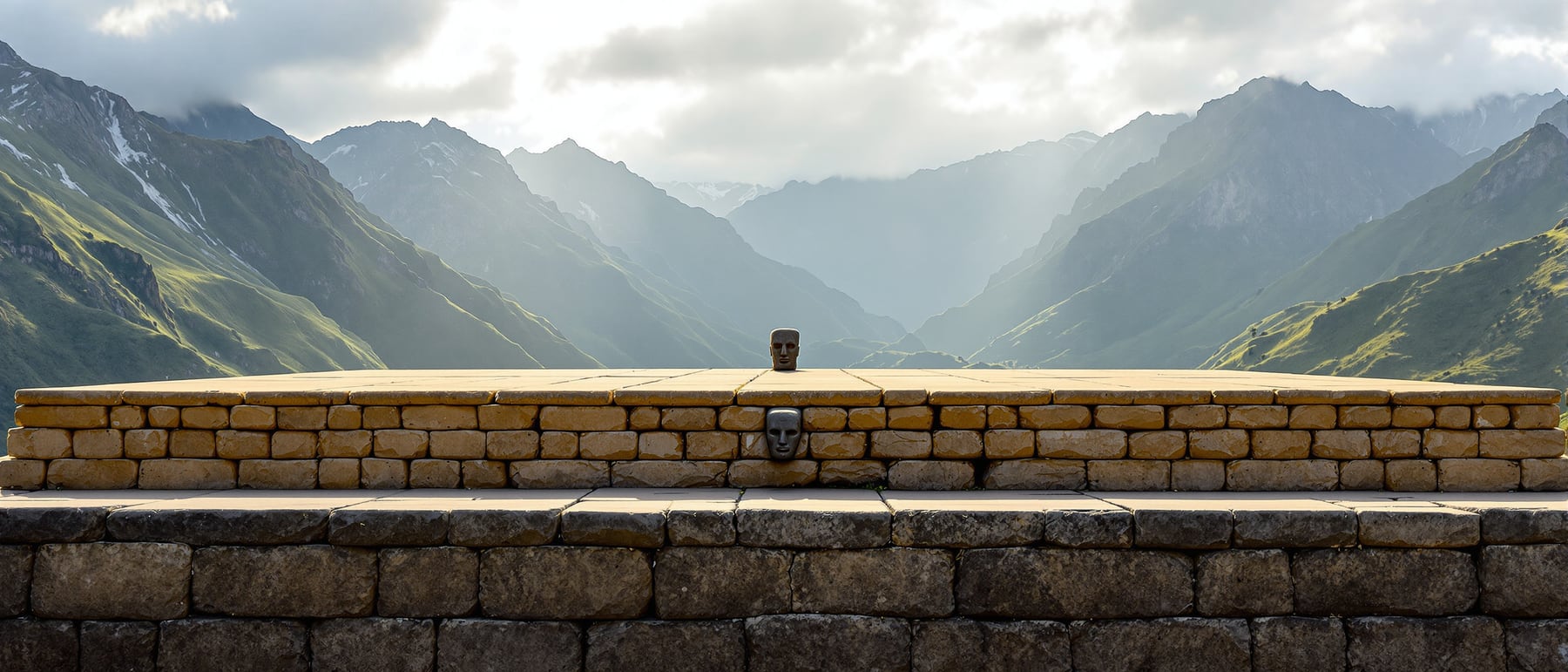
Chavín de Huántar: The Temple That Ruled by Awe
High in the Peruvian Andes, two thousand years before the Inca, a people with no writing and no army built a temple honeycombed with dark stone tunnels — and, at its heart in the pitch black, set a fanged granite god. With conch-shell trumpets, hidden water canals and sacred cactus, they turned architecture itself into a machine for terror and transformation, and drew pilgrims from across Peru without ever conquering a soul.
From Abu Simbel, where the Egyptians aimed the rising sun sixty metres into a mountain to reveal their gods in a blaze of light, we cross the world to the high Andes of Peru — to a temple that did the exact opposite. Here, a people kept their god in permanent darkness, buried at the heart of a maze, and used sound, water and sacred plants to overwhelm anyone who came to meet it. This is Chavín de Huántar, and it may be the most psychologically cunning building in this entire series.
This is the fifty-third article in our Architectural Wonders series, and the sixth in our chapter on the great temples and sacred places of the world.
What makes Chavín extraordinary is not its size — it is not huge — but its strategy. Built by a people with no writing and no standing army, some two thousand years before the Inca, it became one of the most influential places in the ancient Americas. It did so not by conquering anyone, but by becoming a pilgrimage centre so awe-inspiring that its religion, and its fanged art, spread across much of Peru. Chavín is architecture used as an instrument of wonder and control — and to understand how, we have to go inside.
1. A temple at the crossroads of the Andes
Before the god and the darkness, the setting — because Chavín's builders chose their ground with great care.
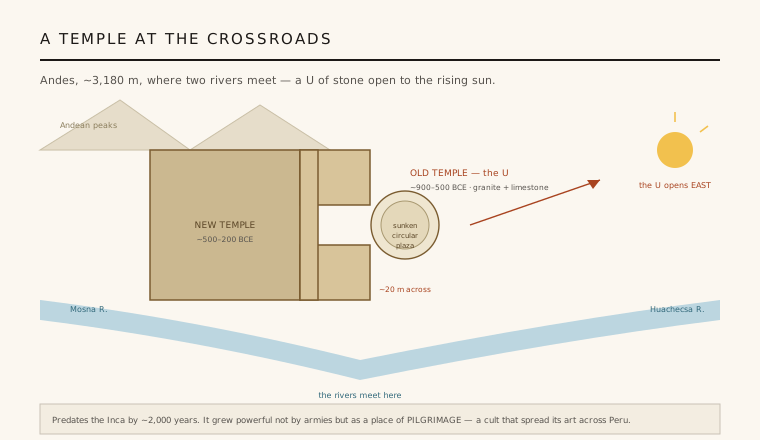
Chavín de Huántar sits at about 3,180 metres in the Peruvian highlands (the Ancash region), at the meeting of two rivers, the Mosna and the Huachecsa — a natural crossroads between the desert coast, the high mountains, and the Amazon beyond. It belongs to the Chavín culture, which flourished roughly 900 to 200 BCE, in what archaeologists call the Andean Formative period — long before the Moche, the Nazca, and some two thousand years before the Inca. Its temples are built of dry-laid granite and limestone blocks and laid out in the classic Andean U-shape: two long platform mounds like arms, embracing a central court that opens toward the east and the rising sun. In the crook of the U lies a beautifully made sunken circular plaza, about 20 metres across. Archaeologists label the older, smaller complex the "Old Temple" (about 900–500 BCE) and the larger, later platform beside it the "New Temple" (about 500–200 BCE) — modern names for a place whose own name for itself is lost. What matters is that this was a destination: people walked for days across brutal terrain to reach it, and Chavín's whole design is built around what happened to them when they arrived.
2. The Lanzón: the god in the dark
At the very centre of the Old Temple, hidden where no daylight has ever reached, stands the thing the whole mountain was built around.
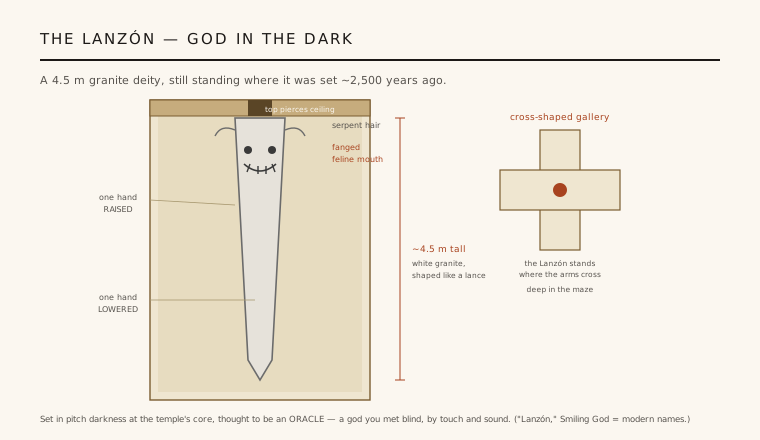
It is called the Lanzón — Spanish for "great lance" — because it is shaped like a colossal blade of stone: a single shaft of white granite about 4.5 metres tall, wider at the top and tapering to a point driven into the floor, like a knife stabbed into the earth (some see instead the form of an Andean digging-stick). It is carved as a deity of pure menace: a snarling mouth with great feline fangs, hair and eyebrows that writhe into snakes, claws, one hand raised and the other lowered, linking the sky and the underworld. And here is the marvel — the Lanzón is still standing exactly where its makers set it, roughly 2,500 years ago, at the crossing-point of a narrow cross-shaped (cruciform) gallery buried deep in the temple's core. Its top even pierces the ceiling into a hidden gallery above, so that a priest could have spoken from over the god's head. To meet it, a pilgrim had to be led, almost certainly in total darkness, through a disorienting stone maze, until they stood before a fanged god they could sense but barely see. Scholars believe it served as an oracle — a god that answered. Whether the answer came from the priest above, we cannot know; but the staging of the encounter is unmistakable, and it is architecture of the highest cunning. (The names "Lanzón" and "Smiling God" are, again, ours, not theirs.)
3. A labyrinth of stone
The Lanzón's power depended entirely on the strange, hollow building around it — because a Chavín temple is not a solid mound.
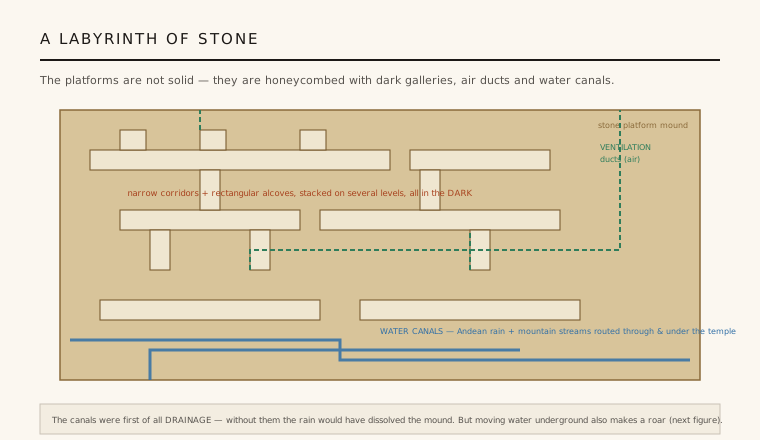
Inside, the platforms are honeycombed with a labyrinth of narrow, stone-lined corridors and small rectangular chambers, stacked on several levels, all in absolute darkness. Threading through the masonry are two hidden feats of engineering that reveal just how sophisticated these builders were. The first is a system of narrow ventilation ducts that let the sealed galleries breathe (without them, a torch — or a crowd — would have used up the air). The second, and more astonishing, is a network of water canals cut through and beneath the temple. Their first purpose was ruthlessly practical: Chavín sits in a valley of heavy Andean rain and flash floods, and without drainage the water would have dissolved the earth-and-stone mound from within. So the builders plumbed the mountain, channelling the rain and the river straight through the sacred core. But — as we are about to see — moving water underground does something else, too. It roars.
4. Stone that roars: sound, plants, and altered states
Put the pieces together — the maze, the darkness, the water, the god — and Chavín reveals itself as something few ancient buildings ever were: a deliberate machine for altering the human mind.
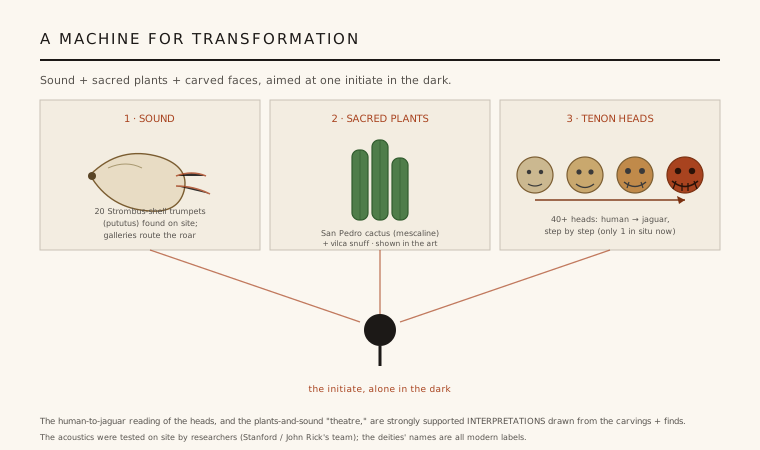
Three forces worked on the pilgrim at once. The first was sound. Archaeologists (John Rick's team, working with acousticians at Stanford) excavated twenty conch-shell trumpets — pututus, made from big Strombus sea shells carried up from the distant coast — and then tested how they sounded inside the galleries. The result: the tunnels and water channels appear to have been shaped so that a blast on a pututu, or the rush of hidden water, would fill the maze and seem to come from everywhere and nowhere — from the very stones, or the god. The second force was sacred plants. The San Pedro cactus, which contains the hallucinogen mescaline and grows in the hills nearby, and snuff from the vilca tree, were used to open visionary states — and the San Pedro is itself carved into Chavín's art, held in the hand of a deity. The third force was the tenon heads (cabezas clavas): more than forty over-life-sized stone heads that once jutted from the temple's outer walls, carved — most scholars believe — as a sequence of transformation, a human face mutating step by step into a snarling jaguar. Imagine the full experience: drugged, deafened by unearthly sound, lost in the dark, walking past a row of stone faces turning into beasts, until you stand before a fanged god — and become, the priests would say, something other than human. The specific readings here (the heads as a transformation sequence; the sound as intentional theatre) are strongly-supported interpretations rather than certainties — but the ingredients are all real, and all found on site.
5. The carved gods, and the cult that spread
Chavín's genius did not stay in the mountains. Its fanged gods, and the art that carried them, travelled across Peru — and made Chavín famous long after it fell silent.
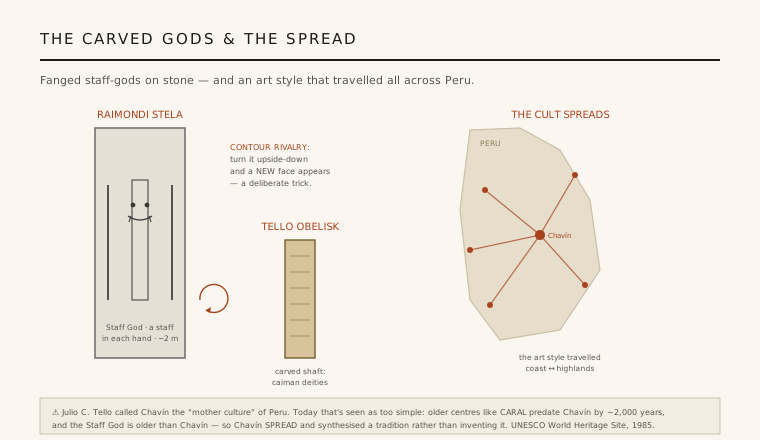
Two more masterpieces of carved stone define the site. The Raimondi Stela is a flat granite slab about two metres tall, incised with the "Staff God" — a fanged deity standing front-on, holding a staff in each hand (the staffs, tellingly, sprout into San Pedro cacti and plants). It is one of the most sophisticated images in ancient American art, famous for contour rivalry: turn it upside down, and the same lines resolve into an entirely different face — a deliberate visual trick that rewards the initiated eye. The Tello Obelisk, a tall carved shaft, is dense with caiman and creature imagery, a whole cosmology in stone. Through images like these, the Chavín art style spread far across Peru, coast to highlands — carried not by armies but by pilgrims and prestige, a shared religion binding distant valleys together. It was so pervasive that the great Peruvian archaeologist Julio C. Tello — the first Indigenous archaeologist of the Americas — called Chavín the "mother culture" of Peru. That claim is now seen as too simple (a fact worth flagging): older centres such as Caral predate Chavín by two thousand years, and the Staff God is older than Chavín itself. Chavín did not invent Andean civilisation — but it gathered, sharpened and broadcast a religious vision more powerfully than anywhere before it. It faded around 200 BCE, its reasons debated; and it was named a UNESCO World Heritage Site in 1985.
6. What a modern architect can learn from Chavín de Huántar
- Architecture can shape a state of mind, not just shelter a body. Chavín's whole plan is aimed at the pilgrim's nervous system — darkness, disorientation, sound, the slow reveal of the god. It is the ancestor of every space designed to move you: the cathedral, the cinema, the museum's darkened gallery. Where Chavín moves the mind through fear and darkness, the Parthenon would later move it through light and serene reason — opposite means to the same end. Ask not only what a space is for, but what it should make a person feel — and design backwards from that.
- Engineering and theatre can be the same act. The water canals were honest drainage and a sound machine; the ventilation kept people alive and served the ritual. The most elegant solutions often make one system do several jobs at once.
- Sequence is everything. Chavín controls not a view but a journey — the long approach, the maze, the dark, the encounter. How you move people through a building, and in what order they discover it, can matter more than any single room.
- You can lead without conquering. Chavín projected power across Peru with no army — through beauty, awe and a shared idea. Influence built on what people are drawn toward can outlast influence built on force.
- Control the light — including its absence. Where Abu Simbel is a masterpiece of letting light in, Chavín is a masterpiece of keeping it out. Darkness is a material. What you choose not to show can be the most powerful thing in the room.
- Be honest about what we can't know. So much of Chavín — the god's name, the oracle's voice, the exact rite — is lost, and good scholars say so. A designer, and a storyteller, earns trust by marking the line between what the stones prove and what we merely, reasonably, imagine.
References & further reading
1. UNESCO World Heritage Centre — Chavín (Archaeological Site) (inscribed 1985). https://whc.unesco.org/en/list/330/
2. World History Encyclopedia — Chavín Civilization. https://www.worldhistory.org/Chavin_Civilization/
3. Smarthistory — Chavín de Huántar and The Staff God at Chavín. https://smarthistory.org/chavin/
4. Rick, J. et al. / Stanford CCRMA — Chavín de Huántar Archaeological Acoustics Project (the pututus and gallery acoustics). https://ccrma.stanford.edu/groups/chavin/
5. Burger, Richard L. — Chavín and the Origins of Andean Civilization (standard scholarly synthesis). https://www.worldcat.org/title/chavin-and-the-origins-of-andean-civilization/oclc/25508400
6. Encyclopaedia Britannica — Chavín. https://www.britannica.com/place/Chavin
*Last verified 2026-07-04. Figures follow UNESCO, the World History Encyclopedia, Smarthistory, the Stanford/John Rick archaeoacoustics work and Richard Burger's scholarship, and are given as widely cited approximations that vary by source. Chavín de Huántar is a ceremonial centre of the Chavín culture in the Peruvian Andes (Ancash region), at ~3,180 m, at the confluence of the Mosna and Huachecsa rivers. The Chavín culture flourished c. 900–200 BCE (some frameworks c. 1200–200 BCE), in the Andean Formative/Early Horizon — roughly two millennia before the Inca. The site is built of dry-laid granite and limestone in a U-shaped plan opening east, with a sunken circular plaza (~20 m diameter); the "Old Temple" (c. 900–500 BCE) and "New Temple" (c. 500–200 BCE) are modern labels. The LANZÓN is a ~4.5 m carved white-granite monolith of a fanged, serpent-haired deity (one hand raised, one lowered), still in situ at the crossing of a cruciform gallery deep in the Old Temple, its top piercing the ceiling into a gallery above; interpreted as an oracle ("Lanzón"/"Smiling God" are modern names). The platforms are honeycombed with dark galleries, ventilation ducts and water canals (drainage for heavy Andean rain, possibly also used acoustically). SOUND: 20 Strombus-shell trumpets (pututus) were excavated (John Rick's team, 2001) and studied for gallery acoustics (Stanford CCRMA); the sound-as-intentional-theatre reading is a supported interpretation. Hallucinogens: San Pedro cactus (mescaline, grows nearby, depicted in Chavín art) and vilca/Anadenanthera snuff. TENON HEADS (cabezas clavas): 40+ over-life-size stone heads once set in the outer walls, widely read as a human-to-feline transformation sequence (interpretation); only one remains in situ. Other carved stones: the Raimondi Stela (~2 m, the "Staff God," famous for contour rivalry — it reads as a different image inverted) and the Tello Obelisk (caiman imagery). The Chavín art style spread widely across Peru through pilgrimage/prestige, not conquest. Julio C. Tello called Chavín Peru's "mother culture," a view now considered too simple (older centres such as Caral, ~3000+ BCE, long predate it; the Staff God predates Chavín). Declined c. 200 BCE (causes debated). UNESCO World Heritage Site "Chavín (Archaeological Site)," inscribed 1985.
Export this guide
Related Guides — Deep-dive reading
Ġgantija: The Oldest Temple Standing, Built by 'Giants'
How a Neolithic island people on Malta — with no metal and no wheel — raised the oldest free-standing stone temples on Earth a thousand years before Stonehenge or the pyramids, moving fifty-tonne blocks on stone balls into clover-leaf sanctuaries for a faith we can trace but cannot read, then vanished, leaving stones so vast that later islanders swore only giants could have built them.
Architectural WondersThe Pyramid of the Sun: A Mountain Raised Over a Cave by a People With No Name
In the Valley of Mexico, a civilisation we cannot name built one of the largest pyramids on Earth — a man-made mountain of a million cubic metres — and set it precisely over a sacred cave they believed was the womb of the world. They left no writing we can read; even the words 'Pyramid of the Sun' were given, a thousand years later, by the Aztecs, who found the city in ruins and called it the birthplace of the gods.
Architectural WondersThe Moche Pyramids: Mountains of Mud, Gods of Blood
How a writing-less people on Peru's desert coast raised the largest mud-brick structure in the Americas from 130 million hand-made bricks, buried temple within painted temple beneath the face of a fanged god who demanded human blood, hid a king in gold no looter found for 1,700 years — and were undone at last by the very floods they had killed to appease.
Architectural WondersRelated Tools — Try Free
Cross-Ventilation Analyzer
Estimate airflow and air changes per hour (ACH) from room size, window areas, layout, and local wind — with NBC 2016 Part 8 compliance check.
Ventilation CalculatorAcoustic Privacy (STC) Visualizer
Indian healthcare acoustic visualizer — compare wall assemblies and noise sources, see received SPL after STC attenuation, and check FGI 2018 / IS 1950 / NABH speech-privacy compliance with live dual-canvas waveform.
Acoustic ToolMaterial Schedule Generator
Generate a room-wise finish schedule — walls, floors, ceilings, trim, and joinery by location.
Material Schedule