
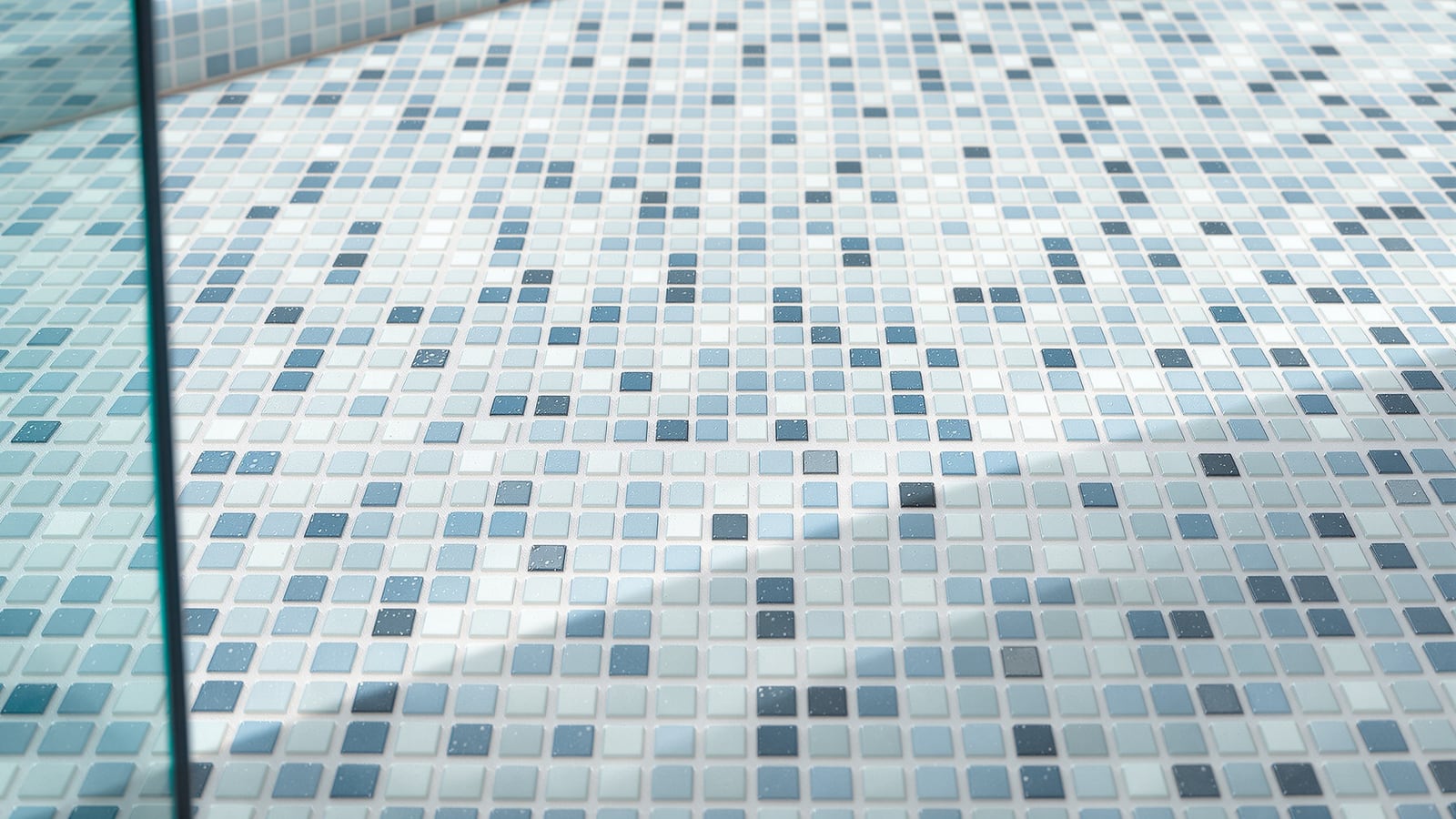
Mosaic Bathroom Flooring in India: Glass, Ceramic, Stone & Pebble Mosaics
Small-format mosaic tiles turn more grout lines into more grip — which is exactly what a wet Indian shower floor wants. A brand-neutral guide to glass, ceramic, stone and pebble mosaics: sheets vs loose, grout choice and sealing, decorative use, cost and maintenance.
A mosaic is any tile small enough that a single unit rarely exceeds 100 mm on a side — usually 20 mm to 50 mm squares, hexagons, penny rounds or river pebbles, mounted in sheets on a mesh or paper backing. That small format is not just a look. On a wet bathroom floor it is a genuine safety feature: dozens of grout joints per square foot break the water film, channel it toward the drain and give the sole of your foot something to key into. Where a large glazed tile can turn into a skating rink under a health-faucet spray, a well-grouted mosaic stays grippy.
This guide is the material-level companion to our bathroom flooring guide for India. It covers the four mosaic families you will actually be offered — glass, ceramic/porcelain, natural stone and pebble — and the details that decide whether the floor lasts: sheet layout, grout choice, sealing and slope. For the broader question of slip ratings across all tile types, read it alongside anti-skid bathroom tiles in India; for using mosaics as the wet-zone floor in an open, kerbless bathroom, see wet-room design in India.
Why small format means more grip
Slip resistance on a wet floor is governed by two things: the micro-texture of the tile surface, and the drainage paths that stop a continuous film of water forming between foot and floor. Mosaics win on the second, dramatically.
Take a 300 x 300 mm tile: it has grout only around its perimeter, so a 1 m x 1 m patch of floor has roughly 12 running metres of joint. Lay the same patch in 25 mm mosaics and you have around 80 running metres of joint — nearly seven times as much. Every joint sits a millimetre or two below the tile face, so it acts as a drainage micro-channel and a grip edge.
A mosaic floor's slip resistance comes mostly from its grout lines, not the tile glaze — which is why a flush, over-filled grout job quietly cancels the safety benefit you paid for. Keep joints slightly recessed.
This is also why mosaics tolerate a gentler slope. A large-tile shower floor needs a clean 1:50 to 1:80 fall to shed water; mosaics conform to a shallower or compound fall because the mesh backing flexes over curves toward a linear or point drain. That makes them the default choice for shower floors, wet-room zones, ramps and any spot where water pools.
The four mosaic families
| Type | Typical size | Wet-floor grip | Water absorption | Best use | Watch out for |
|---|---|---|---|---|---|
| Glass mosaic | 15–25 mm | Moderate (relies on grout) | ~0% (non-porous) | Feature walls, niches, borders | Slippery as a large field on floors; show edges chip |
| Ceramic / porcelain mosaic | 20–50 mm | Good to high (matt/textured) | Porcelain < 0.5% (IS 15622 Group BIa) | Shower floors, whole wet floor | Cheap glazed matt can still be slick — check texture |
| Natural stone mosaic | 15–50 mm | High (honed/tumbled) | 0.5–6% (porous) | Warm, spa-like floors | Needs sealing; etches with acid cleaners |
| Pebble / river-stone mosaic | 10–40 mm pebbles | Very high | Porous | Shower base, reflexology zones | Deep joints trap grime; harder to clean |
Glass mosaics are colour-fast, non-porous and stain-proof, which makes them superb on walls, in niches and as a waterline accent — but as a large floor field they are the slickest of the four and are best confined to borders and vertical surfaces. Ceramic and porcelain mosaics are the workhorse floor choice: porcelain to IS 15622 with a matt or structured surface gives you low absorption plus real texture. Stone mosaics (marble, slate, travertine, granite) bring warmth and a spa feel but are porous, so they must be sealed and kept away from acidic and hard-water descaling chemicals. Pebble mosaics have the highest barefoot grip of all and feel wonderful underfoot, but their deep, irregular joints demand more grout, more sealing and more scrubbing.
Sheets vs loose: how mosaics are sold and laid
Most mosaics arrive as 300 x 300 mm sheets — the small tiles pre-spaced and held by one of three backings. The backing decides how the sheet installs and how well it bonds.
| Backing / format | How it works | Pros | Cons |
|---|---|---|---|
| Mesh-backed (rear net) | Fibreglass net glued to the back | Fast, even joints, adhesive keys through the net | Cheap glue can debond; net can telegraph on glass |
| Paper-faced (front paper) | Paper on the face, peeled after setting | Full adhesive contact on the back = strongest bond | Fiddly; must soak-peel paper and re-clean joints |
| Loose / bulk | Individual pebbles or tiles, no sheet | Bespoke patterns, borders, curves | Slow, labour-heavy, needs a skilled hand |
For an Indian shower floor, mesh-backed porcelain or stone sheets are the practical default. Set them on a full bed of C2-class (IS 15477) cement-based tile adhesive, not on a thick sand-cement mortar dab — mosaics are too thin and light to bed reliably on lumpy mortar, and voids under a sheet become the exact spot a tile pops loose or water tracks. Butter the substrate, comb it, press each sheet with a flat float or a rubber grout beater to seat every piece to the same plane, and align sheet-to-sheet joints so the 300 mm grid disappears.
Loose pebbles and bespoke borders are laid piece by piece — beautiful, but budget for the labour. Whichever you use, the substrate must already be sloped, primed and, in a wet zone, waterproofed: mosaics are a finish, not a waterproofing layer. Get the tanking right first — see our bathroom waterproofing guide.
Grout: the part that actually keeps a mosaic floor alive
Because a mosaic floor is up to 70% more joint than a large-tile floor, grout stops being a detail and becomes the dominant material. Choose it deliberately.
- Cementitious grout (IS-type sanded/unsanded) is cheapest but porous. On a wet floor it absorbs water, harbours mould, and — with India's hard water — stains and effloresces. Only acceptable if sealed and re-sealed diligently. Use unsanded grout for joints under 3 mm (typical glass mosaics) so you do not scratch the glass.
- Epoxy grout is the right answer for a mosaic wet floor. It is non-porous, stain-proof, chemical-resistant, needs no sealing and shrugs off hard-water scaling. It costs three to five times more and sets fast — hire someone who has done it before, because epoxy haze left on glass or stone is punishing to remove.
- Joint width should stay tight (2–3 mm) so the mosaic reads as a field, not a grid. Keep the finished joint slightly recessed below the tile face — flush or proud grout wipes out the anti-slip benefit.
For a stone or pebble mosaic there is a second step: penetrating sealer. Seal the stone before grouting (so grout does not stain the porous face), then seal again after. Re-seal stone floors every 12–24 months, sooner in a daily-use family bathroom. Glass and glazed porcelain need no sealing; only their grout does, and only if it is cementitious.
Decorative use: where mosaics earn their keep
Mosaics are as much a design tool as a floor. Because they bend around curves and cut into any shape, they do things large tiles cannot:
- Shower-floor inlay — a contrasting mosaic tray inside a large-format field visually marks the wet zone and adds grip exactly where you stand.
- Feature walls and niches — glass mosaics behind a vanity or inside a shower niche catch light and read as jewellery against plain field tiles.
- Borders and waterlines — a 50 mm mosaic band ties wall and floor together or defines a datum line.
- Curved and organic forms — vanity aprons, arched niches and rounded shower kerbs where rigid tiles would need mitre cuts.
A reliable rule: use grippy ceramic, porcelain, stone or pebble mosaics on the floor and wet zone; reserve glossy glass for walls and accents where slip does not matter.
Cost, maintenance and the honest trade-offs
| Item | Indicative ₹ (2026) | Notes |
|---|---|---|
| Ceramic/porcelain mosaic sheet | ₹90–₹250 / sq ft | Matt porcelain at the upper end |
| Glass mosaic sheet | ₹150–₹600 / sq ft | Designer/iridescent glass higher |
| Natural stone mosaic | ₹200–₹700 / sq ft | Marble/travertine dearer than slate |
| Pebble mosaic sheet | ₹120–₹350 / sq ft | Sorted, flat-cut pebbles cost more |
| Epoxy grout | ₹120–₹300 / kg | Covers far less area than cement grout |
| Skilled mosaic laying labour | ₹60–₹150 / sq ft | 1.5–2x large-tile rate; loose work more |
Mosaic floors cost more to buy and much more to lay than a large tile — more joints mean more time and more grout — so they earn their premium best in the shower and wet zone rather than across an entire dry floor. On maintenance: epoxy-grouted glazed mosaics are near maintenance-free, needing only a pH-neutral cleaner and a squeegee. Cement-grouted or stone mosaics need routine sealing and gentle, non-acidic cleaning — hard-water scale and acidic descalers are the two things that age them fastest. Pebble floors trap grime in their deep joints and reward a stiff brush.
Do: use porcelain or stone mosaics on shower floors, epoxy grout, tight recessed joints, and a properly sloped waterproofed base. Don't: put glossy glass mosaic across a floor field, over-fill grout flush, skip sealing on stone, or bed sheets on lumpy sand-cement mortar.
For where mosaics fit within the full flooring decision — vitrified, natural stone, anti-skid ceramic and more — return to the bathroom flooring guide for India, and pair this with anti-skid bathroom tiles and wet-room design to lock down grip and drainage together.
References
- National Building Code of India (NBC) 2016, Part 9 (Plumbing Services) and Part 3 — wet-area finishes, floor falls and drainage.
- IS 15622: Pressed Ceramic Tiles — Specification (absorption groups and floor-tile classes, including porcelain BIa).
- IS 13630: Ceramic Tiles — Methods of Test (water absorption, breaking strength, slip/abrasion series).
- IS 15477: Specification for laying of ceramic tiles using adhesives (C1/C2 adhesive classes and application).
- Bureau of Indian Standards (BIS) — tile and adhesive product standards, bis.gov.in.
- CPWD General Specifications for Works — tiling, screed slopes and wet-area workmanship references.
Export this guide
Related Guides — Deep-dive reading
Bathroom Flooring Guide India: Anti-Skid Tiles, Stone, Vinyl & Epoxy Compared
Every bathroom floor material for Indian homes in one place — anti-skid ceramic and vitrified tiles, natural stone, mosaic, vinyl (SPC/LVT) and epoxy — with a full comparison table, slip ratings, ₹/sq ft costs and the safety and slope rules that keep a wet floor from becoming a hazard.
BathroomsEpoxy Grout vs Cement Grout for Tiles in India: Which to Specify (2026)
A plain-English guide to tile grouts for Indian homes: what grout does, how cementitious grout compares with epoxy grout on cost, stain and water resistance, hygiene and durability, and exactly where each one belongs - kitchens, bathrooms, pools, dry rooms and more.
Building MaterialsPebble Flooring in India: River-Pebble Mosaic, Types, Cost & Sealing
Smooth river pebbles set in cement, epoxy or resin give a spa-like, massage-underfoot, natural floor for bathrooms, showers, garden paths and feature zones — here is where it suits, the three types, costs and how to seal it.
Flooring & SurfacesRelated Tools — Try Free
Flooring Cost Calculator
Estimate the all-in cost of a floor — material, laying, wastage, skirting and GST — by area and material.
Flooring CalculatorGrout Quantity Calculator
Estimate grout in kg and cost by tile size, joint width and thickness — cement or epoxy grout.
Flooring CalculatorPool Tile Calculator
Floor, wall and waterline area and the total number of tiles for your pool, with a wastage allowance.
Pool Calculator