

Mistakes to Avoid Before Hiring an Interior Designer
The preparation and sequence errors that sabotage a project before it begins
The most expensive interior-design mistakes are made before a designer is hired. A homeowner who approaches the hire without a brief, without a budget, and without understanding who does what ends up with a project shaped by the loudest salesperson rather than their own needs. Get the preparation and the sequence right, and the hire becomes easy; get them wrong, and no designer can rescue it.
This guide covers the errors to fix before you hire. It is a deep-dive companion to our 25 interior mistakes homeowners regret and the choosing a designer guide.
Mistake 1: Hiring before you have a brief
Walking into a designer meeting without a brief hands over the most important decisions by default. A brief does not need to be elaborate — scope, rooms, style direction, budget range, timeline, and must-haves — but it must exist before you hire, so you choose a designer for your project rather than being sold theirs.
Mistake 2: No budget (or a secret one)
Refusing to share a budget does not get you a better price; it wastes everyone's time and produces designs you cannot afford. A realistic budget range, with a contingency, lets a designer design to reality from day one.
Mistake 3: Confusing designer, contractor, and architect
Many disputes trace back to a homeowner not knowing who is responsible for what. These are three distinct roles, and hiring the wrong one for the job — or assuming one covers another's scope — creates gaps that surface mid-project.
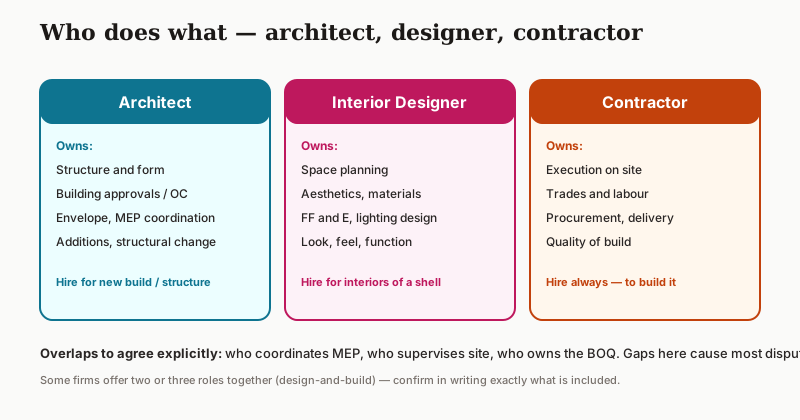
| Role | Owns | Hire when |
|---|---|---|
| Architect | Structure, approvals, building form | New build, structural change, additions |
| Interior designer | Space planning, aesthetics, materials, FF&E | Interiors of an existing or built shell |
| Contractor | Execution, trades, site delivery | Always — to build the design |
Mistake 4: Hiring on price and vibes
The lowest fee or the best first impression is not a hiring basis. A designer is a multi-month relationship handling significant money. Vet the portfolio for range, check references, confirm how they charge (percentage, per sqft, or fixed), and clarify what the fee includes.
Mistake 5: Getting the sequence wrong
The single biggest meta-mistake is sequence. The right order makes every later step easier; hiring first and figuring out the rest later guarantees rework.
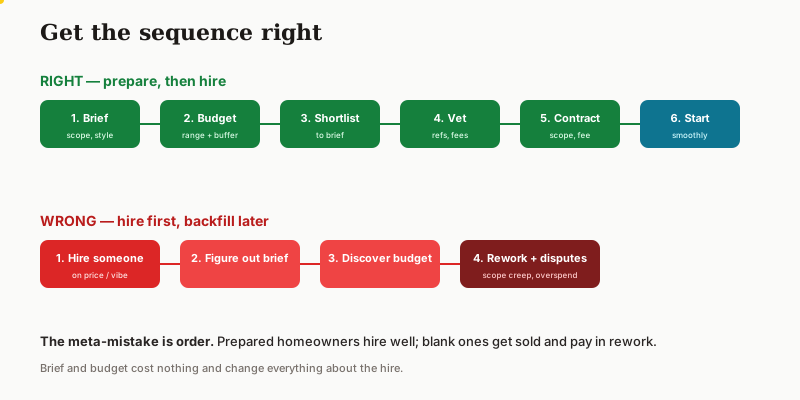
Prepare the brief, the budget, and the questions before you take the first meeting. The homeowner who walks in ready hires well; the one who walks in blank gets sold.
The fix, in order
1. Write a brief before any meeting — scope, style, budget, timeline, must-haves.
2. Set a realistic budget range with contingency, and share it.
3. Understand who does what — architect vs designer vs contractor.
4. Vet portfolio, references, and fee structure — not price alone.
5. Contract scope, fees, and deliverables before work starts.
Prevent it: Structure the decision with the Decision Tree, read the choosing a designer guide and scope boundaries guide, set the money with the Budget Allocation tool, and screen candidates with the Red Flag Checklist.
References
- Council of Architecture (India) (2020) Architects Act 1972 and Regulations. New Delhi: COA.
- Piotrowski, C.M. (2020) Professional Practice for Interior Designers. 6th edn. Hoboken, NJ: John Wiley & Sons.
- Indian Contract Act, 1872 (India). New Delhi: Government of India.
- Kilmer, R. and Kilmer, W.O. (2014) Designing Interiors. 2nd edn. Hoboken, NJ: John Wiley & Sons.
Part of the Studio Matrx Mistakes & Pitfalls series.
Export this guide
Related Guides — Deep-dive reading
How to Plan Your Dream Home Before Meeting an Architect
The homeowner's pre-architect playbook — clarify needs, budget, site and brief so your first meeting starts ten steps ahead
Home PlanningThe Complete Guide to Planning Your Home Before You Spend a Rupee
Why the cheapest, most powerful work happens on paper — a planning playbook for Indian homeowners before any money moves
Home PlanningHow to Hire an Architect in India: A Homeowner's Guide (2026)
A plain-language walkthrough for homeowners - whether you even need an architect, what one does across the stages, how to find and shortlist, how architects charge, what the scope and agreement should cover, and how to work well together.
Hiring ProfessionalsRelated Tools — Try Free
Interior Red Flag Checklist — Before Signing
54 red flags across 8 categories with a live risk score and personalised PDF.
Red Flag ChecklistArchitect Fee Calculator
Estimate architect fees based on COA guidelines, project scope, and city.
ArchitectAIClient Brief Generator
8-section questionnaire that produces a professional design brief PDF with signature lines.
Brief Generator