
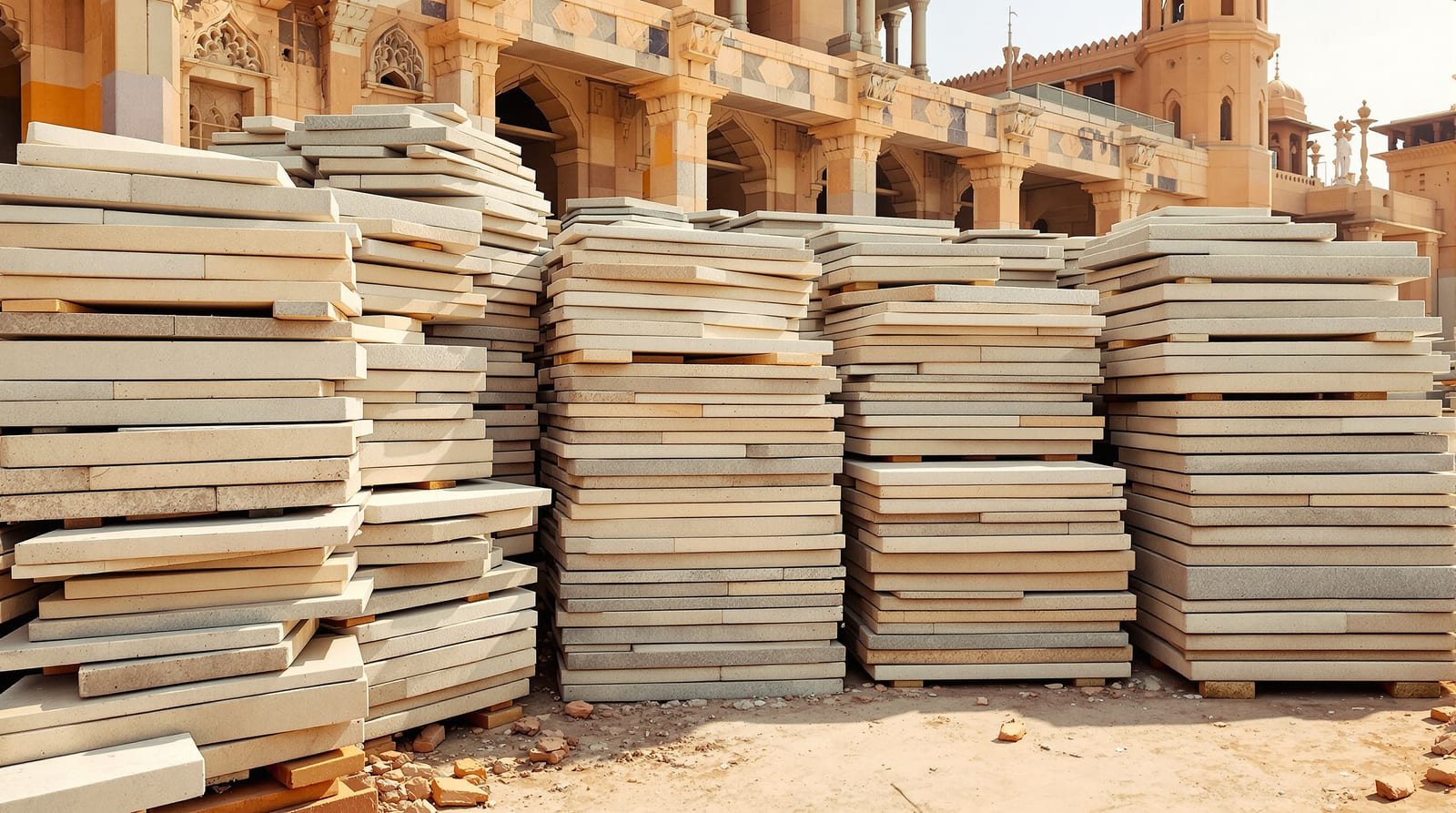
Kota Stone from Rajasthan: Grades, Sourcing & Price Guide (India)
Where Kota stone is quarried, how blue, green-grey and brown grades differ, finishes from natural to mirror-polish, and what it costs at source versus delivered.
Kota stone is the unglamorous hero of Indian flooring: a fine-grained limestone from a small belt of Rajasthan that has paved verandahs, staircases, parking ramps, temple courtyards and entire commercial buildings for generations. It is cheap, hard, slip-friendly and almost impossible to wear out. This guide is about buying it well, where it comes from, how the grades and finishes differ, and what you should actually pay at the quarry versus at your doorstep.
If you want the full how-it-performs picture, the companion Kota stone flooring guide covers laying, sealing and room-by-room suitability. Here we stay with origin, grades and the market.
Where Kota stone actually comes from
Despite the name appearing on price lists across India, true Kota stone is quarried in a compact region of south-eastern Rajasthan, principally Kota district and the neighbouring Bundi district (the village of Ramganj Mandi in Kota and the belt around it is the trade heart). It is a sedimentary limestone rich in silica, which is what gives it the unusual combination of being soft enough to quarry in thin sheets yet hard-wearing once laid.
Because the deposit is geographically tiny, almost all genuine Kota stone in India travels from this one belt. That single fact drives everything in this guide: the closer your city is to the Kota-Bundi belt, the less you pay; the farther away, the more transport eats into what is otherwise one of the cheapest natural stones in the country.
Do not confuse Kota stone with the other Rajasthan stones it is often shelved beside. For context on the wider state, see the Rajasthan marble guide, and for the warm-toned sedimentary cousins read the sandstone flooring guide. Kota is limestone, not marble and not sandstone.
The grades: blue, green-grey and brown
Kota stone is sold by its natural colour, which corresponds roughly to where in the quarry strata it is cut. The trade names vary by dealer, but three families cover almost everything you will see.
| Grade / colour | Look | Typical price (at source) ₹/sq ft | Best uses |
|---|---|---|---|
| Kota blue / blue-grey | Deep greenish-blue to slate grey, the classic dense grade | 18–35 | Flooring, stairs, commercial floors, the all-rounder |
| Kota green / green-grey | Lighter green-grey, slightly mottled | 20–38 | Flooring, courtyards, where a softer tone is wanted |
| Kota brown / honey | Warm brown to buff, sometimes patchy | 16–30 | Verandahs, parking, outdoor paving, rustic looks |
| Polished / mirror-finish select | Any colour, factory mirror-polished thicker slabs | 45–90 | Living rooms, lobbies, premium interior floors |
Prices are indicative for 2026, vary by city and vendor, exclude GST, and rise sharply once polishing, calibration and transport are added. Blue-grey is the most sought-after and most uniform; brown is usually the cheapest and a touch more porous, which is why it lands on outdoor and parking jobs. Mirror-polished select material is a different product entirely, cut thicker and finished to compete with cheap granite indoors.
Finishes: natural, honed, polished
The same slab behaves and prices very differently depending on finish. Understanding this is the single biggest lever a buyer has.
- Natural / rough (random): stone laid as quarried, with its slightly uneven cleft surface. Cheapest, highest slip resistance, and the traditional choice for parking, ramps, steps, terraces and verandahs. Edges are usually hand-chiselled, so joints are wider.
- Honed / machine-rubbed matte: ground flat to an even matte surface. Cleaner look, easier to mop, still grippy underfoot when dry. The everyday interior and corridor choice. Often supplied calibrated (uniform thickness), which speeds laying and reduces lippage.
- Mirror / full polish: machine-polished to a reflective shine. Looks like a budget granite, but the polished surface is slippery when wet and shows scratches over time. Reserve it for dry indoor areas; never for bathrooms, ramps or open verandahs.
A common, economical middle path is to buy honed-calibrated stone and have it floor-polished on site after laying, which gives a softer sheen than factory mirror at lower cost.
Sizes, thickness and calibration
Kota is sold both as random/uncut pieces (cheapest, irregular shapes, lots of cutting waste) and as cut-to-size tiles. Common cut sizes are roughly 1x1 ft, 2x1 ft, 2x2 ft and larger slabs up to about 4x2 ft, though large defect-free pieces cost more.
Thickness usually runs 25 to 40 mm for natural random material and 15 to 25 mm for calibrated, machine-cut tiles. Thicker, rougher stone suits heavy-duty outdoor and parking floors; thinner calibrated tiles suit indoor floors over a level bed. Always ask whether a quote is for calibrated (uniform thickness, faster laying) or uncalibrated stock, because mixing thicknesses on one floor causes lippage and slow, wasteful laying. For the broader picture on uniform sizing across all stone and tile, see the natural stone standards guide.
Why it is a budget-durable workhorse
Kota stone earns its place not on looks but on a rare blend of cheap and tough:
- Hardness and wear: dense, silica-rich limestone that resists abrasion from foot traffic, trolleys and even vehicles, which is why it lines so much parking, stair and commercial flooring.
- Slip resistance: in its natural or honed state it is grippy even when damp, making it a sensible verandah, balcony, terrace and bathroom-adjacent stone (avoid mirror polish in wet zones).
- Cost: among the lowest-priced natural stones in India, often undercutting vitrified tiles on a like-for-like installed basis in cities near the source.
- Repairability: it can be re-polished or re-ground decades later to look fresh, unlike tiles which must be ripped out and replaced.
Its weaknesses are honesty's price: it is porous and stains if unsealed (oil, turmeric, acids), the colour is not perfectly uniform, and the polished finish needs periodic maintenance. None of these disqualify it for the jobs it is famous for.
Price: at source versus delivered
The headline price you see in Kota or on a wholesale list is not what your floor costs. Build the all-in number before you compare it with anything else.
| Cost line | Indicative ₹/sq ft | Notes |
|---|---|---|
| Stone at source (Kota / Ramganj Mandi) | 16–38 | By grade and finish; mirror-polish select 45–90 |
| Transport to far city (e.g. Bangalore, Chennai, Kolkata) | 8–20 | Add little if near Rajasthan; more the farther you are |
| Loading, unloading, handling | 2–5 | Often forgotten in quotes |
| Cutting / wastage on random material | 5–15% of area | Buy spare; random stock wastes more |
| Laying labour (cement bed) | 20–45 | Lower in tier-2 cities, higher in metros |
| Cement, sand, grouting | 8–18 | Mortar bed plus pointing |
| On-site grinding and polishing (if done) | 18–40 | Optional; skip for natural finish |
| GST | 12% on blocks, 18% on slabs/tiles & labour | Insist on a GST invoice |
In a city close to Rajasthan such as Jaipur, Udaipur or Ahmedabad, a natural Kota floor can land installed for a very modest figure. In a far metro like Bangalore, Chennai or Kolkata, transport and metro labour can quietly double the source price, at which point locally cheap stone such as south-Indian granite (see the South India granite guide) becomes more competitive. This source-proximity logic is exactly why you buy stone closest to where it is quarried.
To model your own all-in figure, the flooring cost calculator and the natural stone slab calculator help estimate material plus laying.
Buying tips and transport
- Buy by lot and finish, in writing. Get the grade, finish (natural/honed/polished), calibrated-or-not, thickness, size and quantity on a written quote with GST. For honing the standard buyer checklist see how to buy marble, which translates directly to Kota.
- Inspect in daylight. Check for hairline cracks, white calcite veins, patchy discolouration and warping. Tap-test pieces: a dull thud often means an internal crack.
- Add wastage. Order 8 to 12 percent extra for random material and at least 5 percent for cut tiles, plus a few spare for future repairs, because matching a later lot is hard.
- Ask about calibration. Calibrated, gauged stone costs a little more but lays faster, flatter and with less wastage; for large floors it usually pays for itself.
- Plan transport and the e-way bill. Kota stone is heavy; a full truckload spreads freight cost thinnest. For interstate movement insist the dealer raises a proper GST invoice and e-way bill so the consignment is legitimate and you keep input credit if applicable.
- Direct from the belt for big jobs. For large or commercial quantities, sourcing from Ramganj Mandi / Kota wholesalers and arranging your own freight is often far cheaper than buying through a distant retailer, provided you can handle inspection and logistics.
- Mind the season. Lay and polish in dry weather; freshly laid limestone needs curing time, and monsoon delivery risks staining of unsealed stock.
Frequently asked questions
Is Kota stone the same as marble or granite?
No. Kota is a silica-rich limestone, softer than granite and chemically different from marble. It is far cheaper than both, more slip-friendly in its natural finish, but more porous and less uniform in colour. It competes on durability and price, not luxury looks.
Which Kota grade is best for outdoor verandahs and parking?
Use natural or honed Kota in blue-grey or brown, never mirror-polished, because the unpolished surface stays grippy when wet and shrugs off vehicle and trolley traffic. Brown grades are usually the cheapest and are popular for parking and ramps.
How much does Kota stone flooring cost installed in India?
Indicatively, a natural Kota floor can land roughly in the low tens of rupees per sq ft installed near the source, while transport and metro labour push it higher in far cities. Always build an all-in figure (stone plus transport, laying, cement, polishing and GST) rather than comparing the source slab price alone.
Does Kota stone stain, and can it be polished later?
Yes, unsealed Kota can absorb oil, turmeric and acidic spills, so seal it after laying and re-seal periodically. A real advantage is that it can be re-ground and re-polished years later to look new, which most tiles cannot.
How do I avoid buying fake or poor Kota stone?
Insist on a written quote stating grade, finish, calibration and thickness with a GST invoice, inspect every lot in daylight for cracks and warping, tap-test for hidden flaws, and for big orders buy direct from the Kota-Bundi belt where the genuine stone is quarried.
Export this guide
Related Guides — Deep-dive reading
Flooring Buying Mistakes in India: 12 Costly Purchase Errors and How to Avoid Them (2026)
From ordering the exact area with no spare and losing the dye-lot, to mixing calibre, buying seconds for living rooms, skipping the ISI mark, paying full advance and ignoring transport and loading charges, here are the purchase mistakes that quietly inflate a floor's true cost.
Flooring & SurfacesFlooring Cost Comparison Across Indian Cities 2026: Installed ₹/Sq Ft by Material
A single cross-city reference comparing installed flooring rates across Mumbai, Delhi-NCR, Bangalore, Hyderabad, Chennai, Pune, Kolkata, Ahmedabad and Jaipur — vitrified, granite, marble, wood/laminate and vinyl, plus laying labour — and why each city differs.
Flooring & SurfacesLimestone Flooring India: Honed Matte Stone, Colours, Cost and Care
The soft sedimentary stone family — beige, grey, blue and cream limestone with an elegant honed matte look, cool underfoot — plus its porosity, sealing needs, ₹/sq ft cost and where it suits Indian homes.
Flooring & SurfacesRelated Tools — Try Free
Flooring Cost Calculator
Estimate the all-in cost of a floor — material, laying, wastage, skirting and GST — by area and material.
Flooring CalculatorHome Building & Interior Cost Calculator — 20 Cities
Construction + interior costs for 20 Indian cities across kitchen, wardrobes, flooring, painting, ceiling.
Cost CalculatorInterior Budget Planner
Live room-wise and component-wise cost breakdown in ₹ with contingency, GST, and PDF summary.
Budget Calculator