
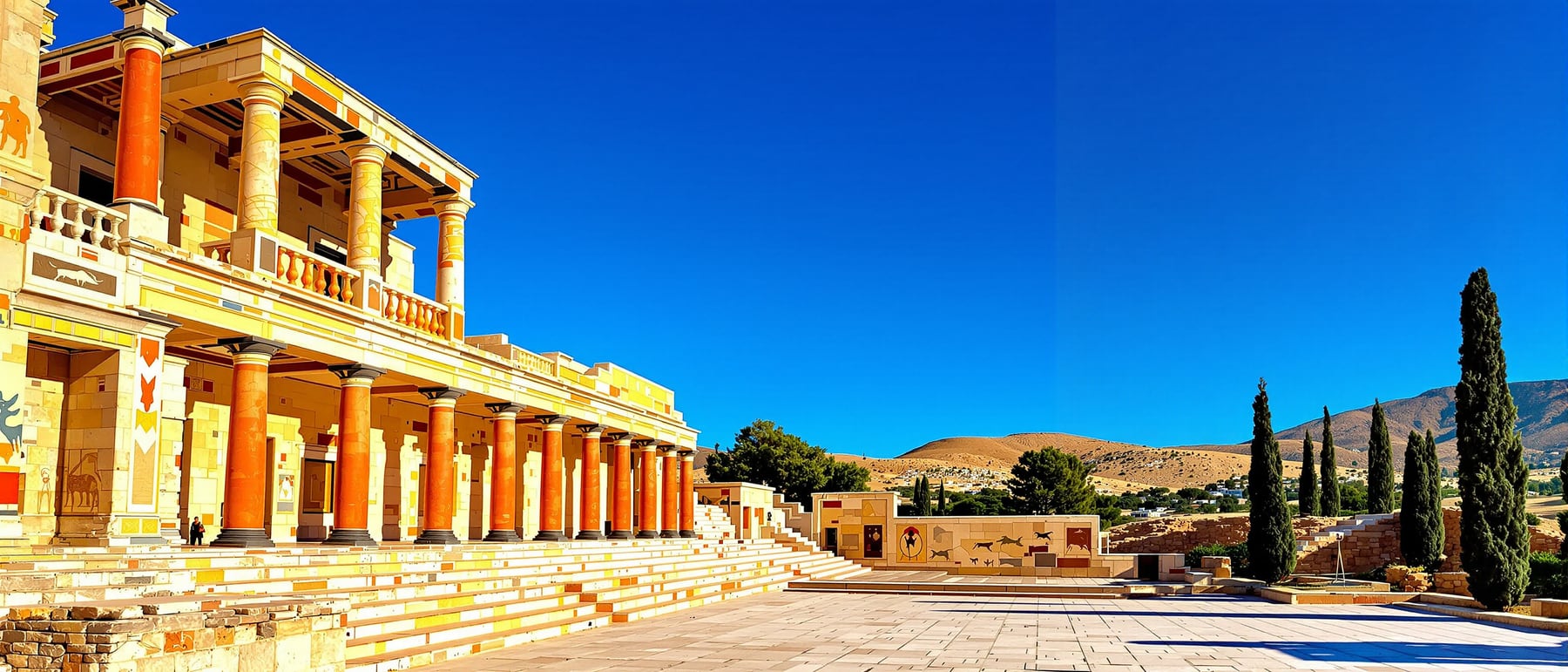
The Palace of Knossos: Europe's First Palace and the Labyrinth of Myth
Nearly four thousand years ago on Crete, Europe's first great civilisation built a palace so vast and maze-like — over a thousand rooms on many floors, with running water, flushing toilets and light wells — that the Greeks who came after remembered it as the Labyrinth of the Minotaur. It is a genuine Bronze Age marvel; it is also, thanks to one archaeologist's concrete and imagination, a monument to how we rebuild the past in our own image. The first article in our chapter on the palaces of worldly power.
For the last sixteen articles, in our chapter on the sacred places of the world, we walked among temples — the houses of the gods. Now we turn to the houses of kings and emperors: the palaces, arenas, baths and pleasure-gardens where earthly power lived, ruled, displayed itself and amused itself. And we begin at the very beginning of European palace-building, on the Bronze Age island of Crete, with a building so extraordinary that it gave the world one of its most enduring myths. This is the Palace of Knossos — the great centre of the Minoan civilisation, and the original Labyrinth.
This is the sixty-fourth article in our Architectural Wonders series, and the first in a new chapter on the great palaces and pleasures of worldly power.
Knossos is really two wonders in one. It is a genuine Bronze Age marvel — a sprawling, sophisticated palace, built by Europe's first advanced civilisation nearly four thousand years ago, with comforts that would not be seen again on the continent for millennia. And it is also a monument to imagination — because much of the vivid, red-columned Knossos we visit today was rebuilt, in concrete and paint, by a single archaeologist who could not resist completing the picture. To walk through Knossos is to walk through both the Bronze Age and the twentieth century at once.
1. Europe's first palace
Before the myths and the controversy, the plain fact of the place: it is where European palace-architecture begins.
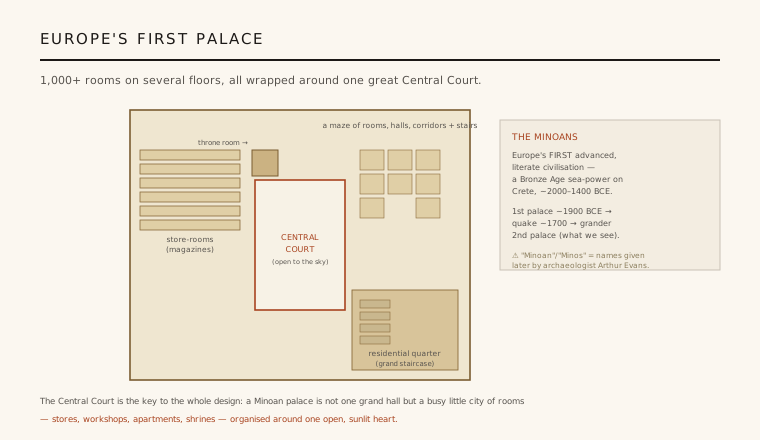
Around 2000 BCE, while much of Europe still lived in villages, the people of Crete built Europe's first advanced, literate civilisation — a Bronze Age sea-power of traders and artists that the archaeologist Arthur Evans would later name "Minoan," after the legendary Cretan King Minos. (We do not know what they called themselves.) Their greatest centre was Knossos, where a first great palace rose around 1900 BCE. After an earthquake levelled it around 1700 BCE, they built an even grander second palace — and it is this one, at its height from about 1700 to 1450 BCE, that mostly survives. It was vast: well over a thousand rooms spread across several storeys, covering some two hectares. And its plan was unlike a Greek temple or an Egyptian pyramid. Everything is arranged around a large, open, rectangular Central Court — the organising heart of the whole design — with wings of store-rooms, workshops, shrines, reception halls and living quarters packed around it and linked by a bewildering maze of corridors and staircases. A Minoan palace was not one grand hall; it was a little city under one roof, and its beating centre was an open court full of sunlight.
2. A machine for living
Step inside, and the truly startling thing about Knossos is how modern it feels.
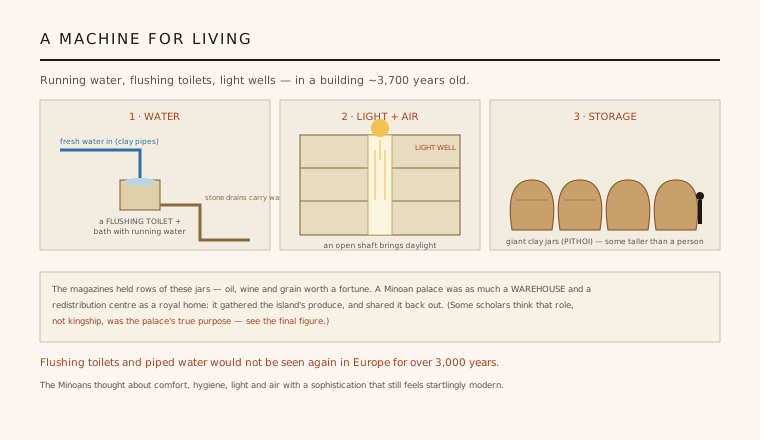
The Minoans engineered Knossos for comfort with a sophistication that can still take your breath away. Buried terracotta pipes brought fresh water in; stone-lined drains carried rain and waste water away; and the palace had bathrooms with running water and even flushing toilets — plumbing that would essentially vanish from Europe for over three thousand years after the Minoans were gone. To light and cool a dense, multi-storey building in a hot climate, they cut open shafts called light wells down through the floors, drawing daylight and cooling air deep into the interior — environmental design far ahead of its time. And along whole wings ran the magazines — long store-rooms lined with rows of enormous clay jars, pithoi, some taller than a person, holding the olive oil, wine and grain that were the palace's wealth. Those magazines hint at what a Minoan palace really did: it was as much a warehouse and redistribution centre — gathering the island's produce and sharing it back out — as it was a royal home. (Indeed, whether Knossos was truly a "palace" in the sense of a king's residence, or mainly a communal and ceremonial storehouse, is a live scholarly debate, as we will see.)
3. The labyrinth and the Minotaur
And now the myth — because Knossos is that rare place where we can almost watch a legend grow out of a building.
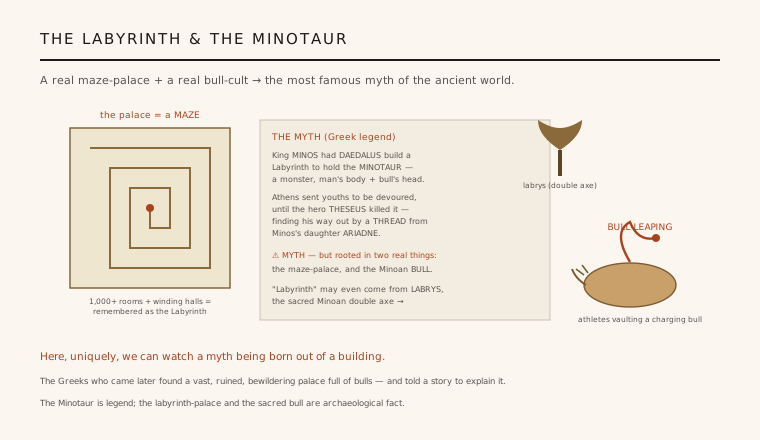
Every schoolchild knows the story: King Minos commanded the master craftsman Daedalus to build a Labyrinth to imprison the Minotaur — a monster with a man's body and a bull's head — to which Athens was forced to send young men and women to be devoured, until the hero Theseus slew the beast and escaped the maze using a thread given to him by Minos's daughter Ariadne. It is a myth. But it grew out of two very real Minoan things. The first is the palace itself: a genuine, bewildering maze of a thousand rooms that later Greeks, finding it in ruins, remembered as the Labyrinth. (The word labyrinth may even derive from labrys, the sacred Minoan double axe whose sign is carved throughout the palace — so "Labyrinth" would mean "the House of the Double Axe.") The second is the bull, which is everywhere in Minoan art and religion — most thrillingly in bull-leaping, a ritual sport in which young athletes vaulted clean over the horns of a charging bull. A maze full of bulls: it is not hard to see how the story of a man-bull in a labyrinth took root. The Minotaur is legend; the labyrinth-palace and the sacred bull are archaeological fact.
4. A world in colour
The Minoans left us more than plumbing and myth. They left us a mood — one of the most beguiling in all of ancient art.
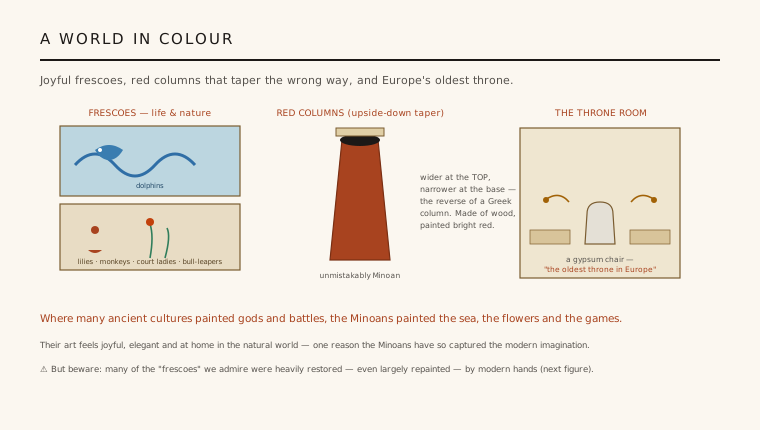
The walls of Knossos blazed with frescoes — and their subjects are astonishing. Where so many ancient cultures painted gods, kings and battles, the Minoans painted dolphins and blue monkeys, lilies and reeds, elegant court ladies and leaping athletes, in bright blues, reds and yellows. Their art feels joyful, sea-loving and at ease in the natural world — one big reason the Minoans have so captured the modern imagination. The architecture had its own signature, too: the famous Minoan columns, made of wood, painted bright red, with round black capitals — and tapering the "wrong" way, wider at the top than the bottom, the reverse of a later Greek column such as those of the Parthenon. And in the room Evans named the Throne Room sits a carved gypsum chair, flanked by stone benches and painted with griffins — often called the oldest throne in Europe. Here, though, we must add the honest caveat that shadows all of Knossos: much of the vivid colour we admire is not entirely ancient. Many of these "frescoes" survive only as small fragments — and were completed, and in places largely repainted, by modern artists. Which brings us to the strangest part of the story.
5. The palace that Evans (re)built
The Knossos you can visit today is, to a startling degree, the creation of one man — and it has divided archaeologists ever since.
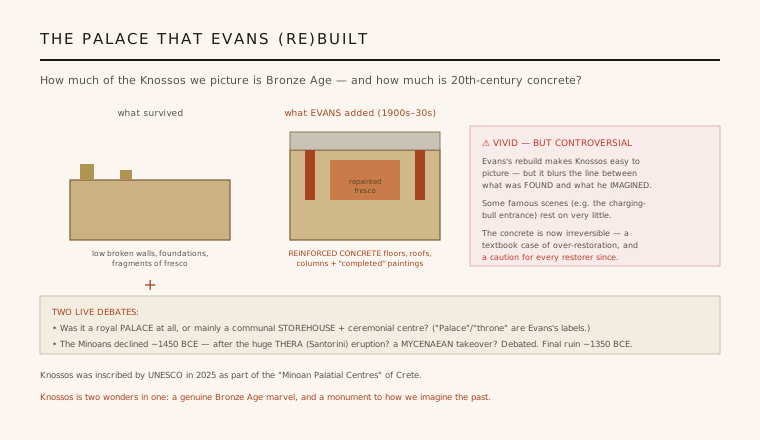
From 1900 into the 1930s, the British archaeologist Sir Arthur Evans excavated Knossos — and then did something few archaeologists would dare today: he rebuilt it. He raised whole sections back up in reinforced concrete, added roofs, staircases and painted columns, and commissioned artists to turn scraps of fresco into complete, vivid scenes. The result is wonderfully evocative — Knossos is far easier to imagine than a field of low ruins — but it is deeply controversial, because it blurs the line between what was found and what Evans imagined. Some of its most famous features (the charging-bull relief over the north entrance, for instance) rest on very little evidence, and the concrete is now irreversible. Knossos has become the textbook cautionary tale of over-restoration — a warning to every conservator since about the difference between preserving the past and re-inventing it. Two genuine debates still swirl around the site: whether it was truly a royal palace at all, or mainly a communal storehouse and ceremonial centre (the words "palace" and "throne room" are Evans's labels, not the Minoans'); and why this brilliant civilisation collapsed around 1450 BCE — perhaps crippled by the colossal volcanic eruption of nearby Thera (Santorini), and then absorbed by the mainland Mycenaeans (the same civilisation that raised the Treasury of Atreus at Mycenae), before the palace's final ruin around 1350 BCE. In 2025, Knossos was at last inscribed by UNESCO, as one of the "Minoan Palatial Centres" of Crete. It remains two wonders in one: a true Bronze Age marvel — and a mirror of our own longing to see the past made whole.
6. What a modern architect can learn from Knossos
- Organise around a void. The genius of the Minoan palace is the open Central Court — a shaped emptiness that gathers and orders everything around it. Sometimes the most important space in a building is the one you leave empty, at its heart.
- Design for the body's comfort — light, air and water. Light wells, cross-ventilation, running water, drains: Knossos treated human comfort as a first-class problem 3,700 years ago. The most "modern" thing a building can do is take the everyday experience of its occupants seriously.
- A palace can be an economy. Knossos was a warehouse and a redistribution engine as much as a residence. Great buildings often do quiet, practical, civic work beneath their grandeur — and understanding that work is the key to understanding the form.
- Buildings breed stories. No temple in this series generated a myth like the Labyrinth. A powerful enough piece of architecture takes on a second life in the imagination — and that afterlife can outlast the stones themselves.
- Restoration is not neutral — it is authorship. Evans's concrete is the great warning of this chapter: to rebuild is to interpret, and every "reconstruction" smuggles in the assumptions of its own age. Honest work marks clearly where the evidence ends and the guess begins.
- Beware the vividness you crave. We love Evans's Knossos precisely because it is complete and colourful — which is exactly why it is dangerous. The most seductive version of the past is rarely the truest; a good designer, like a good historian, learns to distrust a picture that is a little too perfect.
References & further reading
1. UNESCO World Heritage Centre — Minoan Palatial Centres (inscribed 2025; includes Knossos). https://whc.unesco.org/en/list/1720/
2. World History Encyclopedia — Knossos. https://www.worldhistory.org/knossos/
3. Encyclopaedia Britannica — Knossos. https://www.britannica.com/place/Knossos
4. The Ashmolean Museum, Oxford — Sir Arthur Evans and the rebuilding of the Palace of Minos at Knossos. https://www.ashmolean.org/article/rebuilding-the-palace-of-minos-at-knossos
5. Smarthistory — Bull-leaping fresco and the art of Minoan Crete. https://smarthistory.org/bull-leaping-fresco/
6. Cathy Gere — Knossos and the Prophets of Modernism (on Evans's reconstruction and its meaning). https://www.worldcat.org/title/knossos-and-the-prophets-of-modernism/oclc/243544357
*Last verified 2026-07-05. Figures follow UNESCO, the World History Encyclopedia, Britannica, the Ashmolean Museum and standard scholarship, and are given as widely cited approximations that vary by source. Knossos, near Heraklion on Crete (Greece), was the principal centre of the Minoan civilisation — Europe's first advanced, literate (Bronze Age) society. "Minoan"/"King Minos" are modern names coined by Sir Arthur Evans; the Minoans' own name for themselves is unknown. A first palace was built c. 1900 BCE and destroyed c. 1700 BCE (earthquake); the surviving "Second/New Palace" (c. 1700–1450 BCE) is a multi-storey complex of 1,000+ rooms (~2 ha) arranged around a large open Central Court, with magazines (huge pithoi storage jars), a residential quarter via the "Grand Staircase," workshops, shrines and reception rooms, and advanced engineering: terracotta water pipes, stone drains, bathrooms with running water and flush toilets, and light wells for daylight/ventilation. The palace's maze-like plan underlies the Greek myth of the Labyrinth (built by Daedalus for King Minos to hold the Minotaur; Theseus and Ariadne's thread); "labyrinth" may derive from labrys (the Minoan double axe = "House of the Double Axe"), and bull imagery/bull-leaping (taurokathapsia) was central to Minoan ritual. Frescoes (dolphins, monkeys, lilies, court ladies, bull-leapers) and downward-tapering red wooden columns are hallmarks; the "Throne Room" holds a gypsum chair often called Europe's oldest throne. CRITICAL CAVEAT: Sir Arthur Evans (excavations from 1900, into the 1930s) reconstructed large parts in reinforced concrete and had fragmentary frescoes "completed"/repainted — vivid but controversial and irreversible, a textbook case of over-restoration; some features rest on little evidence. Whether Knossos was a royal "palace" or mainly a communal storehouse/ceremonial centre is debated ("palace"/"throne" are Evans's labels). The Minoans declined c. 1450 BCE (possibly linked to the Thera/Santorini eruption and a Mycenaean takeover; Linear B at Knossos records Mycenaean Greek), with the palace's final destruction c. 1350 BCE. Knossos was inscribed by UNESCO in 2025 as part of the "Minoan Palatial Centres" of Crete. This is the first article in the "palaces and pleasures of worldly power" chapter of the Architectural Wonders series.
Export this guide
Related Guides — Deep-dive reading
Chan Chan: The Vast City of Mud Where Every King Built His Own Palace
On the desert coast of Peru sprawl the ruins of the largest city ever built of mud — a thousand-year-old capital of adobe walls three storeys high, carved with fish and seabirds, that survived only because it almost never rains. It was a city of ten royal palaces, one for each king, driven by a strange rule of inheritance; and today, an earthen city in a warming world, it is racing the rain to survive. The ninth article in our chapter on the palaces and pleasures of worldly power.
Architectural WondersThe Palace of Sennacherib at Nineveh: The Palace Without Rival
Twenty-seven centuries ago, on the Tigris opposite modern Mosul, an Assyrian king built a palace so vast he named it, in his own words, 'the Palace that has no rival' — and lined its walls, room after room, with miles of carved stone panels telling the story of his wars. It is the birthplace of narrative art, the home of the winged guardian, and a wonder destroyed not once but twice. The second article in our chapter on the palaces of worldly power.
Architectural WondersSigiriya: The Sky Palace a Guilty King Built on a Rock
Fifteen hundred years ago in Sri Lanka, a king who had murdered his way to the throne fled his own guilt and fear to the top of a sheer 200-metre rock, and there built one of the most breathtaking places on Earth: symmetrical water gardens whose fountains still run, a cliff painted with celestial maidens, a gateway shaped as a colossal lion, and a pleasure-palace in the clouds. A paradise built out of terror. The seventh article in our chapter on the palaces and pleasures of worldly power.
Architectural WondersRelated Tools — Try Free
Cross-Ventilation Analyzer
Estimate airflow and air changes per hour (ACH) from room size, window areas, layout, and local wind — with NBC 2016 Part 8 compliance check.
Ventilation CalculatorAcoustic Privacy (STC) Visualizer
Indian healthcare acoustic visualizer — compare wall assemblies and noise sources, see received SPL after STC attenuation, and check FGI 2018 / IS 1950 / NABH speech-privacy compliance with live dual-canvas waveform.
Acoustic ToolFalse Ceiling Cost Estimator
Live ₹/sqft across 8 ceiling types — POP, gypsum, designer, metal, PVC, wooden — with cove and spot lighting for 20 Indian cities.
Cost Calculator