
How to Choose a Bathroom Mirror in India: Plain vs LED vs Smart vs Cabinet by Budget (2026)
A buyer's decision guide to picking a bathroom mirror in India — plain vs LED vs smart vs cabinet by budget and need, sizing to your basin, the copper-free silvering check that stops black-edge corrosion, demister and IP ratings, mounting hardware, good/better/best rupee tiers and how to spot cheap mirrors that will rot.
A bathroom mirror looks like the easy purchase — a rectangle of glass, pick one and move on. It is also the fitting most people buy wrong, because the decision that matters is invisible on the showroom floor. Two mirrors that look identical and cost the same can behave completely differently after eighteen monsoons of humidity: one stays clear, the other grows a black, cloudy stain creeping in from every edge. This guide is about making the buying decision well — which type to spend on, how big to go, and the one durability check that separates a mirror that lasts fifteen years from one you replace in three.
This is the buyer's companion to our technical bathroom mirror guide for India, which explains the glass, lighting and mounting in depth. It sits under the bathroom shopping guide for India, the pillar that helps you budget a whole bathroom. Read this to decide what to buy; read those to understand how it works.
The mirror decision has four moves: type, size, durability, and light. Type sets your budget band; durability decides whether the money was wasted.
Step 1: Which type fits your need and budget
There are four buying decisions on the shelf — plain, LED, smart, and mirror cabinet — and they map cleanly to need and money. Don't start from the price tag; start from what the mirror has to do.
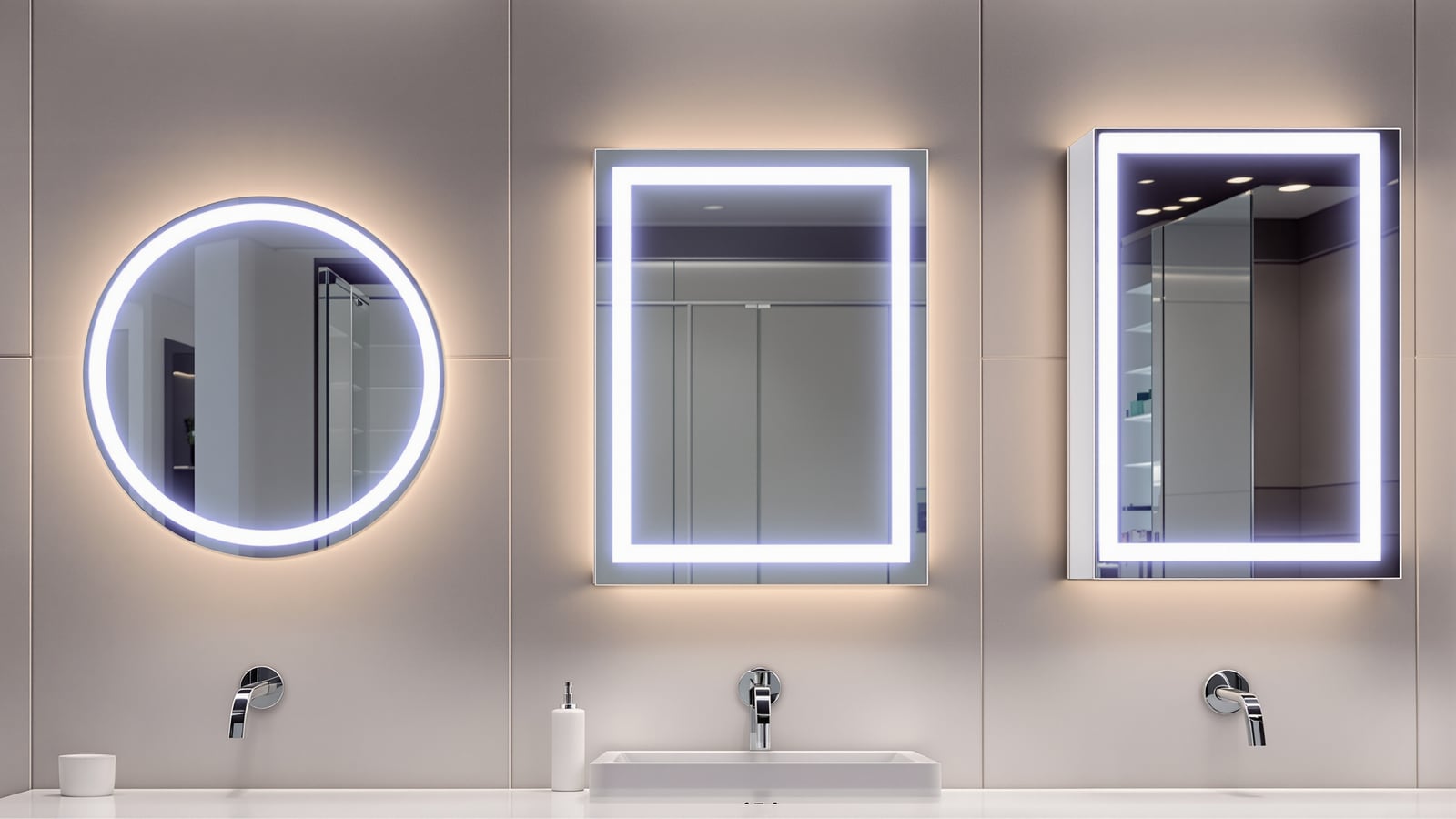
- Plain (silvered) mirror — a framed or frameless glass sheet, no power. The workhorse. Right for guest baths, utility baths, kids' baths, or any vanity that already has good wall lighting. Cheapest to buy and nothing to fail.
- LED mirror — a plain mirror with light built into the glass, giving even, shadow-free light on your face for shaving and make-up. The right upgrade for a daily-use vanity, especially where wall lighting is poor. Needs a 230V feed behind it. Deep-dived in the LED bathroom mirror guide.
- Smart mirror — an LED mirror plus extras: demister pad, touch or motion sensor, warm-to-cool colour switching, clock or Bluetooth. Convenience for a master bath, but more electronics to fail in a wet room. Buy for the demister and colour control, not the gimmicks.
- Mirror cabinet — a mirror door over a recessed or surface storage box, hiding medicines and clutter. The right pick when storage is tight and you want the mirror to earn its wall. Covered in the mirror cabinet guide.
Match the type to the room
| If your bathroom is... | Buy | Why |
|---|---|---|
| A guest or utility bath with wall lights | Plain silvered | Cheapest, nothing to fail, wall light does the work |
| A daily vanity with poor lighting | LED mirror | Even face light for shaving and make-up |
| Short on storage, cluttered counter | Mirror cabinet | Reclaims the wall as hidden storage |
| A master bath, shower-adjacent, high humidity | Smart / anti-fog LED | Demister keeps glass clear; colour control |
| Kids' or elderly bath | Plain, shatter-safety backed | Simple, safe, low maintenance |
Step 2: Size it to the basin, not the wall
The most common sizing mistake is buying to fill the wall. Size to the basin instead. A well-proportioned mirror is a little narrower than the vanity or basin below it and centred on the tap, so your reflection sits square in it.
- Width: aim for the mirror to be the width of the basin up to the full width of the vanity, but no wider than the vanity — a mirror overhanging the counter looks unbalanced and catches splash at the edges.
- Height: a mirror 700–900 mm tall suits most standing adults. The top should clear the tallest user's head; the bottom sits roughly 200 mm above the basin rim so splash does not sit on the lower edge.
- Mounting height: centre the mirror around eye level for the household, typically with the centre at about 1,500–1,600 mm from the floor, adjusting for who uses it.
- Two basins: either one long mirror spanning both, or two matched mirrors centred on each tap.
Take these numbers to the showroom. A mirror sized to the basin always looks better than a bigger one that fights the vanity.
Step 3: The durability check that actually decides it — copper-free silvering
This is the check that separates a good buy from a wasted one, and almost nobody makes it. The black, cloudy stain that creeps into old Indian bathroom mirrors from the edges and screw holes is not dirt — it is the silver reflective layer corroding, called desilvering or "black edge." Traditional mirrors protect the silver with a copper layer; in a humid, splash-prone bathroom, moisture wicks under the backing at any cut edge and attacks the copper first, lifting the silver.
The fix is to buy glass made to a corrosion-resistant spec:
- Ask for copper-free silvered glass. The silver is protected by copper-free, low-lead paint instead of copper. With no copper to corrode, black-edge desilvering is dramatically slower. In a humid Indian bathroom this is the single most important thing to specify — more than frame, shape or price.
- Ask for the standard and a warranty. Quality silvered mirror is made to IS 3438 (silvered glass mirrors in India) or EN 1036. A serious supplier will give a written warranty against desilvering — 5 to 15 years on good copper-free glass. No warranty against black edge is itself a red flag.
- Check the edges. Insist on polished or bevelled, sealed edges. Raw cut edges left wet corrode fastest, even on copper-free glass. Never let a fitter drill a plain mirror on site without re-sealing the hole.
- Ventilation protects your purchase. An exhaust fan or window that clears humidity fast protects the mirror as much as the paint and ceiling.
If a salesperson cannot tell you whether the mirror is copper-free or offer a desilvering warranty, assume it is not, and price it as a short-life mirror.
Step 4: If you buy LED or smart — the demister and IP checks
An LED or smart mirror is a wet-location electrical appliance, so two specs matter before you pay.
- IP rating. A mirror mounted at the basin should carry at least an IP44 rating on its electrical parts, meaning protection against splash from any direction. Anything unrated near water is unsafe and uncertified.
- Demister pad. A demister is a low-wattage (12–40W) heating pad bonded behind the glass that keeps a zone clear of fog after a hot shower. It is the single most worthwhile "smart" feature in a humid bathroom. Confirm it is included, not just "compatible."
- Driver and connection. The LED driver should be a sealed, branded unit, and the mirror must connect to a fused, RCD-protected circuit installed by a licensed electrician — not a bathroom socket run on an extension. Confirm what is in the box: driver, mounting plate, fixings, and instructions.
- Colour temperature. For grooming, look for switchable warm-to-cool (roughly 3000K–6000K) rather than a single fixed cool white, which flattens skin tone.
Step 5: Mounting hardware and what to check before you pay
The mirror is only as safe as its fixings. A glass panel that falls is a serious injury.
- Fixings for the weight. Plain mirrors up to a metre are often bonded with mirror adhesive plus safety clips; larger and LED/cabinet units need through-bolts into wall plugs rated for the load — never adhesive alone on a heavy or powered mirror.
- Fixing into tile safely. Drilling tile risks cracking the tile and puncturing waterproofing. Use the right tile bit and plugs, and keep holes away from wet-zone joints.
- What's in the box. Confirm the mounting plate or brackets, plugs, screws, and (for powered units) the driver are all included, and whether installation is part of the price or extra.
- Warranty terms. Separate the glass/desilvering warranty from the electronics warranty on LED and smart mirrors — they are usually different lengths. Get both in writing with the invoice.
The good / better / best budget tiers
Indicative all-in India prices for a single vanity mirror. Spend the extra on copper-free glass before you spend it on gadgets.
| Tier | Budget (₹) | What you get | Best for |
|---|---|---|---|
| Good | 1,500 – 6,000 | Plain copper-free silvered mirror, framed or bevelled, sealed edges, desilvering warranty | Guest, utility and kids' baths |
| Better | 8,000 – 25,000 | LED front-lit mirror, IP44, copper-free glass, optional demister, warm-cool switch | Any daily-use vanity |
| Best | 25,000 – 60,000+ | Smart / mirror cabinet: demister, sensor, colour control, storage, longer warranties | Master baths, tech-led homes |
Red flags — how to spot a mirror that will corrode
A cheap mirror is not a bargain if it rots in three years. Walk away when you see:
- No answer on copper-free or IS 3438. A vendor who cannot confirm the silvering spec is selling copper-backed glass.
- No desilvering warranty. Serious glass carries one; its absence tells you what the maker expects.
- Raw, unpolished cut edges or a mirror cut to size on the spot without edge sealing — a fast route to black edge.
- Unrated LED mirrors with no IP marking or a no-name driver — unsafe and uncertified in a wet room.
- "Anti-fog coating" claims with no demister pad. A wipe-on coating is not a heated demister and will not keep glass clear after a hot shower.
- Adhesive-only mounting offered for a heavy or powered mirror — insist on mechanical fixings.
Questions to ask the showroom
- Is the glass copper-free silvered, and is it made to IS 3438 / EN 1036?
- What is the warranty against desilvering, and is it in writing on the invoice?
- For LED/smart: what is the IP rating, is a demister included, and what is the separate electronics warranty?
- Are the edges polished and sealed, and does the price include installation and all fixings?
- Online vs showroom: online is cheaper but you cannot inspect edges or backing — for a large or powered mirror, prefer a showroom or a seller with a clear return and desilvering warranty.
The one-line answer
Pick the type for your need — plain for a lit guest bath, LED for a daily vanity, cabinet for storage, smart for a master bath — size it to the basin, and then, whatever you buy, insist on copper-free silvered glass with a written desilvering warranty. That last check, not the price tag, decides whether the mirror is still clear in fifteen years.
References
- IS 3438: Silvered Glass Mirrors — specification, Bureau of Indian Standards: https://www.bis.gov.in/
- EN 1036: Glass in building — Mirrors from silver-coated float glass for internal use, European Committee for Standardization
- National Building Code of India 2016 (Part 8, Building Services and electrical safety in wet locations), Bureau of Indian Standards
- IS 3646 / general lighting practice for interior illumination, Bureau of Indian Standards
- Central Consumer Protection guidance on product warranties and after-sales, Government of India: https://consumeraffairs.nic.in/
Export this guide
Related Guides — Deep-dive reading
LED Bathroom Mirror India: Backlit vs Front-Lit, Colour Temperature, Cost & The Point Behind the Glass
A practical India-first guide to LED and backlit bathroom mirrors — integrated shadow-free face lighting, 2700K-6500K colour temperature and tunable white, halo backlight versus sandblasted front strips, plus the concealed electrical point, IP rating, demister and driver access you must plan behind the mirror before you tile.
BathroomsHow to Choose a Wash Basin in India: Mount Type, Size, Tap Holes & Budget (2026 Buyer's Guide)
A buyer's decision guide to picking the right wash basin — matching the mount type to your vanity and space, sizing it to the room, getting the tap-hole config right for your faucet, judging material and durability, checking what's in the box, good/better/best rupee tiers, the IS 2556 vitreous-china mark, and how to spot seconds, hairline cracks and warranty traps.
BathroomsBathroom Mirror Lighting India: Shadow-Free Vanity Light, Colour Temp, CRI & Cost (2026)
Why a single ceiling downlight throws ugly shadows on your face, how vertical sconces either side of the mirror beat a light bar above, when a backlit mirror is glow not task light, plus the colour temperature, CRI, mounting height, IP rating and 2026 rupee costs that actually get make-up and shaving right.
BathroomsRelated Tools — Try Free
Cross-Ventilation Analyzer
Estimate airflow and air changes per hour (ACH) from room size, window areas, layout, and local wind — with NBC 2016 Part 8 compliance check.
Ventilation CalculatorWindow Cleaning Cost Calculator
Estimate professional window cleaning cost per visit and per year by access and frequency.
Window CalculatorBathroom Mirror Size Calculator
Recommended mirror width, height and mount height above the vanity, plus vanity-light sizing — by basin width and mirror type.
Bathroom Planner